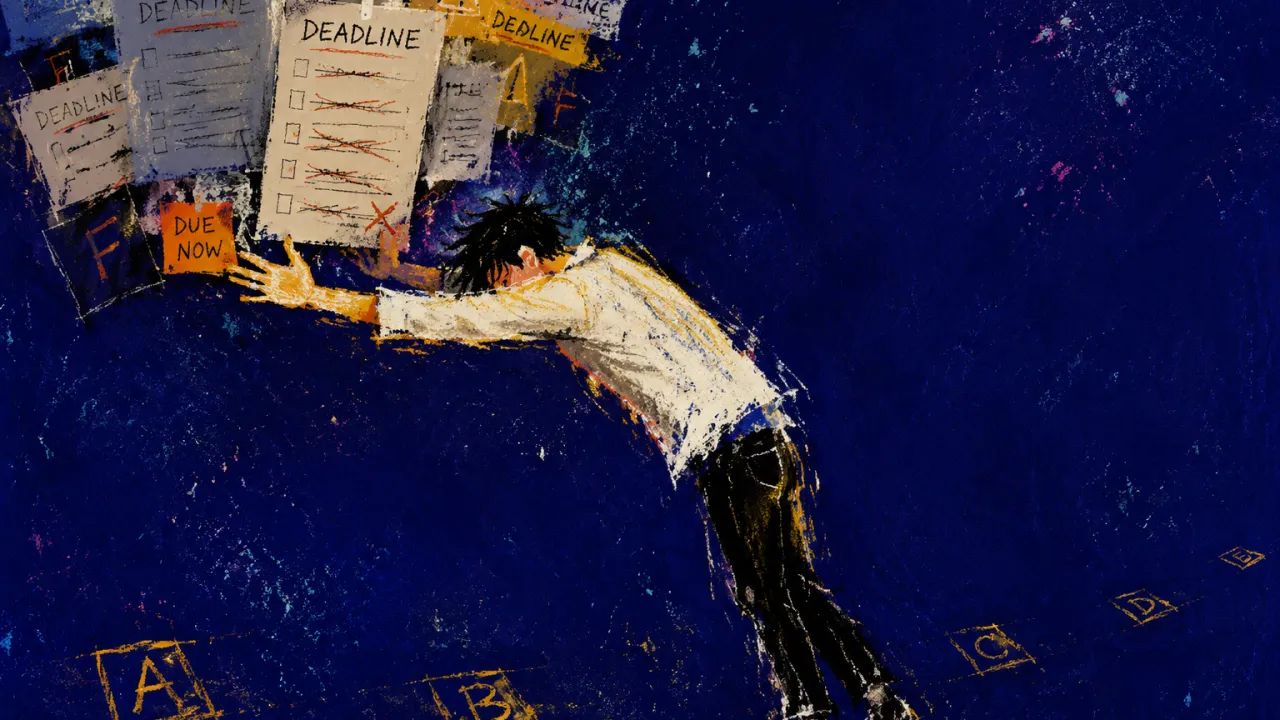
When an Unscaffolded Learning Environment makes every assignment feel like you are building the route while walking it, the tightness in your chest before opening the LMS is part of the situation's signal. This is an environmental, structural dynamic: the course or program may offer content, deadlines, and standards, while leaving the usable path, feedback rhythm, and checkpoints under-built. The cards below do not turn that gap into a personal verdict; they mirror the shape of a learning container that asks for independence before it has made independence workable. Here are the Tarot Cards that tend to reflect this kind of academic setup.
The Fool ReversedThe dog jumps at foot level while the traveler's eyes stay lifted toward the open sky, and the ledge has no rail, sign, or marked descent. Feedback exists, but the environment does not convert it into a usable learning structure. In personal growth, this describes the outside conditions of trying to evolve through books, videos, courses, or private experiments without enough mentorship, pacing, or grounded review. You are not simply missing motivation; the growth environment itself lacks scaffolding, so every step has to double as both practice and navigation.
The Magician ReversedThe raised hand and lowered hand can harden into a pose when neither hand actually touches the tools. The table is fully exposed, the figure stands alone, and no second body appears to share calibration, instruction, or review. In study, this becomes the course, dissertation, online module, or graduate environment where readings, deadlines, and expectations are present but the scaffolding is thin. You are left to convert material into method without enough examples, feedback loops, or protected space for trial and error, so the academic task becomes heavier than the syllabus makes it look.
The High Priestess ReversedThe High Priestess sits before a threshold, holding a scroll that is present but not fully delivered. Behind her, the veil creates depth without a usable pathway, so the viewer can sense that there is more knowledge inside without being given a route through it. That is the architecture of an unscaffolded academic setting. A class, research track, or exam system may demand high-level output while withholding examples, sequencing, feedback cycles, or a clear sense of how one concept leads to the next. The card does not frame the struggle as laziness or lack of discipline. It shows a learning environment where the material exists, but the bridge between exposure and mastery has not been built, forcing you to construct the ladder while already being measured on the climb.
The Empress ReversedThe same rich landscape becomes difficult when the water, wheat, and throne do not connect to a working surface. In study, that shows up as a course or project where material exists everywhere, but the sequence for absorbing it is missing. You are being asked to produce academic output inside an environment that does not provide enough scaffolding. The card makes the real issue visible: the problem is not only effort, but a support system that has not been converted into usable steps.
The Hierophant ReversedThe temple looks complete: pillars, keys, robe, staff, and ritual posture all promise structure. Yet the learners do not hold the tools; they remain below the authority, facing a system that displays order more than it distributes method. For study, this points to a class, program, or online course that looks legitimate but does not actually scaffold the learning process. You may be given readings, lectures, and deadlines, while the missing pieces are examples, pacing, feedback loops, translation of standards, and a usable route from confusion to mastery.
The Chariot ReversedNo visible reins connect the charioteer to the sphinxes, and the vehicle remains parked at the riverbank. The scene has symbols of authority and movement, but the practical transmission system between intention and progress is missing from the picture. In a course, thesis, online program, or self-study track, this becomes the environment where expectations are high but scaffolding is thin. You are told to direct your learning, produce advanced work, or manage your own progress, while the route, feedback loop, and criteria are left partly invisible. The reversed Chariot exposes the difference between autonomy and abandonment. It shows an academic system asking for self-direction before it has built the handles, checkpoints, and traction that make self-direction usable.
Strength ReversedThe field around the woman has no visible classroom, tool, fence, or institution. She faces a powerful animal with bare hands and a garland, while the distant mountain offers challenge without showing a road. An unscaffolded learning environment has the same exposed quality. The course, program, or self-study path may expect polished performance, but the examples, pacing, feedback loops, and structural supports are too thin for the size of the task. The image connects this context to outsourced regulation. You are not only learning the material; you are being made to build the container, the map, and the method while still being measured on the result.
The Hermit ReversedThe lantern becomes the only working light on a moonless ice field. No road, shelter, companion, syllabus, or marked descent appears around the figure; the staff can keep the body upright, but it cannot turn the whole mountain into a learning structure. An Unscaffolded Learning Environment emerges when personal growth has effort but no architecture. You may be doing the reading, tracking the habits, and holding the question, while the external system offers no feedback loop strong enough to turn insight into a next step.
Wheel of Fortune ReversedThe scene floats without ground, desk, doorway, or visible path. It contains books and symbols, but the environment around them does not provide a stable working surface where learning can be sequenced, checked, and supported. That is the reality of an unscaffolded learning environment. You may be handed content, lectures, readings, or platform modules, while the missing structure is feedback, pacing, examples, access to clarification, and the connective tissue that turns exposure into actual comprehension.
The Hanged Man ReversedThe body has no foothold, no free hands, and no visible tool nearby; all stability comes from the frame that also restricts movement. The scene creates dependency without providing the smaller supports that would let the figure actively reposition. In a class or independent study, this becomes an environment where the syllabus, platform, or instructor expects self-direction without enough examples, feedback loops, or intermediate steps. You are not facing pure difficulty; you are being asked to learn inside a structure that has removed too many scaffolds at once.
Temperance ReversedThe angel's hands perform a flawless transfer, but the road to the mountains sits behind the action, narrow and easy to miss. In a reversed academic context, the image can become a learning environment that expects precise self-regulation while leaving the larger route under-explained. You may be in a class, program, or independent study setup where the system assumes you already know how to sequence readings, generate questions, interpret feedback, and measure progress. Temperance exposes the external missing scaffold: the problem is not only effort, but the absence of visible structure around effort.
The Tower ReversedThere is no staircase in the tower, no bridge to the ground, and no handhold near the falling figures. The scene is full of demand and exposure, but almost empty of usable support. That is the academic reality of a course, lab, research project, or independent study that expects advanced performance without clear examples, feedback loops, intermediate milestones, or accessible guidance. The problem is not simply difficulty; it is difficulty without architecture. The card makes the missing scaffold visible. You can stop treating the gap as a private flaw and start naming the external supports that should exist: a map of standards, feedback that arrives in time to be useful, a path from confusion to competence, and a learning container that does not require you to fall before anyone sees the problem.
The Star ReversedThe reversed image turns the same flowing water into uncontained effort. Two streams leave the vessels, but the scene shows no storage system, no built path, and no visible structure that tells the body how much to pour or where the work should go next. That is how an unscaffolded learning environment operates. You may be surrounded by readings, lectures, assignments, and vague standards, while the course or program fails to provide the sequence that would convert effort into mastery. The distant visibility makes the problem sharper. You can see that academic progress is possible, but the ground between here and there has not been engineered, leaving You to build the missing bridge while still being graded on the crossing.
The Sun ReversedThe child rides a powerful horse with no reins, bridle, saddle, or practical steering tool. The scene is bright, but brightness is not the same as scaffolding; the body is expected to stay balanced on momentum alone. In study, this becomes a course, supervisor, lab, or program that expects independence before it has provided enough structure. You are handed movement, deadlines, readings, and output expectations, but the card exposes the missing handles that would turn exposure into a workable learning system.
The World ReversedThe figure floats inside the wreath with ceremonial tools but no floor, desk, road, or practical surface beneath her. The image contains completion symbols, yet the ordinary supports that make work executable are absent. For study, that points to courses, programs, or independent projects where expectations are high but scaffolding is thin. You are expected to perform academic independence before the environment has provided enough examples, pacing, feedback, or structure to make that independence functional.
Ace of Cups ReversedThe cup floats between cloud, bird, and pool with no desk, road, classroom, horizon, or ground beneath it. Inputs arrive and water moves, but the image offers no built environment that explains how the sequence should be practiced, paced, or repeated. In academic life, that is the course, module, online program, or independent research setup that gives you content without a scaffold. There may be readings, lectures, tasks, or expectations, yet the architecture for sequencing, feedback, examples, and review has to be invented by the student. The card's pressure sits in the suspended space itself. You are not simply failing to organize; the learning environment has not provided enough structure for knowledge to land, be tested, and become durable.
Four of Cups ReversedThe scene contains objects but no route. The cups are visible, the figure is seated, and the landscape gives no marked sequence for how to move from available material to meaningful uptake. That absence of structure is the academic pressure inside an unscaffolded learning environment. Lectures, readings, assignments, rubrics, and expectations may all be present, while the learner receives too little sequencing, modeling, or translation to know how effort becomes output. The card makes the problem architectural rather than personal. You are being shown a field full of academic inputs without a reliable bridge between those inputs and the next concrete piece of work.
Page of Cups ReversedThe Page stands on a flat edge with water swelling behind him and almost no built environment around him. The surface is enough to stand on, but not enough to guide movement; the figure's own posture becomes the main structure holding the scene together. Reversed into an academic setting, this is the course, program, or self-study path where the learner has to build the scaffolding that the environment should have supplied. Lectures, readings, assignments, and feedback may exist as separate objects, but they do not form a navigable learning architecture. The pressure here is not simple laziness or weak motivation. The card shows a student forced to stabilize the learning container alone while the surrounding material keeps moving, which makes every task cost more than it would in a properly scaffolded system.
Knight of Cups ReversedThe open riverbank contains a threshold but no bridge, marker, guide, or protected channel. The rider has a cup and a controlled horse, yet the wider environment offers little visible infrastructure for the crossing itself. That is the texture of a course, module, or independent study setup where students are expected to self-direct before enough scaffolding has been provided. The problem may appear as vague rubrics, missing examples, limited office hours, unclear milestones, or teaching that assumes everyone already knows the hidden route. The reversed card keeps attention on the environment rather than turning the issue into a personal flaw. It shows that a student can carry real interest and still lose momentum when the academic container fails to translate intention into navigable steps.
Queen of Cups ReversedThe Queen sits with the cup in her own hands on a small island, surrounded by water and separated from the far shore. No bridge, desk, book, or shared working surface appears in the scene; the task is contained, but the route for using it is not mapped. Reversed, this becomes an academic environment where the student is expected to intuit the method without enough examples, sequencing, or checkpoints. The course may assign the work, but the pathway from confusion to competence remains submerged. Unscaffolded Learning Environment names the external absence of structure that makes effort feel strangely inefficient. The card shows a student holding the material alone, not because they lack capacity, but because the learning system has not provided enough visible crossings from content to skill.
King of Cups ReversedThe shell throne appears to hold the King above the sea, but there is no dock, ground, classroom, or visible support structure beneath it. The hands hold ceremonial objects while the environment offers no practical tool for crossing the water. In academic life, this maps onto a course or program that expects self-direction without giving enough scaffolding. You may be asked to synthesize readings, produce original work, or manage a complex syllabus while the actual steps, standards, and support points remain suspended. The card’s floating throne clarifies why effort alone may not convert into progress. A learning environment can look prestigious or meaningful while still failing to provide the practical architecture that lets attention, comprehension, and output move in sequence.
Ace of Pentacles ReversedThe road is clear, but it runs through one narrow arch toward a distant mountain with no visible guide, steps, or companion structure. The coin is suspended above the land, so the resource is present before the path has been broken into usable stages. In academic life, that fits a course, thesis, independent study, or online module where materials exist but the scaffolding is thin. You may have readings and deadlines, yet the daily structure that turns them into comprehension has to be built from the outside in.
Five of Pentacles ReversedThe crutch, torn clothing, bare winter road, and hidden architecture create a scene where the body must keep moving without enough external support. The tool in hand is not a full system; it is a substitute for what the environment fails to provide. In study, this describes the class, thesis process, lab, or self-directed program that demands output while offering too little pacing, feedback, or usable structure. You may be working hard, but the card shows how much of that effort is being spent inventing the scaffolding that should already be there.
Eight of Pentacles ReversedThe craftsman works alone in open air, near buildings but not inside a guided classroom or protected workshop. The town exists in the background, yet no mentor, peer, or institutional structure stands beside the bench to regulate the sequence of learning. In coursework or self-study, this maps to an unscaffolded learning environment where the student is handed materials, standards, and deadlines without enough structure for how to move through them. You are exposed to evaluation while having to invent the method yourself. The card makes the missing scaffold visible by showing skilled effort happening without a surrounding teaching system.
Page of Pentacles ReversedThe Page stands in a wide open landscape with no desk, guide, map, or visible institution around the learning object. The space is generous, but it does not provide sequence, cadence, or containment. In academic life, that becomes the reality of self-paced modules, independent research, remote courses, resits, or thesis work where autonomy is given before a structure is built. You are not simply looking at freedom; you are seeing a learning environment that requires scaffolding before effort can convert into progress.
Knight of Pentacles ReversedThe knight stands alone in a sparse field with one pentacle, complete gear, and no visible helper, gate, or built shelter. The environment has potential, but it has not been organized into a support structure around the worker. In study life, this becomes the class, program, online course, or independent project where you are expected to self-teach without enough feedback, examples, pacing, or access to guidance. The card shows the strain of being equipped but under-supported: capacity exists, yet the system leaves too much of the learning architecture to you.
Queen of Pentacles ReversedThe carved throne is impressive, heavy, and full of symbolic order, but it does not show anyone explaining how to enter that order. In reversal, the same institutional weight can become a setting where authority exists, standards exist, and the path for using them is poorly lit. In academic life, this is the course, seminar, lab, or degree track where the expectations are real but the scaffolding is thin. You may be surrounded by rubrics, prestige, readings, platforms, and formal support channels while still lacking the practical bridge between what is demanded and how a student is supposed to build toward it. The card gives language to a specific external problem: not laziness, not lack of intelligence, but an environment where the structure is visible and the access points are unclear. Seeing that distinction helps separate the work you own from the missing supports the system has failed to make legible.
Six of Swords ReversedThe small boat carries passengers, six swords, and the entire burden of movement on one oar. There is no dock, classroom, bridge, or wider crew in sight; the visible support system is narrow, mobile, and easy to overburden. That visual structure matches a course, thesis stage, or self-directed module where the learning demand is real but the scaffold is thin. You may be expected to infer standards, teach yourself core material, decode vague rubrics, or progress without examples that make the task legible. The card names the external design problem: the crossing asks for sustained academic movement while providing too little structure to distribute the load.
Eight of Swords ReversedThe woman is enclosed by swords, not sheltered by walls, rails, steps, or a guide. The space has boundaries and consequences, but it lacks the visible supports that would turn restriction into safe passage. An unscaffolded learning environment carries that same design flaw. A course, program, or supervisor may demand independent academic output while providing too few examples, checkpoints, feedback loops, or translation points between instruction and performance. The card makes the missing structure visible. It shows that the student may be struggling inside an environment built around assessment rather than support, where the first act of agency is naming which scaffold is absent instead of absorbing all difficulty as individual failure.
Nine of Swords ReversedThe room contains many signals: blades, symbols, patterned squares, and a carved record, but no visible tool for sorting them. The figure has information around her, yet the space offers no clear route for turning that material into stable movement. That is the structure of an unscaffolded learning environment. You may be putting in hours, collecting sources, watching lectures, or reading the module guide, but the course design does not give enough sequencing, examples, feedback, or checkpoints to convert effort into retained knowledge. The reversed card shows the difference between being challenged and being left without a usable frame. Academic pressure becomes far more corrosive when the institution asks for output while withholding the structure that would make learning possible.
Page of Swords ReversedThe young sword-bearer stands alone with one useful tool, no visible mentor, and no protective wall around the ridge. The mountaintop gives perspective, but it also leaves the body fully exposed to weather, uneven ground, and the burden of self-direction. That visual structure fits a growth path built from scattered books, videos, notes, and private resolve without a stable learning container. You may be trying to upgrade your thinking in a space that gives you curiosity and pressure but not enough feedback, pacing, or support to turn inquiry into skill.
Ace of Wands ReversedA hand enters from the cloud with no visible body, no peers, and no grounded support around it. The wand is powerful, but it is detached from the terrain that would show how the power can actually be used. That image fits an academic setting that offers autonomy while withholding structure. You may be expected to produce independent work, absorb difficult material, or define a direction, but the feedback rhythm, examples, checkpoints, or practical entry points are too thin. The card separates real potential from the missing scaffold that would let it land.
Seven of Wands ReversedThe high ground looks like an advantage until the terrain becomes visible: uneven footing, a split stream, and no flat place to reset. The figure is expected to keep responding while the environment offers little stable support under him. An unscaffolded learning environment feels like that in coursework, research, or independent study. The syllabus may demand performance, but examples, feedback loops, clear sequencing, accessible support, or realistic pacing are missing. The card identifies the difference between productive challenge and unsupported exposure. You may still have the capacity to learn, but the structure around the learning is asking for defense before it has provided enough footing.
Eight of Wands ReversedNo figure holds the wands, no road crosses the ground, and the stream separates the near edge from the open land beyond. The motion is powerful, but the scene does not show a human-scale scaffold for turning that motion into a usable route. For You, this describes a course, supervisor relationship, or self-study track that keeps moving while the support structure remains thin. The card makes the missing scaffold visible: the problem is not just effort, but the lack of pacing markers, examples, access points, and human guidance that would let learning cross the gap.
Nine of Wands ReversedEight wands stand behind the figure like a support system that looks present but cannot actually hold the open gap. The ninth wand works only because someone is gripping it, which makes the protection dependent on constant manual effort. In a course, program, or self-directed study track, that points to a learning environment where materials exist but the scaffolding is thin: unclear sequencing, weak teaching support, missing examples, or no reliable path from confusion to comprehension. The outside structure says support is available, while the lived setup makes you patch the gap yourself. The card gives this context a concrete shape. You can distinguish a personal study issue from an environment that has outsourced too much structure onto the learner.
Ten of Wands ReversedThe carrier has a destination, but no visible scaffold: no cart, no helper, no rail, no intermediate station where the load can be set down and reorganized. The path exists, yet the burden itself blocks the field of vision. An unscaffolded course or research environment works the same way. There may be a syllabus, a final outcome, and a formal expectation to move forward, while examples, feedback loops, pacing, and access to support remain too thin to make the route usable. You are not simply missing discipline in this image. The card shows a mismatch between expected output and available structure, which is why clarity begins with identifying what support the environment has failed to make visible.
Page of Wands ReversedThe Page stands in an exposed desert with no visible road, no shelter, and only one wand to work with. In a learning environment, that sparse field becomes a course, research project, or independent module that asks for output before it provides enough structure. The card does not frame the problem as a lack of ability. It shows a mismatch between the task's demand for self-direction and the missing scaffolds that usually make sustained study possible: examples, rubrics, advisor response, pacing, and a map of what good work looks like.
Knight of Wands ReversedThe desert has a horizon and distant pyramids, but no road, shelter, markers, or visible support system. The rider has personal gear, yet the surrounding landscape offers almost no scaffolding. A course, research placement, or advisor setup can feel exactly like that when output is expected before guidance becomes usable. You are being asked to cross real academic terrain, and the card makes the missing structure visible: unclear checkpoints, thin feedback, and a route that depends too much on self-navigation.
King of Wands ReversedThe desert around the throne has no buildings, plants, or visible study infrastructure; the single wand carries almost all signs of life and direction. Authority is present, but the environment itself does not provide a path, shelter, or support system. In academic terms, this is the course, program, thesis process, or independent study structure that expects output without enough scaffolding. You are being asked to perform as if the route is obvious, while the card shows the external field has not been built to hold the work it demands.
No cards available for this filter.