The 11:48 p.m. Draft: Premature Commitment Pressure
I have learned that someone can run a product timeline in downtown Toronto, coordinate ownership across a dozen moving parts, and still have a six-hour dating reply gap turn their own future into an emergency. That was the exact contradiction I recognized when Maya sat across from me.
She had come in from the cold with her coat still buttoned to the throat. Outside my window, rain glossed the streetlights and a streetcar sighed at the intersection. She told me about Tuesday at 11:48 p.m., sitting on the edge of her bed in a shared apartment: the radiator clicking, her phone hot in her palm, the same relationship-status paragraph disappearing and returning in Notes. Her toes curled against the floor each time she checked whether the person she was seeing had viewed her earlier text.
"I know I am rushing," she said. "But waiting feels worse. If we cannot name this, how do I know it is real?"
I could hear the valid wish beneath the urgency. Maya wanted a freely chosen, mutual commitment. What frightened her was the space before it: the possibility that an undefined relationship might end and appear to prove that she had not been chosen. When a vague answer happened, she told herself she needed a relationship answer. Her body, with its tight chest and restless hands, was asking for immediate relief from a feared meaning.
To me, that kind of uncertainty feels less like a thought and more like trying to sleep while an unanswered notification keeps buzzing under the mattress. It pulls attention out of every ordinary moment: brushing teeth, making pasta, watching a show, waiting for the streetcar. I told her, gently, "Wanting commitment is not the problem. Asking it to erase uncertainty is the pressure point. Let us make a map for the difference."

The Bridge That Does Not Read Anyone's Mind
I asked Maya to put both feet on the floor, take one unforced breath, and hold the question in plain language: why do I keep pushing for commitment before we feel ready? Then I shuffled slowly. I use that pause as a threshold for attention, not as a performance of mystery. Tarot is most useful here as a mirror for patterns, choices, and evidence that may be hard to see while the nervous system is sprinting.
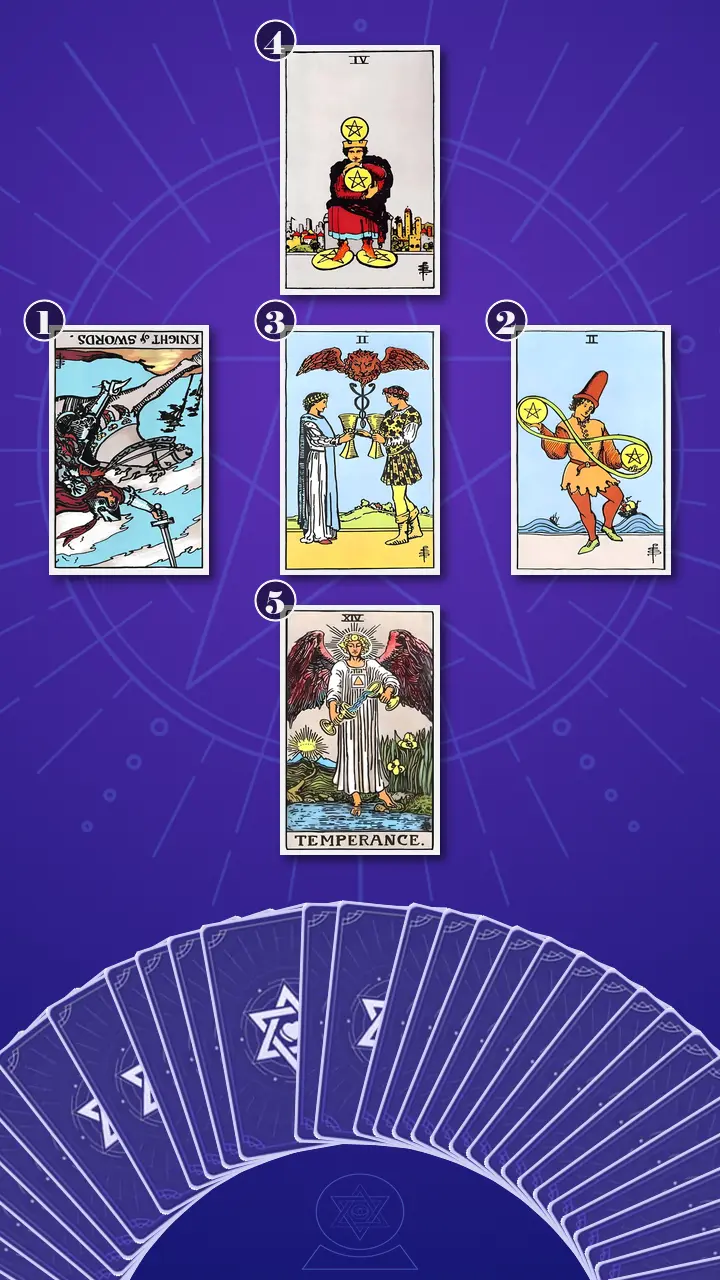
I chose The Bridge: Context Edition, a five-card tarot spread for commitment anxiety and relationship readiness. The shape is a small cross, like a suspension bridge: Maya's current stance on one bank, observable evidence of shared pace on the other, the bond between them in the centre, the pressure above, and a grounded bridge practice below.
I chose this spread because a larger predictive layout would have distracted from the real issue. The question was not what another person secretly felt, and I would not pretend that cards could give me access to anyone's private mind. The useful questions were more practical: what did Maya do when ambiguity arrived, what had the connection actually shown through time and follow-through, what was mutual already, and what could she do next without abandoning herself?
I told her that the first position would show the pattern behind rushed DTR conversations. The second would ask for observable capacity rather than assumptions. The fourth would show what made security feel urgent, and the fifth would offer a way to communicate clearly without demanding that one evening settle the entire future.
The Cards That Slowed the Message Down
A Sword Raised in a Storm
I turned over the first card. "This is the position that presents your current stance and the observable behavior you fall into when ambiguity becomes uncomfortable," I said. It was the Knight of Swords, reversed.
I pointed to the raised sword, the horse charging forward, and the wind-bent trees. Reversed, the Knight's Air energy was not absent. It was excessive and poorly directed: thought moving so fast that directness became a charge for certainty. I could see the card's modern scene immediately. At 11:48 p.m., one present-tense question became a long text about exclusivity, next year, and whether the relationship was real. A paragraph was deleted, restored, revised, and followed by the urge to send a clarification before there was even an answer.
I said, "There is a difference between speaking honestly and speaking at the exact speed of fear. This card does not say your need is too much. It asks whether the message is trying to answer a relationship question or stop a body alarm."
Maya looked down at her phone, face-up beside her tea. Her thumb rubbed once across the black screen. "If I can phrase it clearly enough, then maybe they will finally tell me where this is going," she said. After a breath, quieter, she added, "But what I actually need right then is for the tight feeling to stop."
She gave a short laugh that carried no amusement. "That is so accurate it is almost cruel."
I let the humour soften the moment without using it to dismiss her. "It is not cruel," I said. "It is specific. And specificity gives us options. A reversed Knight can overcorrect into silence, too, but we are not aiming for that. We are looking for one clear question after the storm has passed."
Two Pentacles and the Capacity Board
I turned over the second card. "This position examines concrete, externally observable signals of shared pace and capacity: consistency, follow-through, available time, and responses to direct conversations. It does not claim to know what the other person feels in private." The card was the Two of Pentacles, upright.
Its figure kept two coins moving inside an infinity-shaped ribbon while ships rose and fell on the water behind him. This was balanced Earth energy: not a permanent green status light, but adaptation to changing conditions. I translated it into a product capacity board Maya would understand. A reassuring text could feel good, but what had the calendar shown? Who initiated plans? Which plans were kept or responsibly changed? Did both people make room during a demanding week? What happened when a need was named directly?
"Clarity can answer a question; it cannot make two people ready," I told her. "Readiness is a pattern you can observe, not a verdict you can extract."
Maya's shoulders remained high, but her gaze shifted from the imagined chat thread to the cards. She mentioned a cancelled dinner that had been rescheduled without her asking, a Tuesday plan the other person had initiated, and an honest if tentative conversation about work being overwhelming. The answer had sounded reassuring, she admitted, but she had been treating one vague sentence about next month as louder than everything the calendar had shown.
The Two of Pentacles did not ask her to accept a vague situationship forever. It asked her to look at reality while it was still in motion. There is a real difference between observing a pace and trying to force a fixed relationship narrative before either person has lived enough ordinary weeks to support it.
The Cups Offered at Equal Height
I turned over the third card. "This is the position that identifies the bond and the reciprocal evidence already present, so you can distinguish the relationship you are experiencing from the label you want it to guarantee." It was the Two of Cups, upright.
The two figures held their cups at equal height. Neither pulled the other across the card. The energy here was balanced Water: emotional recognition offered voluntarily, not captured through increasingly forceful requests.
I asked Maya to remember the last warm date without immediately asking what it guaranteed. She recalled that the other person had chosen the venue, remembered her presentation at work, put their phone away during dinner, answered a difficult question honestly, and suggested the next plan without prompting. None of that was a promise about the whole future. It was still meaningful evidence of connection being participated in by two people.
"I did not have to pull that toward me," Maya said, and some of the hard line in her mouth eased. "They brought their half."
The repeated Twos mattered. The Two of Pentacles asked how two real lives made room for one another. The Two of Cups asked whether two people were actually meeting there. I told her, "Reciprocity is a two-way calendar invite, not one person repeatedly dragging the event into place. This is how you separate pursuit from participation."
The Coin Held Against the Chest
I turned over the fourth card. "This position reveals the underlying fear and control pattern that turns a legitimate desire for security into repeated pressure for premature commitment." The card was the Four of Pentacles, upright.
On the card, one coin was clutched against the figure's chest. Two more pinned his feet in place. The distant city sat behind him, available but far away. Its Earth energy had contracted from grounding into holding. I saw Maya's two hands gripping her phone after an inconclusive conversation, while appetite, sleep, and the rest of the evening waited for an answer before they could move again.
For a moment, I remembered a late Highland frost from my childhood, the kind that made people want to pull every fragile green thing indoors. My family taught me that shelter can protect a plant, but too much enclosure can also keep it from meeting the weather it needs. I did not tell Maya to accept uncertainty as a virtue. I told her that security becomes useful when it supports life, not when it freezes it.
"Once I have the label, I can finally..." I began, then waited.
Maya's fingers closed around the edge of her sleeve. Her breath paused. Her eyes went slightly unfocused, as if she had replayed every late-night Notes app speech at once. "...stop fearing that I am temporary," she finished.
I nodded. "That is the tender part. A label given under pressure can quiet the chat without clarifying the bond. It cannot make rejection impossible, and it cannot create readiness that has not been demonstrated. We need to separate a boundary, which is what you will and will not participate in, from outcome control, which asks another person to remove the risk of being hurt."
I also named the social clock sitting quietly in the room with us: engagement reels, move-in photo dumps, soft launches becoming hard launches. Those milestones were not evidence that Maya was behind. They were other people's seasons, not a deadline for her own worth.
When Temperance Let the Answer Move
The Bridge Practice Beneath the Cards
The room felt quieter before I turned over the final card. Rain ticked against the glass with a steadier rhythm now, and I said, "This is the most important card in the spread. It is the bridge forward: the practice of stating your desire, checking current readiness, tolerating an unfolding answer, and evaluating reciprocity through behaviour over time."
The card was Temperance, upright. One foot stood on land and one in water. Between the angel's two cups, liquid poured continuously without spilling. This was balanced Water joined to grounded action. Temperance did not ask Maya to hide that she was dating toward commitment. It asked her to choose a time when both people had capacity, name that direction once, ask what felt genuinely possible now, listen without debating the answer into another shape, and leave enough room for later behaviour to speak.
I brought in the lens I call Seasonal Energy Diagnostics. Sometimes exhaustion comes from trying to force a spring harvest during a winter dormancy phase. In relationships, that does not mean waiting indefinitely or accepting less than one needs. It means refusing to confuse an artificial social deadline with proof that a connection has ripened. Winter is information, not a life sentence. Maya could still decide whether the available pace worked for her.
At 11:48 p.m., the message had still been open, the phone warm in her hand, and every minute without a reply had felt like evidence. I could see how she had been trying to make her chest unclench by asking the future to speak immediately. The reversed Knight charged toward an answer; Temperance kept the direction while changing the pace.
You do not need to force a label to make the bond real; practice paced, mutual check-ins, like Temperance pouring between two cups without spilling either.
For several seconds, Maya did not move. First, her breath caught high in her chest and her fingers stopped halfway to the phone. Then her eyes shifted past me, not away from the conversation but into a memory: Saturday in the cafe, a kind answer about not being ready for the long term, and her own mind immediately drafting a better question. Her lower lip pressed in, then released. Moisture gathered at the corners of her eyes without falling. Finally, she exhaled from somewhere deeper than her throat, and both shoulders lowered as if they had been carrying a backpack she had forgotten was there. The relief was not simple. I could also see the brief blankness of responsibility in it: if she stopped forcing certainty, she would have to feel what the actual answer meant.
"But what if I listen and I do not like the answer?" she asked, her voice thinner but steadier.
"Then you will have honest information," I said. "You can use it to make a choice that honours you. You are not powerless just because you cannot control the timing."
I asked, "Now, with this new view, think back to last week. Was there a moment when this insight could have helped you feel different?"
"Saturday," Maya said. "I could have said, 'I want a committed relationship. What feels honest for us now?' Then I could have let the answer be the answer, instead of trying to negotiate myself out of the feeling it gave me."
That was the crossing I wanted her to notice: from contracted reassurance-seeking and fear of not being chosen to patient self-trust and calm, reciprocal communication. Not a final answer about the relationship, but a new relationship with her own urgency. "You can say what you want without making tonight settle everything," I told her.
A Map for the Next Honest Conversation
I gathered the reading into one story. The reversed Knight showed Maya using verbal speed to outrun uncertainty. The Two of Pentacles redirected her to changing, observable capacity. The Two of Cups reminded her that a connection can be real before it is final when both people bring their half. The Four of Pentacles showed the painful moment when a desire for stability became a grip on an outcome. Temperance offered a different method: direction without force, movement without disappearance.
Her cognitive blind spot was understandable: she had been treating the volume of her body alarm as evidence about the relationship. A slow reply could be difficult, but it was not automatically proof of rejection. Her transformation direction was not from directness to detachment. It was from trying to extract a verdict after ambiguity to observing a pattern of words, behaviour, mutuality, and capacity.
I offered Maya two small practices. I framed the space between them with my Winter Dormancy Ritual: for one week, she would consciously do nothing new to force a blocked goal, meaning no fresh label negotiations simply to relieve a spike of fear. That would not require her to hide a real need, ignore a poor fit, or wait indefinitely. It would give her enough stillness to notice what was already growing and what was not.
- The 30-Minute Temperance Pause Before the next DTR conversation, Maya will set a 30-minute phone timer. In Notes, she will write one direction: "I am dating toward a committed relationship," then reduce her draft to one present-tense question: "Do you feel ready to explore exclusivity with me now?" She will choose a time when both people have capacity and will put any second clarification in Notes for one night. If thirty minutes feels impossible, do the five-minute version: write one line under "What I genuinely need to know" and one under "What I hope the answer will make me stop feeling." Sending can wait until tomorrow.
- The Words and Behavior Window On Friday, Maya will spend five minutes in a private note with four rows: plans made, plans kept or responsibly changed, needs discussed, and initiation from each person. Before reopening the commitment conversation, she will check whether new evidence has appeared or whether the same uncertainty is simply louder that night. This is not surveillance or a scorecard. Record only what she directly experienced, without assigning motives. One kept plan and one mismatch are enough to begin.
I added one final boundary to the map: observation is not endless waiting. Maya remained free to choose a date for reassessing whether the pace and reciprocity actually met her needs. Self-trust did not mean persuading herself to be easygoing. It meant believing she could hear an answer, feel disappointment if necessary, and still remain on her own side.

The Quiet Proof After the Phone Goes Down
Six days later, I received a message from Maya. She had used the private note, asked one readiness question during a calm conversation, and did not send the follow-up paragraph waiting in her drafts. The answer had not become a label. She woke once before dawn wondering, "What if I get this wrong?" Then she made coffee, checked her evidence note, and let the question remain a question.
That was not a fairy-tale ending, and I would not offer it as one. It was a small, bright proof that her life did not have to pause while a relationship found its honest pace. She had moved from asking the phone to certify her belonging toward trusting herself to notice what was freely offered, what was missing, and what she would choose next.
When an undefined bond makes the phone feel welded to your palm and your chest tightens around the brutal possibility that you may not be chosen, noticing that pull is already a movement toward clarity. The answer does not have to be forced into the cup for the connection, or your own worth, to be real.
If you let the next answer emerge through both words and behaviour, what small sign of mutual readiness, as unforced as a second cup offered at equal height, would you be curious to notice?
This story is adapted from psychological research, written so that those in a similar struggle can see their own pattern in it — and find their next step clearly.These insights are not a substitute for professional psychological, medical, legal, or financial advice.
Learn more about our Journey to Clarity.
How did this insight land for you?
🫂 This Resonates Deeply
🌀 Living This Story
✨ Now I See Clearly
🌱 Seeing New Possibilities
🧰 Useful Framework
🔮 The Confirmation I Needed
💪 Feeling Empowered
🚀 Ready for My Next Step
Author Profile
 AI
AI“As the seventh generation of a Highland healing family, I see modern anxieties as a simple, temporary disconnection from nature's rhythm. I bring 67 years of lived seasons not to instruct you, but to hold space for you. Using tarot as a mirror, I want to gently guide you out of the chaos, helping you breathe deeply and rediscover the organic, steady heartbeat of your own life.”
In this Timing Tarot Reading :
Core Expertise
- Seasonal Energy Diagnostics: Diagnosing your deep exhaustion as a misalignment with natural seasons—trying to force a spring harvest during a winter dormancy phase.
- Social Clock Decoupling: Detaching your core self-worth from artificial timelines like peer pressure or societal milestones.
Service Features
- The Winter Dormancy Ritual: A grounded challenge to consciously do 'nothing' regarding a blocked goal for one week, eradicating guilt and rebuilding organic energy.
Also specializes in :
Explore Related Patterns:
Reassurance SeekingAt 11:48 p.m., a six-hour reply gap had you deleting and restoring a relationship-status paragraph, and you later named the immediate need as making the tight feeling stop. The request for commitment was therefore carrying two jobs at once, communicating a real direction and regulating a threat response through the other person's answer. When Saturday's kind but limited answer led your mind to draft a better question, the loop became visible. You were not simply asking what you wanted; you were trying to make one exchange remove the possibility of being temporary. That is why clearer wording kept feeling necessary even after the underlying evidence had not changed. One direct readiness question can protect the honest desire while refusing to use another person's answer as instant relief. You can then read the response alongside follow-through over time, keeping reassurance as information rather than making it responsible for your entire sense of safety.
Urgency BiasAt 11:48 p.m., a six-hour gap turned the future into an emergency, and a present question expanded into exclusivity, next year, and whether the relationship was real. The speed of the message became an attempt to make acting now feel safer than waiting for a fuller answer. The deleted drafts, restored paragraph, and impulse to send a clarification show how urgency can create its own evidence vacuum. Each new sentence promises movement, but it also prevents time and ordinary behavior from showing what the connection can actually sustain. Your alternative is not passivity. It is a paced sequence, waiting until both people have capacity, asking one current question, and letting subsequent follow-through carry part of the answer. That preserves direction while removing the emergency status from a six-hour gap.
Emotional ReasoningYour tight chest, restless hands, and attention fixed on the viewed status appeared alongside the conclusion that an undefined ending would prove you had not been chosen. The feeling was real, but it was being promoted into evidence about another person's intent. That promotion became clearest when one vague sentence about next month outweighed a rescheduled dinner, an initiated Tuesday plan, an honest conversation, and a thoughtful date. The emotional signal was louder than the larger data set, so the relationship was judged by the intensity of the alarm rather than by its full record. Reality testing does not require you to suppress the feeling. It asks you to hold two facts together, uncertainty hurts, and hurt does not by itself establish rejection. When words, behavior, and capacity are reviewed together, your next decision can respond to evidence instead of treating distress as a verdict.
Future-Proofing TrapOne present-tense question became a message about exclusivity, next year, and whether the bond was real, while the sentence 'Once I have the label, I can finally...' ended with 'stop fearing that I am temporary.' The label was being asked to protect the future before the present had supplied enough shared experience. That move is understandable because a fixed status appears to promise protection from rejection, but it asks a symbolic decision to do a job that only time, reciprocity, and honest capacity can do. It can also turn a boundary about what you will participate in into pressure for a specific outcome. You can date toward commitment without requiring an early label to guarantee the eventual result. Naming your direction once, setting a reassessment point, and staying free to choose based on what unfolds lets you protect your future through judgment rather than through premature certainty.
Reality TestingAfter looking at the imagined chat thread, you turned to the cancelled dinner that was rescheduled, the Tuesday plan the other person initiated, the honest conversation about work, and the care shown on the date. Those details moved the question from what one sentence might secretly mean to what two people had actually done. Your later evidence note continued that shift. You recorded plans made, plans kept or responsibly changed, needs discussed, and initiation from each person, without assigning motives. That is a concrete way to challenge selective attention while keeping the assessment grounded in direct experience. Reality testing here is not a demand to accept any pace. It gives you a better basis for saying yes, waiting, or deciding that the available pace does not meet your needs. The clearer your record becomes, the less a single quiet phone can decide for you.
Timing DiscernmentBefore the next DTR conversation, you were asked to choose a time when both people had capacity, state that you are dating toward a committed relationship, and ask what feels genuinely possible now. That sequence gives your desire a clear voice without making one evening responsible for the whole future. The distinction between a boundary and outcome control is the key. A boundary tells you what pace or level of ambiguity you will participate in; outcome control tries to make another person become ready on demand. Your later calm conversation, one readiness question, and unsent follow-up show the former becoming more available. You can remain direct and still let timing be evidence. Reassessing after a defined window keeps patience from turning into indefinite waiting, while choosing the conversation carefully keeps urgency from setting the terms.
Uncertainty ToleranceSix days later, you asked one readiness question in a calm conversation and left the follow-up paragraph unsent. You made coffee, checked the evidence note, and allowed 'What if I get this wrong?' to remain a question rather than an instruction. That pause is not indifference and it is not agreement to wait forever. It is the capacity to feel the unresolved part without immediately converting it into another negotiation. The recognition that a label cannot make rejection impossible creates room for an answer to be disappointing without making it definitive about your worth. With that room in place, you can hear what is honestly available and decide from there. Tolerating uncertainty becomes active self-protection because it keeps your choices connected to the relationship's actual pace rather than to the momentary demand for relief.
Explore Related Struggles:
Ambiguity-Promise FusionAfter the tentative answer about next month, you treat a relationship answer as the missing proof that the bond is real. The undefined space is not left as information about pace; it becomes a demand for a promise. Because the desired commitment is carrying the job of erasing uncertainty, each delay invites a longer draft, a clarification, or a stronger request. The label is asked to settle both the relationship and the meaning of not being chosen, even though it cannot guarantee either. Your clarity returns when you keep these questions separate: what is mutual now, what pace is genuinely possible, and whether that pace works for you. A direct question can gather information without forcing the answer to become proof of your worth.
Commitment Threshold StrainAt 11:48 p.m., you are revising a relationship-status paragraph while the other person has not answered, even though you want a freely chosen, mutual commitment. The same moment makes two demands: name the bond now and allow two real lives enough ordinary time to show readiness. That conflict turns the threshold itself into pressure. You are not pushing because commitment is inherently excessive; you are trying to cross before the evidence and shared capacity have caught up, so waiting feels like standing outside the relationship rather than letting it develop. Seeing the strain separates direction from timing. You can date toward commitment, ask once what is genuinely possible now, and judge the answer through later follow-through without making one night carry the whole future.
Control-Reciprocity LockOn the warm date, the other person chose the venue, remembered your presentation, put their phone away, answered honestly, and suggested the next plan without prompting. Yet the repeated DTR drafts try to pull a fixed label into place before the connection has shown enough ordinary time. That creates a difficult lock: you want a relationship both people freely bring their half to, while using more pressure to make the mutuality arrive on schedule. The harder you drag the event into place, the less clearly you can see whether participation is already being offered. Temperance gives the lock a practical opening. Name your direction once, ask what feels possible now, listen without negotiating the answer into another shape, and watch what follows. You remain free to leave if the pace does not meet your needs; releasing outcome control is not surrendering choice.
Relief-Readiness FusionWhen the phone is warm in your palm, a tight chest and restless hands become the signal to send another carefully phrased question. You can tell yourself the message is about readiness while its immediate function is to make the bodily alarm stop. The distinction matters because a reassuring label can quiet the moment without showing that both people have capacity for the relationship it names. Relief is a real need, but it is not the same evidence as consistency, follow-through, or a mutually chosen pace. Using the thirty-minute pause lets you state the direction toward commitment while leaving the answer intact. You get to ask for honest information and then decide what to do with it, rather than requiring the conversation to regulate the whole night.
Evidence DisconnectionOne vague sentence about next month has been louder than a rescheduled dinner, a plan initiated by the other person, an honest conversation about an overwhelming work week, and the calendar's pattern of making room. When the phone goes quiet, the most immediate signal replaces the fuller record. That disconnect turns a temporary gap into a verdict. You push for commitment because the live notification feels more authoritative than the slower evidence of participation, so you keep trying to improve the wording instead of updating the picture. The four-row note restores a usable reference point through plans made, plans kept or responsibly changed, needs discussed, and initiation from each person. It cannot guarantee the outcome, but it can help you let observed behavior share the weight with the alarm.
Explore Related Emotions:
Ambiguity DreadAt 11:48 p.m., the same relationship-status paragraph disappears and returns while a six-hour reply gap makes Maya's future feel urgent. Your attention can leave ordinary life when undefined space starts being treated as evidence rather than as information that has not arrived yet. When not knowing becomes inseparable from not being chosen, waiting carries more weight than the connection has actually shown. Ambiguity Dread names that suspended inner weather, where an unanswered question seems capable of threatening both the bond and your sense of belonging.
Cautious Self-TrustSix days later, Maya asks one readiness question, leaves the follow-up paragraph in her drafts, and gets up to make coffee even though the relationship still has no label. You begin relying less on an immediate answer when you can believe that you will notice what is offered, face what is missing, and remain capable of choosing. Cautious Self-Trust is not certainty that the relationship will work out. It is the steadier feeling that an answer you dislike will not remove your agency, your standards, or your ability to stay on your own side while deciding what comes next.
Conditional Belonging FearMaya completes the sentence by saying that a label might let her stop fearing she is temporary. The commitment question therefore carries more than a request for shared direction; you may experience the answer as a test of whether your place in the relationship, and perhaps your worth within it, is secure. Conditional Belonging Fear emerges when inclusion seems dependent on receiving the desired label. A tentative answer can then feel like exclusion rather than honest information, which makes it tempting to draft a better question instead of allowing yourself to hear what the current answer means.
Liberating UncertaintyMaya wakes before dawn wondering whether she will get this wrong, then makes coffee, checks her evidence note, and lets the question remain a question. You discover more room around uncertainty when an unresolved future no longer requires the rest of your life to stop moving. Liberating Uncertainty describes the openness created by separating lack of control from lack of choice. You may not be able to determine another person's timing, but you can observe their words and behaviour, decide how long the current pace works for you, and act on honest information when it arrives.
Relational Catastrophe DreadA six-hour reply gap turns Maya's future into an emergency, while one vague sentence about next month becomes louder than several kept plans and caring gestures. Your mind can move from incomplete information to a total conclusion so quickly that the existing bond disappears beneath the imagined ending. Relational Catastrophe Dread is the inner weather created by that expansion. A slow or tentative response does not feel like one difficult data point; it feels capable of invalidating the whole connection and confirming the most painful interpretation of what it means to you.
Relational UrgencyOne present-tense question becomes a long message about exclusivity, next year, and whether the relationship is real, followed by an impulse to clarify before any answer appears. You may be communicating a genuine need, but the speed of the message is also being asked to stop the physical strain of waiting. That fusion creates Relational Urgency. The relationship does not merely feel important; it feels as though something must be done immediately so your body can stand down, even when the shared readiness needed for a durable answer has not yet been demonstrated.
White-Knuckle SecurityMaya grips the phone after an inconclusive conversation while her appetite, sleep, and the rest of the evening seem to wait for movement. You are not simply seeking steadiness here; you are trying to hold the outcome tightly enough that uncertainty can no longer reach you. White-Knuckle Security describes the strain of using commitment as immediate physical reassurance. The grip may quiet the chat temporarily, but it cannot create mutual readiness or remove every risk of hurt, leaving your body dependent on a promise that no label can fully provide.
Mutuality HungerMaya says she wants a freely chosen, mutual commitment, and she visibly softens when she realises that the other person has initiated plans and brought their half. Your underlying desire is not merely for a label; it is to feel that the bond is being carried voluntarily by two people. Mutuality Hunger names this deeper longing for shared investment, equal-height participation, and effort you do not have to pull toward yourself. Recognising that hunger helps separate the valid wish to be met from the urgent attempt to make one conversation guarantee that you always will be.
Emotional FloodingMaya's chest tightens, her hands keep moving, and the unanswered notification follows her into brushing her teeth, making pasta, watching a show, and waiting for the streetcar. When the activation spreads this widely, you can lose access to the ordinary rhythms that would normally help one difficult question remain proportionate. Emotional Flooding captures the point at which the intensity of the experience fills nearly every available channel. The feeling is real, but its volume is not reliable evidence that the relationship itself is collapsing or that an answer must be extracted tonight.
Reciprocal WarmthOn the warm date Maya remembers, the other person chooses the venue, recalls her presentation, puts their phone away, answers honestly, and suggests the next plan. When you let those gestures exist without immediately demanding a guarantee, their emotional texture becomes available in the present. Reciprocal Warmth is the feeling of being met through attention, initiative, and follow-through that arrives freely. It does not promise the whole future, but it allows you to register that the connection is currently being participated in by two people rather than manufactured by your effort alone.
Pattern Recognition CalmMaya's gaze moves away from the imagined chat thread when she starts naming plans made, plans kept, needs discussed, and initiative from each person. You gain a steadier view when one ambiguous sentence is placed back inside the larger pattern of what has actually happened. Pattern Recognition Calm comes from seeing readiness as accumulated evidence rather than a verdict hidden inside one reply. The relationship may remain unfinished, but it becomes more navigable because your attention has concrete signals to assess instead of only the loudest interpretation of the night.
Explore Related Contexts:
Early Dating Pace NegotiationMaya reduces her draft to a clear statement that she is dating toward commitment and one present-tense question about exclusivity. She chooses a time when both people have conversational capacity, leaves the second clarification in Notes, and retains a future date for reassessing the relationship. Those actions make pace a shared negotiation rather than an unspoken race. One person can name a desired direction, the other can state what is honestly possible now, and both can allow subsequent behavior to clarify whether their timelines are becoming compatible. You do not have to conceal your goal in order to respect the stage the relationship has actually reached. A bounded pace also prevents observation from becoming indefinite waiting. You can allow the connection enough time to produce evidence while keeping authority over how long the available arrangement remains workable for you.
Premature Commitment PressureMaya turns a six-hour reply gap into a late-night paragraph about exclusivity, next year, and whether the relationship is real. The draft is deleted, restored, revised, and nearly followed by another clarification before the other person has answered. That exchange is being asked to perform several jobs at once. It must define the present relationship, settle its future, establish that Maya has been chosen, and remove the possibility of a painful outcome. When one conversation carries that much structural weight, direct communication becomes pressure for commitment before mutual capacity has had time to become visible. You can preserve the legitimacy of wanting commitment while examining what the request is being required to guarantee. Separating a present-tense readiness question from demands for a complete future verdict gives you clearer evidence and keeps your next decision within your control.
Readiness Mismatch CycleMaya is dating toward a committed relationship, while the other person has described work as overwhelming and has said they are not ready for the long term. They continue to initiate plans and participate in the connection, but the later calm conversation still does not produce a label. The mismatch concerns present capacity rather than the mere existence of connection. One person is seeking a defined commitment now, while the other is offering meaningful participation without the same long-term position. Rephrasing the question cannot create alignment when the available answers remain materially different. You gain useful leverage by taking both sides of the evidence seriously. You can acknowledge what is being offered, identify what is not being offered, and decide whether the current pace and level of commitment fit the relationship you are choosing to pursue.
Relationship Readiness CheckMaya begins recording plans made, plans kept or responsibly changed, needs discussed, and initiation from each person. She later asks one readiness question during a calm conversation and allows the answer to remain incomplete while subsequent behavior supplies more information. This creates a practical but still unresolved assessment period. Readiness is distributed across available time, direct communication, voluntary follow-through, and the ability to make room for each other over ordinary weeks. You are no longer relying on one reassuring sentence or one difficult evening to represent the whole relationship. The check preserves your agency because observation is paired with a decision point. You can state the direction you want, evaluate the capacity that actually appears, and reassess whether the relationship's demonstrated pace is enough for you.
Situationship AmbiguityMaya can point to warm dates, mutual initiation, attentive behavior, and a rescheduled dinner, yet the relationship still has no agreed status. A vague comment about next month and an honest answer about not being ready for the long term leave the bond active but structurally undefined. This in-between position makes two realities coexist. The connection has meaningful participation, while its future terms remain unsettled. You therefore have evidence that something real is happening without evidence that both people are offering the same level of commitment now. Naming the ambiguity accurately lets you evaluate it without treating either a label or a reassuring date as complete proof. You can observe whether reciprocity continues, ask what is genuinely available, and decide how long this undefined arrangement remains compatible with your own relationship direction.