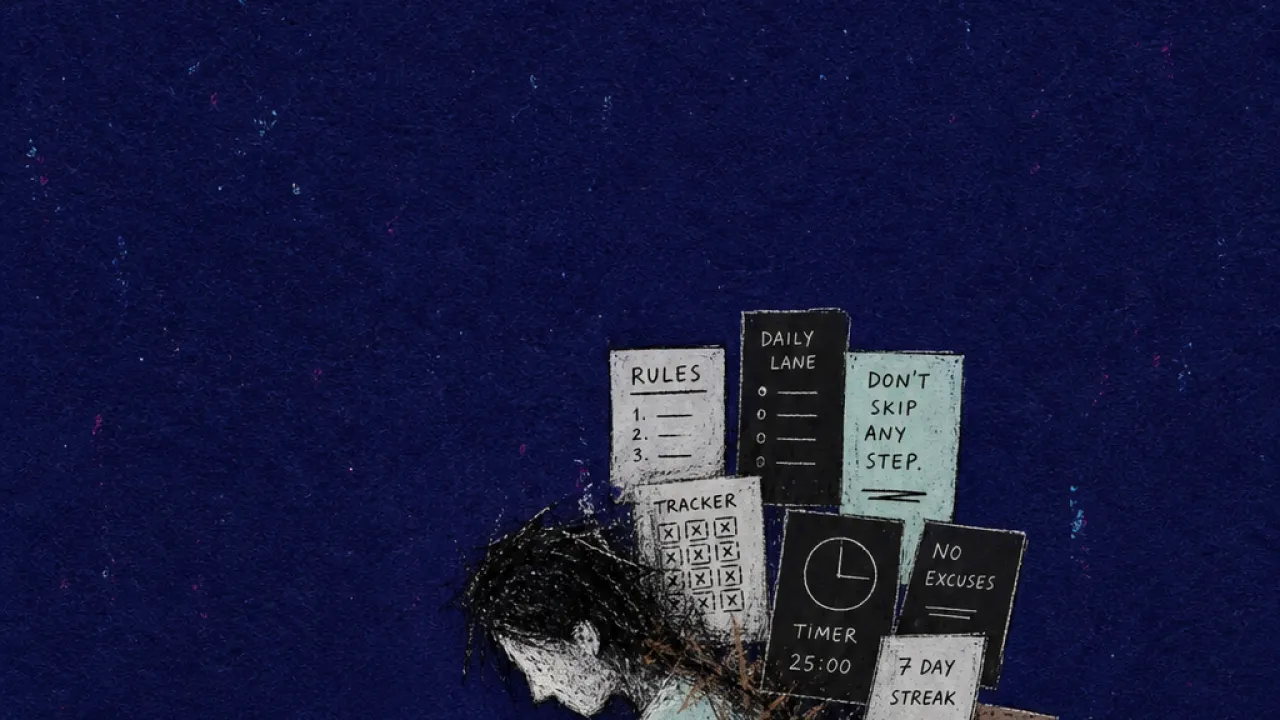
Habit Stacking Overload shows up when the routine meant to hold your day becomes the thing your day has to hold. The pressure sits in your shoulders, hands, and calendar as every tracker, streak, and rule asks for another small correction. This is an environmental, structural dynamic: the system has too many active inputs for one body, one schedule, and one attention span to coordinate. The Tarot Cards below reflect the shape of that overload without turning any single habit into the problem.
Page of Cups ReversedThe cup is intact, but it is small, elevated, and already occupied by a living thing that requires attention. The Page's whole posture organizes around this delicate container, making a modest object carry a surprising amount of responsibility. Personal growth systems can take the same shape when too many habits are stacked into one daily routine. Meditation, workouts, journaling, reading, tracking, planning, and creative practice may each be small, but together they overload the same narrow container of time and attention. The platform beside the water gives the scene a tight holding space. This card reveals the point where the system needs fewer live inputs and stronger containment, so growth can become sustainable instead of constantly requiring delicate rescue.
Knight of Cups ReversedThe Knight's body is already managing several layers at once: armor, reins, horse, cup, posture, riverbank, and the forward route. Every element looks composed, but the whole arrangement depends on a narrow balance. Reversed, this becomes the lifestyle structure of habit stacking overload. Meditation, workouts, meal prep, tracking, journaling, cleaning blocks, app limits, and morning routines can pile into a single day until the system is too delicate to inhabit. The card makes the overload visible through the rider's loaded coordination. It shows where the problem is not the quality of any single habit, but the number of roles the routine is asking one body and one schedule to perform.
Ace of Pentacles ReversedThe hand holding the pentacle has to be precise. Because the coin is flat and heavy, the grip cannot relax too much without risking a tilt, a slip, or a drop. In reversal, that careful handling becomes the lived texture of Habit Stacking Overload. Each new habit looks like a resource on its own, but together they demand constant monitoring, tracking, adjustment, and self-correction. You are not looking at a lack of motivation. The card points to a daily system where the tools meant to create stability have become objects that require too much grip, leaving the life underneath less supported than the plan promised.
Two of Pentacles ReversedThe figure does not simply hold the pentacles; he has to keep them in motion through repeated correction. The loop turns two objects into an ongoing maintenance system, and the raised foot shows how little stable ground the body has while performing it. This is the visual logic of habit stacking overload in personal growth. A morning routine, tracking app, workout plan, reading target, meditation streak, meal system, and reflection practice may each look small on its own, but together they create a foreground where the self is always managing the next object. The card identifies the pressure point as system design. The question is not whether habits are good, but whether the stack has become so dense that the routine now consumes the energy it was supposed to return.
Three of Pentacles ReversedThe craftsman stands elevated at the pillar with a small set of tools facing a large stone structure. The scene is ordered, but the scale difference between one body and the architecture makes the workload physically legible. When applied to habits, that becomes the pressure of loading too many improvements onto one daily system at once. You are not failing because the routines are individually bad; the card shows a build where the body, tools, and timeline have been asked to carry more layers than they can absorb.
Eight of Pentacles ReversedThe bent body, sharp tools, and multiple coins spread across the worksite turn practice into a crowded production field. Each object has a place, but the accumulated demands press the body into a narrow posture of constant maintenance. In personal growth, this maps to a routine system that has become heavier than the transformation it was meant to support. You are looking at structure without spaciousness: rules, trackers, and repeated reps competing for the same limited attention.
Knight of Pentacles ReversedThe horse, armor, saddle, reins, cloak, and pentacle create a dense load around a body that is not moving. Each element has a purpose, but together they can turn readiness into weight. For personal growth, this describes the stage where too many small systems start absorbing the energy they were supposed to release. You may be carrying habits, streaks, rules, and routines that look disciplined while making the growth path heavier than it needs to be.
Ace of Swords ReversedThe sword carries more than a blade: a crown, branches, and bright marks all gather around one narrow line. In reversal, that concentration becomes overload, with too many symbols of improvement balanced on one point of support. This mirrors a lifestyle system where multiple new habits are stacked onto the same limited day. A better morning, better sleep, better meals, better workouts, better planning, better focus, and better self-maintenance may all be reasonable individually, but together they create a brittle load. The card makes the overload visible without blaming the desire to improve. It asks which upgrade is actually load-bearing now, and which ones are decorative weight on a structure that has not stabilized yet.
Four of Swords ReversedThe swords above the knight are not chaotic; they are organized, vertical, and pointed toward the body. What looks like order becomes oppressive when every rule hangs over a system that has no energy left to execute it. That is the core of habit stacking overload in personal growth. You may have built a routine that looks disciplined from the outside, but the structure has become too sharp and too crowded, turning self-improvement into a ceiling of requirements rather than a path of movement.
Six of Swords ReversedThe swords are orderly, but they still take up space in a small boat. Their placement suggests planning, yet their number and weight show how even well-arranged structures can crowd the body when too much is loaded into one crossing. For lifestyle design, this becomes the overload of adding routines on top of routines: trackers, morning protocols, meal rules, productivity blocks, self-improvement goals, and recovery practices all competing for the same limited daily bandwidth. The system looks organized from the outside while becoming cramped from the inside. The card exposes the difference between structure and capacity. You may not need another habit added to the boat; you may need a clearer account of what the boat can actually carry while still moving.
Seven of Swords ReversedThe cluster of swords crowds the figure’s hands and knee, turning useful tools into a risky bundle. The body can still move, but every step requires careful compensation because the load has become too sharp and too concentrated. Habit Stacking Overload follows the same structure in daily life. A morning routine, meal plan, workout streak, reading block, journaling practice, budget tracker, sleep rule, and screen limit may all be useful on their own, yet together they can overload the exact system they were meant to support. The card clarifies why the setup feels clever at first and unsustainable later. The issue is not the value of any single habit; it is the carrying design, where too many tools demand manual control from the same limited bandwidth.
Eight of Swords ReversedMultiple white bands wrap the woman's body in repeated layers, while eight swords add more vertical rules to the space around her. The visual field is not empty or under-structured; it is crowded with restraint. Habit Stacking Overload appears when a growth system contains too many routines, trackers, identity goals, and optimization rules for the body to execute. Each individual band may look reasonable, but together they reduce movement instead of supporting it. The Eight of Swords turns the question toward system load. You may not need more discipline added to the structure; You may need to identify which restraints are no longer serving the growth strategy and which single practice can carry the next stage without crowding the whole field.
Nine of Swords ReversedRows of symbols cover the quilt while rows of swords press above it, placing the figure between stacked systems from below and above. The body is awake, but it is not moving into a clean next action. This is the visual form of a routine plan that has become too crowded to execute. One new habit might support the day; ten simultaneous upgrades turn the recovery surface itself into a checklist. For lifestyle restructuring, the card identifies overload at the design level. You do not need a more impressive stack; you need to see which habits are genuinely carrying the system and which are only adding weight to an already crowded bed.
Page of Swords ReversedThe two-handed grip on a single sword looks disciplined, but the body is already split between direction, footing, and incoming signals. The surrounding clouds and wind make the space feel less like a clean training field and more like a rule-heavy environment with too many moving inputs. That is why the image fits habit stacking overload. When morning routines, trackers, wellness rules, productivity blocks, and reset rituals all demand compliance at once, the lifestyle system stops supporting movement and starts acting like another performance field to survive.
Knight of Swords ReversedThe knight is heavily equipped: armor, sword, reins, cloak, plume, and marked tack all have to function while the horse is already moving fast. In the reversed state, the completeness of the setup becomes load-bearing complexity. That is the outer shape of habit stacking overload. A lifestyle system can be packed with good intentions: morning routine, tracking app, workout plan, meal prep, meditation, cleaning reset, sleep rules, and focus blocks, until the stack itself becomes the pressure. The card connects because every tool demands coordination at speed. It shows how too many improvement systems can make daily life feel fully armored but less livable, with the body committed to maintaining the setup instead of being supported by it.
Ace of Wands ReversedThe thick wand carries many shoots at once, and the hand has to hold the entire living mass in one tight grip. The leaves falling around it show a system releasing energy as quickly as it generates signs of growth. In personal growth, this becomes the overloaded routine stack: morning rituals, trackers, workouts, reading plans, journaling prompts, and identity goals all attached to one life structure. The card shows that the issue is not lack of ambition; it is too many growth demands being forced through one channel at the same time.
Three of Wands ReversedThe three wands create a vertical set of obligations, yet only one is physically held by the figure. The body can lend authority to one support at a time, while the rest of the structure stands around him as a demand for coordination. That image mirrors a day packed with stacked routines: morning pages, workouts, meal prep, hydration targets, screen limits, meditation, cleaning blocks, and productivity rules. The system may look intentional from a distance while asking one body to stabilize too many pillars. Habit Stacking Overload fits because the card's pressure comes from excess structure, not lack of structure. You are being shown the point where a lifestyle blueprint stops supporting movement and starts occupying all the available bandwidth.
Four of Wands ReversedFour posts, multiple garland lines, raised arms, and a formal square create a system with many points of maintenance. The structure is orderly, but every added connection requires someone or something to keep it aligned. In a modern lifestyle routine, that becomes the overloaded habit stack: sleep targets, meal prep, workouts, cleaning blocks, screen limits, and self-improvement tasks all asking to be load-bearing at once. The card makes the pressure visible so the system can be reduced to pillars that actually hold.
Five of Wands ReversedThe figures are not moving through one clean drill; they are trying to manage several raised lines of force on uneven ground. Each wand demands attention, and the body has to keep adjusting before a stable rhythm can form. In personal growth, that image becomes a routine system overloaded before it has matured. Meditation, journaling, workouts, meal prep, language practice, reading, content creation, sleep tracking, and habit apps all get lifted at once, turning discipline into a crowded coordination problem. The reversed card shows that the breakdown comes from sequencing, not from weak ambition. You are facing a structure where too many tools are active at the same time, and the next layer of agency begins with seeing which habit needs grounding before another one is added.
Seven of Wands ReversedThe wands crowd the image as separate vertical demands, while the figure has only one wand and one body to coordinate them. The scene turns improvement into compression: every added rule narrows the space available to stand. That is what happens when a morning routine, workout plan, meal system, screen limit, journaling practice, budget tracker, and sleep protocol all compete for the same day. You may be trying to build discipline, but the card shows when the stack itself becomes the opponent. The useful signal is not failure; it is overload made visible.
Eight of Wands ReversedThe card does not show one wand moving through the sky; it shows eight. They are beautifully aligned, but the bundle is still a bundle, and there is no hand separating the load into what can actually be carried. Habit Stacking Overload appears when personal growth gets packaged as a complete life system all at once. Morning routine, fitness reset, journaling, meditation, learning plan, content diet, and identity shift can travel together as one impressive formation while the receiving body and calendar remain unprepared. The reversed Eight of Wands makes the cost visible. Structure is useful only when it can land at human scale; otherwise discipline becomes an airborne mass that looks organized from above and unmanageable on contact.
Nine of Wands ReversedNine upright wands create a dense field of rules, while the figure grips the last one as if the entire line depends on his tension. What began as support has become a structure that requires constant maintenance from the same body it is supposed to help. In personal growth, this is the overload that happens when routines, trackers, morning protocols, reading goals, fitness rules, and reflection prompts stack into a wall. You may be surrounded by systems, but the card shows the cost of becoming the person who has to hold all of them upright. The defensive posture gives the scene its pressure. The issue is not discipline itself; it is a discipline architecture that leaves no room for recovery, adaptation, or ordinary human fluctuation.
Ten of Wands ReversedTen wands rise in a clean vertical cluster, but the same neatness that organizes the bundle also blocks the carrier’s view. The problem is not disorder; it is over-order, where too many structured elements are held in one rigid formation and the body underneath has no free hand left. That is the exact pressure point of Habit Stacking Overload. You may have built routines that look rational on paper, but the card shows how support systems turn into a wall when every habit demands daily execution, tracking, and identity proof from the same limited source of energy.
Page of Wands ReversedBoth hands are needed to keep a single wand upright, and the staff is still lifted rather than planted. In the open desert, that suspended object has to carry nearly all the scene's momentum by itself. Habit stacking overload appears when too many new routines are loaded onto one small channel of energy. You are not lacking sparks; the structure shows a bandwidth problem where every habit is trying to become the first pillar of the same day.
Knight of Wands ReversedArmor, tunic, plume, wand, reins, saddle, horse, and emblem all crowd the image with signals of identity, control, display, and movement. Reversed, the layered kit becomes harder to coordinate than to admire. That is habit stacking overload: the daily system is packed with routines that each seem useful in isolation, but together they demand too many control points. Morning pages, workouts, meal prep, supplements, cleaning, screen limits, journaling, budgeting, and sleep rules can turn into a second job. The card exposes the overload by showing the split between steering and performing. A lifestyle stack only works when the reins remain usable; once the system exists mainly to prove that you are improving, it starts draining the energy it was meant to organize.
No cards available for this filter.