Sunday Night Calendar Tetris and the Hour Left Unbooked on Purpose

The 9:12 p.m. Calendar Tetris
When Jordan (name changed for privacy) sat down with me, she said something I hear from a lot of late-twenties city professionals: her Google Calendar looked impressive, but her chest still dropped whenever someone asked where she saw herself in two years. I knew immediately that this was about more than time management. Underneath the neat blocks and reliable yeses was a more tender pattern: using a packed calendar and low-stakes productivity to avoid uncertainty about what comes next. In other words, career pivot anxiety in a very productive outfit.
As she described her Sunday night, I could see it clearly: 9:12 p.m. in a small downtown Toronto condo kitchen, blue laptop glow against the dark window, the radiator humming, leftover pasta going cold while she dragged color-coded blocks around for the third time. Webinar. Coffee chat. Reformer class. Quick catch-up call. She kept adding plans the way some people keep twenty-three tabs open—less because any one of them was the answer, more because closing them would mean admitting she still did not know which one mattered.
‘My schedule looks full,’ she told me, looking down at her hands, ‘but I still don’t feel clear. If I stop moving, I’m scared I’ll realize I have no plan.’ The feeling in her body was not abstract anxiety; it was GPS-in-a-tunnel energy—tight stomach, buzzing arms, shoulders held just above rest, like her whole system had decided stillness was unsafe. I met her there gently. ‘A packed calendar can still be an avoidance strategy,’ I said. ‘And there is nothing shameful about that. Busy is not the same as directed. Let’s make a map of the pattern so uncertainty doesn’t have to run the whole room.’

Choosing the Compass: A Situation-Obstacle-Action-Outcome Spread
I asked her to take one slow breath with both feet on the floor and hold the question in a single sentence: Why do I keep filling my calendar when I feel lost about my future? Then I shuffled. For me, that moment is never about theater. It is simply a way of helping the nervous system stop scattering long enough for the real issue to come into focus.
For this session, I chose the Situation-Obstacle-Action-Outcome spread. For readers feeling stuck at a career crossroads or buried in decision fatigue, this is one of my favorite compact spreads. When people ask me how tarot works in moments like this, I say it works through card meanings in context: not as fate, but as a pattern made visible. This spread uses the fewest cards that still cover the full mechanism—the visible habit, the hidden fear, the necessary inner correction, and the practical next step. Jordan did not need a prophecy. She needed a clean mirror.
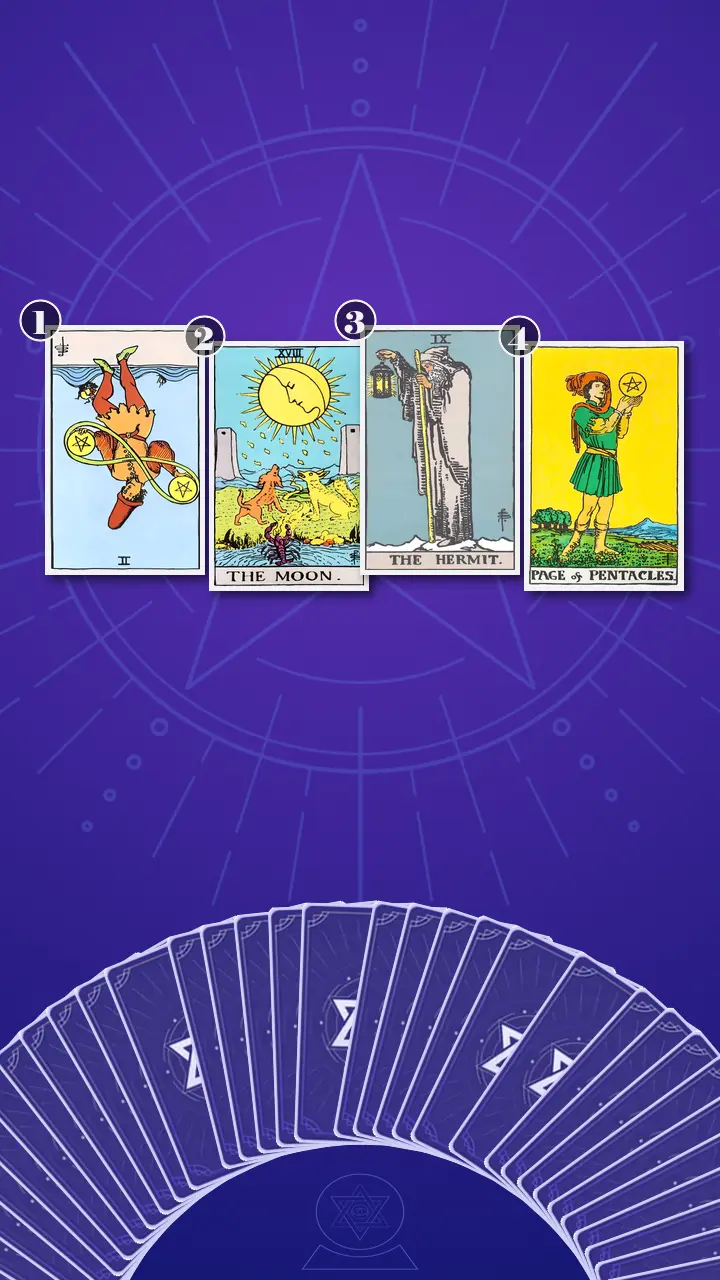
I told her what I was looking for as I laid the cards in a straight line from left to right. The first would name the symptom she was living inside. The second would show what that packed schedule was protecting her from. The third—our key card—would reveal the shift that could interrupt the pattern. The fourth would show how to bring that shift down to earth, into one real experiment instead of another week of overplanning.
Where the White Space Goes
The Loop That Looks Like Momentum
The first card I turned was the one representing the current symptom: the observable habit of overfilling the calendar so uncertainty never has room to fully surface. It was the Two of Pentacles, in reversed position.
I nodded the moment I saw it. In modern life, this card is pure Calendar Tetris. Jordan’s week looked managed from the outside—optional meetings, networking coffees, workout classes, errands, catch-up calls—but inside it was context-switching whiplash. The reversed energy told me the juggling had moved from balance into blockage. Too much motion. Too many micro-commitments. The infinity loop on the card echoed the exact cycle she had described: a gap appears, she fills it, relief hits for five minutes, then the bigger question returns even louder. The schedule kept her moving, but it did not move her anywhere. Busy is not the same as directed.
‘This is what happens when logistics become emotional cover,’ I told her. ‘Your planner is working overtime trying to solve a problem that isn’t logistical.’ She gave a short laugh that carried a little sting in it. ‘Wow,’ she said. ‘That’s accurate enough to be kind of rude.’ Then she rubbed the side of her thumb against her mug, eyes still on the card. ‘I really do treat any white space like a mistake.’
The Fog Beneath the Full Week
The next card I opened was the one representing the underlying blockage: the fear that slowing down will expose how lost she feels about the future and strip away her sense of control. The Moon, upright.
The Moon always makes me think of walking through city fog after dark: there is a road, but your high beams only bounce the mist back at you. In Jordan’s life, it looked exactly like the 6:41 p.m. Line 1 scroll home from work—someone announcing a promotion, someone launching a startup, someone posting one of those ‘so excited for what’s next’ updates—and suddenly her jaw tightens, her chest drops, and before she is even home she has said yes to a networking coffee. That is not poor discipline. That is the body trying to outrun uncertainty. In my Shadow Path Analysis, the subconscious logic was blunt: if she stayed booked, useful, and in demand, she would not have to face the foggy sentence underneath—‘I still don’t know where I’m headed, and that makes me feel out of control.’
I asked her, ‘When a plan gets canceled, what shows up first in your body before you fill the gap?’ She answered without thinking. ‘My chest goes hollow. Then envy. Then panic that I’m wasting my life.’ That was the real obstacle. Not laziness. Not lack of ambition. The Moon was showing us the dog and the wolf at once: the part of her that wanted safety and the part that panicked in the unknown. She sat very still after that, gaze drifting past my shoulder as if replaying a dozen subway rides at once. ‘Oh,’ she said at last. ‘So it’s not just that I’m bad at boundaries.’ ‘No,’ I told her. ‘It’s that unstructured time has been feeling like exposure.’
When the Hermit’s Lantern Lit the Room
One Honest Light Instead of Stadium Lights
When I turned to the third card, the one representing the transformative pivot from reactive busyness toward deliberate solitude, honest self-listening, and self-trust, the room changed. Outside my window, a streetcar bell passed and then even that sound fell away. The card was The Hermit, upright.
This was the antidote. Not disappearing from life. Not becoming less ambitious. The Hermit holds a lantern, not a blackout curtain. I told Jordan that this is where I use what I call Authentic Desire Decoding: we strip away the pseudo-expectations—what looks impressive on LinkedIn, what makes you seem wanted, what earns the reliable-girl gold star—and we ask a simpler question underneath them. What matters when nobody is watching? In practical terms, the card translated beautifully into her actual life: a phone-free walk after work, twenty minutes in a quiet café with one question in Notes, an evening block left intentionally unscheduled so her own signal can get louder than comparison and urgency. The energy here was not excess or deficiency. It was balance through narrowing. Loop to lantern. One clear light instead of flooding the whole street.
I asked her to think about that rainy Thursday when dinner got canceled, the apartment went quiet, and her hand reached for laundry, podcasts, admin, anything that would stop the room from getting honest. She was still trapped in the thought that if she could not see the whole route, she had to fill the tunnel with activity.
A packed calendar is not a compass; let the Hermit’s lantern light one honest step instead of trying to flood the whole road with activity.
First came the freeze. Her inhale stalled halfway, and her fingers stopped moving against the mug as if even her body wanted another second with that sentence. Then I watched the meaning sink deeper. Her eyes unfocused, not blank, but searching backward through memory—the Sunday-night blue glow, the LinkedIn doomscroll, the reflex to say yes before she had even checked whether she wanted the thing. A small line between her brows softened. Her jaw unclenched. Her shoulders, which had stayed slightly raised since she arrived, dropped for the first time. And then, just as often happens when clarity lands, relief rubbed against resistance. ‘But if that’s true,’ she said, voice thinner now, ‘doesn’t that mean I’ve been doing all this wrong?’
‘No,’ I said. ‘It means your busyness has been protective, not pointless. We do not shame the loop. We understand what it was guarding.’ I told her to make the next move small enough that her nervous system could believe it: protect one 20-minute block this week, label it ‘unbooked on purpose,’ put her phone on Do Not Disturb, and write one answer to a single question—What do I want more of, even if nobody claps for it? If her body spiked, she could stop at three minutes or take the question on a no-input walk. She exhaled then, long and shaky, almost a laugh and almost grief. For a moment she looked slightly dizzy, the way people do when a backpack comes off and they realize how long they were bracing under its weight. I asked, ‘Now, using this new lens, was there a moment last week when an empty hour might have felt different?’
She nodded slowly. ‘Thursday night,’ she said. ‘I wouldn’t have needed to fix it. I could have just admitted I was scared.’ That was the real crossing—not from confusion to certainty, but from restless, comparison-driven overbooking to the first honest inch of self-trust.
From a Verdict to a Test
The last card I turned was the one representing grounded integration: the next way of relating to the future through one practical experiment instead of constant motion. It was the Page of Pentacles, upright.
I loved that ending for her. After overloaded earth in the Two of Pentacles reversed, this was earth restored—steady, curious, teachable. In real life, it looked like one informational coffee, one low-cost class, one portfolio sample, one savings transfer into a transition fund. Not a full identity rebrand. Not five parallel side quests. One coin in the hand, studied with care. I told her, ‘This is the future becoming something you test rather than something you perform.’ The Page was asking her to beta-test a possibility and let lived feedback teach her more than another week of podcasts, webinars, and beautifully packed planning ever could. She leaned forward at that, a little more color back in her face. ‘That I can do,’ she said. ‘One thing feels human. Five things feels like a persona.’
From Managing Everything to Tending One Thing
Once all four cards were on the table, the storyline was remarkably clean. Jordan had been using overloaded earth—the management of meetings, errands, and useful little tasks—to compensate for lunar uncertainty. In simpler words: she kept trying to fix the fear of not knowing with more scheduling. That created movement without orientation. The blind spot was subtle but powerful. She had mistaken the discomfort of slowing down for proof that slowing down was wrong, when in fact that discomfort was the exact doorway to the information she needed. The deeper issue was not a broken work ethic. It was a split between persona and desire: the reliable, responsive version of her kept building the week, while her quieter self never got an empty chair.
The Jungian part of my mind always notices this moment. Across cities and cultures, the costume changes, but the mechanism rarely does: the capable persona stays busy enough to keep earning usefulness, approval, or identity, and then wonders why life feels thin. The transformation here was clear—move from using busyness as proof of progress to protecting empty space as the place where real direction can emerge. Or, in the language I gave her before we finished, from managing everything to tending one thing.
I wanted actionable advice, not a beautiful epiphany that vanished by Tuesday. So I gave her three practices, and I said the simplest line on the table out loud: leave one hour empty enough to hear yourself.
- Block the Unbooked WindowTonight, open Google Calendar and reserve one 90-minute slot this week called ‘Unbooked on purpose’—for example, Wednesday from 6:30 to 8:00 p.m. If someone asks for that time, answer with one clean boundary: ‘I can’t do that window, but I can do next week if needed.’ Spend the block in a park, a quiet café, or at home with Do Not Disturb on.If 90 minutes feels impossible, shrink it to 20. The point is protection, not perfection. Resistance is part of the pattern being interrupted, not evidence that the block is wrong.
- Run the Persona Detox ProtocolFor three days, take five minutes during that protected block or on a phone-free walk and make two quick columns in Notes or a journal: ‘What I should want’ and ‘What I actually want.’ Then answer one question: ‘What do I want more of, even if nobody is impressed by it?’ Circle the one phrase that feels alive, honest, or slightly relieving.Do not turn the exercise into a five-year plan. If strategy brain barges in, notice it and come back to one sentence. Voice notes count if writing feels too exposed.
- Choose One-Coin ExperimentBefore the week fills up again, pick one grounded test for your future: message one person for an informational coffee, enroll in one low-cost class, draft one portfolio sample, or move $25 into a savings bucket for a possible transition. Put that single experiment on the calendar first, and leave the rest of the week looser around it.Think beta test, not hard launch. If the experiment energizes you, that matters. If it drains you, that is data too—not failure.

A Week Later: The Quiet Proof
A week later, Jordan sent me a message from a café near Ossington. She had kept her ‘unbooked on purpose’ block. The first ten minutes were awkward in exactly the way The Hermit had promised: she reached for her phone twice, nearly opened a podcast, then stopped. She wrote one sentence in her Notes app instead: ‘I want work that lets me shape ideas, not just organize everyone else’s urgency.’ From there, she did not rebuild her whole life. She sent one email to ask for an informational coffee with a content strategist she admired.
She also added, ‘I still woke up the next morning thinking, what if I pick wrong? But I laughed a little this time and didn’t turn it into Calendar Tetris.’ That bittersweet little sentence mattered to me. It was not perfection. It was proof.
That, to me, is the real Journey to Clarity. Tarot did not hand her a finished future. It gave her an honest structure for seeing the pattern, feeling the fear without obeying it, and taking back authorship of her next step. The cards were not the power. They were the mirror. Her willingness to leave space and listen was the power.
When every open hour makes your stomach drop, it can feel safer to stay booked than to hear how lost you still feel. I know how convincing that loop can be. So I will leave you with this: if one quiet hour this week did not have to give you a five-year plan, what might your own lantern let you hear?