One Difficult Voice Note: Two Calendar Blocks Keep Dinner Booked

Playing Therapist for People I Just Met at 6:42 p.m.
You had dinner booked, your gym bag packed, or one quiet hour protected, and then someone you met twice sent, "Can I tell you something heavy?" I know how quickly that kind of message can turn a flexible schedule into everyone else's emotional overflow space.
At 6:42 p.m. on a Thursday in Toronto, I met Jordan in their apartment near Ossington. Their coat was zipped, the dinner reservation was open on their phone, and a pan of onions had begun to cool on the counter. The radiator clicked in the winter-dark room while Jordan held the warm phone in one restless hand, thumb hovering over a seven-minute voice note.
Jordan said, "Why do I keep dropping plans to play therapist for people I just met?" They had planned dinner with an established friend, but a new acquaintance had started sharing a painful story. Jordan had replied instantly, asked careful follow-up questions, and quietly decided that leaving the conversation would be cruel.
I watched the familiar sequence gather around them: someone discloses, Jordan feels selected, and Jordan's own plan becomes negotiable. The guilt was not just a thought. It moved through their body like a smoke alarm trapped beneath the ribs, followed by heavy shoulders and a delayed resentment that had nowhere polite to go.
"You are not failing at empathy," I told them. "You are trying to solve belonging through immediate rescue. We can look at the pattern without shaming the part of you that learned to stay available. Today, we will use the cards to draw a map toward clarity, while remembering that you remain the person who chooses the route."

The Switchback Map Through the Rescue Loop
I asked Jordan to put both feet on the floor, take one slow breath, and name the question without trying to make it sound reasonable. I shuffled gradually while they focused on the gap between receiving another person's feelings and deciding what belonged to them.
I chose the Transformation Path Grid (6) - Context Edition. This is how tarot works in this kind of session for me: the cards become visual prompts for examining a repeating psychological loop, not predictions about what another person will do. A standard relationship spread would assume a defined two-person dynamic, while a Celtic Cross would scatter our attention across broader themes.
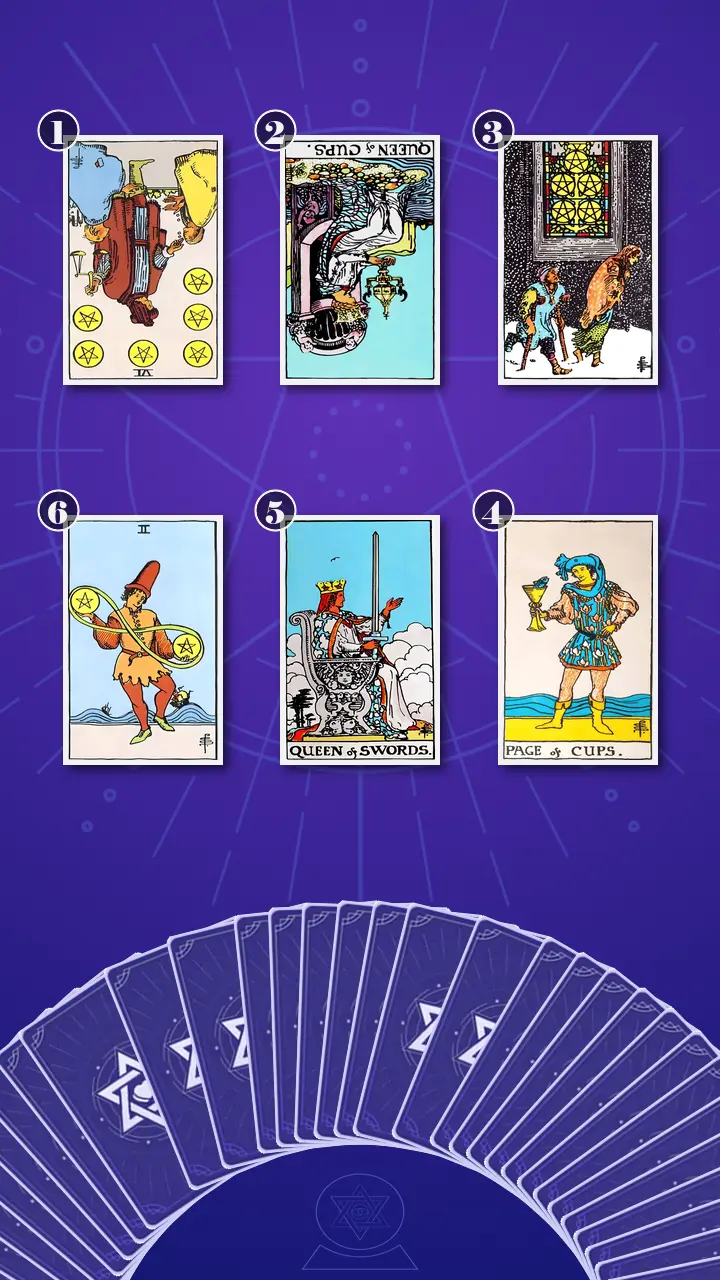
This six-card tarot spread for therapist-friend guilt and emotional boundaries is deliberately small. It preserves the six links we need: the visible habit, the immediate blockage, the belonging fear beneath it, the activating message, the boundary intervention, and the practical integration. The two-by-three arrangement makes a switchback path. The top row shows how Jordan moves from behavior to absorption to fear; the bottom row turns toward a trigger, a clear response, and a sustainable calendar.
I explained the map in plain language. "The first card will show what can be seen on your calendar, phone, and body. The second will show what turns receptivity into self-abandonment. The third will ask what a boundary seems to threaten. Then we will meet the message that activates the cycle, the Queen of Swords intervention, and the Two of Pentacles practice that lets two priorities remain visible."
Reading the Map: Where Care Becomes a Calendar Cost
Position 1: The Calendar Transfer
Now I turn over the card representing the presenting pattern: the observable habit identified in the diagnosis, especially canceling or postponing a pre-existing plan to take on a therapist role for a new acquaintance.
The card is the Six of Pentacles, in reversed position. Its standard meaning concerns the current situation, giving and receiving, resources, and reciprocity. Reversed here, the scales no longer describe freely chosen generosity. They show time and attention being redistributed unevenly, with Jordan's own commitments placed beneath a new person's emotional urgency.
The modern-life scene arrived immediately. At 7:10 p.m., Jordan drags a spin-class block into next week after someone they met on Saturday sends an eight-minute voice note. Jordan offers interpretations, reassurance, and open-ended availability, then checks for a grateful reply because appreciation might make the surrendered evening feel like meaningful care rather than another uneven transfer.
I pointed to the merchant's scales and the unequal height between the giver and the kneeling figures. "Care is being measured by how much of your life you hand over," I said. "Your calendar is not the first resource care must consume. A new person's disclosure does not automatically create a larger claim on your time than the commitment you already made."
I also brought in my Compensatory Routine Decoding lens. I do not read the moved dinner, abandoned workout, or postponed work block as a discipline failure. I read it as a coping mechanism: canceling quiets guilt, creates a quick sense of being needed, and temporarily protects Jordan from the fear of seeming uncaring. The relief reinforces the habit, even while the body keeps the cost.
I asked Jordan to picture the Google Calendar scene: a green dinner block dragged into next week while the voice note continued playing. Their inner sentence was clear: "My plan is flexible, their feelings are urgent, so mine is the obvious thing to move."
Jordan did not nod. They gave a small, bitter laugh and rubbed the edge of their phone. "That is too accurate," they said. "It is almost rude how reasonable I make it sound."
I let the laugh stand. "The goal is not to prove that your generosity is fake," I said. "It is to make the unequal exchange visible without turning your kindness into evidence against you." Their mouth tightened, then softened, and I saw the first small opening in the defense.
Position 2: The Message That Fills the Room
Now I turn over the card representing the immediate blockage: the defense strategy that turns emotional receptivity into self-abandonment, particularly staying available and absorbing another person's feelings.
The card is the Queen of Cups, in reversed position. Her standard meaning includes emotional receptivity, compassion, intuitive attention, and the ability to hold feeling with care. Reversed in this position, that water loses containment. Sensitivity becomes absorption, and Jordan's attention begins to orbit another person's inner world until the original plan is no longer visible.
On the TTC, Jordan rereads one vulnerable text, imagines the sender's entire emotional history, and composes increasingly intimate questions while their own plan passes in real time. The phone grows hot in their hand. The rails screech into a station. Their jaw tightens. The sender's actual words become less vivid than the backstory Jordan is constructing around them.
I focused on the queen's covered cup and absorbed gaze. "This is not simply listening," I said. "It is the moment curiosity becomes a feeling that you cannot leave. You hear, "They sound hurt. Maybe there is more. If I ask the right question, I can help them settle. I cannot leave until they do.""
The distinction mattered. Jordan could believe the other person was hurting without becoming the manager of the entire emotional process. They could ask a caring question without consenting to an unlimited conversation. They could notice that emotional openness had arrived before trust, reciprocity, and capacity had been discussed.
I saw Jordan's chest tighten for a moment. Their fingers stopped above the screen, and their gaze went past the table as if they had suddenly remembered a conversation that had run through an entire train stop. Then they placed the phone face-down, not as a permanent withdrawal, but for the length of one breath.
Position 3: The Warm Window Across the Snow
Now I turn over the card representing the root belief: the underlying fear that keeping personal plans will make Jordan seem uncaring and threaten their sense of belonging.
The card is the Five of Pentacles, upright. Its standard meaning includes exclusion, insecurity, hardship, and the fear of being left outside support. In this root position, it does not announce a fate. It gives shape to the fear beneath the behavior: if Jordan steps away from someone vulnerable, Jordan may feel as though they have been put back outside the circle of warmth.
I asked Jordan to imagine a Toronto winter evening, standing outside a warmly lit restaurant while picturing everyone inside deciding they were cold or selfish. The image was not evidence that anyone had made that judgment. It was the emotional weather that arrived before a boundary was even sent.
Jordan drafted the sentence, "I need to go, but I hope we can talk tomorrow," and then imagined the answer: "Sorry, I thought you cared." No one had written those words. Still, I saw Jordan's stomach drop as if exclusion had already happened.
"Can you ask the card a question instead of accepting its fear as a verdict?" I said. "Does keeping one dinner plan actually reject this person, or does it keep you present in your own life while allowing them to have feelings that belong to them?"
Jordan looked exposed but not defeated. Their shoulders rose, then lowered by a fraction. "I think I have been treating usefulness like an entry fee," they said. "If I am not the person who stays, maybe I do not get to be close."
I told them that the Five of Pentacles could be read as an invitation rather than a diagnosis. The illuminated window also suggested warmth that Jordan had not been allowing themselves to count: established friendships, their own routines, professional support, and the possibility that a healthy connection could tolerate one honest limit.
Position 4: The Unexpected Second Paragraph
Now I turn over the card representing the activating trigger: the moment a new person's emotional disclosure activates the urge to rescue and the need to feel useful.
The card is the Page of Cups, in upright position. Its standard meaning includes an unexpected feeling, a tender message, imaginative receptivity, and emotional openness. The fish emerging from the cup captures the exact surprise of an ordinary exchange becoming intimate without warning.
I described the modern scene: a new dating or social contact writes, "This might be too much, but I feel like I can tell you," just as Jordan is leaving for dinner. The sudden tenderness creates importance and a sense of connection. It may matter. It may deserve care. But the Page does not automatically hand Jordan a therapist's role.
"Being trusted with a feeling is not the same as being assigned responsibility for it," I said. "The useful moment is the pause before your reply. You can receive the message without turning it into unlimited consent."
I watched Jordan's thumb hover over the keyboard. The notification had changed the tone of the evening, but it had not yet decided what the evening would become. First came a small freeze. Then Jordan glanced at the dinner time. Finally, they breathed out and said, "This got intimate fast, which I have been translating as, 'This must matter, so I have to respond now.'"
I nodded. "Tenderness and urgency can arrive together, but they are not the same instruction."
When the Queen of Swords Raised the Blade
Position 5: The Boundary That Keeps the Hand Open
The room became quieter when I reached for the fifth card. I placed it between us rather than turning it toward myself, because the next move had to remain visible and available to Jordan.
Now I turn over the card representing the key transformation: the conscious choice that shifts care from proving love through instant rescue to offering clear, compassionate boundaries around time and responsibility.
The card is the Queen of Swords, in upright position. Her standard meaning includes clear perception, honest communication, independence, discernment, and boundaries shaped by experience. The raised sword separates compassion from responsibility. Her open hand keeps that separation human. She does not demand emotional shutdown; she makes capacity readable.
I used my Psychological Bandwidth Audit here. I asked Jordan to notice the hidden energy already spent before they had typed a reply: scanning tone, imagining history, monitoring whether the sender felt better, and preparing to stay until the crisis seemed resolved. "Your daily reserves can be drained by unresolved stress before your own work even begins," I said. "A time boundary protects bandwidth for care, writing, sleep, friendship, and the rest of your life. It is not a punishment for someone else's feelings."
The core message was simple. Care becomes trustworthy when it is chosen, proportionate, and honest about time. At 6:42 p.m., with a coat on and dinner booked, Jordan was still caught in the belief that leaving would expose a moral defect. Their chest had tightened before the sender had asked for anything specific, and the old strategy was already replacing the evening.
For a moment, Jordan was not deciding between kindness and selfishness. They were standing inside the narrower fear that one delayed reply could reveal them as uncaring, unneeded, and outside the relationship. I watched the belief wait for permission to become a fact.
You do not have to abandon your plans to prove that you care; choose a clear boundary and let the Queen of Swords' raised blade separate compassion from responsibility.
Jordan froze first. Their breath stopped halfway in, their fingers suspended above the phone, and their face went still. Then their eyes lost focus as if they were replaying canceled dinners, missed workouts, and one train stop passed while they wrote someone else's emotional history. Finally, their clenched hands opened against the table, and a long breath moved through their chest. Their eyes shone, but the expression was not simple relief. "But does this mean I have been doing it wrong?" they asked, with a flash of anger at the years spent trying to be good. I answered, "It means the strategy helped you avoid one fear, and it has been costing you more than you can keep paying. You can thank the strategy and retire it in small increments." Their shoulders dropped. "I can believe them, care about them, and still leave on time," they said. I invited them to think back to the previous week: was there one moment when this view could have made the next choice feel different?
This was the first visible bridge from guilt-driven rescue and self-abandonment to compassionate discernment, grounded reciprocity, and relief. The card did not promise that Jordan would never feel guilt again. It offered a sentence strong enough to let discomfort exist without giving it control.
Position 6: Two Priorities on the Same Calendar
Now I turn over the card representing grounded integration: the practical direction that translates the boundary into a sustainable way to honor personal plans while offering proportionate support.
The card is the Two of Pentacles, in upright position. Its standard meaning concerns practical balance, adaptation, rhythm, and the active management of competing priorities. The infinity loop around the coins does not promise perfect balance. It shows repeated adjustment. The ships in rough water suggest that another person's emotional weather can be real without taking control of Jordan's entire schedule.
I translated the symbols into two visible calendar blocks: "Dinner with Sam, 7:00 p.m." and "Check in, ten minutes, tomorrow at lunch." Both could exist. The louder feeling did not automatically get the whole evening. Flexibility did not have to mean self-erasure.
Jordan opened Google Calendar and stared at the empty space where dinner had usually been moved. Then they created a block called "KEEP." I saw practical relief arrive first, followed by the familiar flicker of doubt. "This feels artificial," they said. "Like I am scheduling care instead of feeling it."
"Scheduling support is not less sincere than offering everything immediately," I replied. "It is a way to make your care repeatable. You are not promising less humanity. You are removing the emergency override that lets every new disclosure delete the rest of your life."
I asked Jordan to imagine replying, "I am sorry this is heavy. I can listen for ten minutes, but I am keeping my dinner plans tonight." One hand could acknowledge the feeling. The other could keep the route.
A Calendar That Holds More Than One Truth
When I laid the six cards in their switchback arrangement, the story became coherent. The reversed Six of Pentacles showed time being handed away as proof of care. The reversed Queen of Cups showed the emotional absorption that made stopping feel impossible. The Five of Pentacles revealed the belonging fear beneath both. Then the Page of Cups showed the vulnerable message that activated the loop, while the Queen of Swords supplied clear language and the Two of Pentacles returned the lesson to an ordinary calendar.
I also noticed the elemental movement: Earth was first misallocated, Water became overwhelming, Earth exposed the fear of being outside, Water delivered the trigger, Air brought discernment, and Earth made the new choice practical. There were no Wands asking Jordan to generate more urgency or effort. The problem was not a lack of motivation. It was the absence of a structure that could hold sensitivity without letting it flood every other priority.
The blind spot was not simply "I have weak boundaries." It was the hidden assumption that guilt is a moral instruction and that being needed is safer than risking a limit. Jordan had been treating each disclosure as a test and each canceled plan as evidence of passing. The shift is from proving care through immediate rescue to expressing care through bounded attention that leaves existing commitments intact.
I named the practical direction clearly: compassion and firm time boundaries can coexist. Jordan could listen without becoming someone's unpaid therapist, acknowledge pain without taking over its management, and remain connected without making a new acquaintance the only person whose needs counted.
The Keep-the-Plan Boundary
I offered Jordan three small experiments. None required a personality transplant, a perfect explanation, or certainty that the other person would approve. Each one was designed to let Jordan gather evidence that a boundary could survive contact with real life.
- Keep one existing planBefore one dinner, workout, focused writing block, or bedtime this week, save the sentence "I can listen for ten minutes, then I need to leave" in a phone note. If a new acquaintance sends a heavy message, acknowledge it, offer the defined window if you genuinely have capacity, and keep the plan you already made.Name warmth first and the limit second. The minimum version is "I am heading out now, but I saw your message." Repeat the limit once instead of writing a longer defense.
- Run the Ego Unplugging ProtocolWhen an emotionally loaded message arrives, place the phone face-down and take seven minutes before deciding what to do. Write three headings: "What they actually said," "What I am imagining," and "What I can freely offer without moving my plan." Then separate your self-worth from the speed of your reply, the amount of gratitude you receive, or your ability to make the other person feel settled.If seven minutes feels too large, write only the three headings. This exercise is about capacity and consent, not doubting the person's feelings or diagnosing their situation.
- Hold two blocks visiblyIn Google Calendar, label one pre-existing commitment "KEEP" and add a separate ten-minute check-in for the next day. Before returning one vulnerable voice note, set a ten-minute timer and decide your closing sentence. When it rings, say, "I need to go now, but I am glad you told me."Treat the calendar as an energy budget, not a rigid rule. Your prior commitment does not need to look important to anyone else in order to count.
I reminded Jordan that a boundary is information about capacity, not a verdict on anyone's worth or their own. If someone describes immediate danger, Jordan does not have to assess or manage that alone. The responsible response is to direct the person toward appropriate local crisis or emergency support rather than becoming their sole responder.
"You can start with one plan," I said. "The goal is not total withdrawal. It is proportionate support, practiced until your body learns that pausing is uncomfortable but survivable."

A Small Proof That Did Not Need Applause
Six days later, I received a message from Jordan with a screenshot of their calendar. The blocks read "Dinner with Sam, 7:00 p.m. - KEEP" and "Check in, ten minutes, tomorrow at lunch." A new acquaintance had sent a difficult voice note. Jordan had replied with warmth, kept dinner, and returned to the conversation the following day.
The change was small enough to be real. At dinner, Jordan had still checked the phone once beneath the table. Afterward, they had walked home through cold air with the old fear still present, but the evening had not disappeared to prove a point. The next morning, they woke with the thought, "What if they think I am cold?" This time, they smiled, made coffee, and answered after breakfast.
I do not call that a solved pattern. I call it the first evidence of grounded confidence: Jordan had allowed guilt, care, uncertainty, and a personal commitment to occupy the same day. The cards had not rescued them. Jordan had used the map, chosen a limit, and discovered that belonging did not require handing over the whole route.
That is the work I hope a Transformation Path Grid reading can support: not a verdict from outside you, but a clearer conversation with the part of you that already knows compassion is not the same as responsibility. Finding clarity can begin with one honest pause, one preserved commitment, and one next step that leaves room for both people.
When a near-stranger's name lights up your phone and your chest tightens, it can feel as if keeping your own dinner plan would leave you outside belonging, so your evening disappears before they ever get the chance to judge you. I want you to know that noticing this pattern is already a form of returning to yourself.
If care did not have to cost tonight's plan, what small, honest limit might feel like yours?