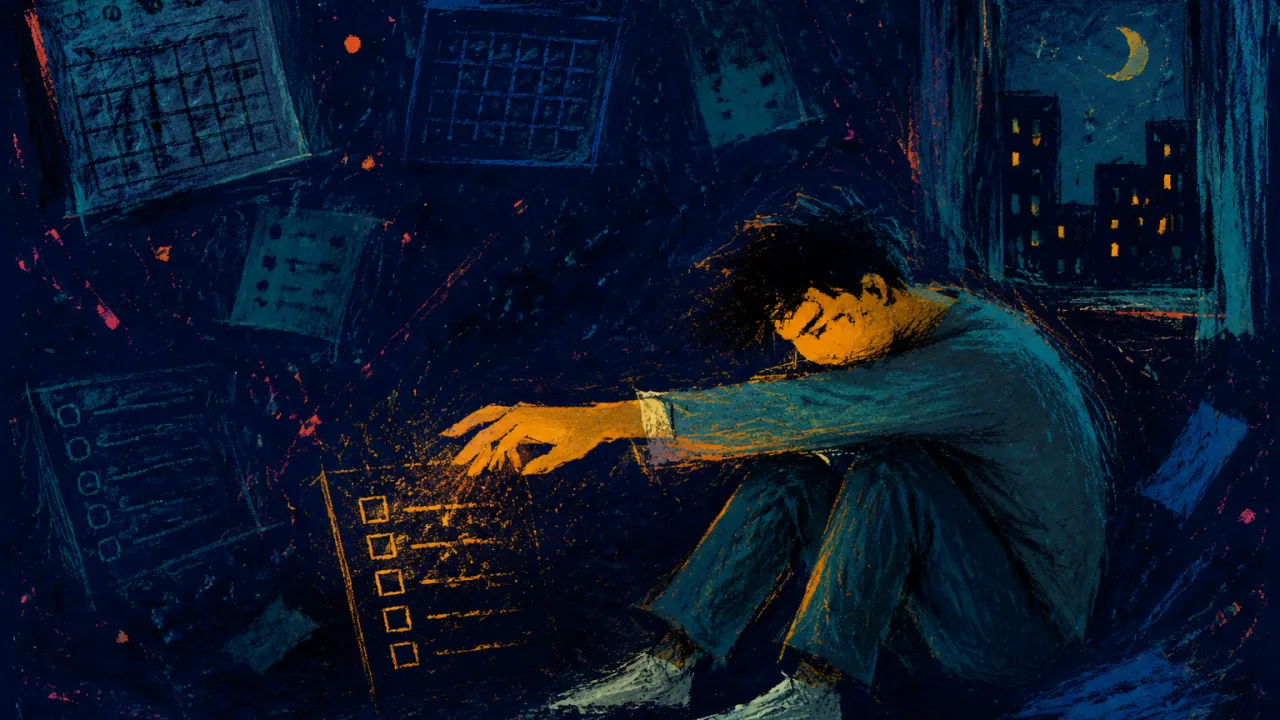
Willpower Dependence Trap lives in the moment when daily life only seems to work while you keep forcing every moving part into place. You can feel it in the locked jaw, tight ribs, and braced shoulders that show up before the day has even fully started. From an existential perspective, the structural framework is about what happens when discipline becomes the load-bearing beam instead of one tool among many. The Tarot Cards below reflect the shape of that grip, the pressure it maintains, and the cost of having no place to set it down.
Strength ReversedThe reversed image concentrates the whole act of strength into the hands locked around the lion's mouth. Instead of a flowing exchange between woman, lion, garland, and infinity, the scene becomes a maintenance task: keep the jaw shut, keep the body bent, keep the force from breaking through. Willpower Dependence Trap belongs here because the card's pressure point is no longer integration but continuous management. The lion remains powerful, yet the system relies on one exhausting control mechanism to keep that power acceptable. In personal growth, this is the self-improvement loop where discipline works only while you are actively gripping it. You are not failing because you lack force; the structure is failing because it asks conscious control to do the work of deeper alignment.
The Hermit ReversedThe reversed Hermit keeps the lantern raised even as the body remains fixed in the cold. The image can become a closed energy circuit: one small light is made responsible for the whole night, and the figure preserves the posture by spending more of himself. Academic struggle often takes this form when structure fails and willpower becomes the substitute. Late nights, private pressure, last-minute intensity, and disciplined isolation may keep the work alive for a while, but the card shows the cost of making inner force carry an oversized system. The struggle is not that you need to try harder. The lantern is already burning; the issue is that it has been turned into the only power source for study, output, direction, and self-belief at the same time.
Wheel of Fortune ReversedThe figures around the wheel do not move it by a single heroic push; they rise, descend, brace, and are carried by the same circular mechanism. When the scene is inverted, force gathers around the rim as if more pressure could solve the problem of phase. That is the shape of effort becoming friction. You can push harder, plan harder, and try to outwork the cycle, yet the wheel shows that momentum depends on where force meets timing. The card names the cost of treating resistance as a personal weakness instead of a signal about position.
Justice ReversedThe figure’s stillness looks composed, but the composition depends on continuous holding. The extended arms, upright sword, level scales, stone throne, and curtained hall all turn balance into a posture that must be maintained under observation. Reversed, that structure hardens into a lifestyle system powered by force rather than design. You may be keeping routines alive through vigilance, self-auditing, reminders, streaks, and pressure, while the actual architecture of your day does not support rest, recovery, or ordinary fluctuation. This is why the card can feel severe in a lifestyle spread. It shows the moment when discipline stops being a container and becomes the only load-bearing wall, leaving your whole routine dependent on how long you can keep yourself upright.
The Hanged Man ReversedThe reversed tension in this image centers on leverage: the body cannot push from the ground, the hands cannot reach forward, and the single tied ankle has to stand in for an entire support system. More effort inside that posture only tightens the relationship between rope, limb, and weight. In daily life, that is the shape of trying to force habits, health routines, and order through discipline alone when the structure around them gives you no usable contact point. You are not being shown a lack of effort; the card identifies a lifestyle setup where effort has become the only tool because the system itself has not been allowed to support you.
Death ReversedThe rider's body is skeletal, yet the black armor remains hard, upright, and functional, with the white horse carrying the mass forward. The scene separates organic vitality from mechanical continuation: motion is still happening, but it is being held by armor, reins, and ceremonial force. Inside a lifestyle spread, that structure points to routines held together by discipline after real capacity has already dropped out. You are not simply trying hard; your daily architecture has become an exoskeleton, and the strain comes from using willpower as the only remaining support beam.
Temperance ReversedThe same graceful posture can become a locked maintenance position when the body has to keep land, water, and flowing cups coordinated without external support. The stream keeps moving, but the burden of keeping it cleanly contained sits entirely in the angel's hands. Willpower Dependence Trap appears when your lifestyle only functions because you manually hold it together. Every meal, reminder, workout, sleep boundary, cleaning reset, and focus block requires another act of internal gripping. Reversed Temperance makes the hidden cost visible. The balancing ritual becomes the drain: the system is not truly stable if it survives only through constant self-control, and the card marks the point where discipline has replaced design.
The Devil UprightThe Devil's raised hand creates a command signal while the left hand holds a torch that burns downward rather than outward. Control and ignition come from the same figure, and the chained pair remain still under a rule that looks powerful but does not produce movement. In personal growth, Willpower Dependence Trap appears when the only tool available is more force against the same system that keeps generating temptation, shame, and pressure. You are not seeing a lack of effort; you are seeing a structure where every push adds heat to the chamber instead of loosening the collar.
ReversedThe Devil's torch adds heat to the scene, but the added fire does not move the chained figures away from the cube. Energy enters the system and becomes more intensity inside the same arrangement. At work, this is the structure behind trying harder when the real binding point is not effort. More hours, more proving, more usefulness, and more resilience may only feed the same career loop if the advancement path is controlled by conditions outside personal output. Willpower Dependence Trap names the exhausting belief that enough effort should eventually break the chain. The reversed Devil shows why that belief can become its own restraint: the system keeps accepting your energy without changing the ring that organizes your movement.
The Star ReversedIn The Star reversed, the same kneeling body can become a locked mechanism: one knee anchored, one foot in the pool, both vessels still emptying. The surrounding oasis is open, but the operating position stays fixed at the shoreline, as if continued output has become the only way to keep the system coherent. That is the timing pressure inside Willpower Dependence Trap. You keep treating effort as the bridge between now and the right moment, even when the season itself has not opened. The problem is not that you are unwilling to work; it is that work has become a substitute for cycle recognition. The reversed image makes the cost visible. When the vessels keep pouring without a felt return channel, persistence begins to imitate alignment, and timing becomes something you try to overpower instead of something you locate.
The Sun ReversedThe white horse moves forward without reins, while the child remains lifted in a posture of open vitality. In the reversed texture, the freedom of the image can become a system that keeps moving only while energy is high, because there is no visible mechanism for pacing, correcting, or recovering. Study often collapses into this pattern when motivation is treated as the main steering device. A bright burst of confidence can carry the first few pages, the first revision plan, or the night before an exam, but the work becomes fragile when the body and mind are asked to continue without that surge. The card names the trap as reliance on solar intensity instead of academic structure. You are not being shown a failure of will; you are seeing the cost of making willpower do the job that scaffolding, feedback loops, and repeatable rhythm were meant to carry.
Judgement ReversedThe trumpet blast is huge, singular, and external, while the coffins below contain no stairs, path, or practical mechanism for continued movement. The scene shows activation arriving as impact rather than as infrastructure. Willpower Dependence Trap appears when daily life only moves under a loud signal: panic cleaning, deadline resets, Sunday-night guilt, or a sudden motivational high. You can feel the call, but the card exposes the missing low-friction route that would let the body keep moving after the blast fades.
Ace of Cups ReversedThe hand can keep the cup upright, but the image gives no visible shelf, base, or ordinary support system. Stability depends on the hand remaining present while the water continues its movement. Reversed, that becomes the lifestyle trap of holding everything together through constant personal force. Sleep routines, cleaning cycles, food choices, boundaries, exercise, and recovery may function only when you are actively gripping the system with attention and discipline. Willpower Dependence Trap names the point where effort replaces architecture. The Ace of Cups shows the vessel needs more than a delicate hand; it needs a structure that can keep receiving life when your willpower is not available to perform maintenance.
Eight of Cups ReversedThe figure's staff carries the body forward, but the card's reversed texture turns that forward force into a system that must keep supplying its own momentum. The cups do not become a support structure behind him; they remain a proof of effort and incompletion. In a lifestyle spread, this points to a daily architecture that only works when you keep pushing. The schedule holds if you overextend, the health plan works if you stay constantly vigilant, the home system stays clean if you never drop the ball, and the reset continues only while willpower is available. Willpower Dependence Trap is the moment effort replaces design. The card shows why another push may feel necessary, but it also makes visible the hidden structural failure: a life system that needs constant force from the body is not yet built to carry the body back.
Page of Cups ReversedThe Page keeps the cup lifted by hand, maintaining the contact between the vessel and the fish through direct attention. Nothing in the scene suggests a larger support system taking over the work; the delicate arrangement holds because he keeps holding it. Reversed, that image becomes a lifestyle system built around constant personal vigilance. You may be using motivation, discipline, trackers, reminders, or sheer self-monitoring to keep routines alive, while the environment itself does not reduce friction or carry any of the load. Willpower Dependence Trap names the exhausting condition where the self becomes the infrastructure. The card's small cup shows why the routine collapses when attention slips: the structure has not become supportive enough to survive without being manually held.
King of Cups ReversedThe reversed King remains seated in a place that offers no solid margin, as if endurance itself has become the method of navigation. The body stays upright, but the posture depends on restriction, not responsive movement. Academic pressure can train the same logic into a study system: push harder, stay controlled, tolerate more, and call that the only route forward. Over time, willpower becomes the throne, even when the sea around it is telling you the structure needs more than force. Willpower Dependence Trap names the point where discipline stops being supportive and becomes the only permitted survival tool. The card shows the cost of holding everything together through control when the learning environment itself needs redesign, pacing, and real containment.
Ace of Pentacles ReversedThe hand does real work to steady the pentacle, but the garden below shows that material growth does not come from grip alone. A coin can be held tightly in the air and still remain separate from the soil, gate, and path that would let it become part of life. Willpower Dependence Trap is the strain of treating effort as the timing mechanism. You may keep pushing because the opening matters, but the card shows effort becoming circular when it is spent preserving the symbol instead of meeting the conditions that can receive it. In timing questions, this is the point where force stops being proof of commitment and starts hiding the rhythm of the cycle. The structure asks you to see whether the moment needs more pressure, or whether it needs contact with the right ground.
Two of Pentacles ReversedThe reversed Two of Pentacles can keep the loop moving even after the movement has stopped being sustainable. The cord still looks continuous, the hands still know the pattern, and the figure can keep adapting to instability long enough for strain to look like normal academic effort. Willpower Dependence Trap appears when school runs on force instead of structure. You may push through panic, urgency, all-nighters, or last-minute adrenaline because the loop has trained you to believe that effort only counts when it hurts. The card does not glorify that endurance. It shows a system where willpower has become the substitute for a stable learning container, so each successful rescue makes the same fragile structure harder to question.
Four of Pentacles ReversedThe figure's muscles act as the fastening system for the entire arrangement. Arms, feet, neck, and spine all hold positions that the environment itself does not support. This is the lifestyle signature of a system that works only while you keep forcing it. The card gives shape to the difference between sustainable structure and constant self-pressure: one supports movement, while the other requires the body to become the support beam.
Five of Pentacles UprightThe crutch keeps the figure moving, but it does not change the snow, the cold, or the distance from shelter. The body has found a way to continue, yet continuation itself becomes expensive because the route is still hostile. Willpower Dependence Trap appears when the only available proof of agency is to keep pushing. You may be using endurance as a timing strategy, even though the card shows a situation where more force cannot turn winter into an open road. The image gives dignity to the effort while also exposing its limit. In this timing field, the question is not whether you are strong enough to keep going; it is whether strength has become the tool you use when the moment itself is not ready to yield.
Six of Pentacles ReversedThe figure's stability depends on holding two functions at once: one hand keeps the standard of balance visible, while the other controls the release of resources. The posture can look composed, but its order is carried by one body staying in command of every moving part. Reversed, that structure becomes a lifestyle system built around personal force. Sleep, food, movement, admin, money, cleaning, social energy, and recovery all depend on whether you can keep extending the right hand at the right moment while still holding the scale steady. The skewed pentacles show how an uneven map can become familiar enough to feel normal. The struggle is the trap of needing willpower to compensate for a structure that should have been carrying some of the weight for you.
Seven of Pentacles ReversedThe hoe stands under the worker's weight, close enough to be a tool but also positioned like a support for staying still. In reversal, the instrument of cultivation becomes the structure that holds exhaustion in place. Willpower Dependence Trap appears when academic effort is maintained mainly by force: more hours, more pressure, more self-command, more refusal to stop. The learning system may still look active from the outside, but the body of the card shows support replacing flow. This struggle is not a failure of discipline. The card marks the moment where discipline has become the only remaining scaffold, and that scaffold is keeping you attached to a method that may no longer be feeding real learning.
Eight of Pentacles ReversedThe hammer and chisel can become more than tools; in the reversed state, they form a closed circuit of force. The same strike repeats against the same surface until motion itself begins to stand in for progress. Willpower Dependence Trap is the academic version of that closed circuit. You push harder, add hours, reread longer, punish yourself into another session, and still feel the work resisting you because the method has become narrower than the learning problem. The card locates the trap at the point where discipline stops being a support and becomes the only available interface. It does not deny your effort; it shows how effort can become structurally overburdened when every academic block is forced through the same channel of self-command.
Nine of Pentacles ReversedThe falcon is controlled so precisely that its power remains present but unavailable. The glove prevents injury, the hood blocks vision, and the composed figure makes restraint look like mastery. In academic work, this becomes the trap of relying on control as the main engine of learning. Strict schedules, forced focus, perfect systems, and self-pressure can keep the performance standing, but they may also replace curiosity, comprehension, and flexible attention. The more the system depends on force, the less room there is for living intelligence to respond. The card names the point where discipline stops supporting study and starts substituting for it. You may still be moving through the motions, but the structure shows a learning instinct that has been managed so tightly it cannot see where it needs to go.
Page of Pentacles ReversedThe raised pentacle can become a load that stays stable only while the Page keeps his grip, gaze, and posture locked around it. Reversed, the body reads less like calm focus and more like a support rig concentrating all stability into one narrow point. In lifestyle terms, Willpower Dependence Trap shows a system that works only when you are actively forcing it to work. You may have routines, trackers, or rules, but the card reveals the deeper strain: the ground around the habit has not been built to hold it when attention loosens.
Knight of Pentacles ReversedThe heavy armor and red tack create a body built around containment, pressure, and forced steadiness. When the horse remains planted, that pressure has nowhere to become movement, so discipline turns into a bracing system. In academic life, this names the trap of relying on force as the only way to study, focus, or finish. You can still push, but the card shows the cost of a learning system that knows how to tighten and no longer knows how to respond.
Queen of Pentacles ReversedThe pentacle is held by hands rather than set into a wider mechanism. The throne, garden, and carved signs of vitality surround the Queen, but the working point of the card is still a closed circuit of gaze, grip, and lap. In a lifestyle reading, that structure exposes the hidden fragility of routines that only work while attention is actively holding them together. You may have systems that look organized from the outside, but the card shows why they collapse when energy drops: the support has not been distributed beyond personal control.
Ace of Swords UprightThe hand grips the sword with concentrated force, and every ounce of motion is narrowed through one hard metal axis. Above it, the crown and branches hang from the point, while the barren ground below remains untouched by the blade's brilliance. Willpower Dependence Trap appears when timing is treated as something that can be forced open if enough pressure is applied. You may keep sharpening the plan, tightening the grip, and pushing harder, while the actual season remains dry, unreceptive, or structurally closed. The card shows the limit of raw mental force. The sword can pierce, clarify, and separate, but it cannot make barren ground become fertile before its time.
ReversedThe hand grips the sword with enough force to keep the whole symbol upright. In its reversed pressure, that firmness turns into a locked posture, where maintaining the image of discipline consumes the movement the blade was meant to create. Willpower Dependence Trap forms when personal growth is organized around constant pressure. You keep the sword raised through intensity, self-command, and mental force, but the ground below stays barren because the system is being held up rather than integrated. The crown and branches crowd the sword tip with the promise of mastery, victory, and peace. The card witnesses the trap of treating force as proof of evolution, when the deeper struggle is that growth has become dependent on strain to feel real.
Five of Swords ReversedThe reversed Five of Swords compresses the figure's grip into a closed system: the blades are still held, the stance still braces, and the open shore no longer feels like usable space. The body is maintaining the scene through force of posture rather than through a stable structure around it. In a lifestyle reading, this is the moment when willpower becomes the main architecture of the day. You may be holding routines together through self-command, streaks, rules, and pressure, while the actual system remains too narrow to support sleep, meals, movement, cleaning, focus, and repair. Willpower Dependence Trap names the hidden cost of that arrangement. The card shows that the problem is not the absence of effort; it is a daily blueprint that only functions when you keep your grip tightened beyond what a sustainable life can ask of one body.
Six of Swords ReversedThe ferryman's long oar is the only visible engine of the crossing, and his split stance turns progress into a sustained act of leverage. The passengers sit still while the boat depends on one narrow mechanism to keep the whole system moving. Willpower Dependence Trap emerges when personal growth is powered mainly by force, discipline, and constant self-correction. The structure may look responsible, but it makes every transition depend on continuous pressure rather than a redesigned inner system. The reversed Six of Swords shows why this becomes exhausting without turning exhaustion into the whole story. The boat can move, but if every crossing requires the same strained oar stroke against hidden weight, progress remains vulnerable to collapse whenever force drops.
Seven of Swords ReversedThe tiptoeing body is held together by acute effort: red shoes balanced carefully, backward glance active, hands clamped, and blades gathered against the knee. Nothing in the scene supports him except precision and tension. For daily architecture, this describes a life system running on forced output instead of supportive design. The struggle is not the absence of discipline; it is the hidden cost of making discipline carry what boundaries, recovery, and environment were supposed to hold.
Eight of Swords ReversedThe red robe carries heat and force, but the white bands convert that force into containment. The more the body holds itself upright inside the restriction, the more energy is spent maintaining the bind rather than changing the field. In a lifestyle context, the card shows the cost of using discipline as a substitute for system design. You may keep tightening rules around food, sleep, screens, spending, or productivity, while the underlying architecture still leaves no open channel for sustainable movement.
Ten of Swords ReversedThe ten swords create the image of effort meeting a field that has already become saturated with force. Nothing in the body suggests a clean next push; every line of pressure has been driven into the same exhausted structure. Willpower Dependence Trap emerges when resistance is repeatedly answered with more force, even after force has stopped creating movement. In timing questions, this is the inner command to keep grinding through a cycle that is asking for pause, protection, or strategic withdrawal. The reversed weight of the card makes the trap more internal: the body begins to treat being pinned as proof that it must push harder. The clearer reading is that willpower has become the wrong timing instrument for the current phase.
Page of Swords ReversedBoth hands clamp the sword as if the body can manufacture safety by grip alone. On the high ridge, that grip keeps the Page upright, but it also turns the whole posture into a constant manual override. This is the shape of a lifestyle system held together by discipline instead of design. You can keep using alertness, rules, streaks, and self-control to prevent collapse, but the card shows the hidden cost: when the hand is always on the sword, rest starts to feel like a structural risk rather than a legitimate part of the system.
Knight of Swords UprightThe knight's body is sealed in armor while the horse forces its way through resistant air. The scene does not show a gentle rhythm of change; it shows a body system organized around impact, resistance, and sustained forward pressure. For personal growth, that physical arrangement turns discipline into the only trusted engine of transformation. You may believe change is real only when it feels like a charge, a streak, a challenge, or a fight against your own limits. Willpower Dependence Trap names the cost of building self-evolution around force alone: the armor keeps you moving, but it also makes softer forms of integration feel illegitimate.
ReversedThe knight’s body is braced into the charge, with armor, horse, sword, and wind all reinforcing one line of force. When this structure turns inward, the body’s forward lock becomes a way to keep moving after flexibility has already been spent. In study, that image maps to the belief that more force must solve every academic blockage. If a method stops working, the response is more hours; if retention drops, more pressure; if a draft resists, more self-command. The card witnesses a willpower system being asked to perform the job of a learning structure. You still have agency, but the struggle is not solved by simply pushing harder, because the very act of pushing has become the container holding the academic self together.
Queen of Swords UprightThe Queen's raised sword is perfectly vertical, but it stays upright only because one hand keeps the grip active. Her posture is composed, yet the composition shows a system that depends on sustained muscular control rather than an architecture that can support itself. When daily habits, health routines, minimalism rules, or sleep plans rely on the same kind of constant grip, discipline becomes the hidden load-bearing beam. The card does not shame the need for structure; it shows the fatigue of a life design that collapses whenever willpower stops holding the blade.
King of Swords UprightThe raised blade carries the signal of decisive action, but the King's seated body holds that action inside a fixed ceremonial frame. Warm red appears at the hood and elbows, yet the larger field of blue keeps the figure visually governed by control. In lifestyle terms, this is the structure of a system that only works when willpower stays in charge. The drive is present, the standards are clear, and the intention is real, but the day has not been built to carry the behavior without constant top-down command. The card makes the hidden cost visible: when discipline is the only load-bearing beam, every habit becomes another test of force. You are not failing because the goal is unclear; the structure is asking conscious effort to do work that an environment, rhythm, or recovery system should be sharing.
ReversedThe King’s posture is controlled, elevated, and impressively contained, yet the ground beneath him is barren and narrow. The sword shows command, but the body’s stillness suggests a system trying to generate evolution from pressure alone. In personal growth, that structure appears when willpower becomes the only trusted engine. You keep raising the standard, tightening the rule, and demanding sharper execution, while the living conditions that allow change to take root remain underfed. The card witnesses the hidden cost of using force as a growth strategy. Discipline is present, but it has been isolated from recovery, desire, experimentation, and support, so the system can look powerful while quietly becoming less adaptive.
Ace of Wands UprightThe cloud-borne hand does not brush the wand lightly; it clamps around a thick living staff with the thumb lifted into visible pressure. The object is alive, sprouting, and charged, yet it is still held like something that must be controlled before it can be trusted. That grip turns vitality into a test of force. You may feel an inner surge and immediately convert it into discipline, self-work, or the demand to finally fix what has been stuck, as if intensity itself could clear the deeper emotional backlog. The wand hovers above the river and land rather than rooting into them. The card locates this struggle in the gap between raw activation and actual inner metabolizing, where willpower becomes the only available handle for a system that needs more than force.
ReversedThe thumb presses hard along the wand, and the fingers close around a living staff that is not rooted in the ground. In reversal, that grip becomes the whole support system: the branch stays upright because it is held, not because it has grown into a stable structure. Willpower Dependence Trap forms when personal growth relies on that same compressed force. You can push through a reset, a challenge, or a burst of discipline, but the system collapses when the hand gets tired because nothing underneath has learned to hold the weight. The reversed Ace of Wands locates the cost of confusing intensity with capacity. It shows growth energy being managed by pressure instead of rhythm, making every fresh start feel like another test of how tightly you can grip.
Five of Wands UprightEvery wand is lifted, every arm is engaged, and the open ground is still blocked. The visual contradiction is stark: more force has entered the field, yet the field has become harder to move through. Willpower Dependence Trap takes shape when resistance is interpreted as a demand for greater intensity. You may be reading a blocked season as a personal challenge to push harder, hustle more, or prove readiness through strain. The card shows why that approach can become self-defeating in timing questions. When the season itself is crowded, misaligned, or underprepared, added force does not open the path; it thickens the resistance already in the air.
ReversedThe bodies rely on braced legs, extended arms, and raised staffs to keep the scene active. Nothing in the image offers rhythm, containment, or a gentler structure; progress is imagined through pressure against pressure. For personal growth, that becomes the trap of treating willpower as the only proof that change is real. You can keep pushing, but the card shows how force can become a closed circuit, turning discipline into constant self-combat instead of a sustainable architecture for becoming.
Six of Wands ReversedThe central wand is gripped like a victory standard while the white horse supplies the actual forward motion. In reversal, the pose hardens into a system where the sign of drive has to compensate for missing rhythm, rest, and repeatable support. Willpower Dependence Trap shows up in daily life when habits only move under pressure, streak energy, or a dramatic push. The card frames the struggle as a mismatch between heroic display and sustainable architecture: you are not short on force, but the force is being asked to do work that a calmer system should be carrying.
Seven of Wands UprightThe figure in Seven of Wands has the high ground, a clear sky, and a wand already in motion, yet none of that gives him rest. His stance works only as long as he keeps bracing, lifting, redirecting, and holding the line against pressure from below. In academic life, this becomes the trap of surviving through force. You can keep pushing through readings, deadlines, revision sessions, and performance moments, but the system starts depending on pressure to activate focus. The card does not frame effort as failure. It shows the cost of making willpower the only bridge between knowledge and output: every task becomes another stand to defend, and the learning system has little room left for absorption, recovery, or steady confidence.
ReversedOne wand carries the entire defensive load. The figure's two hands, widened feet, and angled weapon concentrate six separate pressures into a single line of resistance, leaving no visible support system beyond continued force. In personal growth, that image becomes a structure where discipline has replaced architecture. You may be trying to outwork doubt, outlast inconsistency, and overpower every limiting belief through raw effort, but the card shows a body that can only stay functional while it remains braced. Willpower Dependence Trap names the hidden fragility of a self-improvement strategy built around constant inner combat. The struggle is not that you lack strength; it is that your strength has been forced to do the job of rhythm, recovery, support, and self-trust all at once.
Nine of Wands UprightAll nine wands touch the ground, but only one depends on the figure's grip to stay useful. The body is tense, the neck contracted, and the support system works only because he keeps feeding it muscular effort. In a timing reading, this shows grit being used as a substitute for fit. You may be able to hold the line for a while, but the card names the cost of forcing progress through a moment that is asking for better alignment, not more strain.
ReversedThe figure is still upright, but the posture depends on a narrow load path: two hands, one wand, one tense body. Around him, eight other wands stand available, yet the active burden is concentrated through a single point of force. Willpower Dependence Trap appears when standing becomes proof that the structure is working. You may keep reading strain as discipline because the system has learned to count endurance before it checks whether the load is distributed. In personal growth, this can turn self-improvement into constant pushing. The card's reversed tension shows the cost of using willpower as the whole infrastructure: the self stays vertical, but not necessarily supported.
Ten of Wands UprightThe load stays airborne because the man's body keeps it there. His arms compress inward, his spine pitches forward, and his legs have to continue the journey without any visible support system besides strain. In study, that posture becomes the structure of progress through force. You get movement, but only when pressure, urgency, panic, or self-command supplies the energy; the learning system itself never gets redesigned to carry the work differently. The Ten of Wands makes the trap visible: willpower can move the bundle, but it also becomes the only infrastructure. When every assignment depends on pushing harder, academic momentum starts costing the same part of you that needs to understand, remember, and create.
ReversedBoth arms are consumed by the same action: clamp the ten wands and keep moving. The card gives no visible sorting system, no second method, and no free hand; everything depends on the body's ability to force a difficult bundle forward without changing the design of the carry. For personal growth, the reversed structure exposes the limit of treating willpower as the only trusted engine. You may be pushing with real intensity, but the deeper trap is that every problem is being routed through the same strain-based method, leaving no space for support, pacing, redesign, or a more intelligent relationship with effort.
Page of Wands ReversedThe reversed Page of Wands keeps feeding fire into the upright staff while the desert around it remains unchanged. The symbol of motivation is active, but the surrounding field does not receive it as growth, structure, or sustained movement. In study life, this is the trap of trying to solve a system problem with another burst of drive. You may restart with a new schedule, a new wave of panic, or a fresh promise to yourself, while the deeper academic container still cannot hold attention, memory, drafting, and feedback. The card makes the exhaustion legible without treating it as a lack of ambition. The struggle is that willpower has been asked to do the work of architecture, so every new spark burns brightly for a moment and then disappears into the same unstructured ground.
Knight of Wands UprightThe wand declares will, the armor declares readiness, and the desert quietly refuses to become softer just because the rider burns hotter. The card places personal fire against a landscape that cannot be crossed by intensity alone. Willpower Dependence Trap appears when timing friction is answered with more force instead of sharper cycle reading. You may keep trying to push through a cold or resistant phase as if enough passion can replace the missing conditions. The visual tension is practical and existential at once: the horse can surge, but the terrain will decide how long that surge remains useful. The card marks the boundary between courageous action and self-consuming propulsion.
ReversedWhen the image folds inward, all power concentrates into fire: the red horse, raised wand, plume, armor, and hot desert create a system with ignition but little reserve. The horse can surge, but the scene offers few visible recovery points, and the knight's protection becomes another layer of heat to carry. In personal growth, that structure names the cost of using intensity as the only engine. You may be able to force change through pressure, hype, or a crisis surge, but the card shows why the same engine keeps draining the system that is supposed to evolve.
Queen of Wands UprightA living wand rests against stone steps, and the only green in the desert is held in the Queen's hands. The card concentrates vitality in personal grip while the wider field remains dry, bright, and unreceptive. That is the exact shape of a timing struggle where willpower tries to perform the work of a season. You can have fire, confidence, and visible creative charge, yet still be pushing against conditions that are not ready to receive what you are trying to grow. Willpower Dependence Trap is not a failure of motivation. It is the moment where effort becomes the substitute for timing, and the card shows the cost of trying to make a dry field bloom through heat alone.
ReversedThe wand sprouts and the sunflower blooms, but both depend on the queen's hands to stay present in the composition. The living signs are not rooted in the desert; they are maintained through grip, posture, and constant symbolic control. Reversed, that held vitality can become a closed energy economy. The figure keeps the growth image alive by staying poised, charged, and self-contained, but the scene offers little evidence of systems that could carry the life force without her direct effort. Willpower Dependence Trap is the personal growth struggle of making every change depend on intensity. You may be able to push, restart, recommit, and perform discipline, but the deeper friction is that transformation has not been transferred into structures that can hold you when motivation drops.
King of Wands UprightThe only visible growth in the King of Wands is concentrated in the wand, while the surrounding desert offers no shade, water, plant life, or receiving ground. The card places a living instrument of fire inside an environment that cannot visibly replenish it. That is the structure of Willpower Dependence Trap: vitality is real, but it has been narrowed into one fuel channel. You can keep pushing, deciding, initiating, and holding the inner throne, yet the wider system remains dry because receptivity and recovery are not part of the architecture. For introspective work, the card marks the moment when self-control has become the default answer to every hidden blockage. The problem is not weakness; it is an inner ecology that keeps asking drive to do the work of nourishment, grief processing, shadow contact, and rest.
ReversedThe throne, wand, robe, and desert form a closed circuit of heat. Everything in the scene intensifies fire, but very little in the environment distributes, cools, or renews it. In personal growth, that becomes a system where change depends on pressure, streaks, discipline, and force of will. You can push hard, but the structure has no second source of support when intensity drops. The struggle is not laziness after the fire burns low. It is the cost of building self-evolution around combustion instead of a livable rhythm, where the only way to feel real progress is to keep turning the heat up.
No cards available for this filter.