The 7:18 p.m. Split-Screen: Why I Play Host at My Own Birthday Dinner
If you’re the late-20s city friend who can run a client meeting with zero notes but slips into full vibe-management mode the second work friends, old friends, and a couple plus-ones land at the same birthday table, I recognized the pattern the moment Olivia started talking.
She was twenty-nine, lived in Toronto, and worked in a creative agency where reading people quickly was practically part of the job description. It was the exact pattern behind the question she brought me: why do I play host at my own birthday dinner instead of being in it? When she described 7:18 p.m. at a long candlelit table in the west end, I could almost smell the fried chili oil and someone’s expensive perfume over the clink of cutlery. She said she was half-standing between the server and the first round of hellos, one hand near her wine glass, one eye on the far end of the table, giving little context packages like, “This is Maya, we used to work on travel stuff together,” before anyone had even settled into their seats.
“I just want everyone to feel comfortable,” she told me. Then she laughed without humor. “But if the vibe gets off, I feel responsible. I can tell you exactly who has met whom, but I barely remember what I ate.”
What she wanted was connection. What she feared was that if she stopped managing the room, even for one quiet beat, awkwardness would bloom and somehow say something painful about whether she belonged there at all. The tension in her body felt, even in the way she described it, like carrying a tray of full glasses through a room where the floor kept subtly tilting: shoulders high, breath half-held, eyes darting end to end.
I nodded and kept my voice soft. “That makes so much sense,” I said. “And it doesn’t make you controlling or broken. It makes you very practiced at turning care into coordination. Let’s make a map for the moment when you disappear into host mode, and see how to get you back into your own night.”
Choosing the Compass: A Five-Card Cross for Mixed Friend Group Anxiety
I asked Olivia to take one slow breath and hold the question in plain language: not “Will my social life be okay,” but “Why do mixed friend groups make me tense enough to manage the vibe?” Then I shuffled slowly and laid out a Five-Card Cross. I always treat this part as focus, not theater; the ritual gives the nervous system a doorway into honesty.
For a question like this, the Five-Card Cross is ideal because it is small, clean, and specific. It shows the visible behavior at the center, the immediate friction pressing against it, the deeper wound under it, the sincere intention above it, and the integrating guidance to the side. In other words, it shows how tarot works at its best: not as fortune-telling, but as card meanings in context, tracing a human pattern from symptom to root to next steps.
I told her which parts mattered most. The center card would show the host mode itself. The crossing card would reveal what kind of group energy her body kept misreading as a problem. The card beneath would touch the deeper belonging fear. The card above would show what she was honestly trying to create. The final card would point toward a healthier relational stance, one where she could stay present without becoming the emotional event planner.
Reading the Room Before the Room Reads You
Position 1: The Juggle That Keeps Her Standing
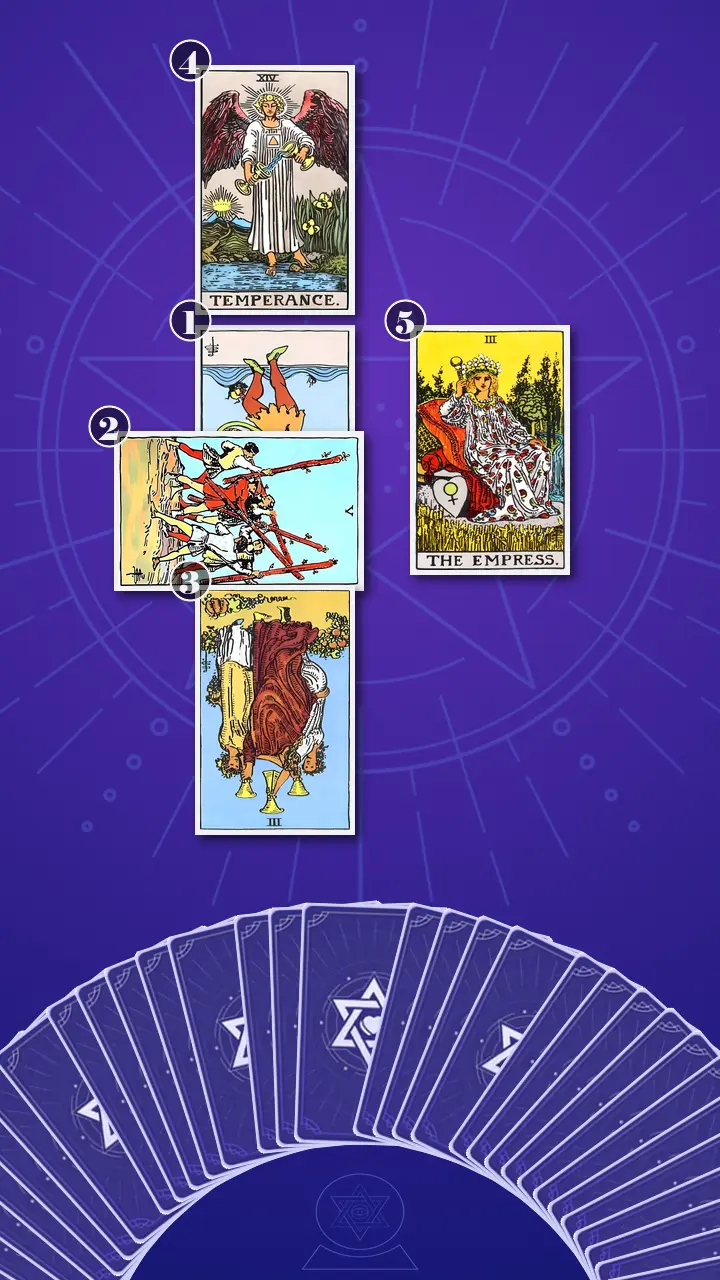
I turned over the card representing the visible host mode at the birthday dinner and how she manages the room instead of inhabiting it. It was the Two of Pentacles, reversed.
I told her exactly what I saw: arriving already inside a live mental dashboard, tracking who should sit beside whom, who needs an introduction, who seems under-socialized, whether the quieter end of the table is okay. Physically at the dinner, internally doing account management for the whole room. The card’s energy was not lack of care; it was overextension. Too many tabs open in the social browser. The infinity loop around the coins felt like The Bear service-mode energy in tarot form: keep every station moving, forget to taste the meal.
“Yes,” she said, then gave a sharp little laugh with something bitter underneath it. “Okay, wow. That’s accurate to the point of being rude.”
I smiled. “That’s the card doing its job. It shows the split-screen. One part of you is present at your own celebration. The other part is standing just outside it, scanning, introducing, topping up, redirecting. So the room sees warmth, but your nervous system experiences strain.”
Position 2: The Silence You Treat Like a Fire Alarm
I turned to the card crossing the center, the one revealing what feels risky, messy, or hard to tolerate when different friend groups share one space. The Five of Wands appeared upright.
I asked her to picture the first twenty minutes of the dinner: one friend jokes fast, one is quiet until she warms up, one arrived fried from work, one only knows the birthday girl, one overshares because he’s nervous. Five social rhythms, all perfectly ordinary, all slightly colliding. The energy here was active fire, not disaster. But her system was reading that fire as conflict instead of adjustment, like five voice notes playing over each other in one group chat and her brain deciding it had to moderate the whole thread.
“A pause is not a social emergency,” I said, and let the line land. “Nothing in this card says the room is failing. It says people are orienting. Nobody is actually being struck. The wands are crossing, not wounding.”
Her fingers stilled around her mug. She looked down at the spread, then back at me, as if she was checking whether she was allowed to believe that a three-second silence could just be three seconds.
Position 3: When Belonging Becomes a KPI
Then I turned over the card beneath the center, the one exposing the deeper fear about belonging, social image, or fragmentation that drives the over-functioning. The Three of Cups, reversed.
This was the ache under the logistics. I described the tiny moments that become far too loud inside a mind like hers: her university friend laughing at her work friend’s story and feeling relief bigger than the moment deserves; someone checking a phone; two side conversations forming; the quieter plus-one not getting pulled in fast enough. In this card, the energy of friendship is blocked by insecurity. Celebration turns into measurement. The dinner becomes a stress test for the whole social ecosystem.
“Being the glue is not the same as feeling connected,” I told her. “This card is asking whether you’ve been using visible group cohesion as proof that you belong.”
She went through the reaction in three clear beats. First her breath paused so suddenly that even her collarbone seemed to still. Then her eyes slipped slightly out of focus, the way they do when someone is replaying a scene only they can see. Then the exhale came, low and tired, and her shoulders dropped a fraction. “I hate that,” she said quietly. “Because I do score the night like that.”
I kept my tone gentle. “Of course you do. If your inner equation is ‘If this table splits, what does that say about me,’ then over-hosting starts to feel logical. But it’s still a painful logic.”
When Temperance Poured Between Two Cups
Position 4: The Gift Beneath the Over-Hosting
When I reached for the next card, the room shifted. A stripe of late Toronto light slid across my table and caught the image before I even named it, making the stream between the two cups look almost alive. The card above the center—the one clarifying the sincere intention beneath her behavior and what she was genuinely trying to create—was Temperance, upright.
I felt immediate relief for her. As an artist, I spend a lot of time thinking about scenes that are over-directed. The instinct is usually noble: you cut faster, score louder, push the transition harder because you want the audience to feel something. But over-editing can flatten the scene you’re trying to save. Temperance always reminds me of a good crossfade. Nothing forced. Nothing smashed together at full volume.
I told Olivia that this card did not accuse her of being fake. It honored the real gift under the strain. She genuinely knows how to bridge humor styles, translate between people, and help a room settle. This was balance energy, not control. “You can be warm without running the room,” I said. “Your instinct for connection is real. The problem is not the wish for harmony. It’s the moment harmony turns into a job description.”
Then I used one of my favorite lenses, what I call Internal Monologue Auditing. “When the table goes quiet for two beats,” I asked her, “what genre does your inner voice switch to? Documentary? Ensemble comedy? Or full social-thriller trailer?”
She laughed, but this time the laugh was softer. “Honestly? Social thriller. Like if I don’t fix it, ominous music starts.”
That was the setup exactly. Cute candles, good food arriving, and instead of tasting any of it, she was monitoring the far end of the table like a producer checking whether the scene still worked.
You do not have to pour yourself into every conversational gap; like Temperance’s cups, connection can find balance through steady presence rather than emotional overwork.
I let the silence after that stay whole.
She didn’t melt instantly. First her mouth pressed into a thin line. Then her fingers hovered above the edge of the card instead of touching it. Then a flash of resistance crossed her face. “But if I stop doing that,” she said, almost annoyed, “doesn’t that make me bad at hosting? And doesn’t it mean I’ve been making my own birthdays harder for no reason?”
“Not for no reason,” I said. “For a very understandable reason. Your mind learned to score every lull like a threat cue. That’s what the audit shows. But a threat cue is not the same as truth.” I asked her to think back to the last mixed-group meal. “Was there a moment when the room went quiet, your shoulders lifted, and you jumped in before anyone else even had the chance?”
She stared past me for a second, toward the window, where the light had turned the glass pale gold. “Yes,” she said. “At my team dinner last month. I asked one person to tell a Lisbon story because one end of the table got quiet. And literally two seconds later, someone else would’ve asked the same thing.” Her voice changed on the last sentence—less defended, more surprised.
“There it is,” I said. “That is the shift. From split-screen attention to grounded presence. From fixing the room to being in the room. Harmony stops costing so much when you stop treating every conversational gap like your private assignment.”
Then I gave her the practice exactly as it wanted to be given: at the next mixed-group meal, pick one seat and one person. When the first lull appears, keep both feet on the floor, exhale once, and wait twenty seconds before helping. If twenty feels impossible, start with eight. If your body spikes hard, step out, text a chosen ally, or stop the experiment there. Change doesn’t need heroics. It needs a new beat.
Position 5: Guest-of-Honor Mode
The final card sat to the right like an exit vector. It represented the healthier relational stance that could let her stay present without becoming the emotional event planner. It was The Empress, upright.
I loved the simplicity of that answer. After all the scanning, the over-reading, the half-standing vigilance, this card offered seated warmth. Not colder. Not less generous. Just embodied. The Empress doesn’t sprint around proving abundance. She lets it gather around a grounded center. In modern terms, I told Olivia, this looked like ordering her own drink first, staying in her chair long enough to taste dinner, letting friends come toward her instead of orbiting every loose thread in the room.
Her face softened in a way it hadn’t at the start. “So the goal isn’t to become the detached birthday girl,” she said.
“Exactly,” I said. “The goal is to receive. Your birthday is allowed to hold you too.”
From Vibe Management to Co-Created Harmony
By the time I looked back over the Five-Card Cross, the story was clear. The reading moved like a sequence of images: spinning, clashing, worrying, pouring, settling. First came the Two of Pentacles reversed, where she was visibly over-juggling and never fully landing in her own seat. Then the Five of Wands showed the immediate friction: not actual social failure, but ordinary mixed-group messiness her body treated like a problem. Underneath that, the Three of Cups reversed exposed the real wound—that part of her was quietly using one dinner as a referendum on whether her worlds, and therefore she herself, truly belonged together. Temperance revealed the sincere heart inside the pattern: she really was trying to create warmth. And The Empress showed the exit: warmth through presence, not performance.
The blind spot was not that she cared too much. It was that she kept mistaking care for coordination. She had started to believe that connection only counted if she engineered it, and that if she stopped running the room, the room would expose her. The transformation direction was gentler and stronger than that: trust co-created harmony, share the social labor, and stay rooted in one real interaction. This isn’t about ignoring actual exclusion or meanness; it’s about not treating every ordinary pause as your assignment.
“Let the room do some of the work,” I said. Before I gave her next steps, I offered her a tool from my own practice called The Director’s Cut of Self-Compassion. When the old punitive voice says, “Fix this, or everyone will feel it and it will be your fault,” I ask her to re-edit the scene like a supportive director instead of a judge: “Scene note: people are warming up. No one is in danger. Stay in the shot.”
- The One-Conversation RuleAt your next mixed-group dinner, choose one person and stay in that conversation for ten full minutes before you facilitate anything else. Do it during the first stretch, when you usually go into social glue mode.If the resistance says, “This is rude,” use the Director’s Cut line and lower the difficulty. Five minutes still counts.
- One Warm Bridge, Then StopWhen a new person arrives, give one friendly introduction—just enough context for a bridge—then let the next thread happen without adding a second explanation. Try this with work friends, old friends, or plus-ones at the same table.When the urge to rescue the silence hits, count to 20 before you jump in. If you have a trusted friend there, ask them beforehand to help pull one quieter person in so the social labor is shared.
- Guest-of-Honor ModeOrder your own drink and meal first, pick one anchor seat for the night, and take three real bites before you ask the table another facilitation question.This can feel selfish at first. It usually isn’t selfishness; it’s withdrawal from over-functioning. Presence is not neglect.
A Week Later, the Chair Stayed Under Her
A week later, I got a text from Olivia after a mixed dinner in the east end. “I asked one friend to help pull a quieter person in if needed,” she wrote. “Then I stayed seated through the first lull. Thought I was dying. Then two people picked it up on their own and I actually remember the gnocchi.”
That was all. No grand reinvention. Just the first clean proof that the room could keep moving without her constant manual input. She told me the old spike still showed up—what if they think I’m being off, what if the vibe drops—but this time it passed like an old soundtrack she’d finally learned to recognize.
That is what finding clarity actually looked like for her. Not perfect certainty. Not a magically seamless table. Just a person moving from social hyper-vigilance and over-hosting toward grounded presence, measured trust, and real connection. The Five-Card Cross didn’t do that for her; it helped her see where her power already was.
Sometimes the loneliest part of a birthday dinner is looking around a table you built, shoulders tight and breath half-held, and feeling like one awkward pause could say something awful about whether you really belong there.
If I can leave you with one question, it’s this: the next time your inner producer reaches for the rescue line, what might happen if you kept both feet on the floor and let one warm conversation be enough?
This story is adapted from psychological research, written so that those in a similar struggle can see their own pattern in it — and find their next step clearly.These insights are not a substitute for professional psychological, medical, legal, or financial advice.
Learn more about our Journey to Clarity.
How did this insight land for you?
🫂 This Resonates Deeply
🌀 Living This Story
✨ Now I See Clearly
🌱 Seeing New Possibilities
🧰 Useful Framework
🔮 The Confirmation I Needed
💪 Feeling Empowered
🚀 Ready for My Next Step
Author Profile
 AI
AI“I’ve always felt our lives are films currently in production. As an artist, I know that when you feel stuck, it’s often because you’ve bravely stayed in a painful scene for just a little too long. I’m not here to coldly analyze you. I want to sit closely with you, look at those difficult moments with profound empathy, and gently hand you the pen so you have the courage to write your next beautiful act.”
In this Introspection Tarot Reading :
Core Expertise
- Internal Monologue Auditing: Identifying the destructive 'genre' (e.g., tragedy, horror) of your subconscious thoughts that constantly induces anxiety.
- Persona Fatigue Diagnosis: Assessing the heavy psychological toll of maintaining an artificial 'social character' that conflicts with your authentic self.
Service Features
- The Director's Cut of Self-Compassion: A mental editing technique to pause a spiral of self-hatred, reframing the internal narrative from a punitive judge to an objective, supportive observer.
Also specializes in :
Explore Related Patterns:
CatastrophizingThe story repeatedly shows Olivia treating ordinary group warm-up as if it is about to become failure: one fast talker, one quiet friend, one tired person from work, one nervous oversharer. Nothing is actually collapsing, but her system reads the friction as a fire alarm. Catastrophizing turns a small social lull into a forecast of awkwardness, rejection, or exposure. In Olivia's case, the distortion is not dramatic on the outside; it looks like quick hosting, a rescue question, or a well-timed story prompt. Internally, though, the pause has already been edited into a social-thriller trailer. Seeing this pattern lets You separate a threat cue from truth. A three-second silence can be people orienting, not evidence that the dinner is failing or that You have to repair the room before it says something about You.
Control CopingOlivia asking someone for a Lisbon story because one end of the table went quiet shows the pattern in miniature. She acts before the room has enough time to self-correct, then only later realizes someone else would have picked it up two seconds later. Control Coping is the use of coordination, fixing, or directing to regulate inner uncertainty. The goal is not domination; it is relief. If You can keep the table moving, keep the introductions smooth, and keep silence short, then the vulnerable feeling of not knowing what will happen becomes easier to bear. The cost is that connection never gets to prove it can be co-created. When You always intervene first, the room stays dependent on your manual input, and You stay stuck believing harmony only exists because You engineered it.
Defensive OverfunctioningOlivia half-standing between the server and the first round of hellos, giving context packages before anyone has settled, shows care converting into social labor almost instantly. Her body is not simply being generous; it is trying to prevent awkwardness by becoming the room's operating system. That is the logic of Defensive Overfunctioning: You take on more responsibility than the situation actually requires because action feels safer than waiting. The introductions, scanning, topping up, and redirecting all reduce short-term uncertainty, but they also pull You out of your own birthday and into a manager role. The key pattern is not that You care too much. It is that your care has been trained to prove itself through coordination. Once that mechanism is visible, the shift is not detachment; it is letting warmth exist without making every silence, plus-one, or side conversation your private assignment.
Relational HypervigilanceOlivia can track who has met whom, who seems under-socialized, which end of the table has gone quiet, and where a plus-one might need pulling in. Those details are real, but the intensity of the scanning turns a birthday dinner into a live threat-monitoring task. Relational Hypervigilance shows up when You keep reading micro-signals because the room's emotional state feels like something You must catch early and fix fast. A pause, a phone check, or a side conversation becomes data to process instead of part of normal group movement. This pattern explains why playing host feels automatic when friend groups mix. Your attention is trying to protect belonging by staying ahead of discomfort, but the cost is that You stop receiving the night as a participant and start auditing it as a risk field.
Relationship Performance AnxietyOlivia's birthday dinner becomes more than a meal when she starts scoring whether her university friend laughs at her work friend's story, whether side conversations form, and whether the quieter plus-one gets folded in quickly enough. The table is no longer just a table; it becomes evidence she uses to evaluate her place in the group. Relationship Performance Anxiety appears when connection has to look successful in order to feel safe. You are not only hoping people enjoy themselves; You are monitoring whether the relationship system reflects well on You, whether your worlds fit together, and whether any visible split might expose a deeper belonging fear. That explains why hosting takes over so fast. If group cohesion feels like a referendum on You, then every lull becomes data, every introduction becomes pressure, and every ordinary mismatch starts to feel like something You have to correct before it turns into a verdict.
Boundary DiscernmentOlivia's practice is concrete: choose one seat, order her own drink, take real bites, wait before helping, and let a trusted friend share the work of pulling someone in. These are small boundary moves inside a social setting where she usually dissolves into the group's needs. Boundary Discernment is not withdrawal from care. It is the ability to tell the difference between warmth and over-responsibility, between offering one bridge and becoming the whole bridge, between noticing a pause and automatically owning it. For You, this pattern matters because the healthier version of hosting is not colder or less generous. It is more precise. You can still create connection while letting other people have their own timing, their own agency, and their own role in making the room work.
Explore Related Struggles:
Evidence DisconnectionThe story keeps showing Olivia treating ordinary social data as if it carries emergency meaning: a three-second silence, two side conversations, a quieter plus-one, someone checking a phone. None of these moments proves the dinner is failing, but her body reads them as signals to act. Evidence Disconnection is the gap between what the room is actually showing and what the old scoring system concludes from it. You are not ignoring evidence; you are overweighting the evidence that points toward danger and undercounting the evidence that people are simply warming up. That is how a normal mixed-table adjustment turns into a private alarm. The strain becomes most visible when she stays seated through the first lull and the room picks itself up. That moment does not erase the spike, but it gives you a cleaner data point: the room can move without constant manual input, and a pause can be real without being a verdict.
False Responsibility LoopOlivia describes a precise loop: the room goes quiet, her shoulders lift, and she jumps in before anyone else has the chance. The team dinner example makes the loop visible because she prompts a story to rescue one quiet end of the table, then realizes someone else would have done the same thing two seconds later. False Responsibility Loop names the way the repair system teaches itself to keep running. You intervene early, the room keeps moving, and the result appears to confirm that your intervention was necessary. Because the group never gets enough time to self-correct, you are left with more evidence for your private assignment and less evidence that the room can carry some of its own weight. This is why the pattern feels so hard to stop even when you can see it. The loop does not rely on failure; it feeds on successful rescues. Each rescued pause makes the next pause feel more urgent, until ordinary social timing starts to look like a problem only you can solve.
Performative HarmonyOlivia keeps turning her birthday dinner into a live production of smoothness: introductions before anyone has settled, constant tracking of who has met whom, and quick repairs whenever the table goes quiet. Her care is real, but the story shows that care being converted into coordination until the celebration becomes something she has to keep proving in real time. That is why Performative Harmony fits the center of the pattern. You are not simply trying to be a good host; you are using visible group cohesion as evidence that the room is safe, that your social worlds can coexist, and that your place at the table is secure. The more mixed the friend groups become, the more harmony stops being a shared atmosphere and starts becoming a personal deliverable. The struggle is that connection becomes harder to feel once it has to be constantly managed. You can read the room quickly, bridge people skillfully, and still lose access to the birthday itself because your attention is stuck proving that the night is working instead of letting the night include you.
Self-Erasure ReliabilityOlivia’s birthday dinner looks warm from the outside: people are introduced, quieter guests are pulled in, and the table keeps moving. Inside the scene, though, she is barely seated in her own night. She is tracking the far end, managing the first lulls, and remembering the social map more clearly than the food. Self-Erasure Reliability fits the reversed structure because her dependability is built through disappearance. You become the person who can be counted on to keep the atmosphere intact, but that reliability quietly requires your own needs to move out of the center. The dinner works because you work, and the cost is that your presence becomes the first thing sacrificed. The struggle is subtle because nobody has to ask you to disappear. The role has already trained you to treat your own enjoyment as optional background data while everyone else’s comfort becomes the main event. Seeing that structure clearly is the first place your agency comes back.
Vigilance-Connection SplitOlivia is physically at the table, but the story keeps placing her attention at the edge of it: one hand near the wine glass, one eye on the far end, half-standing between the server and the first round of hellos. She wants the dinner to connect her people, yet her body keeps preparing for the moment the room might tilt. Vigilance-Connection Split names that divided stance. You are reaching for connection while also scanning connection for signs of collapse, so the same room that could hold you becomes the room you have to monitor. Mixed friend groups intensify the split because every pause, side conversation, or uneven rhythm starts to feel like evidence about whether you belong across your own worlds. The painful part is not that you lack warmth. It is that vigilance borrows the energy that would let warmth land. You can be surrounded by people you chose and still feel outside the frame when your nervous system is busy checking whether the scene is safe enough for you to enter.
Nourishment RejectionAt the dinner, Olivia gives the room a steady stream of social care: context packages, bridges between friend groups, rescue prompts for quiet moments, and constant checks on the far end of the table. The detail that she barely remembers what she ate matters because the birthday is supposed to be one of the clearest places where receiving is allowed. Nourishment Rejection is the quieter strain underneath the hosting. You move toward the role that feeds everyone else’s comfort before your own experience has a chance to register. The table gathers for you, but your attention keeps flowing away from you, as if being held by the night would be riskier than holding the night together. This does not make the generosity false. It shows where generosity becomes a bypass around receiving. You can create a welcoming atmosphere and still need to notice the moment your own celebration stops nourishing you because you have turned yourself into the infrastructure behind it.
Explore Related Emotions:
Conditional Belonging FearWhen your university friend laughs at your work friend's story, the relief is bigger than the moment itself. When someone checks a phone or two side conversations form, the smallness of the scene disappears and the whole table starts to feel like a verdict on whether your worlds can sit together. The ache underneath the hosting is not simply wanting everyone to have a good dinner. It is using visible group cohesion as proof that you belong, and treating ordinary social separation as evidence that something about you might not fit. Conditional Belonging Fear captures that inner equation. If the table blends, you get to feel secure for a second; if the table splits, the split seems to say something about you. That makes over-hosting feel logical, but it also makes belonging depend on a room no one person can fully control.
Hypervigilant AnxietyAt the birthday table, you are half-standing between the server and the first hellos, one eye already checking the far end before anyone has settled. Your shoulders are high, your breath is half-held, and the room has become something to scan before it has even become something to enjoy. The nervous system in this story is not waiting for real social harm. It is treating tiny shifts as early warning signals, so a quiet plus-one, a side conversation, or a three-second pause starts to feel like a problem you must catch before it becomes visible. Hypervigilant Anxiety names the way your attention keeps preparing for social damage before the evidence is actually there. It is not a failure of care; it is care trapped in threat detection, turning your own birthday dinner into a room you monitor from the edge instead of a night you can enter fully.
Performative WarmthThe table sees you introducing people, translating context, smoothing the first hellos, and helping the room settle. From the outside, it reads as warmth, competence, and generosity. Inside, that warmth is routed through performance. You are not fake, and the care is not invented, but it has to pass through constant social production before it reaches anyone. Performative Warmth names the specific discomfort of seeming relaxed and generous while your system is working hard behind the scenes. The feeling is painful because the warmth is real, but it stops feeling freely given when every conversational gap becomes something you have to fill.
Control FatigueYou can tell exactly who has met whom, but you barely remember what you ate. The dinner is full of sensory detail, yet your attention is busy running a social dashboard, checking seating, introductions, the quieter end of the table, and whether anyone needs to be pulled in. Care has become constant manual input. You are not controlling the room because you lack warmth; you are exhausted because your warmth has been converted into a job with no clear end point. Control Fatigue fits because the strain is not just pressure in one moment. It is the tiredness that comes from believing connection only counts if you engineer it, then realizing that the engineering has cost you your own experience of the night.
Grounded PresenceAt the later east-end dinner, you ask one friend to help if needed, then stay seated through the first lull. The old spike still rises, but you keep your body in the chair long enough to watch two people pick the conversation up on their own. That moment matters because the room does not have to become perfect for you to return to yourself. Your attention has enough weight to stay with your feet, your seat, and the food in front of you. Grounded Presence names the emotional shift from managing the room to occupying your own place inside it. It is not total certainty or instant ease; it is the first clean proof that you can be in the dinner while the dinner keeps moving without constant manual input.
Hollow CelebrationThe table is candlelit, the food is arriving, friends are gathered for your birthday, and still the center of the night feels strangely out of reach. You are surrounded by the evidence of celebration while standing just outside it, checking whether the scene is working. Once celebration turns into measurement, the abundance of the room cannot fully land. The birthday becomes a performance review for the whole social ecosystem, and every small lull pulls attention away from pleasure and toward scoring. Hollow Celebration names the ache of having the event without being able to inhabit the joy of it. The room may look warm from the outside, but inside, the night feels thinned out by the effort of making it prove something.
Reciprocal WarmthAt the next mixed dinner, you ask one trusted friend to help pull a quieter person in if needed. Then you stay with one real conversation instead of moving around the table to keep every thread alive. The warmth in the room becomes shared rather than extracted from you. Other people have chances to bridge, respond, and pick up the lull, which lets connection become co-created instead of privately carried. Reciprocal Warmth names the relief of discovering that care can move both ways. You still bring generosity to the room, but the room is allowed to bring something back.
Explore Related Contexts:
Conditional Belonging PressureOlivia does not just notice whether university friends and work friends click; she scores the night through tiny signals. A phone check, two side conversations, a quiet plus-one, or one end of the table going still becomes larger than the moment itself. The external pressure comes from making group cohesion the proof of belonging. When every social world has to blend smoothly for the night to feel safe, the dinner stops being a gathering and becomes an evaluation of whether your life fits together in public. Under that pressure, playing host becomes a way to keep the verdict from arriving. The useful shift is not to care less about connection, but to stop using a single table's chemistry as the scoreboard for whether you belong.
Designated Peacekeeper BurdenAt the mixed table, one friend jokes fast, one warms up slowly, one arrives fried from work, and one only knows Olivia. Those ordinary differences turn into a set of moving parts she feels assigned to keep from clashing, so she scans for the quiet end, redirects conversation, and treats a pause like a fire alarm. The structural issue is not that the room has conflict; it is that she has become the person expected to absorb the possibility of conflict before anyone else has to notice it. You are carrying the emotional risk of the group before the group has had a chance to carry itself. That is why the host mode feels so automatic. Peacekeeping becomes a burden when mixed social energy is allowed to be everyone's normal adjustment process only after it has passed through your private monitoring system.
Unspoken Table Rule PressureBefore anyone has settled, Olivia is already tracking who has met whom, who needs an introduction, which plus-one might be stranded, and whether the far end of the table is doing okay. The rules are not spoken aloud, but she behaves as if the room has a hidden checklist and she is the only one who can see it. That is the pressure of unspoken table rules. A mixed dinner carries real etiquette demands, but in Olivia's version those demands become stricter than the actual group requires: no awkward pauses, no uneven warmth, no slow orientation, no loose ends. For you, naming those rules matters because invisible rules are hard to negotiate. Once they are visible, you can decide which ones are real shared care and which ones are private assignments you no longer need to accept automatically.