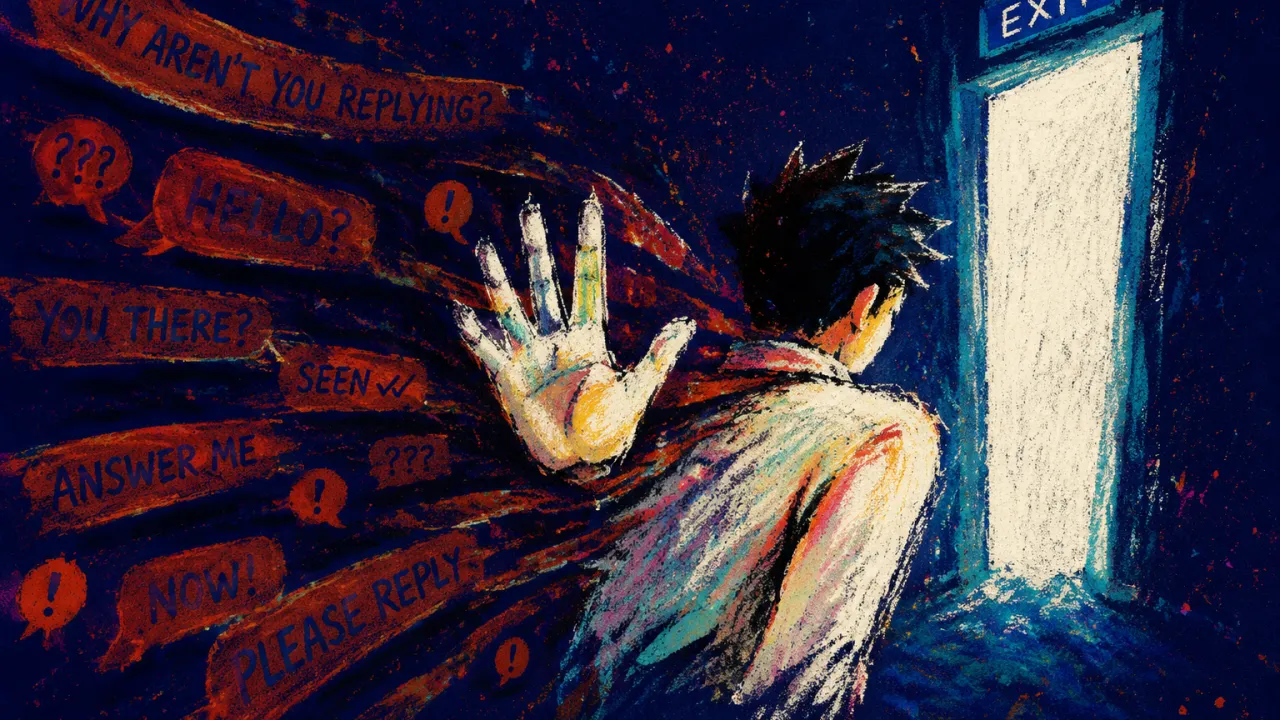
When Care Feels Conditional

A grounded look at this pressure cycle, related tarot cards, and reading insights from similar emotional boundary situations.

Emotional Blackmail Cycle

What is this situation?

Emotional Blackmail Cycle — you step into a family call, a partner conversation, or a close relationship thread thinking you are only answering one message, but the whole exchange already has a script. It may start with a simple request: come over this weekend, reply faster, explain your plans, make an exception, do not disappoint everyone. When you hesitate, the subject shifts from the boundary itself to the pain your boundary supposedly causes: after everything I have done, I guess I know where I stand, you have changed, you used to care, everyone is worried about you. The pressure does not always look dramatic; it can arrive through a long silence, a clipped reply, a tearful voice note, a sudden withdrawal of warmth, or a public display of hurt that makes you feel pulled back into managing the room. Over time, you stop responding only to what was said and start decoding timing, tone, favors, family history, and who might be told about your decision next. A normal adult choice begins to feel like a moral trial, and every attempt to create space gets routed through guilt, disappointment, or the fear of being cast as selfish. The exhausting part is not one argument; it is the loop, the way affection and access seem to reopen when you comply and narrow again when you do not, much like the figures on The Devil, linked by loose collars at the throat, close enough to move but trained to treat every act of speech or refusal as costly.

Why it's not you?

The problem is not that you are too sensitive, ungrateful, or bad at relationships. The problem is a pressure cycle where care, silence, guilt, and approval are used to pull the same response out of you again. When a boundary is repeatedly turned into evidence against you, the situation itself has become the source of the strain.

Emotional Blackmail Cycle in Tarot Cards

The Emotional Blackmail Cycle is the repeated setup where a normal boundary gets recoded as selfishness, rejection, or proof that you do not care enough. The knot in your stomach when your phone lights up is not random; it is tied to an environmental, structural dynamic that has trained ordinary contact to carry a hidden cost. The cards below do not decide who is right or wrong; they mirror the pressure system around guilt, withdrawal, obligation, and conditional warmth. Here are the Tarot Cards that tend to reflect this kind of cycle.

The Fool Reversed
The dog at the Fool's heels creates a scene of constant response around a single forward step. The environment reacts, the edge remains exposed, and the figure's movement becomes surrounded by signals that may warn, plead, accuse, or pull attention away from the ground. In family dynamics, this becomes the cycle where independence is repeatedly framed as selfishness, abandonment, or ingratitude. The card's value is in making the loop visible: the pressure is not only inside you, but in a relational system that tries to convert every step of autonomy into a debt.
The Magician Reversed
The red cloak and white robe create a polished surface of sincerity and intensity, while the closed-loop belt holds the body inside a repeating circuit. In reversal, that visual polish can become a way to make pressure look like care, sacrifice, or moral concern. Family emotional blackmail often works by changing the subject from the boundary to the pain your boundary supposedly causes. A request for space becomes proof that you do not care enough; a different life choice becomes evidence that you have forgotten where you came from. The Magician reversed links this context to managed signals and controlled exchange. You are not facing a single difficult conversation; you are facing a family loop where affection, guilt, silence, and approval are used to pull the same response out of you again.
The High Priestess Reversed
The black and white pillars make the scene look absolute, while the seated figure holds a hidden law at the center. In a family system, that combination can turn connection into a rule-bound threshold where approval is granted or withdrawn according to unspoken conditions. Emotional blackmail operates through that kind of architecture. You are pushed to read the hidden cost of each choice, not just the spoken request, and the cycle keeps pulling you back to the gate where belonging is made conditional.
The Empress Reversed
The Venus shield turns love into an emblem placed where everyone can see it. Pearls, soft cushions, floral robes, and repeated symbols of affection create a polished language of care that also defines who is allowed to set the emotional terms. When that structure turns rigid, family love can become a lever rather than a shelter. You may hear concern, gratitude, disappointment, or worry used to pull you back into a role after you say no. Emotional Blackmail Cycle is anchored in the reversed Empress because the card shows affection becoming a governing atmosphere, where softness carries pressure instead of freedom.
The Emperor Reversed
The sacred objects and royal clothing make command appear legitimate, while the thin stream behind the throne is mostly hidden from view. The scene allows authority to present itself as order while softer exchange is obstructed. That is the family cycle where guilt, sacrifice stories, silence, or approval withdrawal are framed as care. You are not only responding to words; you are moving through a structure where affection and legitimacy are made conditional on compliance.
The Hierophant Reversed
The bright robes, formal blessing, and gray temple create a polished surface around a rigid power arrangement. The followers' lowered posture shows how reverence can make compliance look voluntary from the outside. In family life, emotional blackmail often wears the language of love, gratitude, sacrifice, or respect. The pressure does not need to shout; it can frame your boundary as betrayal, your privacy as selfishness, or your independence as proof that you no longer care. The card helps separate the stated value from the controlling mechanism. You can honor connection while also seeing when loyalty language is being used to keep you kneeling in a role that costs too much.
The Lovers Reversed
The exposed bodies stand under a powerful observing figure while the serpent speaks from the side of the scene. Influence arrives from above and beside them at once, so the choice field is not neutral. The Lovers becomes a pressure chamber where affection, rule, and desire all compete for control of the decision. In family life, this structure appears when guilt or disappointment is used to make autonomy feel morally unsafe. You may be told that a normal adult boundary is selfish, that choosing differently hurts the family, or that love must be proven through compliance. The card’s value is that it makes the pressure visible. Once the emotional demand is seen as a system of influence rather than a private defect in you, the family script loses some of its ability to operate invisibly.
The Chariot Reversed
The chariot has no reins, only a command wand and symbolic emblems carrying authority across the gap. The black and white sphinxes sit before the vehicle as opposing forces that can be activated without direct contact. In a family cycle of guilt, silence, obligation, and sacrifice reminders, pressure often travels through signs rather than explicit demands. You are left decoding tone, timing, favors, and withdrawal, and the card exposes how indirect control can steer your choices while pretending no one is holding the reins.
Strength Reversed
The soft garland around the body and the hand over the lion's mouth create a restraint that looks gentle rather than coercive. The image is not a cage; it is a beautiful tether attached to a living force. That is why the card fits a family pattern where pressure arrives through care, guilt, timing, and loyalty language. You are not always pushed by open conflict; sometimes the family narrows your choices by making every limit look like betrayal. In this reversed texture, Strength shows how softness can become a control system when the exchange is unequal. The point of clarity is seeing the tether as a structure, not as proof that your boundary is cruel.
The Hermit Reversed
The lantern is the only warmth in the scene, and it is held by a figure standing apart in the cold. The image turns connection into something scarce, conditional, and easy to withdraw when the surrounding field offers no other shelter. In a family system, this matches the cycle where guilt, disappointment, silence, or selective warmth pulls the user back toward compliance. Love may not be openly removed, but access to warmth becomes tied to whether the user stays inside the expected role. The reversed Hermit reveals the mechanism without making it mystical or moral. It shows an emotional economy where belonging is made to feel conditional, and the first lever of agency is seeing that structure clearly.
Wheel of Fortune Reversed
The serpent pulls down one side of the wheel while another figure pushes upward and the top figure holds the balance point. Around them, books, letters, and formal symbols keep the whole mechanism looking orderly even when the motion is pressured. That is the structure of an emotional blackmail cycle in a family system: guilt, approval, concern, silence, and access all become levers that keep the same rotation going. The pressure rarely arrives as a single dramatic event; it returns as a familiar script that makes compliance feel like the quickest way to stop the spin. The card makes the cycle observable. You can see where the pressure enters, who benefits from the wheel continuing, and how repeated contact can become less about connection and more about restoring an old control pattern.
Justice Reversed
The scale is supposed to weigh evidence, but reversed it can become a ledger held by the person with the seat, the curtain, and the tools. The sword stays present as a threat of consequence even when no one names the threat directly. In a family system, that is the mechanics of guilt becoming leverage. Help, sacrifice, or past care is presented as proof that you owe a choice, and Justice exposes the hidden accounting so you can see where connection has been turned into debt.
The Hanged Man Reversed
The serene face under the halo does not change the mechanics of the rope. The figure can appear composed, reasonable, and even devoted, while the body remains suspended by a single point that turns every movement back into the same restraint. That is how an emotional blackmail cycle operates in family life. Guilt, disappointment, silence, and loyalty language can make compliance look like love, while the actual structure narrows your choices. The card exposes the difference between a meaningful family bond and a tether that only works when you stay available on demand.
Death Reversed
The white rose sewn onto a black standard places a soft symbol on top of a forceful advance. Around it, bodies lower themselves, turn away, pray, or fall flat, as though the language of purity and duty is moving through a scene that gives them little room to answer freely. That is the structure of emotional blackmail in a family field: pressure arrives dressed as care, tradition, sacrifice, or moral concern. You are asked to respond to the symbol on the flag while your body is dealing with the pressure underneath it. The card helps separate the stated value from the control channel. Once the leverage is visible, you can audit whether the interaction is mutual care or a demand that uses care as its cover.
Temperance Reversed
The no-spill precision of Temperance can become a pressure system when harmony is demanded instead of built. The figure’s threshold position leaves the body exposed between two zones, holding balance under visible standards of correctness. In family dynamics, that becomes emotional blackmail when guilt, withdrawal, or accusations are used to restore the old arrangement. The family asks for peace, but the price of that peace is your compliance with a role that keeps the system comfortable. The card exposes the cycle as a structure, not a private failure. Once the pressure mechanism is visible, the difference between connection and coercive harmony becomes easier to name.
The Devil Upright
The collars around the two figures are loose, yet both chains run into the same metal ring on the black cube. The bondage works because the link is placed at the throat, the point of speech, refusal, and self-definition. That is the family logic of emotional blackmail: contact remains possible, but every attempt to speak plainly is routed through guilt, disappointment, or withdrawal. The card reveals how the pressure lives less in one dramatic event than in a repeated loop that makes your autonomy feel costly before you even act.
Reversed
The collars sit at the neck, loose enough to suggest movement but visible enough to mark control. Above them, the raised hand turns the arrangement into a rule: the bond remains intact as long as the smaller figures accept the terms set from above. In friendship, that becomes guilt-based leverage, where care is used to make boundaries feel like betrayal. You may technically have room to step back, but the relational structure has trained every attempt at distance to trigger punishment, withdrawal, or moral pressure.
The Star Reversed
The kneeling figure pours from both vessels while her own body remains exposed in the open. When this image is strained, the beautiful flow becomes a demand pattern: supply keeps leaving the person at the center, and the scene offers no visible mechanism for checking whether she can keep giving. In family life, that structure can appear as closeness with conditions attached. Love, gratitude, sacrifice, or past help becomes the language used to keep the stream moving toward everyone else's need, even when your own limits have already been reached. The Star's visual softness is what makes this context sharp. It shows how pressure can arrive dressed as care, concern, or family unity, and how regaining agency begins with naming the point where emotional flow has become leverage.
The Moon Reversed
The moon sends down droplets that resemble nourishment, yet the movement is one-way: pressure descends from above while the animals answer upward with alarm. The path is not simply open; it is watched at the threshold before it can reach the towers. That visual field matches a family system where care, sacrifice, worry, or disappointment becomes leverage. You may be told that your choice hurts the family, that independence proves ingratitude, or that peace depends on you staying emotionally available in the exact way the household demands. The card gives this cycle a visible structure. What appears as love may also be operating as a control mechanism, and naming that mechanism is what restores agency: the pressure can be mapped, the trigger points can be seen, and the path no longer has to be mistaken for betrayal.
The Sun Reversed
The red flag rises in the child's hand while the sunflowers and wreath repeat the same bright signal around the scene. Affection, celebration, approval, and visibility all move through one shared symbolic channel. In family life, that channel can become pressure when warmth is tied to compliance. A parent or relative may frame guilt, disappointment, concern, or gratitude as love, making it difficult to tell where care ends and emotional leverage begins. The card names the mechanism without turning it into a moral verdict. You are looking at a structure where love is not absent, but its delivery system pulls you back toward the role the family prefers.
Judgement Reversed
The trumpet sounds from above while the exposed figures below lift their arms before they have fully left their coffins. The call reaches them as a command first, not as a conversation. That one-way pressure is the outer shape of Emotional Blackmail Cycle in a family system. A parent, relative, or wider family group may frame contact as loyalty, gratitude, sacrifice, or emergency, while the actual structure leaves you with only two visible roles: answer the summons or be treated as the problem. In the reversed field, the red cross flag becomes less like repair and more like obligation with a moral costume. The card helps name the mechanism clearly: guilt is being used as a signal system, and your agency begins with seeing the difference between care and coercive demand.
The World Reversed
The red knots bind the top and bottom of the wreath into a loop, and the dancer's movement stays inside that loop. In a family context, this visual structure mirrors contact that keeps returning through guilt, favors, approval, and obligation rather than moving into clean exchange. You are not looking at a one-off argument. The card identifies a recurring circuit where care is offered, pressure is attached, and refusal is treated as evidence against you. Seeing the loop is the first act of separating relationship from leverage.
Ace of Cups Reversed
The cup receives an incoming charge and immediately overflows into streams and droplets, with no protected room around the vessel. The scene becomes a pressure system where emotion moves faster than containment. In a family system, that can mirror guilt, distress, or obligation being poured into you until refusal feels like breaking the entire flow. The card gives the pattern a shape: the issue is not that you lack care, but that care has been wired to compliance.
Two of Cups Reversed
Held cups suspended between two people create a ritual of proof. The exchange is visible, ceremonial, and easy to measure, which gives affection a scoreboard quality when the family system demands the correct response. This matches a cycle where care, silence, guilt, or disappointment becomes the tool that pressures you back into compliance. The card maps the mechanism without making it a character flaw: connection is being managed through emotional terms instead of direct agreement.
Three of Cups Reversed
Cups lifted over a harvest field place approval and resources in the same visual system. The celebration is filled with signs of abundance, but those signs can become leverage when recognition depends on showing up in the approved posture. Within family life, that structure maps onto support that arrives with an emotional invoice attached. You may receive money, attention, invitations, or help that seems generous on the surface, while the hidden exchange requires guilt, availability, silence, or compliance in return.
Five of Cups Reversed
The black cloak folds the figure into a narrow, downward-facing posture over the spilled cups. In a family system, that image maps onto a communication field where loss, sacrifice, or disappointment becomes the central object everyone is forced to orbit. The bridge and remaining cups are present, but the body does not move toward them. That is the outer structure of emotional blackmail: the family keeps the scene fixed at the point of injury so guilt can replace negotiation, and the route toward a cleaner agreement stays unused. The card does not frame You as responsible for repairing every spill on the ground. It exposes the mechanism by which visible hurt can be used as leverage, so the first layer of agency is seeing when a family conversation is asking for accountability and when it is demanding compliance.
Six of Cups Reversed
The offered cup is beautiful, but it is still an object moving within a guarded household perimeter. In reversal, the sweetness of the exchange can harden into a rule: receive the care, remember the care, and remain positioned where the household expects you to stand. For you, Emotional Blackmail Cycle shows up when family affection is repeatedly paired with guilt, withdrawal, or pressure to comply. The Six of Cups exposes the mechanism without reducing it to anyone's private mood: care becomes a lever when the family system controls the meaning of the gift.
Seven of Cups Reversed
Seven of Cups places rewards and threats in the same misted field. Home, wealth, victory, identity, danger, and desire all appear together, and none of them is grounded enough to be tested. The figure is surrounded by options, but the atmosphere makes each option feel loaded with consequence. In a family system, that becomes emotional blackmail when care and threat start arriving through the same channel. Approval may be offered, then withdrawn; help may be promised, then tied to guilt; independence may be framed as betrayal. The pressure works because every choice seems to carry the risk of losing love, access, or belonging. The card does not ask you to dismiss the family bond. It shows the mechanism that turns bond into leverage. Once the mechanism is visible, the emotional charge can be separated from the actual decision in front of you.
Eight of Cups Reversed
The cups remain behind like a visible record of what once existed, while the figure has to cross water without carrying any of them. In the reversed texture of this image, that record can harden into a ledger: what was given, what is owed, and who is accused of abandoning the arrangement. Family emotional blackmail often works at exactly this threshold. The moment you step toward distance, the old structure points back to the cups and reframes your movement as cruelty, selfishness, or betrayal. The card exposes the cycle by showing how the crossing gets interrupted. You are not just navigating a disagreement; you are facing a system that applies guilt at the precise place where adult autonomy begins to move.
Nine of Cups Reversed
The man sits between the viewer and the cups, arms crossed as if access must pass through his approval. The abundance behind him becomes less like a shared table and more like a controlled inventory. In a family system, that layout mirrors care that circulates only when you return to the expected role, agree with the story, or absorb the guilt. The structure is not loud; it works through withholding, reminders, and the quiet conversion of love into leverage. You can see the mechanism once the cups are separated from the gatekeeper. The card gives you a map of where support ends and emotional leverage begins.
Ten of Cups Reversed
The family stands under one shared arc of cups, with the adults' embrace and raised arms organizing the emotional field. Reversed, that canopy can become a demand for synchronized feeling: be happy with us, agree with us, stay close to us, or risk losing warmth. This is where affection becomes a bargaining tool. You may receive love, help, access, or approval only when You protect the family story, answer quickly, attend the gathering, accept the comparison, or avoid naming the issue directly. The card makes the mechanism visible without reducing anyone to a villain. It shows a closed emotional economy where belonging is offered, withdrawn, and restored through compliance, giving You a clearer view of the exchange before You decide how much access to grant.
Page of Cups Reversed
The Page's duty is organized around a fragile cup, and the fish inside makes that object feel alive, responsive, and easy to disturb. Behind him, the water rises close to the platform, so the emotional field is never far from spilling into the role he is performing. This is the structure of family pressure that uses feeling as leverage. A request for space can become a wound you are accused of causing; a normal adult choice can be framed as abandonment, disrespect, or proof that you do not care. You may be facing a cycle where connection is made conditional on emotional compliance. The card makes the mechanism visible: the family cup is treated as something you must protect at all costs, even when that cost is your autonomy.
Knight of Cups Reversed
The single cup becomes the focal object of the whole journey, slowing the horse and organizing the crossing around whether the vessel stays upright. In a reversed frame, the emotional token starts to control movement instead of simply carrying feeling. That is how an emotional blackmail cycle operates in a family setting. Warmth, disappointment, sacrifice, silence, or apology can be used as the cup everyone must respond to, while the practical boundary issue waits untouched at the riverbank. The card’s value is in showing the mechanism without turning it into moral theater. You can see the exchange pattern as a structure, where the family’s emotional signal keeps redirecting attention away from the actual terms of contact.
Queen of Cups Reversed
The chalice is presented like something sacred: closed, decorated, and held with both hands in a private space. Its delicacy gives the whole scene a rule before anyone speaks: handle this carefully, or you become the one who caused harm. In a family system, that visual pressure becomes emotional leverage. Love, sacrifice, hurt, or fragility may be placed in the center of the room so that any boundary you set can be recoded as cruelty, selfishness, or abandonment. The card's structure helps separate care from control. It shows how the emotional object can be made untouchable, and how your agency begins with naming the rule that says you must protect everyone else's feelings at the cost of your own boundaries.
King of Cups Reversed
The scepter is shaped like a cup, turning the symbol of care into an object of command. In the reversed structure, the same hand that appears to hold emotional wisdom can also define what counts as loyalty, gratitude, or betrayal. This maps directly onto family guilt systems where concern is not offered freely; it arrives with a pressure point attached. You may hear language about sacrifice, worry, or love, but the practical effect is compliance, silence, or the surrender of a boundary. Emotional Blackmail Cycle fits because the card's authority is emotional rather than openly forceful. The pressure works by making refusal look like cruelty, and the structure becomes visible when care starts functioning as leverage.
Two of Pentacles Reversed
The infinity-shaped cord is the dominant structure of the card: two material points tied into a cycle that keeps returning through the figure's hands. Reversed, that cycle becomes coercive because the movement no longer creates balance; it keeps the person trapped in repeat response. In family communication, emotional blackmail works through the same closed circuit. A boundary triggers guilt, guilt demands reassurance, reassurance reopens access, and the original boundary is quietly pushed back into circulation. The waves behind the figure show why the pattern feels larger than one conversation. The external conditions keep shifting, but the family script pulls you into the same exchange again, making the task less about proving love and more about seeing the loop clearly enough to step out of its automatic rhythm.
Seven of Pentacles Reversed
The counted fruit and the unsmiling pause give the garden the feeling of an audit. The scene is not chaotic; it is orderly, measurable, and therefore easy to turn into a record of who worked, who benefited, and who supposedly owes the next round of tending. Emotional Blackmail Cycle appears when family members use that record as leverage. The card shows how sacrifice can be converted into pressure: every boundary is answered with a reminder of what was planted for you, and every independent choice is pulled back into the demand to prove that the family's investment was worth it.
Ace of Swords Reversed
The crown is decorated with olive and palm, but both symbols hang from the same point that pierces and judges. When the image hardens, peace and goodness become display objects attached to a sharp demand. That is the family mechanism behind guilt trips, gratitude scripts, and loyalty tests. You are being asked to notice when moral language is being used to make access to your time, body, choices, or attention feel non-negotiable.
Two of Swords Reversed
The swords cross over the heart, turning care, loyalty, and protection into a locked defensive shape. The figure cannot move toward one side without disturbing the balance of the other. An emotional blackmail cycle in a family system uses that same no-win geometry. Love, gratitude, sacrifice, or loyalty becomes tied to compliance, so a personal boundary is treated as betrayal and a simple refusal becomes loaded with moral pressure. The card exposes the mechanism without making it a character flaw. It shows how a family demand can become sharpest when it is dressed as care, and how clarity begins by separating genuine connection from the pressure attached to it.
Three of Swords Reversed
Three swords meeting inside one exposed red heart gives family pressure a precise physical shape: several outside forces aim at the same vulnerable center. The image does not show a private body around the heart, so the emotional organ is treated like public territory, open to contact, judgment, and repeated impact. In a family system, that visual structure maps onto guilt, loyalty, disappointment, and obligation arriving from different directions while demanding the same response from you. The wound is not random; it is organized around the place where connection is supposed to live. Emotional Blackmail Cycle names the moment when affection becomes a pressure mechanism. The card frames the problem as a structure you can inspect rather than a personal defect: who is holding the blade, what message is being used as leverage, and which part of your autonomy keeps being targeted.
Five of Swords Upright
The sword hilts pressed against the chest turn conflict into something held close to the body, while the figures in the distance carry the cost without being able to answer back. The scene is not simple anger; it is a controlled aftermath where pain, leverage, and retreat are arranged into a social script. In a family system, that script can look like guilt being used as proof, hurt being used as currency, and silence being used to make you return to the old role. You may be trying to solve a conversation, but the card points to a cycle where the emotional cost is deliberately kept visible so compliance feels like the only way to end the scene.
Six of Swords Reversed
The six swords travel with the boat as heavy, orderly baggage. They are not chaotic, but their weight changes the crossing; the vessel sits lower because the old material has been loaded into the passage. Emotional Blackmail Cycle forms when family sacrifice stories, guilt, loyalty tests, and debt language are carried into every attempt at separation. You may be trying to move toward a calmer arrangement while the family keeps adding moral weight to the boat. The card makes that weight visible so it can be examined as a structure rather than accepted as the price of belonging.
Seven of Swords Reversed
The armed camp, planted swords, and furtive movement create a world where every step is measured against possible retaliation. The figure moves quietly because the space behind him is organized around control, defense, and watchfulness. An emotional blackmail cycle in a family system turns affection, peace, or belonging into leverage. You may be told that independence is selfish, that privacy is betrayal, or that saying no makes you responsible for someone else’s reaction. Seven of Swords reveals why direct honesty can feel unsafe in that structure. The card does not make guilt the center; it shows the family pressure system that converts ordinary autonomy into a charged offense.
Eight of Swords Reversed
The red robe remains vivid under white restraints, and the swords stand close enough to dictate movement without drawing blood. The danger is organized through implication: the body learns the perimeter before any blade has to move. That is the family logic of guilt, disappointment, sacrifice talk, or withdrawal when you step outside the expected role. You are not facing one isolated argument; you are facing a repeatable pressure system that makes self-protection look like betrayal.
Nine of Swords Reversed
Nine swords run across the black room at head, throat, and heart height, turning a private bed into a place where old words keep landing after the conversation has ended. The quilt tries to cover the body, but the carved scene on the bed remains exposed, showing a power exchange that has been built into the furniture rather than resolved. In a family system, that visual pressure maps onto obligation framed as love, help tied to guilt, and contact that leaves you processing accusations long after you leave the room. You are not looking at a single bad mood; the card names a repeatable communication structure where emotional debt is used to keep access to your choices.
Ten of Swords Reversed
The swords belong to the suit of words, thoughts, and communication, and here they have become a repeated vertical pressure along the body. Their order is what makes the image so severe: the harm looks systematized, as if the same line has been targeted again and again. Emotional Blackmail Cycle fits when family communication turns love, loyalty, sacrifice, or gratitude into instruments of control. You are not only hearing difficult comments; you are being placed inside a rule system where every step toward autonomy is translated back into betrayal. The distant light on the horizon shows why the cycle can be so hard to name. A possible exit is visible, but the communication channel between that exit and the family system is blocked by guilt-coded pressure.
Page of Swords Reversed
The Page's exposed stance shows a person whose safety depends on constant positioning. There is no sheltered room in the image, only a high, windy place where every attempt to hold ground requires the sword to serve as boundary, language, and defense at the same time. Emotional blackmail in a family system often makes independence feel like standing on that ridge. Warmth, approval, or contact may be offered and withdrawn around compliance, leaving You to calculate how much honesty the system will punish. The card reveals the structure behind the guilt pressure: affection is being used as a gate, and clarity begins when that gate is seen as a mechanism rather than a moral verdict.
King of Swords Reversed
Blue robes cover the King's body in rational authority, but red fabric remains visible underneath, making warmth present yet tightly controlled. The sword stands between feeling and expression, turning contact into something filtered through principle, verdict, and obligation. An emotional blackmail cycle often sounds reasonable on the surface: concern, sacrifice, family values, disappointment. Underneath, support is made conditional on compliance, and guilt becomes the hidden currency. The card frames this as a communication structure, not a private defect in you, so the leverage can be named instead of absorbed.
Ace of Wands Reversed
The picture looks like an offering, but the wand never leaves the hand. Leaves fall from the living branch while the source of power stays controlled, creating an exchange where growth is displayed but ownership remains unclear. In a family system, this becomes care that arrives with pressure attached. You may be offered closeness, money, help, or praise, then made to pay for it through compliance, guilt, or the threat of withdrawal.
Two of Wands Reversed
The fastened wand is the key visual pressure point: it looks like support, but it is attached to the wall. The figure can hold the globe and imagine wider movement, yet the family structure still has a point of attachment it can pull on. That is how emotional blackmail operates in a family setting. Independence is not met only with disagreement; it is met with guilt, withdrawal, obligation language, or reminders of what has been given. The reversed Two of Wands helps separate care from leverage. When affection becomes a tool for keeping you at the wall, the task is to name the mechanism clearly enough that your choices are no longer organized around avoiding someone else’s reaction.
Three of Wands Reversed
The figure's posture stays composed while the ships remain at a distance. What could be a simple exchange becomes a watched interval, where access, timing, and response are all loaded with meaning. In a family system, that configuration becomes an emotional blackmail cycle when warmth, approval, help, or belonging are made conditional on compliance. The pressure often arrives in polished language: concern, sacrifice, disappointment, or reminders of what has been done for you. The card's value is that it makes the exchange visible. You can begin to separate care from control, and notice where the family system turns your need for connection into a lever for keeping you in position.
Seven of Wands Reversed
The six wands press upward without revealing the people behind them, while the lone figure has to answer the pressure with his whole body. The exchange is not balanced; one side sends force, and the other side is trapped in response. Emotional blackmail in a family often works through that hidden asymmetry. Guilt, implied disappointment, and loyalty tests can make every boundary feel like a trial, but the card makes the pressure mechanism visible enough for You to stop treating it as a private defect.
Eight of Wands Reversed
The eight wands do not wander; they advance as a unified pressure line across the open sky. Nothing in the image shelters the landing area, and nothing interrupts the force once it has been set in motion. That visual structure fits a family cycle where urgency, guilt, and affection are bundled into messages that feel impossible to separate. The pressure does not need to shout; it works by aligning the whole channel around the idea that your autonomy is a disruption. You are being shown the mechanics of impact, not a moral verdict on the relationship. The card helps locate the cycle in the communication structure itself, where love, obligation, and timing are fused so tightly that choosing your own pace starts to look like betrayal.
Nine of Wands Reversed
The wand in the figure's hands is both support and shield, held close to the chest while his eyes scan for the next approach. Behind him, the row of wands forms a boundary, but its uneven line and visible gap make the defense feel active, not resolved. In a family context, that visual pressure becomes a cycle of guilt, obligation, withdrawal, comparison, and conditional warmth. The issue is not one difficult conversation; it is a repeating pattern where contact trains you to brace before the demand even arrives. Emotional Blackmail Cycle belongs here because the card shows how protection becomes exhausting when the same boundary has to be defended again and again. You are not simply reacting to words; you are responding to a system that has learned how to push on loyalty until the line weakens.
Ten of Wands Reversed
The dense wands stand like a screen in front of the man, directing his body toward the house while blocking his view. The destination is visible, but it functions less like shelter than a point of demand that must be satisfied before relief is possible. Emotional Blackmail Cycle fits this card when family closeness is organized through guilt, obligation, or withdrawal of approval. The pressure is not only the task itself; it is the implied message that love, peace, or belonging depends on you continuing to carry what was handed to you.
Knight of Wands Reversed
The reins keep the red horse responsive, but they also show how force can be redirected through a single point of control. The knight remains exposed in open terrain, so control is not only about movement; it is also about keeping protection available while pressure stays active. Emotional Blackmail Cycle works through that kind of leverage. Guilt, disappointment, withdrawal, family reputation, or obligation language can be used to steer choices without stating a direct command. The relationship remains emotionally charged, but access to warmth or peace becomes conditional on compliance. The reversed Knight of Wands connects to this context because the energy is not absent; it is captured. The card helps name the external loop where your choices are repeatedly pulled back through someone else's emotional pressure point.
King of Wands Reversed
The robe spreads like a field of heat, and the symbols of fire repeat from crown to throne to the small lizard at the step. In reversal, that charged environment can become a closed circuit where intensity keeps returning to the same authority point. This maps onto family guilt loops where every boundary is pulled back into sacrifice, gratitude, or loyalty language. The card names the mechanism without making it mystical: you are facing a social exchange system that converts care into leverage and then calls that leverage love.

Emotional Blackmail Cycle in Tarot Card Reading Insights

When the Emotional Blackmail Cycle turns boundaries into guilt, people often bring that pressure into readings because the pattern is hard to sort through alone. The shift from cards to readings shows how this situation appears when someone is trying to separate care from leverage. Tarot Reading Insights from sessions involving this kind of emotional pressure.

Psychological contexts related to Emotional Blackmail Cycle