A Three-Line Agenda Moves Anger Out of Slack and Into the One-to-One

The 9:47 p.m. Promotion Spiral
If you are a late-twenties tech worker in Toronto who can explain the entire promotion process except for what you actually need, promotion anxiety may look like deleting the one direct question you rehearsed before your one-to-one. Maya, a 29-year-old product operations specialist, brought that exact pattern into our video call.
At 9:47 p.m., I could see a promotion-criteria draft glowing beside a spreadsheet that compared her projects with her colleague’s. Her laptop fan whirred; a streetcar bell cut through the closed window; the coffee by her wrist had gone cold. I watched her shoulders creep toward her ears as she changed the opening line for the fourth time, closed the draft, and returned to polishing a presentation nobody had asked her to revise.
“I’m not angry enough to make a scene,” she said, pressing her tongue against the inside of her cheek, “but I’m too angry to act normal. I want the title and the salary. I also want my work to count. But if I say any of that, I’m scared they’ll decide I’m jealous, difficult, or not leadership material.”
There it was: wanting recognition through promotion while fearing the professional consequences of voicing anger. The pressure looked less like an explosion than a sealed bottle gripped beneath her ribs, shaken by every Slack reaction and held shut by her jaw. The force still had to go somewhere, so it travelled sideways: into extra work, private scorekeeping, and a one-word “Done.” sent to the colleague who had received the praise.
“I’m not going to tell you to just speak up,” I said. “Workplace power is real, and careful communication can still carry risk. I want to help you distinguish what happened, what it touched in you, and what belongs in a conversation with the person who can actually clarify the promotion process. Let’s draw a map of the fog before we choose a route through it.”
Choosing a Map for the Anger Between Desks
I invited Maya to place both feet on the floor, take one unforced breath, and hold a single question in mind: “Why does my promotion rival receive the anger I never voice?” I shuffled slowly while she did that. I use this kind of pause as a transition from rehearsing a problem to observing it, not as a test of belief or a mystical performance.
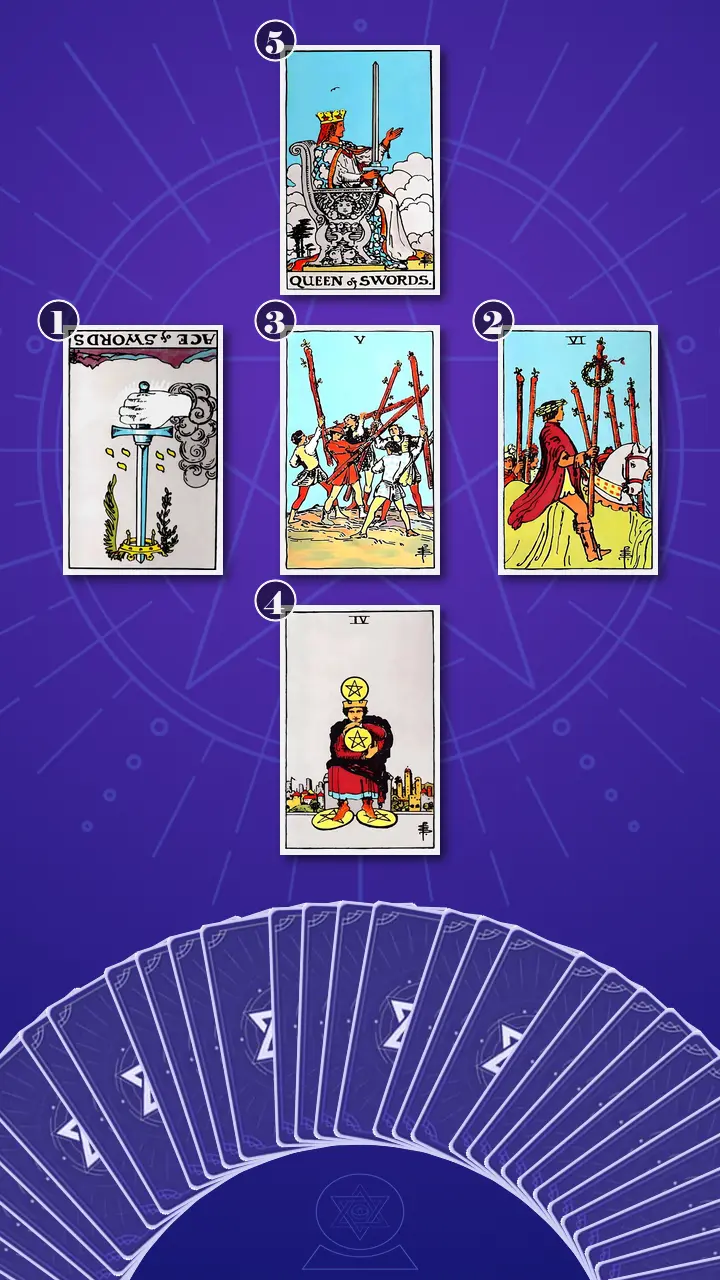
I chose the Relationship Spread · Context Edition, a five-card relationship tarot spread adapted for workplace rivalry and self-advocacy. For anyone wondering how tarot works in a situation like this, I do not use the cards to read a coworker’s private thoughts or predict who will win a promotion. I use card meanings in context to separate visible behaviour, projection, environmental pressure, hidden stakes, and available choices.
This spread was the smallest map that could hold Maya’s whole problem without turning her colleague into a villain. The first position would show how Maya was contributing through withheld speech. The second would show what the rival symbolised in Maya’s experience, not what that person secretly intended. The centre would reveal the active competitive pattern; the card below it would uncover what Maya was protecting; and the card above it would offer the healthiest available direction. Visually, it resembled an office conversation being lifted from beneath the table into clear view.
Where the Meeting Microphone Stayed Muted
Position 1: The Question That Never Left Notes
I turned first to the position representing Maya’s current stance and the behaviour through which she withheld anger, deleted direct requests, and added indirect tension to the rivalry. The card was the Ace of Swords, reversed.
The image showed a hand already gripping the sword, but the reversal obstructed its clear upward function. Maya did not lack language. She had left a one-to-one after hearing “keep increasing your visibility” while the precise question in her Notes app remained unasked: “What specific evidence would demonstrate readiness for promotion?” That evening, she edited a message about recognition four times, searched every line for traces of jealousy, deleted it, and sent her colleague a terse reply instead.
I described the reversed Ace as blocked Air: clarity overcontrolled until it could no longer perform its job. Her inner script was sharp and detailed: “I know exactly what I want to ask, but if I say it plainly, they might decide I’m hard to manage.” What reached her manager was a vague reassurance. What reached her colleague was the edge of the unsent sentence.
“Silence can protect your image and still cost you clarity,” I said. “What exact promotion question did you realise you had avoided only after the meeting ended?”
Maya gave one short laugh, but there was no amusement in it. Her jaw tightened, her thumb rubbed the cold mug, and her eyes moved back to the abandoned draft. “That is so accurate it feels a little cruel.”
I did not push past the sting. “Then we slow down,” I said. “This card is not blaming you for protecting yourself. It is showing the cost of a protection that once made sense. You get to decide whether a smaller, bounded form of directness is safer and more useful now.”
Position 2: The Wreath in the Slack Channel
I turned the card representing what the promotion rival symbolised in Maya’s perception, especially public recognition and feared displacement. I reminded her that this position gave me no ethical basis for assigning motives to her colleague. The card was the Six of Wands, upright.
The laurel-crowned rider was elevated before a crowd. In Maya’s office, that crowd appeared as a cross-functional meeting in which her colleague was praised for “strategic ownership” while applause reactions accumulated in Slack. Maya experienced the visible moment as the entire promotion scorecard. Before the meeting ended, she was mentally listing the incidents she had resolved, the stakeholders she had supported, and the work nobody had mentioned.
Upright, the Six can carry the balanced energy of recognition that is witnessed and shared. The imbalance entered through the amount of meaning Maya’s mind had to place on one public moment. The praise was a verified event; “Everyone just saw who matters here, and it wasn’t me” was an interpretation formed in the absence of clearer criteria.
As I looked at the wreath, I remembered how public recognition changes costume across cultures: a title, a public thank-you, a seat near the decision-makers, a name repeated in the right room. The costume can be meaningful, but it is never the complete record of a person’s value. “A public win is a data point, not the whole scorecard,” I told her.
Maya’s lips pressed together before loosening. She looked away from the card, inhaled through her nose, and said, “I know that logically. My body acts like the decision has already been announced.”
“Then the card is helping us separate two timelines,” I said. “There is the praise that happened in public, and there is the promotion decision process you still do not fully understand. They may be connected, but they are not identical.”
Position 3: The Live Scoreboard With No Published Rules
I turned the central card, representing how unspoken anger, comparison, and competition combined into the active workplace dynamic between Maya and her colleague. The card was the Five of Wands, upright.
Five figures raised their staffs in different directions, each moving on the same uneven ground without a shared target or coordinated plan. I connected that image to an overlapping launch where Maya and her colleague both tried to demonstrate ownership while responsibilities remained blurry and the promotion language stayed broad. Maya tracked speaking time, manager reactions, whose summary was forwarded, and whose contribution received the final public thank-you.
“If they mention one more project, I need to mention two,” she admitted.
I read the Five as Fire in excess. Ambition itself was not the problem; the fire became exhausting because nobody had published a reliable scoring method. Ordinary professional competition had turned into a live dashboard running in Maya’s head long after each meeting ended. Like keeping twenty browser tabs open to compare praise, ownership, and response times, the monitoring consumed more attention while making the original question harder to find.
“Neither of you has to be the sole villain for this to feel combative,” I said. “Vague rules can make two capable people behave as if every contribution is a scarce point. But your colleague cannot resolve criteria your manager has not explained.”
Then I named the displacement plainly: “Your rival is receiving the anger addressed to a conversation that never happened.”
Maya’s breath left her in a long stream. Her shoulders did not fully drop, but they moved a fraction away from her ears. “I keep blaming my colleague for a conversation I haven’t had with my manager,” she said. The admission carried relief and a small, bitter grief at once.
Position 4: What the Title Was Being Asked to Prove
I turned the card beneath the conflict, representing the hidden fear that losing recognition or voicing anger could threaten Maya’s security, professional control, and sense of worth. The card was the Four of Pentacles, upright.
The figure pressed one pentacle to the chest and pinned two beneath the feet. I asked Maya about the tabs beside her promotion spreadsheet. She turned her laptop slightly and showed me a Toronto rent-renewal email, a salary calculator, and the company’s promotion framework. One title had been assigned three jobs: create financial breathing room, certify professional legitimacy, and prove she was not replaceable. Under that pressure, every sign of her colleague’s progress felt like all three forms of safety moving farther away.
I read this as Earth contracted into excess control. Maya responded to uncertainty by documenting more, revising more, and monitoring more. The grip gave her a short-lived sense of protection, but it kept both anger and vulnerability locked against her chest. I also pointed out the absence of Cups in the spread: she had analysed the conflict thoroughly, yet had given herself almost no room to say, “I’m hurt that my work feels unseen.”
Her hand stopped against the mug. Her gaze lost focus as if the rent email, the salary calculator, and the performance document had opened again behind her eyes. Then her fingers released the ceramic, one at a time.
“I don’t only want the title,” she said quietly. “I need it to prove I’m secure, credible, and worth keeping.”
I drew two headings on a sheet: What the promotion would give me and What I am asking it to prove about me. Under the first, Maya named salary, scope, and progression. Under the second, she named competence, legitimacy, and the hope of no longer feeling replaceable.
“Both stakes are real,” I said. “They are simply not the same stake. The title can change your pay; it cannot certify your worth.”
The Four was the main blockage, but it also became the catalyst. Once Maya could see the difference between material security and worth certification, her posture loosened. The promotion still mattered. It just no longer had to function as multi-factor authentication for her entire identity.
When the Queen Raised the Meeting Microphone
Position 5: The One-to-One Above the Contest
Before I turned the final card, a streetcar bell rang again through Maya’s laptop speakers. Its clean note seemed to divide the room’s quiet into before and after. I turned the position representing the shift from indirect comparison to fact-based self-advocacy, clear promotion questions, and professional boundaries. The card was the Queen of Swords, upright.
The Queen held one sword vertically while extending her other hand toward open air. I saw the blade as discernment and the open hand as direct exchange. The modern scene was not a dramatic confrontation. It was Maya entering a scheduled one-to-one with a three-line agenda: a documented recognition or criteria gap, the impact of not understanding how evidence was weighted, and one specific request. Instead of making her colleague the defendant, she would ask, “What evidence would demonstrate readiness for the next level, and where do you currently see a gap?”
This was Air in balance: neither deficient speech nor an excessive blade. The Queen did not ask Maya to unload every feeling at work. She modelled language that was exact without becoming punitive and boundaries that did not require emotional invisibility. Professionalism, in this image, was precise and proportionate speech.
I brought in a diagnostic lens I call Imposter Syndrome Auditing. I drew a line down the page. On one side, Maya listed objective evidence: the launch risks she had resolved, the cross-functional process she had built, and the measurable delay she had prevented. On the other, she listed fears of exposure: “If I have to ask, they’ll realise I’m not really ready,” and “If I sound dissatisfied, I’ll prove I can’t lead.”
The Queen’s sword became the audit line. The left side contained verifiable professional competence; the right contained predictions about judgment. Both affected Maya, but they were different kinds of information. Her fear deserved care, not automatic authority. I also recognised the leadership friction I call Authority Archetype Integration: Maya had been waiting for authority to arrive as a wreath placed on her by the crowd. The Queen invited her to practise authority as a function she could already perform: examine evidence, state her position, ask for a standard, and tolerate an answer she could not control.
I asked her to return to 9:47 p.m. in her mind: the promotion message open beside the contribution spreadsheet, the first line softened again, and her shoulders carrying anger her manager had never heard while she revised work nobody had requested.
Silence is not professionalism; precise and fair speech is, so raise the Queen of Swords' blade to separate facts, needs, and assumptions.
I let the sentence remain between us before translating it into the immediate workplace truth.
Your rival cannot answer a request you have only rehearsed. Anger becomes useful when it reaches the person, process, and question it is actually about.
Her breath stopped first. Her fingers hovered above the keyboard, perfectly still, and her pupils widened as if she had encountered a line from her own private notes. Then her gaze slipped away from the screen. I could almost see the last team meeting replaying behind it: Slack applause, her fixed smile, the sharp “Done.” sent hours later. Her shoulders finally lowered, but relief was not the first emotion through the door.
“But doesn’t that mean I’ve handled all of this wrong?” she asked. Her voice rose at the end. “Like I made my colleague the problem when I was the problem?”
“No,” I said. “It means a protection strategy worked in the short term and cost you something in the long term. You kept your composed image in an environment where judgment matters. That was understandable. Now you can choose whether the same strategy still serves you. Responsibility is not the same as blame.”
Her fist opened against the table. A fuller breath reached her chest, followed by a small, unsteady exhale. “So I actually have to ask,” she said, sounding relieved and exposed at once.
“Only in a form and at a time you judge appropriate,” I replied. “Tarot cannot guarantee a fair answer or a promotion. It can help you stop outsourcing the unanswered question to the nearest competitor. Now, using this new perspective, think back to last week. Was there one moment when this distinction might have changed how you felt?”
“The one-to-one,” she said after a pause. “I could have asked about the evidence instead of asking for another project.”
I recognised the threshold in that answer. Maya had not jumped from resentment to certainty. She had moved one step from compressed promotion resentment, workplace envy, and silent comparison toward grounded assertiveness, clearer promotion criteria, and self-respect that could survive an uncertain outcome. The new clarity also brought responsibility: once she knew where the question belonged, she could no longer pretend that monitoring her rival was the only available action.
The Three-Line Agenda That Replaced the Scoreboard
I traced the spread as one continuous office-conversation diagram. The reversed Ace was a meeting microphone that worked but remained muted. The Six of Wands was the public spotlight fixed on someone else. The Five of Wands was the crowded meeting where ownership became a contest because the rules stayed vague. The Four of Pentacles was the fear held beneath the table: money, status, and worth compressed into one title. The Queen of Swords lifted the real issue into the one-to-one where a person with decision-making responsibility could answer it.
The cognitive blind spot was not simply that Maya underestimated herself. It was that she treated comparison as research and silence as professionalism. Monitoring her colleague felt like preparation, but it could never produce the criteria only her manager could clarify. The transformation direction was specific: stop asking the rival’s visibility to explain Maya’s worth, and bring one verified fact, one feeling or observable impact, and one promotion-related request into a scheduled conversation.
“That sounds clean on the table,” Maya said, “but managers aren’t always neutral. What if asking makes me look difficult anyway?”
“That risk cannot be wished away,” I said. “Direct speech does not require unlimited disclosure, and it does not require you to attack or mention your colleague’s motives. You can ask one neutral process question, request a written follow-up, pause if the exchange becomes unproductive, and document the answer. The Queen offers a boundary, not a promise.”
I kept the actionable advice small enough to test. These were Maya’s next steps, not a verdict delivered by the cards:
- The Seven-Minute Fact-Impact-Request Note Before the next one-to-one, open a private document and set a seven-minute timer. Write exactly three lines: “The fact I can verify is…,” “The feeling or observable impact I have been managing is…,” and “The promotion question I want answered is….” Reduce the final request to one sentence. Keep guesses about your colleague’s motives outside the note. If naming a feeling feels too exposed, describe only the observable impact. Stop if the exercise becomes more activating than useful.
- The Queen of Swords One-to-One Add “Promotion criteria and evidence” to the calendar agenda so the topic does not depend on spontaneous courage. Before the meeting, practise a 60-second version aloud: “I have noticed [fact]. I do not yet understand [gap]. Can we clarify [specific request]?” Ask the question, then stop and let the manager respond. Use the minimum version if needed: “What specific evidence would demonstrate readiness for the next level?” Ask to follow up in writing if the answer remains broad.
- The Competence Anchoring Exercise On Friday, set a ten-minute hard stop and record three recent achievements in a private impact log. For each, write the observable outcome, the evidence another person could verify, and the capability it demonstrates. This anchors professional self-assessment to completed work rather than Slack reactions or imagined rankings. This is an anchor, not a perfect promotion dossier. Use one recent event if three feels like overwork, and do not keep polishing after the timer ends.
I reminded Maya that anger did not need to disappear before she acted professionally. It only needed a more accurate address. She remained free to assess her manager’s response, seek written criteria, set limits around overwork, or reconsider the company if the process stayed persistently opaque. Finding clarity did not mean surrendering judgment; it meant having enough information to use it.
A Week Later, One Question Asked Aloud
Six days later, I received a message from Maya. She had added the agenda item, read her three lines once before the call, and asked the promotion question without mentioning her colleague. Her manager did not offer a promotion or a perfectly satisfying answer. The manager did name two specific evidence gaps, acknowledged that ownership on shared projects had been documented inconsistently, and agreed to send written expectations before a six-week follow-up.
Maya also told me she had answered her colleague’s next routine request in one neutral, complete sentence after waiting for her jaw to loosen. It was not friendship, forgiveness, or a solved workplace. It was simply the first time she had refused to make punctuation carry an argument meant for someone else.
That night, she slept until morning. Her first thought was still, “What if asking made things worse?” She smiled at the familiar line, opened the written follow-up instead of LinkedIn, and made coffee while the streetcar moved past her window.
I did not see tarot secure Maya’s future. I saw Maya use a five-card Relationship Spread as an objective mirror, recover a question from Drafts, and place it in the room where it belonged. The cards offered the map; she supplied the discernment, the boundary, and the voice.
If someone else’s praise makes your jaw lock while you work hard to look unaffected, I hope you remember that wanting recognition does not make you petty, and fearing the cost of asking does not make you weak. Simply noticing that the meeting microphone is muted means you are no longer confusing silence with the only professional choice.
If your anger only had to unmute one verified fact and one promotion request, what might you quietly name in your next one-to-one?