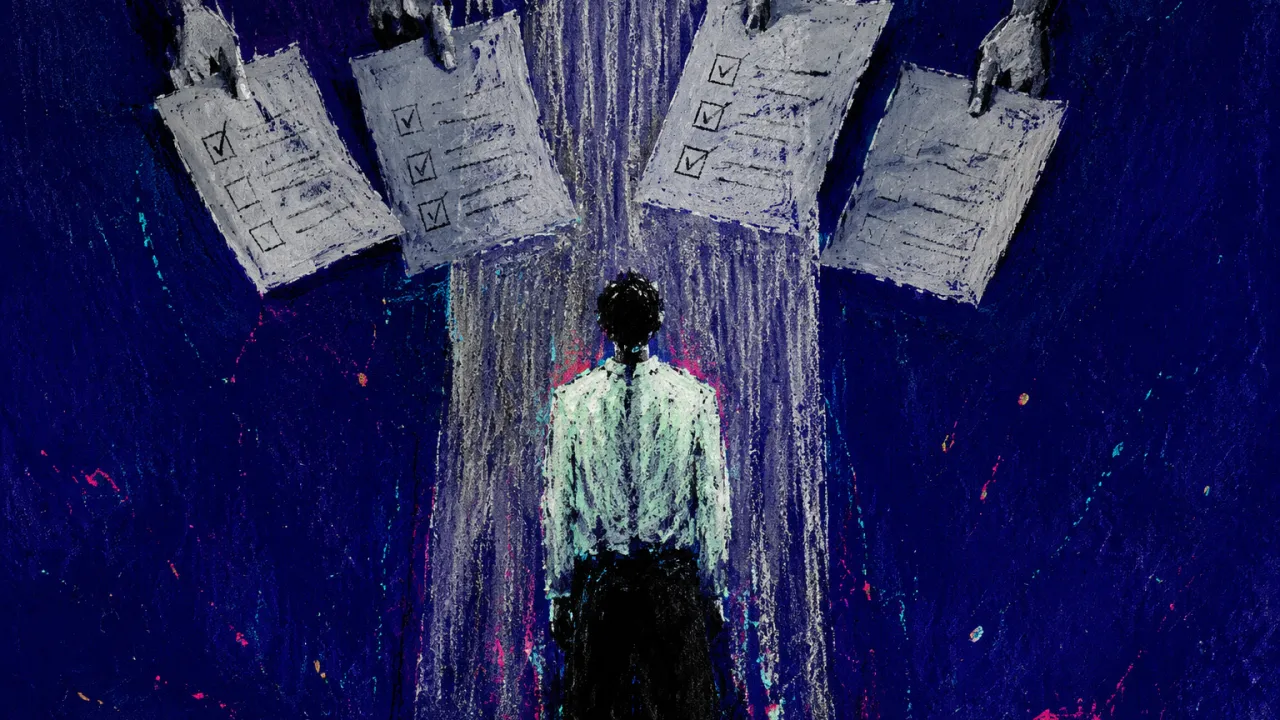
Silent Evaluation Period is the stretch where your work, message, application, or place in a group is being read before anyone says what it means. The pressure lands in the small body cues: the tight shoulders at your desk, the phone checked again, the breath held when a notification appears without the answer attached. This is an environmental and structural dynamic, not a private overreaction; the silence has been built into the way access, approval, timing, and feedback are controlled. The Tarot Cards below reflect the shape of that suspended assessment without forcing a verdict before the room has spoken.
The High Priestess UprightThe Priestess sits still at the sanctuary entrance, not rejecting the passage and not opening it. The pillars make the threshold visible, while her seated authority turns movement into a matter of timing, readiness, and controlled access. As a personal growth context, this describes a silent evaluation period where progress is not yet public, rewarded, or confirmed. You are operating near a threshold that demands observation before action, which can make every choice feel quietly weighed by the surrounding structure.
ReversedThe High Priestess faces forward in silence with a half-covered scroll, seated between pillars that resemble a formal review gate. Nothing in the image announces a verdict, but the document and threshold show that assessment is already structured. In a career setting, this becomes the period where performance is being read before feedback is being shared. You may sense that your work is under review while the criteria, timeline, and decision-makers remain behind the veil, which makes the silence itself part of the power structure.
The Hermit UprightThe hooded figure says little, and the lamp reveals only a controlled radius of the scene. Most of the landscape stays dark, so the visible signal matters more than open explanation. That is the texture of a silent evaluation period at work: output has been placed in front of others, but the verdict, criteria, or next conversation has not arrived. The card turns the silence into a structure you can inspect, separating actual signals from the blank space your workplace has left unfilled.
Wheel of Fortune UprightThe sphinx holds its sword in stillness while the rest of the wheel remains active around it. The corner figures keep their books open, suggesting a field where information exists, but it arrives through mediated channels rather than direct ground-level certainty. Silent Evaluation Period fits when a choice cannot be made cleanly because the outside world is still withholding a decisive signal. You may be waiting on a person, an institution, a market shift, or a response that changes the cost of each option. The card's value here is not to glorify waiting. It separates active observation from passive suspension, showing which pieces of information are worth waiting for and which forms of delay only disguise the fear of choosing.
Justice ReversedThe judge faces forward with the scale visible, but the purple curtain keeps the operation behind the chamber out of reach. The scene has all the signs of assessment without showing when the process will resolve. In an introspective reading, this becomes the outer silence that turns the inner world into a waiting room. You may be replaying messages, feedback, conversations, or small social signals because the actual verdict has not arrived, and the card reveals how delayed response can become a structure of self-surveillance rather than a neutral pause.
The Hanged Man UprightSuspended from a single ankle beneath the living crossbar, the figure is present, visible, and unable to move the scene forward. The halo and calm face keep the pause from becoming pure rejection; the structure is holding him in a threshold where nothing has been confirmed yet. In a social context, that becomes the period when a group, community, or network has noticed you but has not given you a clear place. You may still have agency, but the card points to the hidden cost of waiting for signals from people who control the pace of inclusion.
The Moon ReversedThe moon's face hangs above the scene with closed eyes and a sealed mouth, while the animals react below and the towers wait in the distance. The landscape is full of observation, but almost no direct communication moves through it. That is the atmosphere of a workplace evaluation period where something is being decided before it is spoken. A manager, panel, client, or leadership group may be watching performance, testing readiness, or weighing fit, while feedback arrives late, indirectly, or not at all. The Moon anchors this context through its suspended visibility. You can sense that the environment is reading you, but the criteria have not been brought into daylight, so the real task is to distinguish observable signals from projection and to locate where the evaluation is actually taking place.
Three of Pentacles UprightThe craftsperson works elevated while two robed figures watch with the plan nearby. The body is not hidden, and the work is not private; progress is being viewed, measured, and discussed before the structure opens further. In timing terms, this points to a period where you may be doing real work while the external response has not fully arrived. The card names the pressure of being between effort and confirmation, where the next window depends on review rather than speed.
ReversedThe craftsperson is raised on a workbench while two figures face him with the plan. His contribution is active and visible, but the criteria for approval sit partly outside his hands. That physical arrangement mirrors the social phase where a new group watches before it includes. People may be polite, attentive, and present, while still withholding the clearer signs that say you are trusted, chosen, or fully part of the room. The card names the pressure of being readable before you are secure. You can treat the silence as data: not proof of rejection, but evidence that the group’s evaluation process has become the real environment you are moving through.
Seven of Pentacles UprightWith the cultivator standing still and studying the coin-bearing vine, the image looks like a worksite paused for inspection. The pentacles are visible outcomes, but most of them remain attached to the plant rather than placed in the worker's hand. That structure mirrors the career period where performance exists as evidence but has not yet been translated into a raise, title, or public endorsement. You can see the results, and other people may be able to see them too, yet the reward depends on a review cycle, a manager's readout, or an institutional timing mechanism. The card gives that waiting period a physical shape. It separates actual output from recognized value, making the real question not whether work has happened, but who controls the moment when work becomes career capital.
Page of Pentacles UprightThe Page's gaze does not wander across the field. It stays fixed on the pentacle, creating a private inspection zone inside an otherwise open landscape. That visual narrowing fits a relationship phase where one person is watching the evidence before speaking the verdict. Texting patterns, consistency, repair after conflict, effort, and reliability become the real material under review. The silence is not empty; it is structured observation. You are in a stage where the relationship may look calm from the outside while a quiet decision is being formed from repeated practical signals.
Two of Swords UprightThe blindfold does not erase the world around the figure; it changes the mode of assessment. With the swords held steady across the body, the image turns silence into a controlled observation field rather than an empty absence. In a friendship, this points to the period when you stop over-explaining and start watching what happens when you no longer manage everyone’s comfort. The pattern may appear in who follows up, who avoids accountability, who respects the pause, and who tries to pull you back into the old role. The quiet shore gives the evaluation its social realism. Nothing has to explode for the relationship to reveal its structure; sometimes the clearest data arrives when the usual emotional labor is withdrawn.
Four of Swords UprightThe swords above the knight are fixed in place, like evidence arranged over a still body. Nothing is being argued aloud, yet the scene is not empty; it is a chamber of suspended assessment. In friendship, that becomes the quiet period where you stop performing closeness and start noticing what the other person does with the silence. The card links the pause to evaluation: reciprocity, repair, and initiative become visible precisely because motion has stopped.
ReversedThe knight waits beneath swords that are mounted, not swinging. The scene is quiet, but the stillness is organized around judgment suspended above the body. In academic life, that becomes the gap after submission, interview, exam, or supervisor meeting when the next move depends on someone else's response. You are held in a corridor of delayed feedback, where clarity is not produced by doing more but by recognizing which part of the process is no longer in your hands.
Nine of Swords ReversedThe swords line up like measures, but no judge, manager, or messenger appears in the room. The pressure is unmistakable, while the source of the decision stays hidden in the dark space behind it. That is the texture of a silent evaluation period at work: a review cycle, probation window, restructuring conversation, or leadership calibration where you can sense that your standing is being assessed, but you are not inside the room where the meaning is being made. The Nine of Swords makes this waiting state legible. It shows how silence becomes an active workplace force when decisions are pending, criteria are unstated, and your body is left to hold the pressure of a process you cannot see.
Page of Swords UprightThe Page of Swords turns his head away from the sword's direction, scanning the ridge while still holding the blade ready. The body is not rushing into action; it is reading the field, measuring risk, and holding judgment in reserve. That posture fits a silent evaluation period in introspection, where you are not yet ready to speak, decide, confess, or expose the full truth. The outer situation may be giving you mixed cues, so the mind starts collecting evidence before allowing the inner world to move. The card gives that pause a structure. It shows a legitimate surveillance phase of the self, but it also makes visible the cost of staying too long in watch mode: the blade remains raised, the terrain remains tense, and clarity can become another form of delay.
Queen of Swords UprightThe Queen's face remains sealed while the sword stays upright, and the clouds sit low beneath her elevated seat. Nothing in the scene rushes forward; the whole composition holds judgement in suspension. For You, that becomes the academic waiting room after a submitted essay, exam, portfolio, or application has left your hands. The silence is not empty; it is a controlled institutional pause where grades, comments, or acceptance signals have not yet returned, leaving your mind pressed against an unseen standard.
King of Swords UprightThe king holds the sword upright, but the scene is still. His posture suggests that a decision is forming, not yet released, and the open sky behind him makes the waiting feel public even without visible movement. At work, this becomes the phase where your readiness is being observed before a promotion, leadership handoff, internal move, or major responsibility becomes official. You may sense that every meeting, response, and strategic choice is being quietly added to an invisible file. The upright King of Swords frames the silence as an evaluation container. The path is not closed, but it is controlled by timing, evidence, and the judgment of people who need to see whether your decisions can stay clear before they give you more authority.
No cards available for this filter.