Defending Unfinished Work?

A grounded look at public review pressure, related tarot cards, and reading insights from critique, defense, and feedback-room sessions.

Critique Panel Pressure
What is this situation?

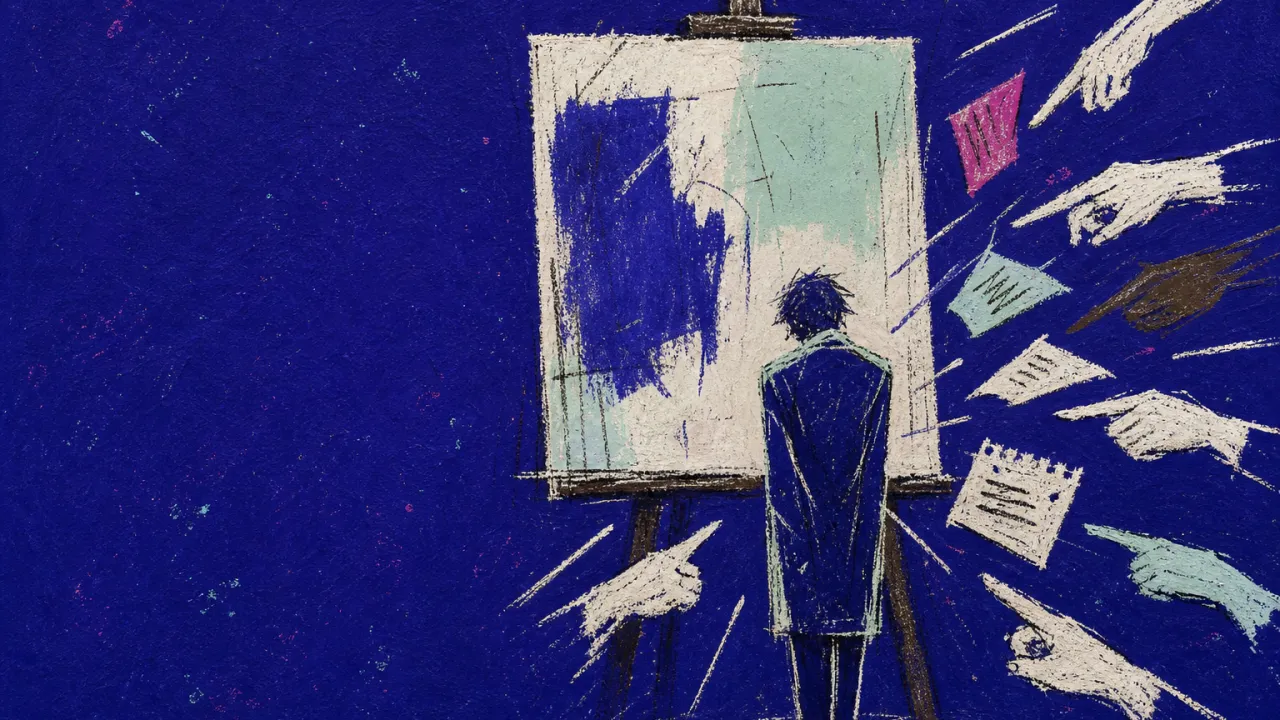
Critique Panel Pressure — you walk into the room already knowing your work is not finished, but the chairs are arranged as if it should be ready to defend itself. It might be a studio pin-up, thesis panel, viva practice, lab meeting, seminar presentation, portfolio review, pitch, or draft checkpoint; either way, your project is now on the wall, on the screen, on the table, or in a shared document where other people can point at it. Tutors, supervisors, classmates, reviewers, or stakeholders take turns holding the criteria while you stand beside the thing you made, trying to explain what is still forming as if it has already become stable. One person asks about evidence, another questions the structure, another picks at a choice you made early and have not had time to rebuild, and the comments start arriving faster than you can sort useful direction from public performance. You can feel your throat tighten before answering, your shoulders lift while someone flips back to a slide you thought was safe, your hand hover over your notes as if one better sentence could keep the whole project intact. The hard part is not simply being watched; it is being asked to stay receptive, articulate, and professionally composed while the room has permission to interrupt, rank, sharpen, and reshape work that still has wet edges. Afterward, you leave with notes, fragments of advice, and a body that still feels like it is standing under the projector light, much like the worker on the Three of Pentacles, elevated mid-action while others face the unfinished craft and measure what it is becoming.

Why it's not you?

The pressure is not proof that you are weak or unprepared; the setup itself is demanding. Being asked to expose unfinished work while people with criteria, status, or decision-making power evaluate it in public creates a specific kind of strain. That strain belongs to the review structure, not to a personal defect in you.

Critique Panel Pressure in Tarot Cards

Critique Panel Pressure is the moment when unfinished work is placed in front of people who hold criteria, grades, approval, or reputation in the room. The tight throat, lifted shoulders, and hand hovering over your notes are not random; they track an environmental, structural dynamic where exposure and evaluation happen at the same time. These cards do not decide whether the feedback is fair or useful; they reflect the visible shape of being reviewed while still mid-process. Here are the Tarot Cards that mirror this kind of public assessment field.

Three of Pentacles Upright
The worker is elevated, visible, and mid-action while two figures face the unfinished work. The scene is not private practice; it is work-in-progress placed inside a formal review frame. In academic settings, this becomes the pressure of class critiques, draft reviews, thesis panels, studio pin-ups, lab meetings, and presentation checkpoints. You are being asked to show something before it is complete, while the standards for improvement are held by other people in the room. The card gives the pressure a structure: exposure, evaluation, and craft are happening at the same time. It does not reduce the moment to performance; it shows how critique can become the temporary public chamber where unfinished work gains shape.
Ace of Swords Upright
The blade enters the crown at the center, placing a sharp line of reasoning directly into the symbol of recognition. The image carries the social geometry of a seminar room, defense table, or presentation slot where a claim has to survive contact with formal judgment. For you, the pressure is not just being seen; it is having an idea tested in public by people who control feedback, grades, or approval. The card links this context to the moment when academic work stops being private drafting and becomes an exposed argument that must hold its edge.
Three of Swords Upright
Three blades enter the red heart from separate angles and meet in one exact center. In an academic critique, comments do not arrive as loose background noise; they converge on the project, the argument, and the part of the work that feels most exposed. The balanced geometry of the swords mirrors the formality of a panel, studio review, viva, or proposal defense. You are not just receiving feedback from one person; you are standing inside a structured evaluative field where multiple voices can make one draft feel like the entire target. The card makes this pressure legible without turning it into a personal defect. It shows how critique can be both procedurally valid and physically hard to absorb when every blade points toward the same academic center.
Ten of Swords Reversed
The card presents judgment as a field of many sharp points, all directed into the same exposed body. The hidden face matters: the person cannot answer back from the position shown, so the visual emphasis falls on being acted upon, marked, and reduced to the impact of the blades. That is the social shape of a critique panel when feedback stops feeling like a learning exchange and starts feeling like a public convergence of authority. A viva, studio review, seminar critique, or thesis defense can become a stage where the student's work, voice, and standing are all placed under concentrated scrutiny. The card does not make critique inherently hostile. It identifies the moment when evaluation has lost enough containment that the student can no longer metabolize feedback as information. Seeing that structure helps distinguish useful critique from a setup that turns academic development into public exposure.
Page of Swords Upright
Both hands hold the sword as the Page turns back across the ridge, alert to whatever may be approaching through the wind. The image makes language, judgment, and defense visible at once: the young figure is not merely thinking, he is preparing to answer. In personal growth work, that posture maps onto the pressure of having your goals, work, or new identity reviewed before it feels fully secure. You are dealing with an external evaluation field where feedback can sharpen the blade, but the same field can also make every unfinished step feel exposed.
Knight of Swords Upright
The knight occupies the visual center with the sword raised high, fully exposed in armor and moving straight into a contested field. The image has the feel of an argument made in public, with every piece of equipment arranged around being seen, tested, and answered. That structure maps cleanly onto critique panels, vivas, studio reviews, thesis defenses, and seminar interrogations. The academic stage is not private study anymore; it is a front-line position where your ideas must withstand direct evaluation. You are dealing with a setting where clarity is valuable because it can survive contact. The card does not soften the panel environment, but it does locate the real pressure: the gap between knowing your work privately and holding your line when the room becomes a testing ground.
Queen of Swords Upright
Sideways on the stone throne, the Queen holds a vertical sword while her other hand marks a controlled opening. The image is built like an academic defense room: one figure has the criteria, the blade, and the right to ask for precision while the work must survive contact with formal judgment. For You, this maps to the pressure of critique panels, seminar presentations, thesis defenses, or supervisor meetings where thought has to become publicly defensible. The card does not frame the pressure as personal inadequacy; it reveals an external assessment structure that demands clarity, evidence, and composure before it grants recognition.
King of Swords Upright
The King sits front-facing on a raised stone throne, sword held upright like a visible standard of judgment. Nothing in the scene is casual: the plain robes, severe gaze and elevated seat turn the body into an instrument of formal evaluation. That is the academic pressure of being read in public by people who control the criteria. A critique panel, viva, seminar defense or portfolio review does not only test the work; it tests whether you can hold your reasoning steady while authority is looking directly at it. The card names the structure without reducing it to personal weakness. You are not simply trying to be more confident; you are standing inside a performance chamber where clarity, evidence and composure become the currency of survival.
Five of Wands Upright
The staffs are lifted like arguments in a live room, crossing before any one voice can land. The bright sky keeps the clash exposed, so the pressure is public, visible, and difficult to dismiss. That is the shape of critique panel or seminar feedback when comments arrive faster than the work can metabolize them. You may be dealing with useful signal mixed with performative challenge, and the card separates the visibility of feedback from the value of each comment. Critique Panel Pressure fits because the image is not a quiet revision desk; it is a public arena. The real academic task is identifying which raised wand is a usable direction and which one only increases noise.
Six of Wands Reversed
The raised wands line the route like a corridor of attention, and the rider moves through the center with every symbol pointed toward public display. In the reversed texture, that corridor becomes less like celebration and more like an academic stage where the body has to perform while being watched. This maps to critique panels, thesis defenses, seminar presentations, studio reviews, and high-visibility class moments where the work is not only evaluated but exposed. The card helps you separate the task from the stage: the pressure is not just the content of the work, but the social architecture of being assessed in front of an audience.
Seven of Wands Upright
The raised wand held across the body turns the figure into a live defense line, while the six lower wands make the challenge visible as a public field of questioning. The high ground gives You perspective, but the uneven footing shows that holding a position still costs effort. In an academic critique, thesis review, seminar, or studio panel, the same structure appears when Your work becomes the object everyone is testing at once. The card does not reduce the pressure to personal weakness; it maps a demanding evaluation setting where the argument, draft, or project must stay coherent while multiple voices press into it. The useful signal here is not that critique is automatically hostile. It is that the environment requires a defensible stance, clear ownership of Your claim, and enough structure to separate useful challenge from noise.
Nine of Wands Upright
The figure stands directly in front of the gap in the wand wall, chest closed around the staff while his gaze tracks something outside the frame. The image is built around exposure at a boundary: the defense exists, but the open point is where the body has to appear. That is the academic texture of critique panels, viva practice, studio crits, seminar presentations, or advisor meetings where your work becomes visible before it feels fully protected. The panel is not just feedback; it is a social stage where your argument, method, and credibility are pressed at the same time. The Nine of Wands links this context to the cost of repeated evaluation. You can identify whether the real pressure is the quality of the work, the format of public judgment, or the need to keep defending a project that still needs space to develop.
Queen of Wands Reversed
The Queen faces outward from a formal seat, surrounded by lions, crown, and repeated solar symbols that make her authority visible from every angle. When the scene is pressurized, the throne becomes less like support and more like a platform where the body and its work are exposed to judgment. Academic critique settings carry the same architecture. A viva, studio review, seminar grilling, portfolio panel, or thesis meeting can turn learning into a public test where every answer feels tied to authority, credibility, and social standing. This card links to the pressure of being evaluated in the open. It does not collapse the experience into personal sensitivity; it shows the room, the hierarchy, and the gaze as part of the academic event you are trying to navigate.

Critique Panel Pressure in Tarot Card Reading Insights

Critique Panel Pressure often shows up when someone brings a viva, studio crit, seminar presentation, thesis review, or stakeholder-style feedback room into a reading. The shift from cards to readings shows how this setting appears when people are trying to name what happened under that public gaze. Explore Tarot Reading Insights from sessions shaped by critique, review, and exposed work-in-progress.
Psychological contexts related to Critique Panel Pressure