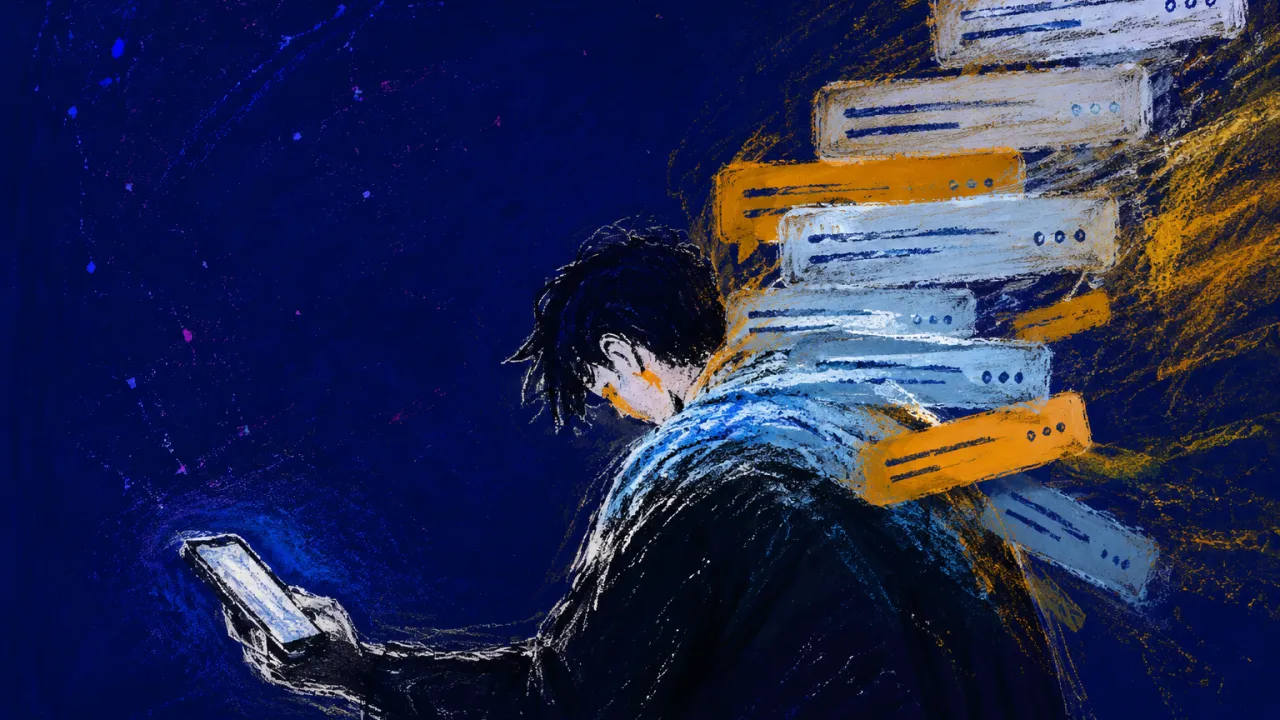
Emotional Dumping Friendship is not just one heavy conversation; it is the repeated setup where your attention becomes the default landing place. That tight jaw you feel when your phone lights up again is part of the body's record of the pattern. This is an environmental, structural dynamic: the friendship has built a one-way channel for urgency, venting, and disclosure. The Tarot Cards below reflect the outline of that channel, the overflow, and the missing return loop.
The Fool ReversedThe rose in the Fool's open hand is delicate, while the dog at the feet keeps sending a signal into the body of the scene. In a friendship built around emotional dumping, care is present, but the exchange has no clear container for what arrives, how often it arrives, or what comes back. You are not failing at compassion when the role starts to feel one-way. The card shows a support channel without a railing, where someone else's overflow can define the friendship unless the edge of access becomes visible.
The Magician ReversedThe full table of tools can become a one-person support station: cup, pentacle, wand, and sword all sit within reach of the central figure, while no reciprocal figure appears in the frame. In friendship, that maps to the external situation where your availability has become the default surface for someone else's repeated venting, decisions, and late-night intensity. The raised wand and pointing hand create a body that is always ready to translate, process, and direct. That is the exact burden of an emotional dumping friendship: the conversation keeps arriving as raw material, and you are expected to convert it into clarity, validation, or a plan. You regain agency by naming the structure as uneven flow. The issue is not that a friend has needs; it is that the friendship has normalized one-way processing as if it were mutual closeness.
The High Priestess ReversedThe water is held behind the curtain, the scroll is partly covered, and the seated body does not move away from the threshold. The image can become a container where hidden material keeps arriving but does not fully circulate. In Emotional Dumping Friendship, that container becomes your social role: the friend who receives repeated confessions, crises, and private spirals without a matching return of care. The card's reversed structure makes the imbalance visible, showing where listening has stopped being mutual presence and started functioning as unregulated access to your attention.
The Empress ReversedThe stream and waterfall keep pouring through the garden while pearls rest at the throat of the seated figure. The image gives emotional flow a visible channel, but that flow gathers around one central receiver. In an introspective context, Emotional Dumping Friendship appears when people use your steadiness as their overflow system. You may be treated as the calm garden where everyone releases pressure, while the exchange structure leaves your own material with no equivalent place to land.
The Lovers ReversedOne gaze is directed toward the other figure, while the other gaze is pulled upward, leaving the exchange uneven before anything is spoken. The open hands do not create a closed container; they create availability. In friendship, that becomes the structure of emotional dumping. One person repeatedly brings the intensity, the crisis, or the long processing thread, while the other is expected to stay open, receptive, and ready to absorb it. The issue is not that friends should avoid hard conversations. The card points to a one-way channel: care moves into one body, but repair, checking in, and consent do not reliably move back.
The Chariot ReversedThe smiling and crying faces sit on the Charioteer's shoulders, fixed directly onto the armored load-bearing area of the body. Emotional contrast becomes something carried as equipment, not something freely exchanged. In friendship, that visual pressure points to one-way venting where another person's swings, crises, or spirals are placed on you without pacing or reciprocity. The missing reins matter: you are expected to hold the emotional vehicle, but the connection does not give you a clean way to steer the load.
Strength ReversedThe garland links the woman and the lion, but the physical labor is not evenly distributed: the lion brings force, and the woman’s hands manage its opening. The image creates a living circuit where one body absorbs, regulates, and redirects intensity that does not originate from her. Emotional Dumping Friendship has the same structure when someone repeatedly arrives as raw force and you become the steady hands at the mouth. The card does not blame your capacity to listen; it shows where listening has become an unpaid containment system with no matching space for your own material.
The Hermit ReversedThe raised lamp makes one solitary figure responsible for holding the only visible light in a dark field. His arm cannot rest while the scene depends on that glow, and the staff-bearing side has to absorb the remaining weight. That is the outer structure of Emotional Dumping Friendship: one friend repeatedly arrives in private distress, crisis narration, or heavy disclosure, while the other is expected to stay lit, available, and steady. The issue is not that care exists; it is that the friendship has organized itself around one person's output and another person's absorption. The absence of a returning light is the crucial detail. You are not looking at mutual intimacy; you are looking at a support channel that has lost its exchange loop.
Wheel of Fortune ReversedOne figure strains upward along the wheel while the serpent drags down the opposite side, and the central mechanism absorbs both forces. The image shows motion without equal exchange: contact is constant, but the pressure does not distribute evenly. That structure fits a friendship where one person's updates, crises, and spirals repeatedly enter the bond while mutual attention thins out. The image names the external pattern: the connection keeps moving because you carry the emotional load, not because care is flowing both ways.
Justice ReversedThe figure's arms are held out in service of weighing and containing, while the body stays fixed in the chair. Reversed, that posture maps onto a friendship where one person becomes the receiving station for every spiral, crisis update, and late-night download. The scale can look balanced from the outside because the friendship still has affection and history. The hidden issue is load distribution: you are not just listening, you are being positioned as the place where someone else's material is repeatedly deposited without an equal channel of care returning.
The Hanged Man ReversedSuspended by one ankle with his hands hidden behind his back, the Hanged Man turns the body into a fixed receiving point. The halo suggests attention and insight are still active, but the limbs cannot freely redirect the load, which mirrors a friendship where listening becomes a role rather than a chosen exchange. The living frame holds him in place while the white background removes ordinary privacy and interruption. In a close friendship, that becomes the structure of being constantly available for someone else's processing: the conversation keeps arriving, the body stays still, and the cost is paid through time, attention, and unspoken depletion. This card does not reduce the bond to selfishness or failure. It names the point where care stops circulating and becomes one person's suspended duty, giving You a clearer view of which part of the friendship is support and which part has become extraction.
Death ReversedThe mounted figure raises a banner while the bodies below have no equal channel back. The scene is not balanced exchange; one force takes up the vertical field while the figures on the ground absorb the impact. In friendship, that imbalance mirrors the person who repeatedly unloads heavy material but does not make reciprocal space. You become the receiving ground for updates, spirals, and emergencies while your own needs lose their tools and position. The card's severe composition clarifies the issue without moralizing it. The problem is not that care exists; it is that care has become one-directional, unbuffered, and structurally expected.
Temperance ReversedThe stream between the two cups looks controlled, but reversed it can read as a channel that keeps being used for transfer without checking the level of either vessel. The body has to hold the whole exchange steady while the action repeats. That is the external structure of an emotional dumping friendship. You are not dealing with ordinary closeness; the friendship has become a one-way containment system where crisis, venting, and private chaos arrive without equal curiosity, repair, or return support.
The Devil ReversedThe torch points downward into the smaller figure's space, sending heat into a body that is already tethered. The chain does not need to be tight for the transfer to feel compulsory; the scene makes intensity flow into the person with the least room to refuse. In a friendship reading, this becomes the pattern where one person's unprocessed life keeps pouring into the same listener. You are not simply being supportive; the card maps a setup where emotional material has found a default container and reciprocity has fallen out of the circuit.
The Star ReversedThe body is low to the ground, both hands occupied, both vessels pouring. The image gives no visible intake point, no reciprocal stream, and no other figure offering water back into the system. In a friendship circle, that becomes the structure of being used as the place where everyone unloads. The role can look caring from the outside, but the resource pattern is one-directional: your attention keeps leaving while the network treats your availability as a shared utility. For You, the reversed Star exposes the difference between mutual support and a social role that quietly drains you. The card does not pathologize care; it shows where care has become infrastructure for other people's processing while your own replenishment is missing.
The Moon ReversedThe animals howl upward while the small creature rises from the water into an exposed threshold. Sound, droplets, and reflected light all move through the scene, but none of them create a balanced exchange. That is the social shape of a friendship where one person repeatedly pours private turmoil into the bond while the other becomes the receiving surface. The interaction can look like intimacy because it happens in vulnerable hours, but the flow keeps moving in one direction. The Moon reveals the difference between being trusted and being used as an unmarked container. Once the exchange is seen as a channel with pressure, limits, and direction, the friendship can be assessed without reducing care to endless absorption.
Judgement ReversedThe trumpet sends sound in one direction, and the bodies below are arranged to receive it. In reverse, the exchange loses reciprocity: one side broadcasts, the other side absorbs, and no visible channel exists for negotiation. That is the structure of an emotional dumping friendship, where a friend repeatedly uses the bond as a venting outlet while your limits stay offstage. You are not measuring kindness; you are mapping a one-way support channel that has been mistaken for closeness.
Ace of Cups ReversedThe cup overflows into a shared body of water, and the hand beneath it remains open enough to receive the force of what moves through. When that openness loses proportion, the vessel becomes a place where too much private material is poured without structure. In introspection, this maps onto friendships where one person’s processing repeatedly becomes the other person’s job to contain. Deep talks, voice notes, crisis recaps, and late-night downloads may look like intimacy, but the exchange can quietly lose reciprocity. The card makes the boundary problem visible through water leaving the cup faster than the vessel can define it. You can care about the person and still see the structure of the exchange with clearer edges.
Two of Cups ReversedThe cups are small personal containers, not endless reservoirs. When the exchange position becomes fixed, the same vessel that should carry mutual care can turn into the only available place for one person's repeated unload. That is why this image can surface an emotional dumping friendship in reverse. You are seeing a bond where every update, spiral and conflict recap arrives through the same channel, while the return flow, pause and closure that would make the exchange sustainable are missing from the scene.
Three of Cups ReversedThe cups are designed for shared celebration, but in a distorted friendship field those same cups become containers that one person keeps filling and another keeps holding. The harvest abundance shifts from mutual plenty into too much material arriving with no balanced return. This context fits the friend who repeatedly brings crisis-level emotional volume into the bond while calling it intimacy. You may be positioned as the reliable listener, the late-night responder, or the person expected to absorb every spiral because the relationship has normalized unlimited access to your attention. The Three of Cups gives the pattern a clean external shape: a cup is not endless just because it is offered in friendship. The card reveals where a ritual of closeness has become a one-way disposal system wearing the language of trust.
Four of Cups ReversedThe figure's folded limbs form a brace while cup after cup sits outside the body. Nothing is being shared through a mutual channel; the scene holds repeated emotional containers in front of someone who has stopped reaching. In friendship, that visual structure becomes Emotional Dumping Friendship when one person's problems keep arriving and the other person is expected to absorb, soothe, and remain available. You may look like the stable listener from the outside, but the card shows a body that has become a storage point rather than a participant in exchange. The cloud-borne cup intensifies the pattern because even a new offer can feel like more material to hold when the channel is already overloaded. Four of Cups links this context to the moment when care has stopped being mutual nourishment and has become repeated impact against a closed perimeter.
Five of Cups ReversedThe three cups in front of the figure are not just empty; they are overturned, actively spilling their contents onto the ground. The figure's whole posture is drawn down toward that spill, while the two upright cups behind them remain outside the active field of exchange. That visual structure fits a friendship where one person's unresolved material keeps flooding the relationship. The connection becomes organized around processing the latest disappointment, complaint, or crisis, while the mutual parts of the friendship sit behind the main action, unseen and unused. You may be carrying a role that looks like intimacy from the outside but functions like cleanup work in practice. The card makes the imbalance visible so the friendship can be assessed by flow, reciprocity, and containment rather than by how long you have been willing to listen.
Nine of Cups ReversedThe cups are full, but no one is shown drinking together, passing anything, or meeting each other across the table. The hands are folded, the resources are staged, and the image holds emotional material in storage rather than in mutual movement. Reversed in a friendship context, that stillness can become a pattern where one person's inner overflow is repeatedly deposited into the bond while the actual exchange remains blocked. You may be treated as the place where every crisis, complaint, or spiral lands, without the friendship offering comparable attention to your own reality. The card makes the imbalance visible without blaming care itself. It shows that the issue is not having cups, empathy, or history; the issue is a friendship container where emotional material piles up on one side and never becomes reciprocal circulation.
Ten of Cups ReversedThe river and cups show emotional material moving through a shared field, but no single figure actually holds a cup. Reversed, that visual arrangement can become a system with plenty of emotion in the air and no clear container for who receives it, who returns it, and who gets emptied by it. In friendship, this points to the dynamic where one person's problems repeatedly flood the bond while mutuality stays vague. You are not just dealing with a talkative friend; the structure shows emotional flow without agreed limits, which is why the relationship can feel close and extractive at the same time.
Page of Cups UprightThe Page holds the cup like a small emotional station, steadying it at shoulder height while a living fish rises from inside it. The scene is gentle on the surface, but the structure is clear: one figure is assigned to receive, contain, and respond to whatever emerges from the private vessel. In friendship, that visual arrangement maps onto a bond where one person becomes the default container for another person's emotional overflow. The sea behind the Page gives the cup a larger pressure field; what looks like one small disclosure is connected to a wider pattern of repeated release. You are not being shown a bad friendship in a dramatic sense. You are being shown a friendship where access to your attention may have become too easy, too constant, and too assumed, so the real question becomes whether the exchange still has consent, timing, and reciprocity built into it.
ReversedThe cup is small, but the sea behind the Page is vast. When the living fish is kept inside that cup, the image concentrates a much larger emotional environment into one hand, one vessel, and one private exchange. In a friendship, that becomes the structure of being used as the default container for someone else's overflow. You are not simply hearing a friend out; the social arrangement has narrowed until their updates, spirals, and crises keep landing in your cup while the wider support system stays invisible. The Page's fixed gaze matters here. Reclaiming clarity begins with seeing how much of the exchange has become one-way, then naming the boundary where care stops being mutual and starts becoming an assigned role.
Knight of Cups ReversedThe cup stays in the knight's hand with no visible receiver, and his attention narrows around the emotional object he is carrying. When that image is read through the reversed current, the offering stops functioning as mutual exchange and becomes a single vessel demanding the whole scene's focus. In a friendship, that is the structure of repeated emotional dumping. You may be positioned as the available listener, but the visual problem is that the cup never becomes shared; it stays heavy, central, and constantly brought forward without a clear agreement about timing, consent, or return.
Queen of Cups ReversedThe Queen holds a sealed vessel rather than an open cup, and the water around her suggests emotional material pressing in from every side. Reversed, that container becomes overused: private capacity is treated as a place where someone else can pour without checking the limit. In a friendship, this shows up when messages, calls, and late-night spirals arrive as if your availability is already granted. The bond may still matter, but the exchange pattern has started to bypass consent, timing, and reciprocity. The card gives the dynamic a boundary. It shows that being a safe person does not require becoming the permanent vessel for another person's overflow.
King of Cups ReversedThe cup is held above a restless ocean, and the throne has no shore around it. In the reversed texture of this image, the container is still present, but the surrounding water keeps pressing toward it from every side. That is the shape of emotional dumping in friendship: one person's crisis material repeatedly arrives without checking whether there is consent, timing, space, or mutual capacity. You become the exposed platform where someone else deposits what they cannot process elsewhere. The card makes the structure visible without blaming care itself. It separates real intimacy from unfiltered discharge, showing that a friendship can include emotional honesty while still requiring pace, permission, and reciprocity.
Five of Pentacles ReversedThe injured figure leaning on a crutch and the huddled companion move through a storm without real shelter. Their closeness offers some human warmth, but the environment around them gives no replenishment; the bond is being asked to function while both bodies are already exposed. That visual pressure maps cleanly onto emotional dumping inside friendship. You become the person walking beside someone through every crisis, every late-night spiral, every repeated collapse, while the wider support structure remains unused or unavailable. The friendship still looks intimate, but its operating condition has become scarcity. Five of Pentacles does not shame care. It shows what happens when care has no container, no rotation, and no recovery space. The card makes visible the point where being a loyal friend turns into being the only shelter someone keeps returning to.
Eight of Pentacles ReversedThe bent body over the workbench can harden into a service posture, repeating the same hammer-and-chisel motion while more material waits nearby. The open work site makes that labor easy to access and difficult to shield. In a friendship, this becomes the friend who brings every crisis, spiral or conflict to your bench and expects you to process it into something cleaner. You are not simply being supportive; the structure shows repeated emotional material being routed through one person as if their attention is a public utility. The polished pentacles matter because the friend may leave feeling lighter, clearer or more organized while the labor that produced that relief stays uncounted. The card exposes the external arrangement: one person gets usable output, and the other absorbs the work cycle.
Two of Swords ReversedThe arms locked across the chest can only hold for so long. The body is braced against the very emotional field behind it, with the sea present but not integrated and the swords preventing clean exchange. In friendship, that image captures the person who becomes the default container for someone else’s crisis, spirals, complaints, or late-night processing. The outside may look calm because the dumping happens privately, but the structure is physically unsustainable: one person unloads while the other performs steadiness. The reversal sharpens the blockage. The issue is not that emotional support exists; it is that support has lost reciprocity, timing, and consent, leaving you to hold material that the friendship never helps you metabolize.
Three of Swords ReversedThe heart functions like the only container in the image, and every blade enters that same container. With no hands, ribs, or boundary around it, the scene mirrors a friendship channel where other people's pressure keeps entering one exposed center without a visible exchange back. You may have been positioned as the place where crises land, not as a person with timing, limits, and reciprocal needs. The card frames the issue as a flow problem in the friendship: contact is frequent, but care moves in one direction.
Six of Swords ReversedOne standing figure powers the boat while the seated passengers remain silent and enclosed by the swords. The vessel moves only because one body keeps handling the weight, direction, and pressure of the crossing. That uneven distribution mirrors a friendship where one person repeatedly becomes the place where everything is unloaded. The conversations may look intimate from the outside, but the structure is lopsided: one side releases pressure, while the other absorbs, organizes, and carries it forward. The narrow boat makes the cost visible. There is only so much room inside the friendship container, and when every crossing is packed with unprocessed material, reciprocity gets crowded out before the bond has a chance to breathe.
Eight of Swords ReversedThe bound hands and blindfold make the figure receive the scene without being able to sort, refuse, or respond on equal terms. The swords around her resemble a set of urgent problems placed into the same small space, while her own agency is visibly narrowed. Emotional dumping friendship works the same way when another person's crisis material repeatedly fills the bond and your capacity becomes the container. You are not only dealing with a friend who vents; you are dealing with a structure where reciprocity, consent, and pause buttons have been pushed outside the room.
Nine of Swords ReversedNine swords crowd the air above the bed, and the lower blades cut through the level of the body rather than remaining safely distant. The image does not show a clean conversation; it shows repeated mental material entering a private rest space as pressure, interruption, and accumulation. That is the outer structure of an Emotional Dumping Friendship. A friend may be using closeness as permission to unload without checking whether you have capacity, whether the timing is fair, or whether the exchange ever moves back toward mutual care. The bed matters because this is supposed to be a protected zone. When the swords occupy that space, the card makes visible how a friendship can invade recovery time and turn intimacy into a one-way emergency channel.
Knight of Swords ReversedThe shouting knight and straining horse turn communication into a charge, with urgency moving faster than the scene can absorb. The raised sword does not invite exchange here; it cuts through the air as a demand for immediate attention. You can feel the external structure of Emotional Dumping Friendship in that one-way velocity. A friend may be arriving with repeated unloads, midnight spirals, or crisis-coded messages, while your role becomes the open field they gallop into. The card names the imbalance without blaming your capacity for care: the problem is the uncontained access pattern, not the existence of need.
Queen of Swords ReversedThe cloud-patterned cloak falls over the Queen’s body as if the atmosphere itself has become something she has to carry. Her hand is open, but the sword beside it shows that unlimited access would turn that openness into a burden. In a friendship, this is the shape of repeated emotional unloading without consent, timing, or return. You are placed in the role of processor, interpreter, and stabilizer while the other person treats closeness as permission to pour everything into the same channel. Emotional Dumping Friendship is anchored in the reversed pressure of this card because the Queen’s clarity becomes trapped under social weather that is not hers to manage. The card makes the imbalance visible so the friendship can be judged by reciprocity, not by how much one person can absorb.
Ace of Wands ReversedThe wand sheds living leaves while the river below carries a narrow flow through the landscape. In reversal, that movement becomes less like mutual circulation and more like output from one source into a field that does not visibly replenish it. This is the outer structure of emotional dumping in friendship. A friend’s crisis, venting, anger, or repeated processing takes the available channel, while your own needs remain outside the main current of exchange. The Ace of Wands makes the pattern sharper because the original material is life force: attention, urgency, motivation, and emotional charge. When that charge is constantly discharged into one friend, the bond stops feeling like shared support and starts functioning like an unpaid holding container.
Two of Wands ReversedThe figure stands alone above a wide domain, holding the world in miniature while the full landscape spreads beneath him. The image concentrates too much overview in one body, as if one person has become the private lookout for a much larger field. Reversed, that concentration mirrors a friendship where another person repeatedly brings their crises, spirals, and unresolved stories to you without creating equal room for your reality. The connection may be intimate, but the exchange has become structurally lopsided. The card does not shame care; it separates care from being made into a container. When one friend always arrives with the whole world in their hands and leaves it with you, the friendship needs an audit of capacity, reciprocity, and consent.
Four of Wands ReversedThe foreground figures are the ones visibly holding the celebratory tone, while the garlands carry the abundance across the structure. Reversed, that visual load can show one person being made responsible for keeping the friendship emotionally decorated. Emotional Dumping Friendship is not simple closeness or a friend having a hard week. It is an external relational setup where one person repeatedly arrives with heavy material, expects immediate containment, and does not return the same care when the direction of need changes. The Four of Wands connects because its ideal is reciprocal celebration and shared shelter. When that exchange becomes one-way, the arch still looks like friendship from the outside, but the load-bearing work is concentrated on the person expected to stay warm, available, and receptive.
Seven of Wands ReversedOne wand has to answer six incoming lines, and no spare tool or ally appears beside the figure. The image shows a resource distribution problem before it shows a personal endurance problem: too much incoming force is being routed through one body. In friendship, emotional dumping works through the same imbalance. You become the default place where venting, conflict processing, and late-night urgency land, while your own need for space or reciprocal attention remains offscreen. The hidden people behind the lower wands sharpen the point. Pressure arrives without full accountability, so the card helps name the friendship structure that asks for containment without offering equal presence in return.
Ten of Wands ReversedThe ten wands are not resting on the ground; they are lifted, bundled, and pressed into the man's body as he moves toward a fixed destination. In a friendship context, that image turns emotional material into something one person physically carries for someone else, with no visible second carrier and no pause built into the route. The green wands still look alive while the carrier appears withered, which sharpens the logic of a one-way transfer. The friendship may be full of intense texts, crisis calls, and late-night debriefs, but the energy that keeps the bond moving is being pulled from one side more than the other. This context names the moment when being a trusted friend has quietly become being the container for someone else's unresolved load. The card does not frame your care as wrong; it makes the carrying structure visible so You can see where support has turned into extraction.
Page of Wands ReversedThe Page is a messenger with both hands occupied by one upright wand, standing in a dry landscape with no visible audience or container. The image gives the body a task, but not much support around the task. In friendship, that can mirror the structure of being used as the default receiver for someone else's unfiltered output. You may be carrying messages, reactions, updates, and escalations that arrive with urgency but leave little room for your own experience to return. The desert sharpens the imbalance because nothing in the scene shows replenishment. The card links this context to a one-way channel: communication keeps moving toward you, while reciprocity, rest, and shared containment remain missing from the field.
Queen of Wands ReversedThe desert around the throne is dry, while the only living green is held visibly in the Queen's hand. Her open posture and displayed sunflower make her warmth available, but the wider field does not show equal sources of replenishment. That imbalance mirrors a friendship where another person's feelings, updates, and crises keep landing on you as if your attention is the available water source. The card gives the situation a structure: care is flowing into one channel, while reciprocity remains too thin to keep the relationship alive without draining the person who receives it.
No cards available for this filter.