Critique or permission?

Pattern definition, related tarot cards, and reading insights for turning critique into usable calibration without losing your own judgment.

Feedback Integration
What is this really?

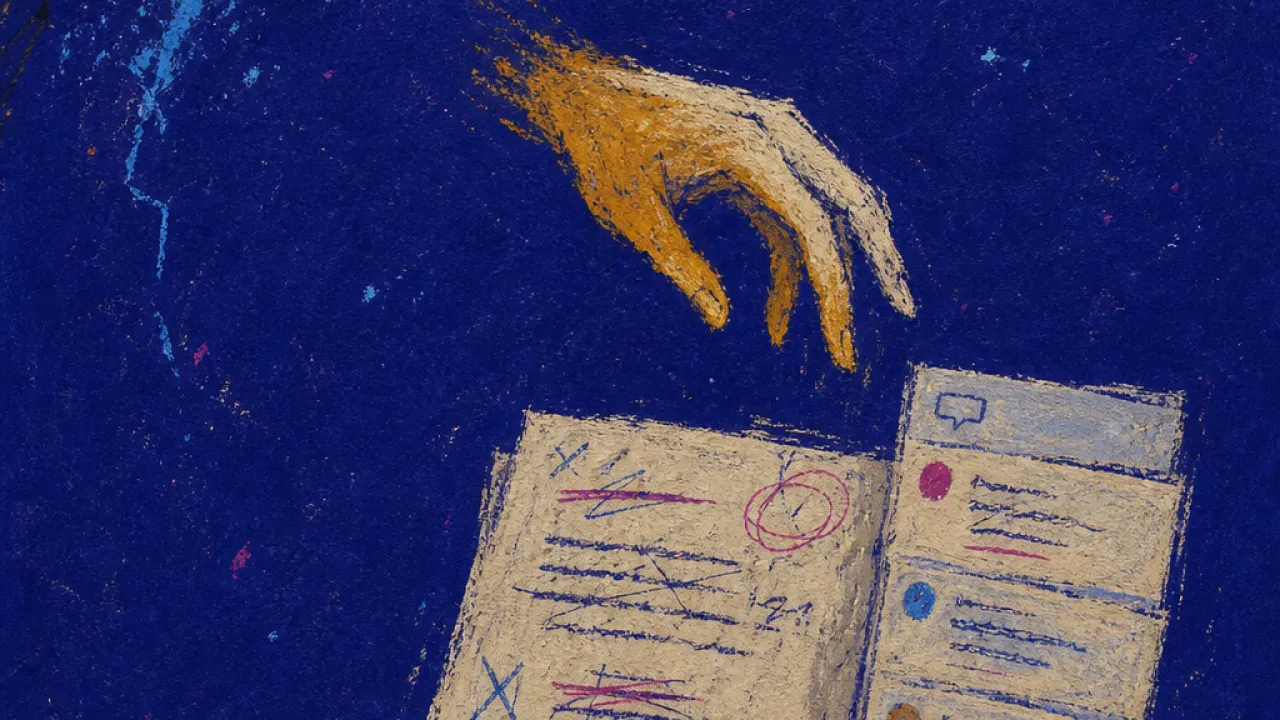
You bring other people's notes into the work: you ask for margin comments, compare the plan with the draft, and pause long enough to let an outside eye test what your private reasoning may have missed. You're trying to keep the feedback loop useful, reducing cognitive dissonance between what you meant, what landed, and what still needs revision while protecting the boundary around your own judgment. But when input starts feeling like permission, every note can make your hand hover over the next move, swinging between defending the work and outsourcing the decision, much like the craftsman in the Three of Pentacles holding his tool while the blueprint and watching figures pull focus from the stone.

Why did it happen?

At some point, another person's eye may have helped you catch the missing line before it became harder to fix, so pausing for input taught your body a way to lower pressure. If praise, grades, manager notes, or a partner's comment once changed the room, waiting for a signal could feel like staying oriented. Now the same inner pattern can keep you refreshing the thread, rereading the note, and waiting for one more check, leaving a tired buzz behind your eyes before anything moves.

How does it feel?

  • A teammate leaves a short note in the doc, and you keep the cursor blinking under the same sentence, reopening the comment even after you have read it twice. In that pause, your jaw tightens and your breath gets shallow, as if the next keystroke needs to pass through the note first. It can stay as one piece of information for now.
  • After a marked essay or review lands, you pinch the corner of the page and trace the same margin line with your thumb before looking at the next paragraph. Your stomach may drop a little, and the space behind your forehead starts to buzz before any revision begins. The page can be held without swallowing all of it at once.
  • When someone close says, "Can I be honest?", you nod quickly and hold your mug with both hands, keeping your eyes on the table while they talk. Heat can rise in your face, your shoulders lift, and your throat feels smaller for a moment. Not knowing where the comment belongs yet is allowed.
  • Alone before sending the message, you line up three bits of advice in different tabs, then hover over the button without pressing it. Your fingers feel cold, and a thin pressure gathers behind your eyes while the screen stays still. The pause can be a pause, not a verdict.
  • In a meeting, you give a small laugh and type every suggestion into your notes, even the ones that are still vague. Your pulse may tap at your wrists while your back stays locked against the chair. You can let one comment wait outside the door for a minute.

Feedback Integration in Tarot Cards

When every comment becomes a checkpoint and your hand hovers over the next move, the pattern is already in the body: the jaw tightens and your breath gets shallow. Jungian archetypal theory gives this tension a language without turning it into a verdict. The Tarot Cards below reflect the unconscious dynamics of building under observation, where input can sharpen the work or take over the hand:

Three of Pentacles Upright
The craftsman does not work in isolation: his raised tool, the open blueprint, and the two watching figures form a visible circuit of action, observation, and correction. The work is not finished, but it is structured enough to receive input without dissolving into chaos. That visual circuit maps directly onto Feedback Integration. In personal growth, the pattern is not about obeying other people's opinions; it is about metabolizing useful signal without turning every comment into a verdict on your worth. You stay in contact with the work, the data, and the larger design at the same time. The Three of Pentacles makes this mechanism unusually concrete because feedback is literally built into the scene. The blueprint does not replace the hammer, and the observers do not replace the worker; their value appears only when the system keeps returning to embodied revision.
Six of Pentacles Upright
The scales hang between the standing figure and the kneeling recipients, turning value into something visible, weighed, and delivered through a shared point of attention. The recipients do not simply grab; they orient themselves toward a measurement system before anything changes hands. Feedback Integration appears when measurement becomes a refining instrument rather than a verdict. In personal growth, the card points to the difference between using feedback to calibrate your next move and letting every external signal decide whether your progress counts at all.
Seven of Pentacles Upright
The figure's gaze moves between the laden vine and the single pentacle already on the ground, with the hoe held as a tool for the next adjustment rather than as decoration. The scene is not a celebration; it is a sober checkpoint where evidence is inspected before the next round of labour. That visual structure maps directly onto feedback integration. In academic life, You may receive grades, tutor comments, mock results, or supervisor notes as raw data, but the nervous system can mistake them for a verdict. Seven of Pentacles keeps the feedback inside the field of cultivation, revealing how a result can become calibration instead of collapse.
Eight of Pentacles Upright
The finished pentacles hang beside the coin still being shaped, so past work and current correction sit in the same field of vision. The hammer and chisel do not punish the material; they give the next mark a precise place to land. Feedback Integration grows from that arrangement: visible evidence of progress can exist alongside unfinished edges. You are not asked to collapse a mistake into an identity verdict; the pattern being audited is whether feedback becomes usable data or a threat to the self-image of growth.
Page of Pentacles Upright
The Page does not merely carry the coin; he studies it at eye level with a careful, almost tactile gaze. His hands hold the symbol lightly enough to examine it, while his body stays grounded on the field rather than recoiling from what he sees. That inspection creates a feedback loop where evidence can be looked at without becoming a personal attack. You can let real data refine your growth strategy when the coin is treated as information, not as a final judgment on your worth.
Queen of Pentacles Upright
The pentacle sits close enough to matter, but it is still an object in the Queen's hands rather than part of her body. Her gaze meets it calmly, with a boundary between the observer and what is being observed. Feedback Integration follows that boundary. In academic work, grades, comments, and rubrics can be held as information instead of swallowed as identity verdicts; the card's stillness shows the nervous system staying present long enough to turn evaluation into usable adjustment.
Ace of Swords Upright
The cloud-borne hand does not hover vaguely; it grips a straight sword and turns an abstract flash into a usable instrument. The yellow light around the hilt makes the moment feel like raw information becoming structured enough to hold, aim, and apply. That is the psychology of Feedback Integration: a signal arrives from outside the usual self-story, and the mind has to decide whether to defend against it or metabolize it. In personal growth, the sword's clean line shows the difference between taking feedback as identity threat and using it as a precise cut through confusion. You are not being asked to accept every opinion as truth. The pattern reveals the moment when critique, reflection, or sudden clarity can be separated from shame and converted into a next move that actually changes the system.
Queen of Swords Upright
The Queen's extended hand is open, but the sword remains upright beside it. The card holds two facts at once: information can be received, and discernment still stays in command. That is the healthy mechanism inside Feedback Integration. In academic settings, You may need to hear critique without turning it into a verdict, extract the useful signal, and leave behind the part that only activates shame or defensiveness. The visual logic matters because the Queen is neither flooded by the clouds nor cut off from them completely. Her position shows the psychological distance required to turn comments, grades, and supervisor notes into revision material instead of identity evidence.
Four of Wands Upright
The two figures raise their garlands inside a four-pillar frame, while the wands stand by themselves without being gripped or defended. The body language is exposed and celebratory, but it is held by structure: the square frame, the hanging garland, and the stable space beneath it all turn effort into something that can be witnessed without becoming chaotic. That visual architecture mirrors Feedback Integration because the card does not show achievement as a final identity verdict. It shows completion as a contained threshold: something is finished, recognized, and then placed inside a larger structure. In academic life, You need that same container when grades, comments, supervisor notes, or exam results arrive. The pattern becomes visible when feedback can be used as information instead of absorbed as shame or inflated into proof of permanent competence. The Four of Wands supports a version of learning where recognition stabilizes the next cycle, rather than making You freeze, defend, or immediately chase the next milestone.
Six of Wands Upright
The rider advances through a crowd whose raised wands do not block him; they frame the movement forward. The scene is public, but it is not chaotic. Attention, recognition, and motion are organized into one shared direction. That geometry turns social response into usable information. The crowd is not merely applause; it becomes a feedback field that confirms where effort has landed and gives the next movement a clearer line. In academic life, Feedback Integration appears when comments from tutors, marks, seminar reactions, or peer review are taken in without collapsing into shame or inflation. The Six of Wands shows the psychologically mature version of recognition: feedback is allowed to matter, but it is processed into strategy rather than swallowed as identity.

Feedback Integration in Tarot Card Reading Insights

For anyone who keeps rereading a note until the next move feels stalled, others have brought this same checkpoint feeling into readings. After the cards, the focus shifts to what shows up when someone sits with critique, revision, and the pull for one more signal. Below are Tarot Reading Insights that speak to Feedback Integration.

Psychological patterns related to Feedback Integration