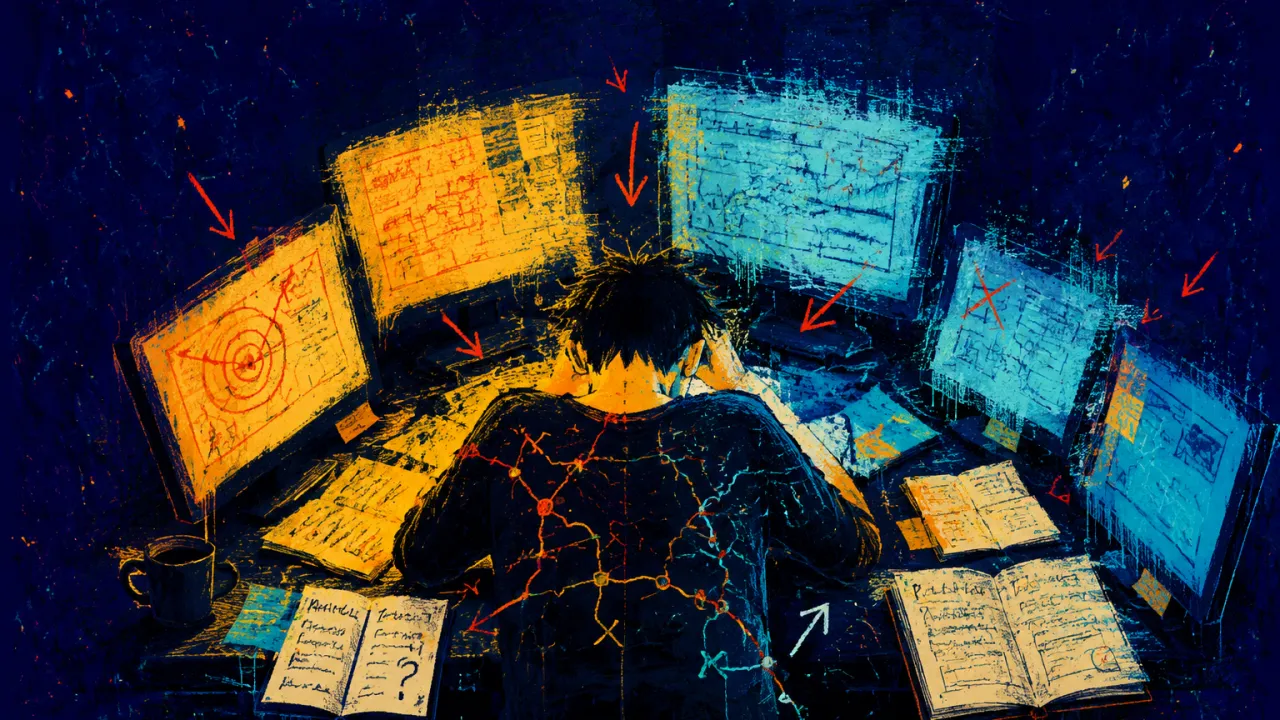
Inner Compass Overload lives in the moment when every signal has evidence, and none of them can become the one you can move by. You can feel it in the tight chest, locked jaw, shallow breath, and the late-night urge to gather one more input before deciding. From an existential perspective, the structural framework of this struggle is not about lacking guidance; it is about forcing too many meaningful signals through one inner channel. The Tarot Cards below make that crowded compass visible without flattening it into a single answer.
The Magician UprightThe Magician’s body is a vertical axis, with one hand raised, one hand lowered, and four distinct tools spread across the table. Every part of the image offers a possible signal: direction from above, grounding below, and separate instruments for emotion, thought, action, and material reality. In introspection, that abundance can turn the self into the only interpreter of too many inner messages. A feeling, a memory, a dream, a trigger, and a bodily reaction can all seem urgent at once, and each appears to demand the correct meaning before you can move. This struggle lives in the pressure of being your own entire reference system. The card gives form to the overload that happens when inner guidance is real, but the number of signals exceeds the capacity to sort them into one usable direction.
ReversedThe Magician gathers every level of the scene through one body: upper symbol, raised wand, lowered hand, table, tools, and ground. Reversed, that concentration overloads the axis that was meant to conduct energy. In a direction reading, this can mirror the exhaustion of trying to process every possible signal at once. You may be weighing instinct, practicality, ambition, identity, timing, and other people's expectations until the inner compass can no longer tell signal from interference. The card does not frame the overload as weakness. It shows an over-instrumented navigation system, where too many meaningful inputs are being forced through one channel and clarity cannot emerge until the load itself is seen.
The High Priestess ReversedMoon symbols, hidden water, a veiled interior, a central cross, and a partly covered scroll all compete as reference points around one unmoving body. The image does not lack inner signal; it contains more subtle signal than the seated form can turn into motion at once. You run into this pressure when self-reflection starts multiplying meanings faster than your life can metabolize them. The card locates the overload in the structure itself: intuition, memory, values, signs, and private knowing are all active, but no single channel has enough priority to become the next clean move.
The Empress ReversedThe reversed Empress intensifies a field already crowded with signals: stars above the head, wheat at the feet, water behind the throne, forest at the back, Venus on the shield, and comfort under the body. Each symbol carries a form of readiness, but together they can overload the inner reference point that decides when to act. Inner Compass Overload shows up when timing is not unclear because there are no signs, but because there are too many. Intuition, social pressure, bodily comfort, emotional flow, and material opportunity all compete to become the main clock. In this structure, the task is not to gather more confirmation. The card witnesses the moment when confirmation itself becomes noise, and your sense of timing needs a clearer hierarchy before the next move can feel internally real.
The Emperor ReversedThe Emperor holds multiple command symbols inside a red field, with the throne, crown, armor, mountains, and hidden water all competing to define orientation. In the reversed texture, those coordinates stop forming a hierarchy and begin crowding the same inner dashboard. Your future can feel overwhelming when every path presents itself as duty, ambition, security, identity, and timing all at once. The problem is not that you have no signal; it is that too many signals are trying to become the final authority. The card witnesses the overload as a structural compression of guidance. The inner compass cannot point cleanly while every inherited rule, practical concern, and private desire is trying to occupy the throne.
The Lovers ReversedThe garden is crowded with guidance signals: the radiant angel above, the serpent at the fruiting tree, the flaming tree behind the man, the mountain between the figures, and the sun pressing light across the whole field. None of these signals is hidden, but they do not merge into one navigable route. When the question is direction, this structure can feel like too much meaning arriving at once. You may be surrounded by signs, advice, urges, and possible futures, while the inner compass loses precision because every signal carries a different kind of authority.
The Chariot UprightThe Chariot gives the driver too many coordinates at once: stars above, city behind, river boundary, square vehicle, command wand, and opposing sphinxes in front. Direction is not absent; it is overdetermined by signals that do not naturally agree. This is Inner Compass Overload in the family field. You may be trying to honor your own values, maintain workable contact, protect your nervous system, and avoid becoming the version of yourself the family expects, all at the same time. The card shows why the question feels bigger than a practical decision. The steering problem is symbolic: every route carries identity, history, guilt, and future selfhood, so the compass becomes crowded before the chariot even moves.
ReversedThe chariot is crowded with directional signals: stars above, command in the hand, emblems on the vehicle, city walls behind, a river boundary, and two sphinxes marking the forward field. Each sign can claim to guide the journey, but together they create more orientation input than the body can immediately convert into a single path. Inner Compass Overload appears when personal growth becomes saturated with possible selves, methods, metrics, and meanings. You are not lost because there is no signal; the card shows a field where too many signals press into the same steering center until inner direction becomes harder, not easier, to hear.
Strength UprightThe woman holds the lion at the mouth, the exact place where force would become sound, bite, or outward motion. Her gaze does not chase the distant mountain; it stays with the living pressure in front of her, turning direction into a sustained act of inner calibration rather than a straight road forward. That structure matches the exhaustion of trying to locate a future by checking every impulse before it is allowed to move. You are not lacking a horizon in this image; the horizon exists, but the usable compass is crowded by too many signals asking to be regulated at once. Strength carries this struggle because its power is not shown as conquest. It is shown as a living interface between instinct and intention, where clarity can only return when the force that wants to move and the self that wants meaning stop overloading the same inner control point.
The Hermit UprightA single lantern shines against a moonless sky and a frozen mountain field. Its light is real, but the scale of the surrounding dark makes the lantern carry more responsibility than any small source can physically hold. That is the shape of Inner Compass Overload in introspection. You may turn inward for direction, emotional truth, shadow recognition, and meaning all at once, until one private signal is forced to answer every hidden question in the system. The star in the lamp gives guidance, but the ice field shows the pressure placed on that guidance. The struggle begins when the inner compass stops being a reference point and becomes the whole weather system You are trying to survive.
ReversedThe star inside the lantern, the bowed head, and the hand held near the heart create a closed circuit of light. With the outer sky blank, the entire navigation system is forced into one small object. In career decisions, that structure becomes the burden of having to generate direction, meaning, and certainty from within when external markers are not trustworthy enough. You may be weighing role changes, skill bets, or leadership moves as if each choice has to prove your entire purpose. The card names the overload of an inner compass carrying too much of the map. Its light is real, but the pressure increases when it has to replace feedback, community, timing, and practical coordinates all at once.
Wheel of Fortune UprightThe wheel is crowded with letters, spokes, books, and elemental marks, all arranged as if the image were both clock and compass. The sky around it is open, but the operational logic is packed into the central device. In inner work, that density mirrors the state of scanning every feeling, sign, memory, and reaction for a final answer. Inner Compass Overload is not a lack of intuition; it is the moment when too many meaningful signals compete to become the one direction you can actually inhabit.
ReversedThe wheel is packed with letters, spokes, elemental symbols, and directional cues, all arranged with apparent precision on a single circular surface. In reversed tension, the same ordered system becomes too dense to navigate because every sign points somewhere and no single line becomes a livable route. For self-growth, this is the overload of trying to build an inner compass from too many frameworks, metrics, and identity upgrades at once. You are not lost because there is no map; the card shows a map so saturated with meaning that your own signal becomes hard to separate from the machinery.
The Hanged Man ReversedThe halo glows around a head hanging below the body, while the feet and hands cannot translate that illumination into movement. Insight gathers at the lowest point of the figure, disconnected from the body's practical channels. Inner Compass Overload is not the absence of intuition; it is too much inner signal without a grounded reference system. You may be reading every sign, urge, and meaning cue, yet the card shows those signals circling inside a suspended body that has no stable horizon.
Temperance UprightTemperance places several reference points in one quiet frame: the water, the shore, the angel's balanced body, the cups, and the distant light at the end of the path. Each one offers a different kind of orientation, and the figure has to keep them aligned while the liquid keeps moving. This is why Inner Compass Overload fits the card in an introspective setting. The struggle begins when every inner signal feels potentially meaningful: a body reaction, a memory, a trigger, a dream, a sudden moment of clarity, a fear that might be wisdom or might be residue. The cups are not passive containers here; they are instruments. The card witnesses the burden of trying to refine too many signals into one trustworthy direction, especially when self-analysis has made the inner world more visible than it is manageable.
ReversedWaterline, stone, diagonal stream, upright body, and distant road all create orientation cues in the same frame. None of them is meaningless, but each asks the body to trust a different kind of information. In a future-direction reading, that density becomes Inner Compass Overload. You are not lost because there are no signals; you are overloaded because every signal feels potentially important, and the system has not decided which one deserves authority. The card contains the overload by making it visible. The compass is not broken; it is crowded by competing inputs that need to be separated before a real bearing can emerge.
The Tower ReversedThe tower's vertical line, the zigzag lightning, the falling crown, and the inverted bodies create competing axes in the same frame. Nothing offers a single trustworthy horizon; every visible cue points the body and attention in a different direction. In a direction reading, this is the overload that happens when every possible future arrives with its own claim on you. Status, intuition, fear, timing, responsibility, and desire can all feel urgent at once, until the inner compass stops distinguishing signal from impact. The reversed Tower contains this struggle as a reference-system failure rather than a lack of ambition. The image shows why choosing can feel impossible: the problem is not that there are no directions, but that too many unstable coordinates are trying to become north at the same time.
The Star UprightThe sky is full of points of guidance, but the body can only work through two small vessels and one grounded posture. The image carries an overload of meaning into a limited human interface, forcing vast direction to pass through ordinary hands. In personal growth, this is the pressure of having too many frameworks, signs, ideals, future selves, and possible callings competing for authority. You are not lost because there is no light; the overload comes from too much symbolic input asking to become one clear next step. The Star places the struggle between the sky and the vessel. Guidance becomes difficult when every signal feels meaningful, because the self then has to choose which light can actually govern a life.
ReversedThe large star, smaller stars, and reflective water create several points of orientation in the same quiet field. When this structure turns inward, guidance stops feeling like a single light and becomes a crowded sky of signals competing for authority. Inside an introspective loop, every hunch, sign, memory, and body cue can seem meaningful, yet none becomes stable enough to steer by. The card locates your confusion in an overloaded orientation system, where the problem is not lack of insight but too many reference points asking to be trusted.
The Moon UprightThe dog, wolf, and crayfish all respond to the same Moon, but none of them speaks the same bodily language. One signal is domesticated, one is wild, and one rises from water before it can walk the road. In a direction reading, that divided animal field gives Inner Compass Overload a precise shape. You may have guidance everywhere, yet the guidance arrives through incompatible systems, so every possible future feels charged before any one path becomes coherent.
ReversedThe reversed Moon turns the whole scene into a field of competing cues. Reflected light, animal calls, water pressure, the emerging creature, and the narrow path all ask to be read, but none of them becomes a stable center of orientation. Inner Compass Overload takes shape when every signal starts to feel meaningful and therefore none of them can organize movement. In personal growth, that can look like mistaking every fear, body sensation, algorithmic self-help prompt, synchronicity, and ambition spike for an instruction about who you are supposed to become. The card does not say your inner compass is gone. It shows a compass flooded by too many inputs, where the deeper task is not to chase another sign but to recognize the noise field that has swallowed your sense of direction.
The Sun UprightThe Sun's rays spread across the whole card rather than pointing to one road. Child, horse, wall, flag, and sunflowers are all equally illuminated, so the scene offers visibility without a built-in hierarchy. Inner Compass Overload appears when the problem is not darkness but too much undifferentiated light. You may be able to see many possible futures, values, and versions of yourself at once, yet the inner ranking system that would turn visibility into direction is overloaded. The card holds that saturation as a structural fact: clarity is present, but it has not become guidance.
ReversedThe sun saturates the whole scene: rays, flowers, wreath, feather, banner, skin, and horse all carry signal at once. The brightness crowds the field until every marker seems equally charged, with almost no shaded interval for sorting intensity. In a choice, that creates a private overload where every option can be defended as meaningful. You are not lacking signs; the struggle is that too many signals are lit at the same intensity, so your inner compass cannot separate true pull from amplified noise.
Judgement ReversedThe trumpet does not enter a quiet field; it floods the entire image from above. Below it, the coffins appear to rest on a surface that is neither cleanly land nor fully water, so the awakened bodies receive a huge signal while their base remains physically ambiguous. Inner Compass Overload emerges when personal growth becomes saturated with meaning. You may be surrounded by frameworks, insights, goals, healing language, and potential timelines, yet the overload of signals makes the next grounded step harder to feel. Judgement gives that condition a spatial form. The call is powerful, but when every part of the self is summoned at once, orientation can collapse into intensity, leaving you awake to everything and anchored by almost nothing.
The World UprightThe World gathers the figure, wands, scarf, wreath, ribbons, clouds, and four corner presences into one synchronized field. The image is not a single signal; it is a total system asking the body to dance while every major reference point stays active. That is the structure behind a choice that suddenly feels bigger than the choice itself. You are trying to hear one preference inside a whole-life audit, and the card locates the overload in the fact that every value, role, timeline, and desire is speaking at once.
Ace of Cups UprightThe Ace of Cups stacks several signals on one axis: a hand from the cloud, a descending dove, a central cup, five streams, falling droplets, and the pool below. Each point seems meaningful, and each one competes to define where the center of the experience is. Inner Compass Overload forms when too many inner authorities activate at once. Feeling, intuition, desire, spiritual language, self-improvement ideals, and imagined future selves all begin to speak, but no single signal becomes stable enough to guide movement. In personal growth, this card can mirror the moment when every framework feels relevant and every impulse feels like a sign. You are not empty of direction; you are crowded by meanings that have not yet been sorted into a usable inner hierarchy.
ReversedTurned upside down, the same cup, dove, and water system no longer reads as a clean descent into overflow. The signal, vessel, and stream still exist, but their directional relationship becomes harder to trust as a guide. Inner Compass Overload is the state where every internal cue starts competing for authority. One part of you reads desire as truth, another reads fear as protection, another reads guilt as duty, and another reads relief as escape. The card's reversed structure captures that saturation: the water is active, but the system no longer knows which movement is the compass. For a choice spread, this struggle matters because more introspection may not immediately create more clarity. The card names the point where the inner field is too crowded to function as a clean signal, and the first act of agency is recognizing that not every feeling deserves the same voting power.
Two of Cups UprightThe serpent staff rises between the two cups like a vertical measuring rod, while the distant town pulls the eye into depth and the two bodies hold a lateral line. The image offers several legitimate reference points at once, none of them physically erased by the others. That is the shape of an overloaded compass: connection, desire, stability, and symbolic promise all compete to define the long-range route. You are not lacking signals; the card locates the strain in having too many signals occupying the same inner dashboard.
Seven of Cups UprightThe cups do not present one desire with background details around it; they present seven symbolic demands at equal height, equal distance, and equal intensity. Home, recognition, wealth, creativity, temptation, image, and hidden identity all become coordinates in the same clouded field. Inner Compass Overload appears when personal growth stops having a stable center and becomes a collision of inner authorities. You can feel the pull of multiple true things at once, but the card shows why that truth becomes unusable when no grounded reference point organizes the field. The shrouded figure in one cup sharpens the tension. The deeper self is present, but it is only one symbol among many, so the search for self-realization becomes crowded by every other version of a meaningful life.
ReversedSeven cups present seven value signals at once, and none is placed closer to the figure than the others. Security, recognition, desire, creativity, image, and hidden self all occupy the same misty plane, crowding the body's ability to sense a single pull. You may be able to explain every possible degree path and still not feel which one is yours. The card names Inner Compass Overload as the moment academic desire is drowned out by too many equally charged meanings.
Eight of Cups UprightThe moon covers the sun over a path that is already difficult to read. The figure keeps moving, but the scene offers mixed light: intuition, memory, dream logic, and ordinary visibility overlap without becoming one stable map. Inside an introspective process, that sky describes the overload of relying on inner signals when every subtle cue starts to feel meaningful. You are not lacking an inner compass; the strain is that the compass is receiving too much symbolic weather at once, and the path asks you to move before the signal has simplified.
ReversedThe moon crossing the sun puts the scene under mixed light, while the figure moves without a fully visible destination. The path is guided by internal pull rather than bright external proof, and that guidance can become heavy when every sign has to be decoded before the next step. In personal growth, the same structure appears when introspection, healing content, journaling, and meaning-making start crowding the action system. You are not empty of insight; the problem is that insight becomes another sky to navigate while the ground still demands a step. Inner Compass Overload gives that pressure a shape. The card shows an inner search powerful enough to eclipse ordinary markers, leaving you with too many signals and not enough embodied direction.
Page of Cups UprightThe Page's eyes are held by one small cup while the whole sea behind him continues to move. The sky offers no marker, no road, and no external point of orientation; the most vivid signal in the scene is the one he is already holding. Inner Compass Overload appears when every inner ripple starts competing for the status of guidance. You may not be lacking signs; the strain comes from having too many delicate signals and no stable hierarchy for which one should become your long-range direction. The card gives that overload a shape: a young body trying to stay poised while the smallest symbol becomes louder than the horizon. It marks the point where sensitivity stops feeling like guidance and starts flooding the navigation system.
ReversedThe Page keeps the cup lifted and his posture composed while the fish breaks the expected function of the vessel. The scene looks delicate from the outside, but the body is managing several unstable references at once: the formal role, the strange message, the moving water, and the need to keep the cup steady. Inner Compass Overload appears when decision guidance becomes too crowded to navigate. You may be trying to treat every feeling, sign, fear, attraction, and timing cue as equally meaningful, until the inner system loses the ability to rank what matters. The reversed pressure is not a lack of intuition. It is a saturation of inner reference points, where the cup keeps receiving signals but no longer helps you choose which signal deserves authority over the next move.
Knight of Cups ReversedThe Knight carries too many directional symbols at once: wings for elevation, armor for protection, fish for emotional movement, the cup for longing, the horse for travel, and the river for transition. In reversal, this symbolic richness can stop functioning as guidance and become a crowded internal dashboard. You may not be empty of signs, desire, or meaning. The strain comes from having too many signals claiming to be the true compass: the beautiful option, the safe option, the emotionally charged option, the spiritually meaningful option, and the one that might actually carry you forward. The card frames this overload as a navigation problem rather than a personal failure. The work begins where the signals are separated, ranked, and returned to scale so that one direction can become visible again.
Queen of Cups UprightThe Queen sits at the edge of water with her whole upper body organized around a sealed cup. Her gaze does not travel toward the open sea or the wall beyond it; it returns to the vessel in her hands, as if the future must be read from an inner object before any movement can begin. That structure makes direction feel dense rather than absent. You are not facing a blank horizon so much as a horizon filtered through too much inner material, where every possible route has to pass through feeling, intuition, memory, and private symbolism before it can become a choice. Inner Compass Overload names the strain of having an active inner guidance system that has become too saturated to function as a compass. The card holds your search for direction inside a beautiful but closed vessel, showing how depth can become disorienting when it cannot translate into a livable line forward.
ReversedThe card layers water upon water: sea, shell clasp, fish, cup, flowing shawl, and throne carvings all speak in the same symbolic register. The horizon and land exist, but they are quieter than the emotional field surrounding the Queen. Reversed, the intuition field becomes too dense to navigate. You may receive feelings, signs, dreams, bodily reactions, and imagined outcomes all at once, but the overload flattens their hierarchy until no signal can guide the decision. Inner Compass Overload is not the absence of intuition; it is too much unweighted intuition inside too small a coordinate system. The card names the moment when the inner sea stops pointing north and starts surrounding every option equally.
King of Cups UprightThe card repeats the water symbol at multiple scales: the Cup in the hand, the fish at the chest, the dolphin rising nearby, the ship in the distance, and the sea beneath the throne. None of these signals is identical, but all of them ask to be read. In a choice spread, that repetition becomes an overload of inner evidence. Gut feeling, emotional memory, imagined consequence, timing, and longing all seem to speak at once, while the throne itself rests on a moving reference point. This struggle appears when the problem is not lack of intuition, but too much internal weather arriving without hierarchy. The card gives shape to the moment when the inner compass multiplies into several competing readings and the choice loses its single north.
Two of Pentacles ReversedThe sea behind the figure moves in heavy waves while the foreground loop demands total attention. In reversal, the body keeps serving the circuit, and the larger field of orientation becomes something endured rather than read. Inner Compass Overload emerges when the rhythm of managing growth replaces the felt sense of where growth is actually going. You may have too many maps, metrics, methods, and versions of a better self, until the act of navigating becomes louder than the direction itself. The card gives this struggle a concrete shape: a person maintaining motion inside a closed loop while the wider horizon keeps shifting. The issue is not that you lack a path; it is that the inner instrument used to sense the path is carrying too many signals at once.
Six of Pentacles ReversedThe scales, the falling coins, the hanging pentacles, and the flat platform all offer different ways to read the scene. In the reversed texture, those reference points do not clarify the field; they multiply the measurements until the body no longer knows which signal deserves trust. Inner Compass Overload in direction work is not the absence of guidance. It is the pressure of too many metrics, too many interpretations, and too many practical arguments crowding the quiet signal that would otherwise orient your next long-range move.
Nine of Pentacles ReversedThe falcon is the scene's sharpest instrument of orientation, yet its hood removes sight while the estate supplies plenty of external landmarks. House, trees, vines, coins, and cultivated borders can all tell the body where it is, but none of them can replace the bird's line of sight. Inner Compass Overload appears when too many finished signals crowd out the one signal that would actually choose a direction. You may have evidence, options, and sensible markers everywhere, while the part of you that knows how to track the living horizon has been covered by the noise of what already looks successful.
Queen of Pentacles ReversedThe card contains several possible centers: the stone throne, the living garden, the flowing water, the crown, and the pentacle. In the reversed structure, attention collapses too forcefully onto one axis of value, while the rest of the inner landscape remains active but under-consulted. This is the shape of introspection when clarity becomes overcrowded. You may be trying to listen to your body, your values, your comfort, your ambition, your shadow material, and your need for peace all at once, then forcing one symbol to settle the whole field. Inner Compass Overload names the breakdown of orientation caused by too many legitimate signals competing for authority. The card's richness becomes a map of the problem: the guidance is not absent, but the inner coordinate system is carrying more reference points than it can rank.
Ace of Swords UprightCrown, olive, palm, light, and blade all balance on one narrow vertical instrument. The whole image concentrates authority, peace, victory, and thought into a single axis, while the hand must keep that axis steady without any visible body or ground beneath it. You may be asking one inner answer to carry too much: timing, purpose, identity, risk, approval, and the shape of the next decade. The struggle is not that your compass is missing; it is that the compass has been overloaded until every direction feels too heavy to hold.
Two of Swords ReversedThe crescent moon, tide, sea, and covered eyes all point toward inner perception, but none of those signals reaches the arms in a way that changes the posture. The body receives atmosphere, rhythm, and pressure while the swords remain fixed. Inner Compass Overload emerges when every internal signal starts competing for the role of truth. In a choice spread, intuition may not be absent; it may be overcrowded by fear, desire, timing, guilt, and imagined future cost all speaking in the same volume. The card shows why listening harder can become another form of paralysis when the inner field has no organizing center. The moon sits between the blades rather than beyond them, so the guidance itself is caught inside the split. The struggle is not that you lack an inner voice; it is that too many voices have been forced into one narrow decision channel.
Nine of Swords UprightThe quilt covers the lower body, but its patterned surface is crowded with repeated and incomplete signs. What should be a soft boundary for sleep becomes another map to read, another surface where the mind can search for causes, timing, and hidden meaning. Inner Compass Overload is not the absence of signs; it is too many unstable signs competing for authority inside the same private room. The figure is awake beneath a grid that promises orientation yet offers no clean sequence, while the swords above keep thought sharp and urgent. In introspection, You may be surrounded by symbols, memories, dreams, screenshots, synchronicities, and emotional clues, but none of them settle into direction. This card marks the overload point where meaning-seeking stops guiding the self and starts fragmenting the inner compass.
Page of Swords UprightThe Page stands high enough to see farther than the ground beneath him can safely support. Birds cross the upper sky, clouds gather close to the body, and the wind keeps everything in motion at once. Inner Compass Overload is the pressure of too much directional material arriving without a clear ranking system. You are not shown as lacking options; the card shows a field where possibility, warning, curiosity, and movement all compete for the same inner bandwidth. The raised sword tries to create a clean line through that atmosphere, but the surrounding elements keep multiplying the signals. The struggle becomes the burden of turning a crowded future into one livable heading.
Knight of Swords ReversedClouds, trees, horse, plume, cloak, sword, and shouting face all pull the eye into competing signals of speed and direction. The sky is clear enough to move, yet the wind makes the whole field feel mechanically loud. That pressure carries Inner Compass Overload in choice work: too many signs begin to sound like instructions, and every option seems to demand immediate interpretation. You are not lacking signals; the card shows a navigation system flooded by signal strength.
Ace of Wands ReversedThe wand is a powerful sign of beginning, but it is not a map. Around it, the cloud, river, trees, hill, and distant castle all provide possible coordinates, while none of them clearly tells the hand what the next movement should be. When turned inward, that abundance of signal can become too much to sort. A mood, dream, urge, trigger, or repeated symbol may all feel important, and the inner compass starts receiving more meaning than it can rank. The hand keeps holding the wand even without a visible body or path. The card frames the struggle as compass overload, where guidance has not disappeared; it has become so charged and crowded that direction itself starts to lose signal quality.
Three of Wands UprightFrom the cliff, the figure can see land, water, ships, hills, sky, and three separate wands holding different vertical points around him. The view is expansive, but it asks one body to organize too many possible directions at once. Inside deep self-reflection, that open field can overload the inner compass. Every interpretation, future self, and hidden motive seems plausible, so clarity turns into a map with too many routes and no felt north. The card ties this struggle to the geometry of the horizon. You are not lost because there is nothing to see; the pressure comes from seeing too much before one direction has become embodied enough to trust.
Five of Wands UprightThe Five of Wands fills the foreground with five raised staffs, each angled toward a different point, while no figure holds the center long enough to organize the movement. The bright open sky gives the future visual space, but the human field below turns that openness into competing vectors. You meet the direction question inside that collision field: every possible route carries charge, but the card shows no shared axis that can translate charge into a course. Inner Compass Overload emerges when the future is not empty but over-signaled, and clarity is buried under too many live claims on your attention.
ReversedThe reversed Five of Wands distorts the body's ability to read the field. With limbs, wands, and uneven footing all overlapping, it becomes hard to tell which movement is threat, which is defense, which is performance, and which is simply momentum. Inside an introspective process, that distortion becomes Inner Compass Overload. Too many signals arrive with equal urgency: one says protect yourself, one says push harder, one says you are overreacting, one says something is wrong, and one says keep going until the noise resolves. The uneven ground shows the deeper cost. When instability becomes the baseline, the compass does not disappear; it floods, overcorrects, and loses calibration because every inner signal has been trained to sound important at the same time.
Eight of Wands ReversedEight nearly identical wands fill the open air with the same slant, spacing, and speed. The scene has no figure, no hand, and no face, so there is no visible center of perception inside the rush. In a direction reading, the repeated vectors become too much signal with no inner receiver. The card locates the overload in the gap between many urgent paths entering the field at once and the missing embodied point that could sort which one is actually yours.
Page of Wands ReversedThe open desert gives the Page too much horizon and too little route. The wand, his body, and the distant pyramids all offer vertical reference points, but none becomes a grounded way through the field. Inner Compass Overload appears when every inner sign starts acting like a direction. In shadow work, you can become crowded by symbols, impulses, and possible meanings until the nearest guide is the one object you are already straining to hold upright.
Knight of Wands ReversedThe distant pyramids are present, but the rearing horse dominates the frame so completely that the long horizon becomes secondary. The body's immediate balance problem pulls attention away from the larger geography of the journey. That is the spatial logic of an overloaded compass. When too many signals crowd the field at once, the strongest sensation starts to feel like the truest direction, even if it is only the nearest surge. For direction work, the reversed Knight of Wands names a navigation system flooded by impulse, possibility, pride, timing pressure, and signs of achievement. The struggle is not that there is no signal; it is that the signal field has become too loud to separate guidance from stimulation.
Queen of Wands UprightThe Queen is surrounded by too many active signals: wand, sunflower, lions, crown, throne, desert, pyramids, and the black cat at her feet. Each symbol carries a possible bearing, but all of them converge on one still body that must hold the whole charge at once. Inner Compass Overload forms when every signal feels meaningful and none can become primary. In a direction reading, this card can witness the pressure of having too many futures, desires, identities, and intuitive hits competing inside the same inner dashboard.
ReversedThe Queen is surrounded by competing guidance systems: the wand, the sunflower, the crown, the lions, the black cat, the throne, and the distant desert markers. Each symbol offers a different kind of signal, but the body remains seated in the center of all of them. In a decision, that becomes the overload of having too many forms of knowing active at once. Instinct, desire, image, strategy, fear, and meaning all claim to be the real compass, and the more signals you consult, the harder it becomes to feel a single direction. The card does not reduce the struggle to confusion. It shows an overpopulated inner dashboard, where the problem is not the absence of guidance but the lack of a clear hierarchy among the signals asking to steer the choice.
No cards available for this filter.