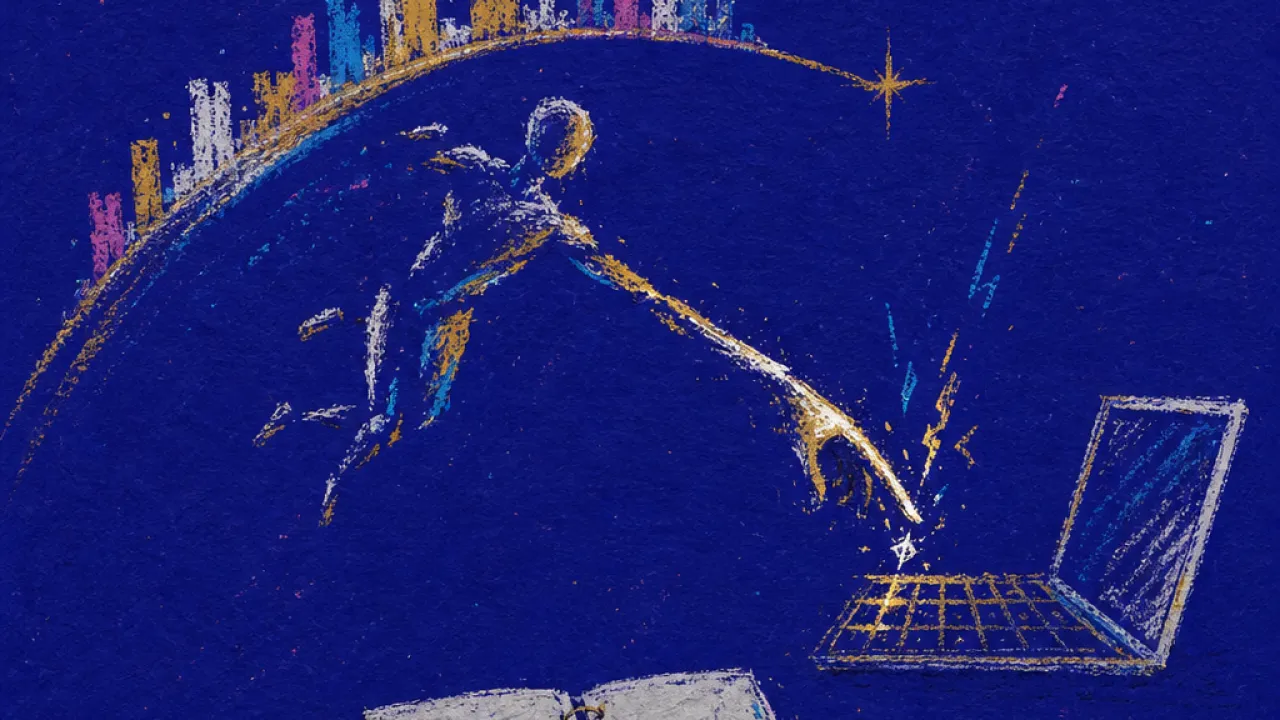
That moment when the future is vivid but the first line, message, or routine stays untouched is where Vision-Execution Split becomes visible. Your shoulders climb, your breathing gets shallow, and your hand hovers over the keyboard as if the body is waiting for a bridge the mind has already drawn. From an existential angle, the structural framework of this struggle is the gap between a horizon that feels clear and a life that has to carry it through small, repeated moves. These Tarot Cards trace that outline without turning it into a lesson.
The Star UprightThe Star makes the future visible without making the route simple. Sky, water, land, and body all appear in one clear field, yet each belongs to a different order of reality, so the image holds vision and embodiment close together without collapsing them into the same thing. In personal growth, this is the ache of seeing the person you could become while struggling to build the daily architecture that would make that person real. The vision may be bright, sincere, and stabilizing, but execution still belongs to the ground, the schedule, the body, and repeated choices. The card witnesses the split between a self that is already visible in the inner sky and a life that has not yet reorganized around it. The struggle is not a lack of desire; it is the unfinished bridge between revelation and repetition.
The Sun UprightThe red flag is lifted high, but the child's hand is not attached to the horse's movement through reins or a bridle. The card separates proclamation from steering: one symbol declares life-force and direction, while the other carries the body forward without a visible control interface. That separation is the exact shape of Vision-Execution Split in personal growth. You may know what kind of person you want to become, feel the force of the vision, and even announce it inwardly with conviction, while the daily mechanism that would guide the next step remains vague. The Sun's brightness makes the split more visible, not less. It shows that inspiration can be genuine and still structurally incomplete when it has not been translated into practice, pacing, and grounded contact with action.
The World UprightThe dancer holds two wands with visible mastery, but neither wand points to a road outside the wreath. The tools are active, the posture is alive, and the body is capable, yet the available motion is still organized by the completed circle. Vision-Execution Split lives in that mismatch between inner readiness and outer route. You may have a clear sense that your life needs to move, and you may even have the skills, language, and energy to begin, but the card shows those tools circulating inside a symbol of completion instead of extending into a specific path. In a direction reading, this card gives the struggle a precise edge. The issue is not whether you have potential; it is that the vision has not found a channel that can carry it into the next terrain.
Seven of Cups UprightThe cups are full, but nothing pours. They hold castles, jewels, symbols, and creatures as images suspended above the figure rather than materials moving into the figure's hands. That separation is the core geometry of Vision-Execution Split. In personal growth, the future can become intensely visible while the mechanism for building it stays absent, making transformation feel vivid in imagination and strangely unreachable in practice. The figure's stillness matters because the card does not show a lack of vision. It shows vision without transfer, where the energy of self-improvement rises into symbolic possibility but fails to descend into habit, discipline, and repeated action.
ReversedThe figure faces a complete display of possibilities, but no cup is touched, lifted, emptied, or carried away. Vision fills the card while execution has no visible tool, path, or point of contact. In career terms, Vision-Execution Split appears when planning, researching, comparing, and imagining create the sensation of movement without producing contact with reality. You may have the pivot map, the skill list, the promotion plan, or the leadership narrative, yet the action system remains below the cloud line. The reversed structure turns the display into a loop: more vision does not create more traction. The card marks the boundary where career imagination must stop substituting for contact, because the path cannot begin while every plan remains suspended in the same air.
Knight of Cups UprightThe Knight holds the cup in front of him with full attention, while the horse still has to carry his body toward a river crossing. The vision is not vague; it is visible, cherished, and centered. What remains unresolved is the translation between the object of aspiration and the mechanics of movement. You can recognize this tension in personal growth when the future self feels more alive than the next repeatable step. The inner image has emotional authority, but the reins, hooves, riverbank, and pace show that transformation still has to pass through friction, sequencing, and physical follow-through. The struggle is not a lack of desire. It is the split between a self that can hold the cup and a system that has not yet learned how to cross with it.
Three of Pentacles UprightThe blueprint, the hammer, and the finished pentacles do not occupy the same level of the scene. The plan is held beside the work, the tool is pressed toward one pillar, and the symbols of completion sit above a structure that is still being shaped. Vision-Execution Split emerges from that vertical separation. You can see the long-term architecture, but the next timed action still belongs to a slow material process that must be handled piece by piece. In a timing reading, this struggle appears when the future image becomes louder than the real sequence available now. The card does not collapse the vision; it shows where vision must pass through craft, feedback, and staged timing before it becomes something you can enter.
Seven of Pentacles UprightThe hoe is in the figure's hands, but it is functioning as a prop instead of a tool. His gaze stays on the vine, making the card's action field strangely suspended: the instrument for doing is present, while the body remains in evaluation. That suspended tool is the visual core of Vision-Execution Split. In lifestyle terms, the blueprint may be clear enough to imagine: a cleaner room, a better sleep rhythm, a healthier week, a more intentional pace. The difficulty appears at the point where the plan must become a bodily sequence inside an ordinary day. The card does not accuse the pause of being empty. It shows the gap between seeing what a life could become and locating the next usable action that would let that vision enter the physical system you actually live in.
Eight of Pentacles UprightThe craftsman bends over a single pentacle with hammer and chisel, while the path toward the distant town sits outside the active line of his body. The card's visual tension is not idleness; it is the narrowing of attention until execution becomes the whole field of vision. That narrowing gives Vision-Execution Split its shape. You can keep doing the next right thing, refining the next deliverable, and proving your discipline, while the larger route remains untested in the background. For a direction reading, this card locates the friction between competence and orientation. The workbench shows where your energy is going, but the distant town asks whether that energy is still attached to a future you can actually recognize as yours.
Page of Pentacles UprightThe boots are ready on the grass, but the body is not traveling; the raised coin suspends the upper body in inspection. A journey is implied by the plain and mountains, yet the current mechanics of the figure keep vision above the path rather than inside it. Vision-Execution Split lives in that gap between the future you can picture and the movement you can actually inhabit. You may have enough clarity to name a direction, but the card shows the moment where clarity has not yet become a route your body trusts.
Ace of Swords UprightThe sword is held with precision, but its blade is not cutting into the terrain below; it is lifting a crown in the open sky. The tool of thought is elevated into a symbol of achievement, while the ground where work would actually be done stays distant and dry. That distance gives this card its career pressure. You may have a clean insight, a sharper plan, or a strategic read on what needs to happen, yet the path from that mental clarity to visible execution is not physically present in the scene. Vision-Execution Split names the gap between knowing what would move the work forward and having the grounded structure, mandate, or leverage to make it happen. The Ace of Swords does not dilute the clarity; it shows why clarity alone can feel exposed when the workplace has not built a runway for action.
Ten of Swords UprightThe swords are not in the figure's hands; they are embedded in the body. Thought has stopped being a tool that can point, cut, compare, or decide, and has become a weight that fixes the whole system to the ground. In a direction question, this becomes Vision-Execution Split. You may still recognize a possible horizon, but the same mental force that maps the future also overloads the body that would need to move toward it, so the plan stays visible while action remains unavailable. The card's cruelty is its precision: each sword is aligned, direct, and final. That precision mirrors the kind of overanalysis that feels accurate but leaves no living joint free, turning insight into a structure that explains the dead end without opening it.
King of Swords UprightThe King's sword is ready, vertical, and perfectly visible, but it is not cutting anything in the scene. His attention stays aligned with the instrument of decision itself, making clarity the center of the image rather than the road beyond it. That is the exact shape of a future that can be conceptualized more easily than entered. You may have the language, principles, and strategic map for your next direction, but the card shows the blade held as a symbol of readiness while the body remains seated, separating vision from the friction of execution. In direction work, this struggle often feels like being almost ready for months or years. The King of Swords reveals that the obstacle is not ignorance; it is the way a clean mental model can become so commanding that real movement feels premature, messy, or insufficiently proven.
Ace of Wands UprightThe hand emerges from the cloud with a sprouting wand already in its grip, yet the wand is still suspended above the landscape rather than planted into it. Leaves fall and the river moves, but the central force has not crossed into a concrete path, page, or structure. In academic work, this is the exact shape of having a thesis idea, a study plan, or a flash of understanding that never becomes usable output. You are not facing a lack of spark; the friction sits where inspiration must become paragraphs, solved problems, revised drafts, or a repeatable study motion.
Two of Wands UprightThe figure holds the globe at chest height while the wand rests against the battlement, turning the whole academic horizon into something visible but not yet entered. The coast, fields, and mountains are laid out in front of him, but the body stays on the castle edge, supported by the same wall that keeps movement suspended. That is the shape of Vision-Execution Split in study: You can see the essay, degree path, or research direction with almost painful clarity, yet the work does not cross into the page, exam script, or supervisor-facing draft. The card locates the friction in the gap between mapped possibility and embodied production, where knowing the route is not the same as stepping into it.
Three of Wands UprightThe man stands beyond the two planted wands, with one hand on the third while his gaze travels across water toward ships already in motion. His body has crossed a threshold, but the next movement is displaced into distance: sight moves faster than feet, and strategy reaches farther than contact. For personal growth, this structure names the friction between a clear future self and the daily mechanics that would make that self real. You are not lacking a horizon; the card locates the strain in the gap between knowing where expansion points and having an embodied path across the water.
Eight of Wands UprightEight wands are almost at the land, yet they remain suspended in air, separated from the green ground and the stream below. The visible trajectory is real, but the point of contact is missing, so intention has not become lived terrain. For a future-path question, this makes the split between vision and execution concrete. You can see the line of movement, but the card holds it just before landing, naming the strain of having a future image that has not yet found a stable way to enter your life.
Ten of Wands UprightThe distant building gives the scene a clear direction, but the man's immediate field is crowded by the very wands he is using to get there. His arms can hold the load, yet that holding position steals the freedom to look, adjust, and choose the next step with full sight. For personal growth, this is the split between having a future self in view and losing contact with the lived path underneath your feet. You may know the goal, the framework, the identity you are trying to build, but the execution stack becomes so dense that it blocks the real-time feedback needed to move with clarity.
Page of Wands UprightThe Page holds the wand upright like a live signal, but the staff is suspended above a barren field rather than planted into anything that can receive it. His gaze rises toward the wand and beyond it, while the desert around him offers no bench, road, audience, or built structure where the spark can become a repeatable act. That visual friction maps directly onto the split between having a vivid image of growth and having a grounded channel for execution. You may be able to name the next version of yourself with startling clarity, yet the daily system that would carry that version into form remains dry, open, and underbuilt. The card does not reduce this to laziness or lack of ambition. It shows a real current of creative fire being held in the wrong relationship to matter: lifted, admired, announced, but not yet given a place to land.
ReversedThe wand remains upright as a clear sign of promise, but it is still held above the ground rather than rooted into it. The bright clothing, raised head, and heraldic posture create a visible signal while the surrounding desert shows no change in the practical terrain. In love, that structure exposes the split between what is imagined or said and what is actually carried through. You may be responding to the heat of plans, messages, and chemistry while your body keeps noticing that consistent effort has not arrived in the real field of the relationship.
Knight of Wands UprightThe wand is held like a clear standard, but the horse's body is still in the launch mechanism rather than on the road. A destination appears in the far desert, while the foreground is dominated by reins, armor, and a mount that has not converted force into travel. That gap gives the personal-growth struggle its shape. You can carry a vivid image of the self you want to become, yet the daily execution layer remains loaded, suspended, and hard to land, so the vision stays bright while the body of change never fully enters motion.
Queen of Wands UprightThe Queen holds a wand in one hand and a sunflower in the other, but the wand stops at the throne steps instead of reaching the desert ground. Her attention is pulled toward the living flower while the implement of action remains upright, controlled, and partly absorbed into the architecture of her seat. That visual gap gives Vision-Execution Split its shape in a direction reading. You may be able to see the future that feels alive, yet the mechanism meant to carry that vision into motion still terminates inside an older platform of identity, leaving the next move suspended at the edge of action.
King of Wands UprightThe king leans forward with the alertness of someone already seeing the next horizon, yet his body remains seated and the wand is planted into the ground. The image holds vision and movement in different parts of the body: the eyes travel, the torso prepares, but the base stays locked into command. That structure mirrors a personal growth state where your future self feels vivid but your daily system has not caught up. You can feel the direction, name the goal, and even hold the symbol of power, but the route from insight into habit is still missing. The struggle is not a lack of ambition. It is the split between a mind that has already moved ahead and a body-level life that is still organized around watching, planning, and holding the throne.
No cards available for this filter.