Forced Positivity After Hurt: Hearing Anger Behind 'Happy to Help'

The Bright Reply That Hid the Warning Light
If a colleague has ever talked over you and you have answered with an unusually warm Slack message before checking whether something actually hurt, I know how invisible that moment can look from the outside. Forced positivity often arrives dressed as emotional intelligence: polished, collaborative, and quick enough to erase the evidence before anyone sees it.
Maya (name changed for privacy), a 28-year-old communications coordinator in Toronto, brought me one of those moments. At 5:47 on a rainy Thursday, she had been standing on Line 1 after a coworker handed her a last-minute task. The train brakes squealed against the rails, wet coats carried that metallic rain smell, and her phone was warm in her palm. In Notes, she typed, “I cannot take this on.” Then she deleted it and sent, “Happy to help!”
I watched her jaw tighten as she told me. She felt heat, then edited it into reassurance. She felt dismissed, then edited it into an explanation of the coworker's workload. She felt the edge of a boundary, then edited it into gratitude for having a job at all.
“I can be grateful and still be angry,” Maya said, pressing her tongue briefly against the inside of her cheek. “But I keep acting like I have to choose. I want to hear what my anger is saying before I turn it into a lesson.”
I told her, “You can be grateful for the relationship, the job, or the opportunity and still be angry about what happened inside it. Those feelings do not cancel each other. And hearing anger does not mean obeying it.”
The pressure in her body looked to me like a warning light hidden beneath a screen turned to maximum brightness. Everything appeared cheerful, but the alert had become harder to read. Shame followed close behind the heat, settling over the original feeling like a hand reaching for the mute button.
“How does forced positivity keep me from hearing my anger?” she asked.
“Let's give the feeling somewhere to exist before we decide what it means,” I said. “Our goal is not to make you angrier, prove anyone wrong, or force a confrontation. We are going to map the sequence between what happened, what your body registered, and what you chose to say. The clarity will come from your own recognition.”

Choosing the Ladder Beneath the Bright Surface
I invited Maya to put both feet on the floor and take one slower breath. I shuffled while she held the question in mind, using the brief pause as a transition from rapid explanation into focused observation, not as a mystical test she had to perform correctly.
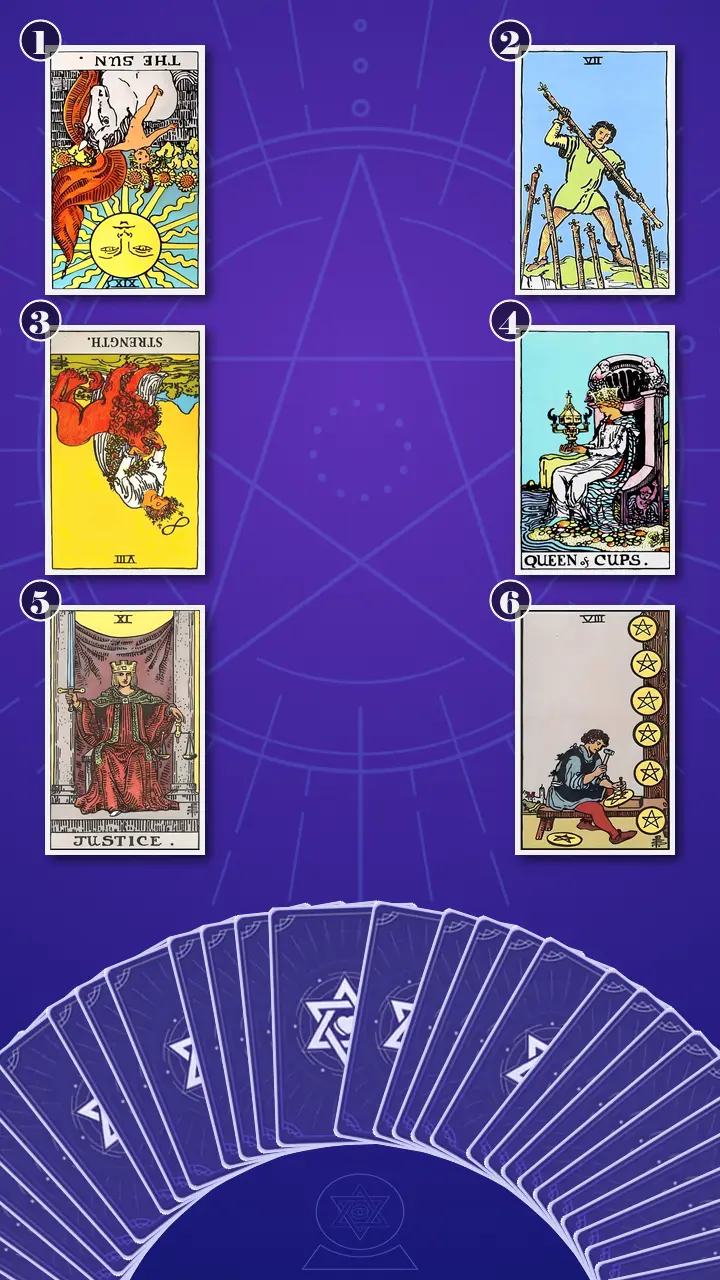
I chose the Four-Layer Insight Ladder · Context Edition, a six-card tarot spread designed to trace a visible behaviour down through its emotional mechanism and back into a practical response. This was an inner-excavation question, not a request for a prediction. A past-present-future spread would have imposed a timeline Maya had not asked for, while a larger outcome-based spread could have distracted us with possibilities outside her control.
This is how tarot works in my practice: the cards externalise a pattern so we can examine it without treating the first explanation in our minds as the whole truth. Card meanings in context become prompts for recognition, differentiation, and choice. They do not determine another person's motives, guarantee a relational outcome, or replace Maya's judgment.
The first position would show the presenting behaviour: the bright emotional edit. The second would reveal the message suppressed beneath it, especially any boundary the anger might be protecting. The third would expose the control script that made anger feel morally unsafe. The fourth would show the emotional permission Maya needed. The fifth, our transformation lever, would help distinguish feeling from fact, conclusion, and response. The sixth would turn that discernment into one repeatable practice.
I arranged the cards in a two-by-three grid. The upper pair held the visible pattern and its buried signal. The middle pair held the control rule and the inner resource capable of loosening it. The lower pair held discernment and action. To my eye, the layout resembled a staircase descending beneath a brightly lit surface and returning to ordinary life with something usable.
The Brightness Test That Looked Like Maturity
Position 1: The Reply That Erased Its Own Reason
The card I turned over now represented the presenting energy: the specific way Maya edited anger into reassurance or gratitude before understanding it. It was The Sun, reversed.
I pointed to the enormous white sun, the unguarded child, and the row of sunflowers. Upright, The Sun can express freely felt clarity, vitality, and openness. Reversed here, that brightness had become an overcorrection. Joy was no longer simply available; looking bright had become a standard Maya felt required to meet.
“This is the Slack moment,” I said. “You feel heat after a dismissive reply and type, ‘No worries at all!’ before checking what felt unfair. The message looks resolved on screen, but your jaw is still tight. The bright tone does not clarify the interaction. It floods the frame until the specific injury disappears.”
I read the reversal as both Excess and Blockage: too much performed brightness, blocking access to the information beneath it. It was like an algorithm trained to recommend gratitude content every time anger appeared. The feed became calmer while the underlying search remained unanswered.
Maya did not nod. She gave one short laugh, dry at the edges, and looked away from the card. “That is so accurate it feels almost cruel.”
I let the sentence settle before answering. “The card is not criticising you. This response has probably helped you preserve social smoothness very quickly. We are only examining its cost. A strategy can be understandable and still stop serving you.”
Then I said the distinction I wanted her to carry into the next position: A positive tone is not evidence that nothing is wrong.
Position 2: The Boundary Still on the Screen
The card I turned over now represented the suppressed message: what Maya's anger might be trying to protect or make audible before she said everything was fine. It was the Seven of Wands, upright.
The lone figure stood on raised ground, holding one staff across the body while six others pressed upward. I explained that this was not necessarily a picture of aggression. In this position, it showed a legitimate protective force asking to be recognised.
“Think of the last-minute task,” I said. “The heat in your face may not have been demanding revenge or a dramatic confrontation. It may have been protecting your time, your existing workload, or your right to be consulted before your evening was treated as available. The sentence under the cheerful reply was simple: ‘I cannot take this on tonight.’”
Upright, the card carried relatively Balanced fire. The problem was not that Maya had too much boundary energy. The problem was that she argued against that energy before learning what it was defending. Anger may be the part of her still keeping the boundary on the screen after the rest of her has reached automatically for a smiling reaction.
“What were you trying to protect on that train?” I asked. “Your time, your dignity, your need for advance notice, or something else?”
Her thumb moved over the edge of her phone without unlocking it. Her eyes narrowed as though she were rereading the deleted draft. Then her hand became still. “The right to have my own plans count,” she said. “I keep acting as if another person's urgency automatically outranks them.”
I nodded. “That is already more specific than ‘I am being negative.’ Specificity is where a feeling starts becoming useful information.”
The Lion Behind the Calm Voice
Position 3: When Self-Control Became Self-Erasure
The card I turned over now represented the control script: the limiting belief and defensive strategy that made anger seem incompatible with being reasonable, good, or lovable. It was Strength, reversed.
I showed Maya the woman's gentle hand resting on the lion's jaw and the infinity symbol above her head. Upright, Strength describes compassionate courage and a trusting relationship with instinct. Reversed here, gentleness had become excessive control. The lion was not being heard and guided; it was being soothed into silence before it could communicate.
Maya described sitting on the edge of her bed after a friend interrupted her during a serious conversation. The bathroom fan rattled through the wall while she rehearsed, “I felt dismissed when you cut me off.” She called herself mature for not responding, yet her shoulders stayed near her ears and her breath never reached the bottom of her ribs.
“Calm can help you choose a response,” I told her. “It does not have to mute the feeling that informs it. Not acting impulsively is self-regulation. Refusing yourself access to the feeling is self-erasure. They are not the same thing.”
This was where I used my Limiting Belief Deconstruction process. I treat the belief as an internal system to audit, not as a flaw to shame. Together, we separated its sequence: the trigger was interruption or assumed access to her time; the hidden rule was, “If I admit I am angry, I become difficult”; the safety behaviour was an unusually calm rewrite; the immediate reward was social smoothness; and the delayed cost was an unnamed boundary followed by private resentment.
I put the subconscious bargain into one sentence: “If I can make this calm enough, maybe it will stop proving that I am difficult.”
Maya's lips parted, but no reply came. Her fingers tightened once around the cuff of her sleeve. Her gaze drifted past the table as if a series of old conversations had started replaying in the room behind me. Then she released the fabric and breathed out through her nose.
“People call me easygoing like it is a compliment,” she said. “Sometimes it is. Sometimes it feels like a job I am not allowed to quit.”
I did not ask her to reject warmth or cooperation. I told her the belief had become like an old app that still ran automatically because it once protected something important: belonging. The work was not to hate the app. It was to stop letting one outdated metric, social smoothness, control every decision.
Position 4: A Closed Cup Beside Moving Water
The card I turned over now represented emotional permission: the inner condition that could allow anger, hurt, grief, and care to exist together without immediate judgment. It was the Queen of Cups, upright.
The Queen held an ornate closed cup at eye level. Water moved beside her throne, but she did not spill the cup, throw it, or pretend it was empty. She looked. I read that receptive water as Balance: enough containment to remain present, and enough openness to let the feeling become legible.
“This card does not tell you to send a message,” I said. “It offers a private hearing. You can write, ‘I am angry and hurt,’ and leave the sentence untouched for five minutes. No ‘but.’ No list of the other person's good intentions. No verdict about what kind of person either of you is.”
The Queen was the catalyst in the spread because she changed the function of calm. Calm no longer meant making anger disappear. It meant staying near the closed cup long enough to notice whether anger was sitting beside grief, disappointment, exhaustion, or a need for reciprocity.
I invited Maya to open Notes and try the sentence privately. She typed it, placed the phone faceup beside the card, and resisted touching it again. Rain traced a thin line down the window while the room went quiet enough for the radiator's soft ticking to become audible.
After a while, she read the sentence once and said, “I do not have to decide what this means yet. I can listen for what it is connected to.”
Her shoulders lowered by less than an inch, but I noticed. The change was not relief in any dramatic sense. It was the first small absence of pressure to clean up the feeling immediately.
When Justice Put the Bright Reply on the Scales
Position 5: The Difference Between a Signal and a Verdict
Before I turned the fifth card, the room seemed to narrow around the space between us. This was the reading's central bridge.
The card I turned over now represented transformative discernment: the shift that could turn forbidden anger into information and information into a fair, chosen response. It was Justice, upright.
I drew Maya's attention to the balanced scales, the upright double-edged sword, and the seated figure between two pillars. Justice carried Balanced air: precise enough to separate categories, but not cold enough to deny emotional truth. The sword could cut through a cheerful distortion without turning anger into an accusation. The scales could hold fact, feeling, responsibility, context, and proportion at the same time.
My mind flashed to years of moving across cultures and watching people become highly skilled translators of themselves in order to belong. Translation can create connection, but it can also become too efficient. Maya's emotional language had developed an automatic conversion: anger went in, gratitude came out, and the most important meaning was lost between them.
I brought the earlier belief audit into focus. Her inner algorithm treated a positive tone as evidence of goodness and another person's comfort as evidence that her response was fair. Justice challenged both metrics. Fairness was not the absence of discomfort. It was an inspectable structure.
I could see the old binary still running: either Maya stayed positive and lovable, or she admitted anger and became harsh. Justice introduced the missing middle, where the feeling could be real, the conclusion could still be checked, and the response could remain entirely hers to choose.
I placed the core insight between us as plainly as I could:
Stop treating a positive tone as proof that nothing is wrong; use Justice's scales and upright sword to weigh what happened, name what matters, and act from clarity.
Then I gave her the deeper permission beneath it:
Anger does not have to become positivity to be acceptable. Let it show you what happened, what matters, and where a fair boundary may begin; then choose your response with clarity.
For a second, Maya's breathing stopped. Her fingers hovered above her phone, frozen as if she had been caught between deleting and sending. Her pupils widened, then her gaze lost focus; I could almost see her replaying the train, the interruption, the cheerful Slack reply, and the hours of resentment that followed. Colour rose along her cheeks. Her jaw loosened, but her eyes shone with the sting of recognition rather than simple relief. Then her shoulders dropped and a breath came from deep in her chest. It sounded unsteady, almost like a laugh, until she looked directly at me and said, “But doesn't that mean I have been wrong this whole time? That all that maturity was fake?” The clarity had opened space, but the space made her momentarily dizzy. If the old rule was not absolute, she could no longer hide inside it. The freedom came with responsibility, and I could see both landing at once.
“No,” I said. “It means you used a strategy that helped you protect belonging, and now you can see where that strategy also abandons useful information. We are not putting your past self on trial. Justice is helping you update the standard. Your warmth was real. The cost of maintaining it was real too.”
I drew three lines on a page: What happened.What I felt.What I need to ask for.
“The feeling is real; the conclusion still needs checking,” I said. “That is why the first line stays observable. ‘I received a request at 5:40 for work due tonight.’ The second line does not prosecute anyone: ‘I felt angry and pressured.’ The third makes the relevant limit visible: ‘I need advance notice, or I need to decline tonight.’”
I then asked, “Now, using this new perspective, think back to last week. Was there a moment when this insight could have made the experience feel different?”
Maya looked at the three lines. “When I got that task on the train, I thought my only choices were to help cheerfully or make a scene. I could have kept the first note private. I could have checked my calendar. I could have replied, ‘I cannot complete this tonight, but I can review it tomorrow morning.’”
“Exactly,” I said. “Justice does not require disclosure. A private note can be a complete act of recognition. If you do communicate, the goal is not to control their reaction. It is to make your own limit clear and proportionate.”
This was the critical movement in Maya's journey: from positivity-driven self-silencing, anger shame, and boundary guilt toward emotional honesty and self-trusting discernment. She had not solved every conflict. She had crossed one essential threshold: anger no longer had to pass a positivity test before she was allowed to examine it.
Position 6: One Honest Sentence at the Workbench
The card I turned over now represented grounded integration: a repeatable, observable practice for hearing anger, identifying a possible need, and choosing a response without trying to control anyone else's. It was the Eight of Pentacles, upright.
The craftsperson worked on one pentacle while seven completed pieces hung nearby. I read the card as Balanced earth: focused effort, practical feedback, and competence built through repetition. Emotional honesty was not a personality test Maya had to pass in one perfect confrontation. It was a skill she could practise in ordinary, low-stakes moments.
“Your workbench can be your Notes app,” I said. “The next time someone assumes access to your evening, you can practise one sentence: ‘I can review this tomorrow, but I cannot take it on tonight.’ Then assess the attempt by what you controlled: whether you named the limit, kept the language proportionate, and allowed the other person to have their own response.”
I reminded her, You do not need a perfect confrontation; you need one honest sentence you can practise.
Maya looked from the Eight of Pentacles back to Justice. Her face was softer, though not carefree. “That feels less like becoming a different person,” she said. “It feels like learning a sentence I was never taught to use.”
Warmth Without Pretending
When I read the spread as one connected story, its elemental movement was clear. The first three cards contained fire: over-bright in The Sun reversed, protective in the Seven of Wands, and over-controlled in Strength reversed. The Queen of Cups introduced water so the feeling could be held without being denied or obeyed. Justice brought air to separate facts, feelings, needs, and conclusions. The Eight of Pentacles brought earth by turning that clarity into a small behaviour Maya could repeat.
The influence maintaining the loop was not a past event the cards claimed to know. It was a rule Maya already recognised in her daily life: being calm, helpful, and easy to work with had earned genuine appreciation, but she had started treating those qualities as conditions of belonging. Every time she used brightness to cover the warning light, the immediate interaction became smoother and the original boundary became less legible.
Her cognitive blind spot was the belief that a cheerful response was automatically the fairest response. It was not. A cheerful response could be generous, avoidant, strategic, sincere, or all four at once. Tone alone could not tell her whether she had honoured the facts or abandoned her own limit.
The transformation direction was equally precise: replace the reflex to prove everything is positive with a two-stage pause. First, name the anger and the boundary or need it may be pointing toward. Then decide whether the fairest response is a private note, a clarification, a boundary sentence, delayed communication, support, documentation, or no further action.
I adapted my Cognitive Reframing Protocol as our action framework. This protocol does not reframe anger into gratitude. It translates a vague fear such as “If I name a limit, I will become difficult and lose belonging” into information Maya can inspect: what happened, what she felt, what she may need, what risk is actually present, and what response remains within her control.
- The ten-minute warning-light pause When a Slack message, text, or conversation brings heat to the chest or tension to the jaw, set a ten-minute timer before sending reassurance. In Notes, write one unedited sentence beginning, “I am angry because...” Do not add “but,” “at least,” or an explanation of the other person's intentions. When the timer ends, choose freely: keep it private, ask for clarification, or prepare a factual boundary.Start with one low-stakes interaction. If ten minutes feels too activating, use two. A private sentence counts, and no conversation is required.
- The Three-Line Justice Note In the Notes app, separate the event into three lines: “What happened,” “what I felt,” and “what I need or want to ask for.” For one predictable situation, draft a proportionate sentence such as, “I can review this tomorrow, but I cannot take it on tonight.” Spend no more than five minutes refining it, then decide whether sending it fits your authority, comfort, and context.Review the experiment by what you controlled: clarity, timing, and proportionality. If there is a power imbalance or safety concern, use a private record, support person, or formal channel instead of forcing directness.
I made one final distinction for Maya: these next steps were experiments, not a new standard she had to perform perfectly. She did not need to become less warm. She needed enough internal space to discover whether warmth was freely chosen or being used to make the truth disappear.

A Wednesday Reply Without the Extra Exclamation Mark
Four days later, I received a message from Maya. At 5:36 on Wednesday, another request had arrived with the familiar assumption that she could stay late. Her chest warmed. Her first draft began, “Of course, happy to help!”
She did not send it. She set the timer, wrote the three Justice lines, and discovered that the anger was protecting a need for advance notice. Her final reply was, “I cannot complete this tonight, but I can review it tomorrow morning.” No extra apology. No smiling reaction. No claim about the other person's character.
The reply she received was brief and neutral. Maya still felt heat in her chest, but she did not use the heat as evidence that she had done something wrong. She recorded what she had controlled and closed the app.
She slept through the night. In the morning, her first thought was, “What if I got it wrong?” She told me she smiled, not because certainty had arrived, but because the question no longer erased what she knew.
I do not consider that a prediction fulfilled or a magical result produced by the cards. Tarot gave Maya an external map of an internal sequence. She supplied the honesty, assessed the context, chose the boundary, and tolerated the small vulnerability that followed. The agency was hers from the beginning.
That was our Journey to Clarity: not a journey from anger to permanent calm, but from automatic bright reframing to enough self-trust to hear a warning before deciding what to do with it. The proof was deliberately small: one pause, three lines, and one sentence that remained warm without pretending.
When your chest warms and your jaw locks after you have been dismissed, I know the smile that appears can be an attempt to keep belonging. But if that smile requires you to abandon the part of yourself that noticed a line was crossed, simply seeing the pattern means you are no longer standing at its beginning.
If you let the next flash of anger remain visible for two minutes before putting the bright filter back over it, what small truth would you place on Justice's scales: a limit on your time, a need to be heard, or something you have not yet allowed yourself to name?