The 6:18 Streetcar and the Friend Who Was Warm in DMs but Cold in the Group Chat
When Jordan sat across from me in my Toronto reading room, I had one immediate thought: if you’re a twenty-something city worker who can spot tone shifts in campaign copy for a living but still spend your TTC ride home decoding one dry group-chat reaction, this is probably mixed-signal friendship anxiety. She had booked the session with a question I hear constantly now from digitally connected twenty-somethings: why is my friend warm in DMs but cold in the group chat? She kept her phone face-down in her palm like it might light up and accuse her at any second.
She told me about Tuesday at 6:18 p.m. on the westbound 504 streetcar: TTC doors hissing open, wet coats steaming, somebody’s umbrella dripping by her boots, her thumb still cold from the metal pole. She opened a sweet DM from her friend — “miss u, we need a catch-up soon” — then flipped into the group chat and saw the same friend firing off laughing emojis at someone else’s joke while her own message sat there untouched. Before she’d even reached her stop, her stomach had tightened and something in her chest had dropped like an elevator missing a floor.
“I know it sounds small,” she said, giving me the apologetic half-smile I hear right before someone names the thing that has actually been eating their whole week. “But the difference feels too obvious to ignore. If you’re warm with me in private, why do I feel weirdly invisible when other people are around?”
I told her I didn’t think it was small at all. A dry group-chat reply can hit harder than silence when the DM was warm five minutes ago. The confusion had the texture of trying to use tone as a GPS while the signal kept bouncing between two towers: private warmth on one side, public chill on the other, and her nervous system trying to decide which one counted as truth. “Let’s not make your Notes app do all the emotional labor,” I said. “Let’s make a map and see where the fog is actually coming from.”

Choosing the Map: A Five-Card Relationship Spread for Mixed-Signal Friendship Anxiety
I asked Jordan to take one slow breath with both feet on the floor and hold the question in the plainest possible language: why does this friendship feel warm in DMs and cold in the group chat? Then I shuffled slowly, not as theater, but as a way of helping the mind stop sprinting long enough to notice what is true.
I told her I was using the Relationship Spread · Context Edition, a five-card layout I reach for when someone wants clarity around a friend who acts different in private than in public. This is how tarot works best for social ambiguity: not by pretending to read someone else’s hidden motives, but by separating what is observable, what dynamic is being created, what wound is being triggered, and what healthy next step becomes possible. It is clean, practical, and especially useful for group chat anxiety because it moves from symptom to root trigger without turning guesswork into certainty.
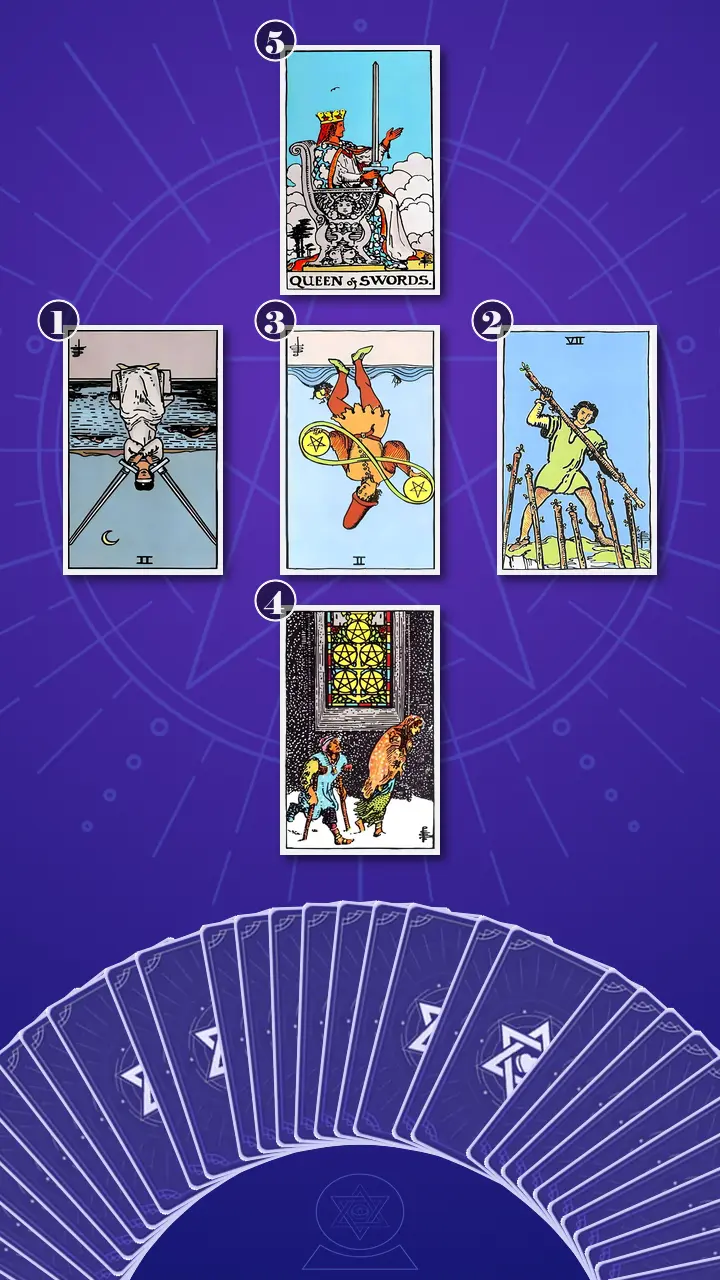
On the table, the spread formed a cross. Card one would show me what the mixed signal was doing inside Jordan in real time. Card three at the center would name the actual DM-versus-group-chat pattern. Card four underneath would tell me why this landed so hard in her body, and card five above the center would point toward finding clarity without self-abandonment. In other words: self, social context, dynamic, blind spot, next steps.
Reading the Split Screen
When I read friendship mixed signals, I want card meanings in context, not abstract tarot poetry. So I moved through the spread exactly the way the layout asked: left, center, right, beneath, then up.
Position 1: The Tabs That Never Close
Now turning over the card representing Jordan’s immediate experience of the mixed signal, I got the Two of Swords, reversed.
This card looked almost embarrassingly literal in her case. It looked like opening the warm DM and the cold-feeling group thread side by side at midnight, drafting three different replies, deleting all of them, and telling yourself you just need a little more evidence before you can decide whether anything is actually wrong. The energy here was blocked Air tipping into excess: too much interpretation, not enough grounded information. The crossed swords became two conflicting explanations she kept holding at once, the blindfold became context she did not actually have, and the dark water behind the figure was the hurt she was trying to out-think.
Jordan let out one short laugh with a bruise inside it. “That’s… rude,” she said. “Accurate, but rude.” Her thumb rubbed the edge of her water glass the way people do when a card has just said the quiet part out loud.
I nodded. “This is the screenshot-folder stage of anxiety,” I told her. “It’s like having eighteen tabs open and thinking one more refresh will finally make the answer obvious. The problem isn’t that you have zero data. It’s that you’re trying to force one stable answer out of two tones that keep canceling each other out.”
Position 2: Main-Feed Energy, Close-Friends Warmth
Now turning over the card representing what was visibly different about her friend’s behavior in public, I found the Seven of Wands, upright.
Here the imagery mattered: one figure on higher ground, staff raised, managing pressure. In real life, this looked like the friend who feels relaxed and easy one-on-one, then turns clipped or socially armored the moment the whole thread is active, like public visibility makes them manage optics instead of intimacy. It was not proof of hidden cruelty. It was defensive Fire: energy that braces before it softens.
“Think main-feed versus Close Friends energy,” I said. “Same person, different level of guard. Public tone is data, not a verdict.”
Jordan’s eyes lifted from the table for the first time in a way that looked less hunted. “She does get weird in groups,” she said quietly. “Like she’s trying to keep up with everyone’s vibe at once.” I stayed with the observable, because this spread was never about reading her friend’s mind. It was about reading the pressure field around the friendship.
Position 3: The Two-Channel Reality Check
At the center of the spread — the pattern created by the split itself — I turned over the Two of Pentacles, reversed.
This is the unstable rhythm of treating DMs and the group chat like they should deliver the same emotional temperature, then feeling thrown every time one room runs warmer than the other. The figure in the card keeps juggling, the infinity loop keeps moving, the ships in the background keep lifting and dropping in rough water. In Jordan’s life, it was constant app-switching: comparing emojis, timing, sentence length, who got the warmer reply, and telling herself the mismatch had to mean something final. The energy was strained Earth, not settled Earth. Instead of grounding her, it made the whole friendship feel like a balance problem she could never quite solve.
A very old part of my Wall Street brain flickered on there. When I used to sit with market dashboards open, two charts could look completely different because they were measuring different things. That did not always mean one of them was lying. Sometimes it meant the observer was committing a category error. “Jordan,” I said, “you’ve been trying to merge two app dashboards that track different pressures and calling the mismatch a verdict. Screenshots can preserve evidence; they cannot create clarity.”
She went still for a second, then gave the smallest nod. I could almost see the sentence forming behind her eyes: I’ve been forcing one story out of two formats. The room loosened by a degree.
Position 4: Outside the Emotional Room
Then I turned over the card beneath the center, the one uncovering the belonging wound underneath all of this. It was the Five of Pentacles, upright.
This is the moment a short or absent public reply stops feeling merely confusing and starts hitting like exclusion. Not dramatic, not cinematic — just sharp in that specific modern way, like standing outside a warm apartment party, seeing the light through the window, and wondering whether you were actually invited emotionally. The lit window in the card sat close but unreachable. The cold outside was the body-sense she already knew too well: tight stomach, chest drop, shoulders inching upward because one flat group-chat moment had suddenly become a referendum on whether she belonged.
Jordan looked away from me and toward the rain-blurred window beside the table. Her breathing paused, her jaw set, and then she let out a long breath that seemed to come from lower than her lungs. “It wasn’t even that dramatic,” she said. “But my body heard it as being left out.”
“Exactly,” I said. “The pain is bigger than the message. The real shift in the story is the second you stop asking, ‘What does this text mean?’ and start hearing the more painful sentence underneath it: ‘Maybe I matter less here than I thought.’”
No Cups had appeared anywhere in the spread so far, and I noticed that too. The feelings were absolutely present, but they were buried under analysis, guard, social pressure, and self-protection. It was a relationship reading with the heart hidden under systems.
When the Queen of Swords Cut Through the Theories
Position 5: The Sentence That Could Actually Change the Friendship
When I reached for the final card, the room felt noticeably quieter. The rain outside had thinned to a fine silver mist, and a band of clearer light moved across the window just as I turned over the Queen of Swords, upright. I have learned not to force meaning onto weather, but sometimes the environment conspires with a symbol so neatly that even I smile.
This position points to the cleanest way out of the spiral, and Jordan’s card could not have been clearer. The Queen of Swords is the part of her that closes the screenshot folder, names the exact pattern without dramatizing it, and says, “Hey, I’ve noticed you feel different in the group chat than you do in DMs sometimes. Am I reading that right?” The energy here was balanced Air at last: discernment instead of over-analysis, direct speech instead of private detective work, self-respect instead of self-erasure.
You know that moment on the ride home when one sweet DM briefly relaxes your body, then one flat group-chat beat makes your chest sink all over again? That swing feels personal because your brain is trying to turn contrast into certainty. Jordan was still caught in the fear that if she asked directly, she would sound intense — like being easygoing had quietly become the rule that kept her silent.
You do not have to keep swallowing the coldness and decoding it alone; let the Queen of Swords raise her clear blade and replace mind-reading with one honest question.
She froze first. Her fingers stopped halfway around the glass, and her breath stalled so lightly I only noticed because I spend my life watching for the body to speak before the mouth does. Then came the cognitive part: her gaze slipped off the card and unfocused, as if she were replaying a half-dozen commute rides, a half-dozen deleted drafts, the whole Fleabag-style inner monologue that had been working overtime while the actual friendship stayed mostly silent. Then came the feeling. Her shoulders dropped. The line between her brows softened. And right at the edge of that release, she gave me a look that carried both relief and resistance. “But if I ask,” she said, voice thin with the old fear, “doesn’t that mean I’ve made it a whole thing?”
“No,” I told her. “It means you’re finally letting reality participate. Mixed signals are not a puzzle you have to solve silently; if the pattern keeps hurting, it deserves one clear question more than ten more re-reads.” I paused, and an old professional reflex rose in me — not the trading floor itself, but the discipline it drilled into me. I call it Negotiation Alchemy: in any conversation that matters, I look for three things — the observable fact, the clean ask, and the self-respecting boundary if the answer stays foggy. In business that framework protects capital; in friendship it protects dignity. So I asked her, “Using that lens, what is the fact? What do you actually want to know? And if the answer stays vague, what boundary helps you stop auditioning for closeness in the group chat?”
She swallowed, nodded once, and looked back down. “The fact is that she’s warmer in private than in the thread. What I want to know is whether I’m reading distance that’s actually there. And if it stays vague… I think I stop letting the group chat decide how close we are.”
That was the moment the reading changed. Not into certainty, not into a perfect answer, but into grounded curiosity. I asked her to think back over the last week with this new lens. She gave a soft, embarrassed laugh and told me about a Monday morning in the office when she had typed a genuinely warm reply in the group chat and edited it down to a dry little “lol” so she wouldn’t look more invested if her friend didn’t match it. Seeing that mattered. This was the first real move from tone-scanning confusion and belonging anxiety toward self-trust and clearer friendship boundaries.
From Screenshots to Conversation
Once all five cards were on the table, I gathered the story they were telling. First came the split mind: Jordan compared warm DMs and cold public replies until the contrast became its own self-feeding loop. Then came the friend’s visible public guardedness, which may be real without automatically being rejection. At the center sat the unstable two-channel dynamic itself: two different digital rooms, two different pressures, one nervous system trying to turn them into a single verdict. Underneath all of it was the actual wound — the fear that a cooler public tone meant she mattered less and belonged less. And above it all stood the Queen, asking her to stop solving the friendship through screenshots and let conversation do what screenshots never can.
I sometimes summarize a reading the way I used to summarize a risk memo, because clarity likes structure. In Jordan’s relational SWOT, the strength was real private warmth. The weakness was her habit of treating ambiguity like proof. The opportunity was a grounded check-in. The threat was letting a belonging wound write the whole story before any honest conversation had happened. Her cognitive blind spot was not caring too much; it was assuming that public coolness had the authority to define the friendship. The transformation direction was simple and difficult at the same time: from decoding to directness, from public tone as verdict to public tone as data.
So I gave her actionable advice that was deliberately small. Not a grand confrontation. Not a twelve-paragraph message. Just practical next steps.
- The Three-Line NoteOpen your Notes app within the next 10 minutes and write only these headers: “What happened,” “What I made it mean,” and “What I want to ask.” Keep it brutally short. One concrete behavior, one story your mind added, one question you actually want answered.If your body is buzzing, draft only. Both feet on the floor, slower breath, no sending yet. Clarity does not require instant vulnerability.
- The One-Clean-Question Check-InThis week, send one grounded text — or ask on a walk, in a voice note, or over a low-pressure coffee — using my Cocktail Party Algorithm: one warm opener, one observation, one question. For example: “Hey, I’ve noticed our vibe feels different in the group chat than in DMs sometimes. Am I reading that right?”No evidence deck. No accusation. No apology for having noticed. Keep it short on purpose; one clean question beats ten private theories.
- The Two-Channel Reality CheckFor the next seven days, pick two windows only to look at the group chat — especially not on the streetcar home and not in bed. When something stings, write down the observable behavior before you ask a trusted friend to review screenshots.This is data hygiene, not denial. Different channels carry different audience pressure. If two windows feels impossible, start with a 20-minute delay before reopening the thread.
Jordan grimaced at the second step and gave me the most honest objection of the session. “But I can barely send a normal meme right now,” she said. “A message like that feels huge.”
“Then don’t start with text,” I said. “Use the same sentence on a walk. Or send a voice note so your tone can carry the care. The Queen of Swords isn’t asking for drama. She’s asking for clean language.”

A Week Later, the Proof Was Quiet
A week later, Jordan sent me a message that was blessedly short. She had asked her friend for coffee after work instead of dropping a paragraph into the middle of a Wednesday afternoon. She used the one-question version. Her friend told her the group chat makes her terse with everyone when it gets busy, and that she had not realized Jordan was feeling the difference so strongly. It did not solve friendship forever. But it gave the situation a real shape instead of the haunted one Jordan’s late-night theories had built.
My favorite part was the image that came after. Jordan wrote that she left the café, sat alone by the window with an oat latte, and stared out at Queen Street for ten quiet minutes. Clear, but still a little shaky. The next morning her first thought was still, “What if I read that wrong?” — only this time she caught herself, smiled, and did not reopen the chat before getting out of bed.
This is why I still trust tarot as a decision-making tool: not because it hands me certainty on a silver tray, but because it helps me separate noise from pattern and pattern from truth. In a Five-card Relationship Spread · Context Edition for warm DMs and cold group chat dynamics, the real magic is often very practical: from tone-scanning confusion and belonging anxiety to grounded curiosity, self-trust, and clearer friendship boundaries.
When one warm DM can calm you for an hour and one flat group-chat moment makes your stomach drop again, the ache is rarely just about tone; it’s about how quickly belonging can start to feel conditional.
If you stopped asking your screenshot folder to act like a courtroom, what one honest question might help you feel a little more solid in your own skin this week?
This story is adapted from psychological research, written so that those in a similar struggle can see their own pattern in it — and find their next step clearly.These insights are not a substitute for professional psychological, medical, legal, or financial advice.
Learn more about our Journey to Clarity.
How did this insight land for you?
🫂 This Resonates Deeply
🌀 Living This Story
✨ Now I See Clearly
🌱 Seeing New Possibilities
🧰 Useful Framework
🔮 The Confirmation I Needed
💪 Feeling Empowered
🚀 Ready for My Next Step
Author Profile
 AI
AI“I spent years in the intense, high-stakes world of Wall Street. I know exactly how isolating and heavy the weight of uncertainty can feel in the dead of night. I use strategic, commercial logic not to be cold, but to protect you from unnecessary friction. Think of me as a fellow traveler who has walked the same rocky path—offering sharp but deeply supportive wisdom to help you clear the fog and confidently win your narrative back.”
In this Friendship Tarot Reading :
Core Expertise
- Reciprocity ROI Analysis: Objectively measuring the emotional give-and-take in your core friendships to identify asymmetrical, high-drain relationships.
- Sunk-Cost Decoupling in Loyalty: Separating the 'ten years of history' from the current reality of a one-sided, demanding friendship.
Service Features
- The Friendship Downgrade Strategy: A calculated tactical approach to gradually and decently de-escalate a toxic friendship into a low-maintenance acquaintance without triggering dramatic conflict.
Also specializes in :
Explore Related Patterns:
Certainty SeekingJordan opens the warm DM and the cold-feeling group thread side by side, drafts three replies, deletes all of them, and tells herself she needs just a little more evidence. The screenshot folder starts functioning like a courtroom, as if one more refresh could finally decide which version of the friendship is true. Certainty Seeking fits because the coping strategy is not simple curiosity. It is the attempt to eliminate ambiguity by gathering more tone data from two channels that were never carrying the same social pressure. DMs and group chats are different rooms, but her mind keeps demanding one final verdict from both. The loop becomes painful because each new detail briefly feels useful and then reopens the same question. You get more information without more grounding. The shift toward clarity begins when the question moves from 'What does every signal prove?' to 'What observable pattern can I ask about directly?'
Mind ReadingJordan sees one friend warm in DMs and cold in the group chat, and the gap immediately starts demanding a hidden explanation. The untouched message becomes more than an untouched message; it starts to look like evidence that her friend is showing the 'real' friendship in public. Mind Reading fits because the distress comes from trying to infer an inner motive from incomplete social signals. The public thread, the laughing emojis sent to someone else, and the lack of response to Jordan's message become clues in a private investigation, even though none of them can confirm what the friend actually means. The pattern is not that you are wrong to notice inconsistency. The pattern is that the mind tries to close the uncertainty by assigning intention before conversation has happened. That can feel like clarity for a moment, but it keeps you trapped inside a theory instead of letting reality participate.
Rejection SensitivityJordan's stomach tightens and her chest drops before she has any confirmed explanation for the group-chat silence. A small public cue hits with the force of exclusion, as if the colder reply has suddenly revealed where she stands in the friendship. Rejection Sensitivity fits because the story shows ambiguous social information being processed as a threat to belonging. The warm private DM is still there, but the cooler public moment carries more emotional authority because it activates the fear that she matters less when other people are watching. This pattern is not about being dramatic. It is about the speed with which uncertainty becomes a rejection signal inside the body. You can notice the hurt without letting the hurt become the whole verdict.
Relational HypervigilanceJordan's thumb moves between the warm 'miss u' DM and the untouched group-chat message, then the whole ride becomes a scan for danger: emojis, timing, sentence length, who got warmth, what the silence proves. The same attention that helps her read tone professionally starts treating every micro-shift in the friendship as relational threat data. The defense is understandable. When public warmth feels like proof of belonging, scanning can feel like protection. But the data is ambiguous, so the scan keeps widening instead of resolving. You end up trying to feel safe by catching every tiny tonal change before it can hurt you. Relational Hypervigilance fits because the story is not just about noticing a mismatch. It is about a nervous system trying to secure belonging through constant social monitoring. The pattern becomes visible when the group chat stops being one context among many and starts acting like the control room for the entire friendship.
Assertive CommunicationJordan's clean question names the exact pattern without building an evidence deck: she has noticed the vibe feels different in the group chat than in DMs, and she wants to know whether she is reading that right. The sentence is short because it is designed to create contact, not win a case. Assertive Communication fits because the story's turning point is direct speech with emotional boundaries intact. She does not accuse her friend, apologize for noticing, or collapse into silence. She brings one observable fact and one grounded question into the friendship. That is the practical repair move for this kind of mixed signal. You stop trying to decode someone into clarity and give the relationship a chance to answer. The strength is not in sounding perfectly unaffected; it is in letting your question be clean enough that reality can respond.
Reality TestingJordan's three-line note separates what happened, what she made it mean, and what she actually wants to ask. That structure matters because it interrupts the slide from observable behavior into private certainty. Reality Testing fits the upright movement of the story. The group-chat coldness is not dismissed, but it is also no longer allowed to act as a final verdict. The mind starts checking assumptions against actual interaction instead of letting screenshots do all the emotional labor. The later coffee conversation shows why this pattern is powerful. Her friend explains that the group chat makes her terse with everyone when it gets busy, which gives the situation a real shape. You do not need perfect certainty to regain ground; you need enough contact with reality to stop a theory from becoming the whole friendship.
Emotional Self-CensorshipJordan keeps swallowing the coldness and decoding it alone, even though the question she wants to ask is simple. When the clean sentence appears, her first fear is that asking it will make her seem intense, as if having a need would automatically turn the friendship into drama. Emotional Self-Censorship fits because the protective move is to mute the feeling before it can be seen. She deletes drafts, trims warmth, and keeps the real question private, not because she has no words, but because the words feel too revealing. The pattern protects against exposure, but it also blocks repair. You may avoid the risk of sounding needy, yet the unspoken need keeps running the conversation from underneath. Clear language becomes the way out because it lets care exist without turning it into accusation.
Relationship Performance AnxietyJordan types a genuinely warm group-chat reply and edits it down to a dry 'lol' so she will not look more invested if her friend does not match it. That small edit is one of the clearest behavioral tells in the whole story because it shows her managing her visible care level in real time. Relationship Performance Anxiety fits because the group chat has become a stage where warmth can feel socially risky. Instead of asking what is happening, she starts calibrating how relaxed, unbothered, and easygoing she appears, as if the safest role is the person who never needs too much. The cost is that the friendship stays filtered through performance instead of contact. You are not just wondering what your friend means; you are also monitoring how much of your own care is allowed to show. The pattern loosens when being clear becomes safer than performing chill.
Boundary DiscernmentJordan names the boundary in plain language: if the answer stays vague, she stops letting the group chat decide how close the friendship is. That sentence marks a shift from being emotionally ruled by the thread to choosing what kind of evidence gets authority. Boundary Discernment fits because she is not cutting the friend off or pretending the public coldness does not matter. She is separating categories: her friend's group-chat style, the private warmth between them, and her own need for steadiness are related, but they are not the same thing. This is the self-respecting edge of the reading. You can ask for clarity, notice the answer, and still refuse to audition for closeness in public. The boundary is not punishment; it is the point where your belonging stops depending on one digital room.
Explore Related Struggles:
Outsourced BelongingJordan eventually names the boundary herself: if the answer stays vague, she stops letting the group chat decide how close they are. Before that moment, the thread has been acting like an external judge; one untouched message or clipped public beat gets permission to define the whole friendship. You can see the struggle in how her body reacts before the conversation happens. Belonging gets outsourced to the most visible cue in the room, so self-trust has to compete with emojis, timing, sentence length, and who gets answered first.
Visibility-Connection SplitJordan opens the sweet DM on the 504 streetcar, then flips into the group chat and sees the same friend laughing with someone else while her own message sits untouched. The friendship is not simply warm or cold; it changes temperature when the audience changes, so the public room starts competing with private closeness for authority over what the bond means. You end up caught between two true-looking signals. Private contact says there is care, while group visibility makes that care feel less available, and the struggle is deciding whether connection still counts when it is not performed in front of other people.
All-or-Nothing BelongingWhen one warm DM relaxes Jordan for a while and one flat group-chat moment drops her chest again, the friendship starts moving like a switch instead of a spectrum. The private warmth cannot simply coexist with public chill; one signal keeps trying to cancel the other. You are left living inside a binary that the actual relationship may not be asking for. The painful part is not just uncertainty; it is the speed with which a small public mismatch becomes evidence that you either matter or do not matter.
Clarity-Exposure SplitThe clean question is right there on the table: "I’ve noticed you feel different in the group chat than in DMs sometimes. Am I reading that right?" Jordan freezes because asking could make her sound intense, as if naming the pattern would create the problem rather than clarify it. You are caught between the relief of reality participating and the exposure of being the person who noticed. The struggle is that clarity requires a small public claim on your own perception, while silence lets you keep the easygoing image at the cost of staying alone with the pattern.
Analysis ParalysisAt midnight, Jordan has the warm DM and the cold-feeling thread open side by side, drafts three replies, deletes them, and tells herself one more piece of evidence will settle it. The more she compares timing, emojis, sentence length, and who got the warmer reaction, the less grounded the friendship feels. You can feel the mind trying to protect itself by building a case, but every new screenshot creates another possible theory. Analysis becomes a holding pattern: it delays the risk of asking directly while keeping the same ambiguity alive.
Explore Related Emotions:
Cautious Self-TrustAfter Jordan asks the one clean question, the situation does not become perfectly solved. The next morning, the old thought still appears: 'What if I read that wrong?' This time, though, she notices it and does not reopen the chat before getting out of bed. Cautious Self-Trust is built in that small pause. You are not forcing yourself into certainty; you are giving your own perception enough respect that it no longer has to be cross-examined every morning. The steadiness is modest, which is why it feels believable. Jordan can hold both things at once: she may not know everything about the friendship, and she can still stop letting the group chat decide how solid she is in her own skin.
Conditional Belonging FearJordan names the sentence underneath the whole pattern when she asks why she feels weirdly invisible when other people are around. The untouched group-chat message does not stay a small digital detail; it becomes a social temperature check, especially because the private DM had just offered warmth. Conditional Belonging Fear grows from that exact contrast. You can feel close to someone one-on-one and still feel exposed when the friendship enters a public room, because the group setting seems to ask whether the closeness will be acknowledged where others can see it. The story’s strongest ache is the lit-window feeling: warmth exists nearby, but you are not sure whether you are inside it. That fear makes every cold public beat feel like a possible referendum on your place in the friendship, even before any direct conversation has happened.
Friendship Screenshot AnxietyJordan drafts replies, deletes them, compares timing and emoji warmth, and keeps trying to decide whether one more piece of evidence will finally make the pattern obvious. The friendship becomes something reviewed in private rather than something tested through direct contact. Friendship Screenshot Anxiety is the inner weather of turning ambiguity into a case file. You are trying to protect yourself by preserving the data, but the archive keeps feeding the loop: each screenshot proves that something felt off without proving what the other person meant. The ache here is not that you care too much. It is that your need for clarity has been pushed into a format that can only replay the wound. Screenshots can show the mismatch, but they cannot tell you whether the relationship can hold a clean question.
Mixed Signal DreadJordan opens a sweet private DM on the streetcar, then sees the same friend laughing with someone else in the group chat while her own message sits untouched. The switch happens fast enough that her body has no time to sort it cleanly: stomach tight, chest dropping, the phone becoming a tiny room where two different versions of the friendship are happening at once. That is the core shape of Mixed Signal Dread. You are not simply noticing inconsistency; you are being asked by your own nervous system to decide which signal is the real one before the situation has enough grounded information. The private warmth says closeness is intact, while the public chill makes that closeness feel suddenly negotiable. The dread intensifies because screenshots cannot resolve the emotional contradiction they preserve. Every reread gives you more detail but not more solidity, so the mind keeps circling the same question: whether the warmth counts if it disappears when other people are watching.
Relational WhiplashOne warm DM can calm Jordan for an hour, and one flat group-chat moment can make her stomach drop all over again. The two signals arrive through the same device, often minutes apart, so there is almost no emotional buffer between closeness and distance. Relational Whiplash captures that snap in the body. You are not reacting only to a cold reply; you are reacting to the speed of the contrast, the way intimacy seems to appear in private and vanish when the room gets crowded. This makes the friendship feel less like a steady bond and more like a sudden drop in pressure. Your system keeps bracing because it cannot predict whether the next message will land as reassurance or erasure.
Clarity ReliefJordan asks for coffee instead of dropping a paragraph into a Wednesday afternoon thread, and the conversation gives the situation a real shape. Her friend explains the group-chat terseness, and the story becomes less haunted by private theories. Clarity Relief arrives through contact with reality, not through perfect reassurance. You can feel the body loosen because the mind no longer has to carry every possible interpretation by itself. The relief is quiet rather than final. It does not promise that the friendship will never feel confusing again; it simply returns the problem to a human scale, where one honest question can do more than ten rereads.
Grounded CuriosityJordan separates the observable fact from the story her mind added: her friend is warmer in private than in the thread, and she wants to know whether she is reading distance that is actually there. That distinction gives the question a clean edge. Grounded Curiosity is what happens when you stop trying to win certainty from the group chat and start asking what can be known directly. You are still open, but you are no longer abandoning yourself to stay open. This feeling matters because it keeps agency intact. Jordan can ask, listen, and set a boundary if the answer stays vague, which means curiosity becomes a stable stance rather than another loop of private investigation.
Evidence AnxietyJordan compares emojis, sentence length, timing, and who gets the warmer reply. The group chat becomes a dashboard, and each tiny difference starts to feel like it might finally reveal the hidden rule of the friendship. Evidence Anxiety forms when observation stops giving you steadiness and starts demanding more observation. You are looking for enough proof to justify your discomfort, but the proof keeps multiplying the discomfort instead of resolving it. The deeper issue is permission. Jordan seems to need the evidence folder to become airtight before she allows herself one direct question, so ambiguity gains more authority than her own felt experience.
Guarded LongingJordan’s unsent drafts show that she does want contact; she is not indifferent to the friendship. At the same time, every possible reply has to pass through the fear of sounding intense, needy, or out of sync with the public vibe. Guarded Longing is the feeling of reaching for closeness while keeping one hand on the exit. You want the friendship to feel warm and acknowledged, but you also protect yourself from being seen as the person who cares more. That guardedness makes the longing quieter, not smaller. It lives in the deleted messages, the rereads, and the hope that the other person will make the closeness obvious enough that you do not have to ask for it.
Low-Maintenance ShameJordan admits that asking one clean question feels huge, and later remembers editing a genuinely warm group-chat reply down to a dry little 'lol.' She is not only reading her friend’s tone; she is managing her own warmth so she will not appear more invested. Low-Maintenance Shame sits in that self-editing. You want clarity, care, and mutual warmth, but part of you treats those needs as too much to show. Being easygoing starts to function like a rule that keeps the real question trapped inside. The shame does not mean the need is wrong. It means the need has been forced to pass through a filter of social coolness before it is allowed to become language.
Rejection ChillJordan sees her friend laugh at someone else’s joke while her own message sits there untouched. Because this happens right after a sweet DM, the absence does not feel neutral; it feels cold in a very specific, social way. Rejection Chill is the sharp drop that happens when a public room seems to keep moving around you without turning toward you. You are close enough to see the warmth being given elsewhere, but not close enough in that moment to feel included in it. The chill matters because it lands in the body before the mind can make a fair interpretation. Her stomach tightens and her chest drops because the group chat briefly feels like a door left half-open, with the warmth visible but not reachable.
Relational FogJordan is trying to use tone as a GPS while the signal keeps bouncing between private DMs and the group chat. Both channels are real, but they are not measuring the same social pressure, and that makes the friendship hard to locate. Relational Fog is the disorientation that appears when no single interaction feels trustworthy enough to stand on. You keep reaching for the map, but the map updates every time the friend changes rooms. The fog matters because it blurs the difference between data and verdict. A clipped public tone may be information, but in the fog it starts to feel like the whole truth of the bond.
Explore Related Contexts:
Conditional Belonging PressureJordan eventually remembers typing a genuinely warm reply in the group chat and editing it down to a dry 'lol' so she would not look more invested if her friend did not match it. That detail shows the social pressure is no longer only coming from the friend’s behavior; it is shaping Jordan’s own public self-presentation too. You are looking at Conditional Belonging Pressure because the group chat has started functioning like a test of where Jordan stands. Public warmth feels risky, public coolness feels meaningful, and the thread begins to decide whether closeness is safe to show. The structural issue is that belonging becomes dependent on visible reciprocity in front of others. Once the group chat gets that authority, every dry beat can seem to rank the friendship. Reclaiming agency means refusing to let a public thread be the only place where closeness is measured.
Digital Intimacy Boundary ConfusionJordan keeps comparing emojis, timing, sentence length, and who receives the warmer reply, as if DMs and the group chat are two dashboards tracking the same relationship metric. The story shows her trying to merge formats that are shaped by different levels of privacy, audience pressure, and social performance. You can see why Digital Intimacy Boundary Confusion fits: the boundary between private intimacy and public interaction has become blurry. A DM can hold warmth because it is one-to-one, while a group thread can become clipped because it is crowded, visible, and socially managed. The confusion is external before it becomes personal. The platforms create different rooms, and each room rewards different behavior. The shift toward clarity comes when the channels stop being treated as identical evidence and start being treated as separate contexts that deserve one direct question.
Mixed Signal LimboJordan opens a DM that says 'miss u, we need a catch-up soon,' then sees the same friend laughing at someone else’s joke while Jordan’s own group-chat message stays untouched. The external problem is not one cold reply in isolation; it is the split between two social rooms that keep assigning different weight to the same friendship. You are watching a channel-level ambiguity turn into a social reality problem. Private warmth gives one data point, public chill gives another, and neither channel can fully explain the relationship by itself. Mixed Signal Limbo fits because the friendship is not clearly ending, not clearly secure, and not readable through one screenshot more than the other. The useful audit point is that this limbo has a structure: two formats, two audience pressures, one person trying to extract one verdict. Clarity starts when the contrast is treated as a pattern to ask about, not as a case file that must be solved alone.
Public Mask MaintenanceThe friend is described as relaxed and easy one-on-one, then clipped or socially armored when the whole thread is active. Jordan also recognizes that this friend gets weird in groups, as if trying to keep up with everyone’s vibe at once. Public Mask Maintenance fits because the coldness is tied to visibility. The group chat is not simply a larger version of the DM; it is a public room where tone can become guarded, performative, or optimized for the audience. You do not have to treat the public mask as proof of secret hostility. It is still real data, but it is data about how the friend behaves under group visibility. The clearer question becomes whether the friendship can make room for direct warmth outside the performance field, and whether the public chill is workable for you.
Silent Group Chat ExclusionJordan’s message sits untouched in the group chat while the same friend actively reacts to someone else. That is a specific public-facing gap: engagement is visibly available in the room, but not directed toward her at the moment she is looking for it. You are not just dealing with silence; you are dealing with visible silence beside visible attention. Silent Group Chat Exclusion fits because the pain point is created by public contrast. The friend’s private DM says closeness is available, but the group thread creates a scene where Jordan can watch acknowledgment move around her. That matters because group chats are not neutral containers. They distribute visibility, timing, and social proof in front of an audience. When one person gets the laughing emojis and another gets left hanging, the thread becomes a stage where belonging can look uneven even before anyone says anything explicit.
Low-Maintenance Friendship PressureJordan asks whether bringing it up would mean she has made the situation 'a whole thing.' Later, she sees that she has already been shrinking her own warmth in the group chat, editing a real reply into a dry 'lol' so she will not look more invested than the other person. That is Low-Maintenance Friendship Pressure in action. The external rule is subtle but powerful: be chill, do not need too much, do not ask for clarification unless you are ready to risk seeming intense. Under that rule, directness starts to feel socially expensive even when the pattern keeps hurting. You are not wrong for wanting a friendship that can survive one clean question. The pressure to be low-maintenance should not get to turn silence into maturity or self-erasure into ease. The story points toward a healthier standard: small, specific, reality-based communication instead of pretending the mismatch does not matter.