The Sunday Dinner Courtroom: Finding Clarity in Family Conflict
If you work a hybrid early-career policy job in Toronto and still arrive at Sunday dinner with a mental folder of receipts, one relative saying that they did not mean it that way can turn a wish for warmth into an impact-versus-intent argument before the food reaches the table.
I met Jamie at 8:12 p.m. in their family's crowded kitchen, where a fluorescent light buzzed above the table and the dishwasher ran through its final cycle. Jamie unlocked an iPhone under the table, found a two-year-old iMessage screenshot, and held the warm phone in their palm while a plate of food cooled in front of them.
A relative had just said, 'That never happened.' Jamie looked at me and said, 'Why do I keep putting my family on trial at the kitchen table? I came here for dinner, and somehow I am presenting exhibits again.'
I could see the physical shape of the argument before Jamie explained it: jaw clenched, shoulders raised, breath shallow, attention narrowed to exact wording. The frustration was like a legal brief tightening around their ribs, page by page, while hurt and longing for acknowledgment waited underneath. Jamie wanted the family to acknowledge the impact of their words, yet feared that ending the argument without a verdict would make the experience disappear.
I told Jamie that I did not see a lack of care or intelligence in the evidence-building. I saw a protective strategy that had become expensive. We could look at it without judging the family, predicting anyone's motives, or asking Jamie to call harm harmless. Our Journey to Clarity would be about drawing a map of the pattern and returning the authority over what happened to the person who lived it.

Choosing the Compass for a Family Conflict
I invited Jamie to put both feet on the floor, take one slower breath, and hold the question in a single sentence. Then I shuffled at an even pace. The movement was not a supernatural test; it was a small transition from reacting to observing, a way to let the nervous system arrive at the same table as the mind.
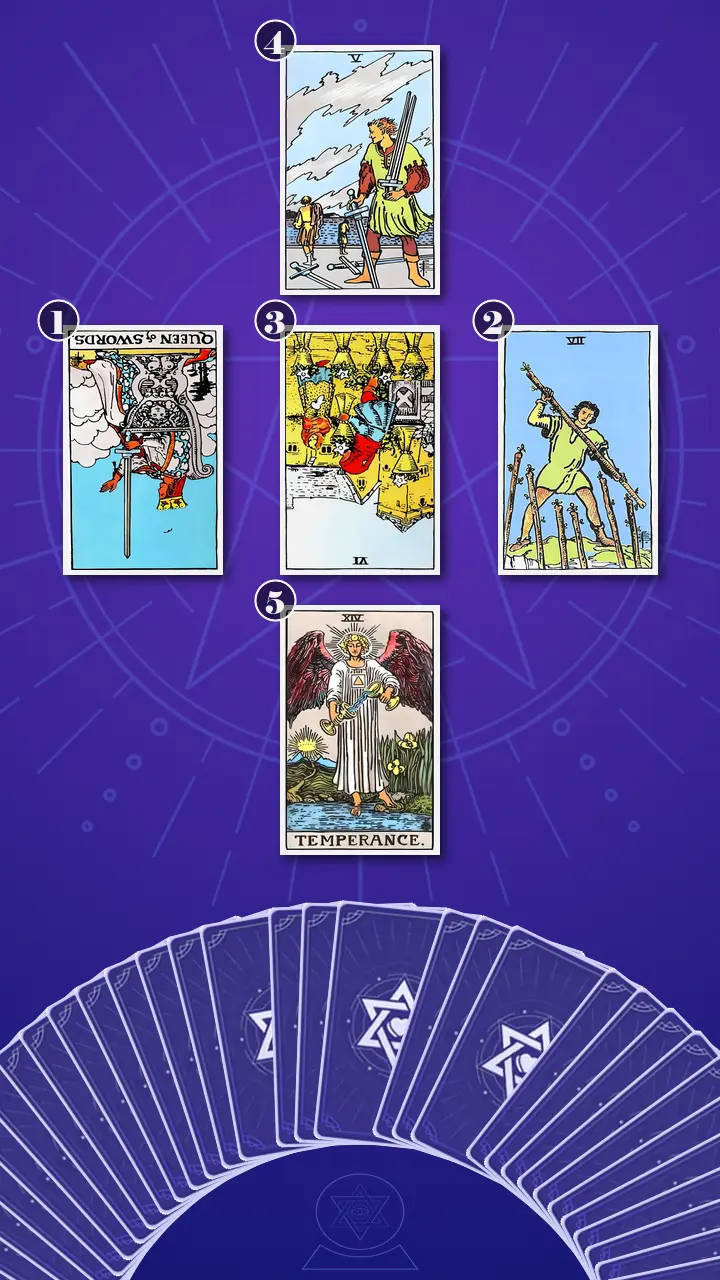
For this reading, I used the Relationship Spread · Context Edition. For anyone wondering how tarot works in a family conflict reflection, this spread does not prove who is right or reveal a relative's private motives. It places the interaction in context so card meanings can be read alongside observable behavior, emotional impact, shared history, and practical choices.
The five positions create a simple kitchen-table map. The first shows Jamie's stance and conscious need. The second shows the family's observable response climate, without claiming access to anyone's inner world. The third reveals the shared history beneath the argument. The fourth identifies the self-reinforcing challenge, and the fifth offers a constructive direction rather than a prediction.
I chose this contextualized five-card Relationship Spread because the question concerned a repeated relational process, not a single future event. A Celtic Cross would have introduced more layers than Jamie needed. This layout was sufficient to show the movement from precision used as prosecution, through defensive replies and a contested family archive, toward a bounded exchange where accountability and connection could coexist without requiring unanimous agreement.
Reading the Map Without Adding Another Exhibit
Position 1: The Raised Sword in the Notes App
Now I turn over the card representing Jamie's prosecutorial stance, including the need to establish a definitive record and the use of precision to seek acknowledgment. The card is the Queen of Swords, in reversed position.
In Jamie's life, this is arriving at Sunday dinner with an Apple Notes page full of timestamps, screenshots, and anticipated counterarguments. When a relative says, 'I did not mean it that way,' Jamie corrects the wording, narrows the question, and keeps going until the answer sounds like acknowledgment. The Queen's raised sword becomes command of evidence. Her extended hand, which might receive another perspective, is blocked by the demand that the response arrive in the approved format.
The reversal shows discernment in excess and receptivity in blockage. Jamie's ability to notice contradictions is real, but under pressure it becomes a way to control the permitted answer. Each correction is meant to protect a valid experience. Instead, it invites a debate about dates and intent, leaving the original impact further away. This is the policy-analyst brain opening Google Docs Suggesting mode when what the moment needs is one clear sentence, then treating every imperfect reply as a revision that must be corrected.
I use a lens I call Adult-Child Regression Auditing here. I do not mean a diagnosis, and I do not assume that anyone is consciously manipulating Jamie. I mean that I examine the environmental cue that pulls an adult into an anxious, defensive teenage posture around their parents: the familiar kitchen, the dismissive phrase, the sudden pressure to prove that the memory is legitimate. I asked Jamie to notice whether the current conversation was asking for one present truth, while an older part of the nervous system was preparing to defend an entire history.
Jamie gave a small, bitter laugh. 'That is too accurate. I am not trying to win. I am trying to make the record impossible to deny.'
I said, 'You can be right about the impact and still notice that the conversation has become a trial.' Jamie's thumb stopped moving across the phone. They looked at the screenshot, then placed the device face down, not as a promise to stay silent, but as a first interruption to the automatic evidence search.
Position 2: The Family's Defensive Ground
Now I turn over the card representing the family's observable response climate, especially the counterarguments, interruptions, and defensive positioning that appear in the interaction. The card is the Seven of Wands, in upright position.
I read this card narrowly and ethically. It does not tell me what Jamie's relatives secretly intend. It shows the visible moment when several people answer at once with qualifications, counterexamples, and explanations. Jamie asks for an admission; the family appears to brace against the pressure, so each response protects a position rather than addressing the original hurt.
The Seven of Wands carries an excess of defensive fire. The figure on uneven ground is trying to hold territory while feeling challenged, and the rising wands become the separate objections that make the room louder. This is the family dinner version of comment-section mode, where everyone opens a new tab called Counterexample before anyone has finished explaining the problem. The more Jamie treats an answer as an objection to defeat, the more the exchange trains everyone to defend rather than listen.
I asked Jamie to observe what happened after the next sentence, without guessing why it happened. Did someone answer the request, defend a version, interrupt, go quiet, or leave the room? Observation would not make the behavior acceptable. It would simply keep Jamie from spending precious energy proving an inner motive when the interaction itself already supplied enough information.
Jamie nodded slowly, then looked toward the kitchen doorway. Their hands had been folded tightly in their lap; now one hand opened and closed once. 'I keep asking for an answer,' they said, 'but I am also making the answer feel like a surrender.'
Position 3: The Family Archive Between You
Now I turn over the card representing the shared family history beneath the conflict, including the belonging need, contested memories, and the fear that an unchallenged version of the past can erase Jamie's experience. The card is the Six of Cups, in reversed position.
Here, one present comment becomes a search term that pulls up every old family group-chat result. Jamie retrieves earlier birthdays, old texts, and previous dismissals before anyone has finished responding. Other relatives retrieve their own backups. The table fills with incompatible archives, and the current behavior disappears inside the question of who remembers the past correctly.
The reversed Six of Cups shows water caught in repetition. The flower-filled cup could carry tenderness, context, and a history of genuine closeness. In reversal, it becomes evidence. The past is no longer helping the present conversation stay specific; it is being asked to settle the entire case. Jamie may privately preserve every slight so that no incident can be denied, but the growing archive makes it harder to notice present-day change or ask for one repairable behavior.
I said, 'An unchallenged family version is not the same thing as the truth of your experience.' I wanted the sentence to separate two things that had fused together for Jamie: the reality of what hurt, and the need to force another person to use the exact language that would certify it.
Jamie stopped looking at me and stared at the grain of the table. Their breathing became audible for one long exhale. I watched recognition arrive with a trace of grief, because letting the present moment remain small did not mean the older moments were small. It meant that not every memory had to be brought to dinner in order to remain real.
When the Correct Point Left the Room Empty
Position 4: The Victory That Could Not Hear the Hurt
Now I turn over the card representing the self-reinforcing relational loop in which proving a point brings brief control, leaves the original hurt unheard, and makes the next conversation more adversarial. The card is the Five of Swords, in upright position.
This is the central challenge. In Jamie's modern translation, the card is the moment when a relative finally admits the exact wording of an old message, someone begins clearing plates, and the factual point remains in Jamie's hands like a sword collected from the floor. The correction is accurate. The room is still empty of acknowledgment.
The Five of Swords shows compressed air and conflict organized around winning. It does not ask Jamie to pretend the wording did not matter. It asks what the final correction actually produced: a changed behavior, a clear request, a usable boundary, or only the silence of people leaving the table. When the Queen's sharpness meets the Seven's defense and the Six's contested archive, thought becomes a weapon that secures a point while draining the relationship of room.
I described the version-history panel becoming a courtroom exhibit. The inner sentence was not, I am trying to win. It was, I am trying to make the record impossible to deny. Then I traced the observable sequence with Jamie: one correction, one counterargument, another correction, and finally a quiet kitchen after everyone withdrew. The conflict was not a choice between truth and kindness. It was a struggle between self-trust and the demand for an external verdict.
Jamie remembered a specific dinner. At 9:18 p.m., they had finally heard a relative concede the exact wording. First their breath had paused and their thumb had hovered above the phone. Then their eyes had lost focus as they replayed the exchange and searched for the next point that would make the acknowledgment complete. Finally their shoulders dropped, just briefly, before their chest went hollow. 'I got them to admit it,' Jamie said. 'So why does the room feel emptier?'
I let the refrigerator hum fill the pause. 'A clear boundary is not a failed verdict,' I said. The factual point could remain true without being converted into a demand for one more round. The brief control was information, not proof that Jamie needed a stronger case next time. It showed the cost of the current method clearly enough to make another method worth trying.
When Temperance Poured Between Two Cups
Position 5: A Bounded Exchange That Can Hold Truth
The room seemed to quiet before I turned the final card. Now I turn over the card representing the relationship's potential direction and the lesson available for integration: discuss one incident, name its impact, make one request, listen without immediate rebuttal, and use a boundary when the exchange becomes circular. The card is Temperance, in upright position.
The card's balanced water offers an actionable form of accountability. One cup can hold Jamie's account of the impact, the other can hold a relative's different memory, and neither cup has to be emptied for the conversation to end. One foot on land and one in water becomes the practical combination the spread lacks in Pentacles: a time limit, one topic, a specific request, and a planned stopping point.
Using my Adult-Child Regression Auditing lens, I asked which part of the scene belonged to this Sunday and which old cue was pulling Jamie toward a defensive teenage posture. Then I introduced my Regression Circuit Breaker, a cognitive grounding protocol for keeping adult psychological sovereignty and objective reasoning during high-stress family interactions.
I asked Jamie to picture Sunday at 8:12 p.m., phone warm beneath the table, dishwasher humming, and one screenshot turning a casual remark into a hearing. I asked them to feel the urge to finish the record before anyone changed the subject, then to place both feet on the floor and name the present room before choosing the next sentence.
You do not need a unanimous guilty verdict to validate your experience; mix clear boundaries with paced listening, as Temperance pours between two cups without emptying either.
For a moment, Jamie did not move. First, their breath stopped halfway in and their fingers tightened around the edge of the chair. Then their gaze went slightly unfocused, as though an old family dinner were playing behind the fluorescent light. I saw the thought land: I can let them disagree without handing them my reality. Their jaw loosened by degrees. Their shoulders lowered, and a shaky breath left their chest with a small sound of surprise. Relief arrived, but it carried a thin vulnerability. Without a verdict to chase, Jamie would have to choose the boundary and live with the uncertainty of another person's response. Outside the window, a streetcar bell sounded once, clean and distant, and the room no longer felt like it needed to produce a sentence. I asked, 'Now, use this new perspective to revisit last Sunday. Where might one clear impact have stood on its own, without asking the entire archive to testify?'
For the next ten minutes, I suggested, Jamie could write one present behavior, its impact, and one request. They could read it once, stop, and choose whether it ever became a conversation. If the exercise felt too exposed, they could write only the impact and close the note. The choice to continue, pause, or leave would belong to Jamie.
This was the first visible movement from prosecutor-like hyper-analysis and verdict-seeking toward bounded self-trust, paced listening, and measured accountability. Temperance is not pretending it was fine; it is giving the truth a container. It does not promise reconciliation, agreement, or access. It gives Jamie a way to remain a participant in the relationship without making connection depend on surrendering the facts or obtaining a unanimous family verdict.
One Impact, One Request, One Boundary
When I placed the five cards together, I could see the whole story. Jamie enters the kitchen with the Queen's sword, trying to protect a real hurt by making the record airtight. The family's visible defense raises the Seven of Wands. The reversed Six of Cups pulls old evidence into the present until the current request is buried. The Five of Swords reveals the cost of getting the final word. Temperance offers a different process: truth can remain clear while the exchange becomes smaller, slower, and bounded.
The blind spot is not that Jamie cares too much or communicates badly. It is the rule beneath the argument: if nobody explicitly agrees, then the experience must still be unproven. That rule turns stopping into surrender and listening into danger. The shift is from proving the whole family history to naming one present impact, one boundary, and one request, then allowing disagreement without reopening every exhibit.
I told Jamie that the aim was not to become calm enough to tolerate anything. The aim was to identify the outcome needed from this specific conversation. Was it acknowledgment, a changed behavior, a boundary, or simply the decision to stop participating in a circular exchange? That question made the next steps practical rather than symbolic.
One impact, one request, one boundary: the whole archive does not have to testify tonight.
The Regression Circuit Breaker and the Two-Cup Conversation
- The One-Impact, One-Request PracticeBefore the next Sunday dinner, write three lines in Apple Notes: one observable event, one impact on you, and one concrete request. Keep it short enough to read in under one minute. At the kitchen table, say those three lines, then ask one open question such as What did you hear me asking for?Keep older examples in a private background archive instead of bringing them to the table. If three lines feel too exposed, use the two-minute version and write only the impact first.
- The Regression Circuit BreakerWhen your jaw tightens or your speech speeds up, place both feet on the floor, name three present facts, and take one slow breath before answering. Remind yourself that this is one current interaction, not a hearing about your entire history. Then listen once without treating listening as surrender, and decide whether the next move is a request, a boundary, or a pause.Use a physical cue, such as one hand around a glass, to delay the rebuttal by one breath. Grounding does not require accepting insults, threats, or disrespect; you can end the conversation.
- Boundary Without VerdictBefore dinner, save an exit line in your phone: I have said what I needed to say, and I am not going to keep debating the details tonight. If the exchange becomes circular, pause for ten seconds, move to another room, wash one dish, or step outside. If you want to revisit the issue, name a later time and one topic.Write the line before you are activated. The smallest version is one sentence, one glass of water, and five minutes away from the table. Leaving is a limit, not a declaration that the other side won.
Jamie read the list twice, then looked up with a practical objection. 'But what if I cannot even fit ten minutes into the conversation? Once the defensiveness starts, I am already gone.'
'Then begin with ten seconds,' I said. 'Feel both feet. Say only the impact. You do not have to earn the right to stop by completing the entire case.' I wanted the protocol to be usable in the actual kitchen, with hot food, overlapping voices, and a family group chat waiting on the lock screen, not only in a perfectly regulated version of the future.
These are next steps, not a test of whether Jamie has healed. A boundary can protect closeness, create distance, or simply end one evening. Tarot gave us a pattern to examine; Jamie remained the person who decides what the pattern means, what the relationship can hold, and what contact is healthy enough to continue.

A Small Sentence That Held
Four days later, I received a message from Jamie. They had used the three-line note before Sunday dinner. When the relative disputed the wording, Jamie said what the comment had done, asked for one change, listened once, and stopped when the answers became circular. The conversation was not perfect. It was shorter, and Jamie did not spend the night drafting closing arguments.
After that dinner, Jamie slept a full night. In the morning, the first thought was still, What if I handled it wrong? This time they smiled, put both feet on the floor, and did not open the family chat before making coffee.
I told Jamie that this was the kind of proof I trusted: not a solved family, not guaranteed repair, but one observable choice that contradicted the old loop. The movement was from prosecuting to participating, from evidence-building to self-trust, and from needing a verdict to tolerating honest disagreement while keeping a clear limit.
When your jaw locks over one disputed sentence and your mind starts assembling years of evidence, you are often trying to protect two things at once: the truth of what hurt and the hope that being heard will not require winning the whole case.
If you could let one clear impact and one boundary stand without reopening the whole family archive, what small sentence might you want to carry into the next dinner?
This story is adapted from psychological research, written so that those in a similar struggle can see their own pattern in it — and find their next step clearly.These insights are not a substitute for professional psychological, medical, legal, or financial advice.
Learn more about our Journey to Clarity.
How did this insight land for you?
🫂 This Resonates Deeply
🌀 Living This Story
✨ Now I See Clearly
🌱 Seeing New Possibilities
🧰 Useful Framework
🔮 The Confirmation I Needed
💪 Feeling Empowered
🚀 Ready for My Next Step
Author Profile
 AI
AI“Having traveled across cultures... I've learned that what we often lack isn't a simple answer, but a moment of being truly understood. I use a Jungian psychological lens to help you deconstruct your subconscious patterns—not to prove anything, but to be the gentle companion who helps you unravel your knots, free of judgment, so you can reconnect with your inner wisdom.”
In this Family Tarot Reading :
Core Expertise
- Adult-Child Regression Auditing: Decrypting the specific environmental triggers that force you to regress into an anxious, defensive teenager around your parents.
- Emotional Blackmail Deconstruction: Identifying guilt-trips, silent treatments, and subconscious manipulation tactics used to enforce family loyalty.
Service Features
- The Regression Circuit Breaker: A cognitive grounding protocol to maintain your adult psychological sovereignty and objective reasoning during high-stress family interactions.
Also specializes in :
Explore Related Patterns:
Certainty SeekingWhen you fear that ending without a verdict will make the experience disappear, the conversation is carrying a rule deeper than the disputed sentence. The rule says that your reality becomes secure only when another person repeats it in the right language, so every imperfect response feels like a reason to continue rather than information about what the exchange can actually provide. A concession may bring a brief pause, but the story shows your attention immediately searching for the next point that would make the acknowledgment complete. That is the cost of outsourcing certainty to a family response that remains outside your control. You can allow the other person to disagree while deciding for yourself whether the conversation has produced an acknowledgment, a behavior request, a boundary, or enough information to stop.
Relational ScorekeepingWhen one present remark pulls up birthdays, old texts, and previous dismissals before anyone has finished responding, your mind is trying to preserve continuity. Keeping the record can protect you from having a painful event minimized, but each added item raises the stakes and changes a specific request into a case about the entire relationship. The archive can prove that your memory has a history, yet it cannot make the other person process every entry in one conversation. When old evidence buries the current behavior you want changed, the record has stopped serving clarity and started recruiting the past to secure the present. You can keep the background privately while bringing only one observable event, one impact, and one request to the table.
Truth WeaponizationWhen you unlock a two-year-old screenshot under the table, correct the wording, and keep narrowing the question until the answer sounds like an admission, precision is doing more than preserving facts. It is becoming a protective weapon that gives hurt a structure and tries to prevent anyone from rewriting your experience. The shift from impact to intent turns the table into a courtroom because another person's imperfect response is treated as a revision that must be defeated. The record may be accurate, but making it airtight cannot guarantee the acknowledgment you want. When the final concession leaves the room quiet rather than repaired, the pattern has shown its cost: evidence secured the point while the original need remained unheard. You can keep the truth of the impact without requiring the conversation to certify it in one approved format; a boundary, request, or exit can protect what the verdict was meant to protect.
Family Role RegressionWhen the familiar kitchen, a disputed phrase, and the pressure to prove your memory are present together, the current conversation can feel younger than your actual age. Your jaw tightens, your shoulders rise, and the need to defend an entire history replaces the narrower question that was asked in the room. The shift is not evidence that your experience is childish or invalid. It is information that an old relational position has entered the present interaction and is demanding a full defense. Naming the room, feeling both feet on the floor, and choosing one present-day request can help you respond from your current authority instead of letting an older family hearing determine the size of the conversation.
Explore Related Struggles:
Agreement-Agency SplitAfter a relative finally concedes the exact wording of an old message, Jamie does not experience the case as complete. Their attention moves immediately toward the next point that might produce a fuller acknowledgment, while the brief factual victory leaves the underlying experience waiting for certification. When your authority over what happened depends on another person's agreement, an imperfect answer cannot simply remain imperfect. Stopping feels like abandoning your own account, and listening can feel as though you are allowing someone else to rewrite it. The central divide lies between possessing your experience and requiring a family verdict to authorize it; seeing that divide allows disagreement to exist without taking ownership of your reality away from you.
Connection-Defense FusionJamie comes to dinner wanting warmth and acknowledgment, yet arrives prepared with screenshots and anticipated counterarguments. Once a response is treated as an objection to defeat, the relatives brace, interrupt, qualify, or withdraw; those reactions then give Jamie more reason to tighten the case. When an answer has to resemble surrender before it counts, correction and defense begin producing each other. You can be reaching for connection while participating in an exchange that only rewards stronger positioning, leaving everyone present but unavailable. Seeing that structure clarifies why another exhibit cannot soften the room: the interaction has made defense the price of staying in it.
Pain-Logic FusionJamie unlocks a two-year-old iMessage screenshot while dinner cools, then narrows the exchange to timestamps, wording, and anticipated counterarguments. The evidence protects details that have previously been disputed, yet every added detail gives the conversation another factual branch to debate while the impact remains underneath the case. When your hurt has to be converted into proof before it can count, logic becomes both a shield and a bottleneck. Precision can preserve the record, but an airtight record cannot guarantee that another person will acknowledge what the event did to you. Identifying this fusion makes room for the impact to stand as lived information, even when the surrounding facts remain disputed or the desired response never arrives.
Victory-Connection SplitAt 9:18 p.m., Jamie finally hears a relative concede the exact wording, but the expected completion does not arrive. Their shoulders drop only briefly before attention returns to the next point, while people clear plates and the kitchen becomes quiet around an accurate correction. A factual win can establish what was said without producing the recognition or relational change you hoped it would carry. When those outcomes separate, the emptiness after the concession makes a stronger case seem like the missing solution, restarting the same contest. The point can remain correct without being assigned the impossible job of restoring connection, and its actual result can inform the boundary you choose next.
Then-Now SplitOne comment at Sunday dinner becomes a search term that retrieves old messages, birthdays, previous dismissals, and competing versions of family history. Before the current request can be answered, the whole archive has taken a seat at the table and the present incident is carrying the weight of every earlier one. When this Sunday has to account for all the Sundays before it, you are no longer asking one conversation to hold one repairable issue. You are defending continuity across an entire history while the people around you retrieve histories of their own. Separating the time layers does not make the older events smaller; it keeps the current behavior, request, and stopping point visible enough to act on.
Intention-Impact SplitWhen Jamie names what a comment did, the relative answers that they did not mean it that way. Jamie then sharpens the wording to keep the impact visible, while the family supplies explanations, qualifications, and counterexamples that defend intention without answering the request being made. The exchange is running on two standards at once: one evaluates what the speaker meant, and the other evaluates what the recipient experienced. When your account keeps being answered with a defense of intention, greater precision can produce more opposition without producing acknowledgment. Recognizing the mismatch lets you assess the observable response for what it is, without having to prove a private motive or surrender the impact.
Explore Related Emotions:
Certainty HungerYour mental folder contains timestamps, screenshots, and anticipated counterarguments because an airtight record seems like the only thing that can keep the experience secure. Once the family archive splits into competing versions, each new detail promises to close the gap, but instead makes the present conversation carry more history. The hunger is for a form of certainty that another person's exact admission could finally settle. That search changes the purpose of the exchange. A request for one present behavior becomes a demand for the entire archive to testify, and the approved wording matters more than whether anything usable can happen next. Separating the truth of your impact from the family's ability to phrase it precisely allows certainty to come from your own clear account rather than from endless cross-examination.
Invalidation AcheWhen a relative says, 'That never happened,' you move toward screenshots, timestamps, and exact wording because the impact still has not been met. The table then becomes a dispute about intent and dates, leaving the original hurt without a receiving place. The ache is the felt gap between what happened to you and the acknowledgment you are waiting to hear. Because the current reply is asked to certify the whole experience, one imperfect response can make the past feel newly erasable. You keep presenting exhibits to protect a truth you already lived, while each added exhibit pulls the conversation farther from the simple sentence that could name the impact. Naming that gap returns authority to your experience without requiring the family to use one approved version of the event.
Verdict DreadYou say that ending the argument without a verdict could make the experience disappear. That rule turns stopping into surrender, so even after a relative concedes the exact wording, your thumb searches for the next point that might make the acknowledgment complete. The dread is attached to what an unresolved exchange seems to say about reality, not merely to whether the other person agrees. The kitchen becomes a courtroom because a final decision appears to promise protection from being erased. A boundary interrupts that rule by letting the fact remain true without asking the conversation to deliver a complete judgment. You can end the exchange while keeping the authority to name what happened and what you will do next.
Evidence AnxietyAt 8:12 p.m., your jaw is clenched, your shoulders are raised, your breath is shallow, and your warm phone holds a two-year-old screenshot while dinner cools. Your body is already treating one disputed sentence as a case that must be secured, so every qualification sounds like another opening for proof. The evidence search carries a tight, watchful pressure because an incomplete record feels unsafe to leave unattended. That pressure keeps the process moving after the original point has been made. One correction becomes another correction, then a search for the detail that might finally make the admission complete. The pattern is not a failure of intelligence; it is a costly attempt to make certainty arrive through a response that another person controls.
Grounded AgencyYou save an exit line before dinner and use it when the exchange becomes circular. Choosing to pause, move to another room, or leave no longer has to mean that the other side won; it can simply mark the limit of what this conversation can hold. The decision belongs to you even when the family does not provide the response you hoped for. That choice changes the role you occupy at the table. You are no longer required to finish the entire case before you are allowed to stop participating. One topic, one later time, or no further conversation can each be deliberate decisions rather than automatic retreats or escalations.
Grounded Self-TrustFour days later, you use the three-line note before Sunday dinner, state the impact, ask for one change, listen once, and stop when the replies become circular. The conversation is not perfect, but you do not spend the night drafting closing arguments, and you leave the family chat unopened while you make coffee the next morning. Those choices give your own account a place to stand before anyone else confirms it. You are not being asked to call the impact harmless or to become calm enough to tolerate anything. You are practicing a different authority, one that can hold the fact, choose the boundary, and allow disagreement without turning your reality over to the room. The steadiness is cautious because another person's response remains uncertain, but your next action no longer depends on obtaining a verdict.
Hollow VictoryAt 9:18 p.m., you finally hear a relative concede the exact wording. Your breath pauses, your thumb hovers, and then your mind searches for the next point that might make the acknowledgment complete; when the room quiets, your chest feels hollow even though the factual point is yours. The correction has landed, but it has not created the receiving response you wanted. That emptiness shows why proving the point keeps failing to close the exchange. The brief control is useful information about the cost of the current method, not evidence that you need a stronger case next time. A boundary can let the accurate point remain intact while you decide whether the relationship has offered anything further to participate in.
Relational Distance AcheYou arrive at Sunday dinner wanting warmth, but overlapping counterarguments turn the table into a set of defended positions. As each person protects a version of the past, the exchange loses the ordinary contact that brought you there, and the kitchen eventually goes quiet. The ache comes from being close enough to argue yet too far apart to feel received. The family does not have to agree on every memory for you to notice what the interaction can and cannot hold. When the room withdraws after the concession, that distance becomes observable without requiring you to prove anyone's private motive. One bounded request and one clear exit can protect your connection to yourself while showing whether the relationship has room for a smaller, more workable exchange.
Truth ReliefAfter the later dinner, the conversation is shorter because you say what the comment did, ask for one change, listen once, and stop when the exchange turns circular. The next morning, the old question about whether you handled it wrong is still present, but you do not open the family chat before making coffee. A small sentence has held without needing the whole archive to testify. The relief is not a promise that the family will agree or repair everything. It comes from allowing the impact and the boundary to remain valid even when the response is incomplete. You can carry the truth forward, decide what contact is workable, and leave the rest of the verdict outside the room.
Cautious ReceptivityTemperance gives the conversation two cups, one for your account of the impact and one for a relative's different memory. You can listen once without immediately correcting the wording, then decide whether the next move is a request, a boundary, or a pause. The openness is measured rather than unprotected because the exchange has a time limit and a clear subject. This creates room for another perspective without asking you to empty your own account. Listening becomes information about the interaction, not a concession that the other side has won. A bounded form of receptivity lets you stay present long enough to see what the relationship can offer while preserving the option to end the conversation.
Cognitive OverwhelmOne comment pulls old birthdays, texts, prior dismissals, and family group-chat results into the same conversation while several people answer at once. In the crowded kitchen, the fluorescent light and dishwasher keep the scene physically busy as your attention locks onto exact wording. The result is an overloaded inner workspace where every detail feels urgent and the original request becomes harder to see. The archive does not simply preserve information; it changes the size of the moment. A present behavior is asked to answer for years of disputed history, so the conversation has no natural stopping point. Reducing the exchange to one impact, one request, and one boundary gives your attention a smaller container without declaring the older memories unimportant.
Explore Related Contexts:
Accountability Evasion CycleJamie asks for acknowledgment, and the observable family response moves through denial, explanations of intent, qualifications, counterexamples, and eventually withdrawal. Even when a relative concedes the exact wording of an old message, the discussion does not reach the impact or a concrete change in behavior. That sequence creates an accountability process with continual side exits: each response addresses a technical objection while leaving the original request unanswered. If you keep returning with more complete evidence, it may be because the external exchange repeatedly substitutes factual debate for usable accountability; seeing that substitution helps you judge the conversation by what it produces, rather than by how thoroughly you can document it.
Impact Versus Intent ConflictA relative answers Jamie's account with "I did not mean it that way," and the conversation immediately moves from the effect of the words to the speaker's intention and the accuracy of the record. Jamie responds by tightening the question and correcting the wording, but every added detail gives the family another technical point to contest. When another person's intent is treated as the final authority over your experience, proving the impact can start to look like the only available route to acknowledgment. The resulting conflict is larger than a communication mistake: two different standards of truth are competing for control of the conversation, and recognizing that structure lets you separate a valid impact from the impossible task of securing unanimous interpretation.
Kitchen Table TribunalJamie unlocks a two-year-old iMessage screenshot under the table after a relative says, "That never happened," then begins presenting timestamps and exact wording while dinner goes cold. The family answers with objections, alternate memories, and overlapping explanations, so an ordinary shared meal acquires the roles and procedures of an informal courtroom. When your account only seems to receive standing after it has been documented, defended, and conceded by other people, the kitchen table stops functioning as a place for connection and becomes a tribunal. Naming that external structure clarifies why bringing stronger evidence has not ended the cycle: the family exchange keeps rewarding argument preparation while withholding a shared process for acknowledgment.
Defensive Communication LoopOne correction from Jamie produces a family counterargument, which produces a narrower correction, followed by more defensive replies and people leaving the room. The interaction trains every participant to prepare a position before the other person has finished speaking, so the next disagreement begins with the residue of the previous one. A loop like this is sustained by the exchange itself, not by one isolated sentence. The harder you press for an answer that sounds unmistakably like acknowledgment, the more each imperfect answer is processed as another objection; identifying the loop gives you a practical point of agency because you can stop participating in the sequence without declaring the disputed experience unreal.
Hollow Victory TrapAt 9:18 p.m., Jamie finally hears a relative concede the exact wording, then watches people clear plates and leave while the requested acknowledgment remains absent. The factual correction is real, but it produces neither a changed behavior nor a stable endpoint, so Jamie begins searching for the next point that might make the admission complete. The trap sits in the gap between winning the record and receiving what you actually came to the table for. If accuracy repeatedly leaves you alone with the final point, a stronger case cannot automatically create recognition or connection; measuring the exchange by acknowledgment, behavior, and boundary respect reveals whether another round can produce anything materially different.
Family Boundary NegotiationJamie prepares the sentence, "I have said what I needed to say, and I am not going to keep debating the details tonight," along with the option to pause, move rooms, or name a later time for one topic. At the next dinner, that limit becomes observable when Jamie stops after the answers turn circular. The negotiation concerns more than whether the family agrees with you; it determines who controls the duration, scope, and conditions of the exchange. A boundary gives your account a container that does not depend on a verdict, while the family's response supplies concrete information about how much disagreement and accountability the relationship can currently hold.