When Choosing Feels Like Losing Power
Understand the conflict between desire and control through a grounded definition, related tarot cards, and shared reading insights.

Power-choice Split
What does this feel like?
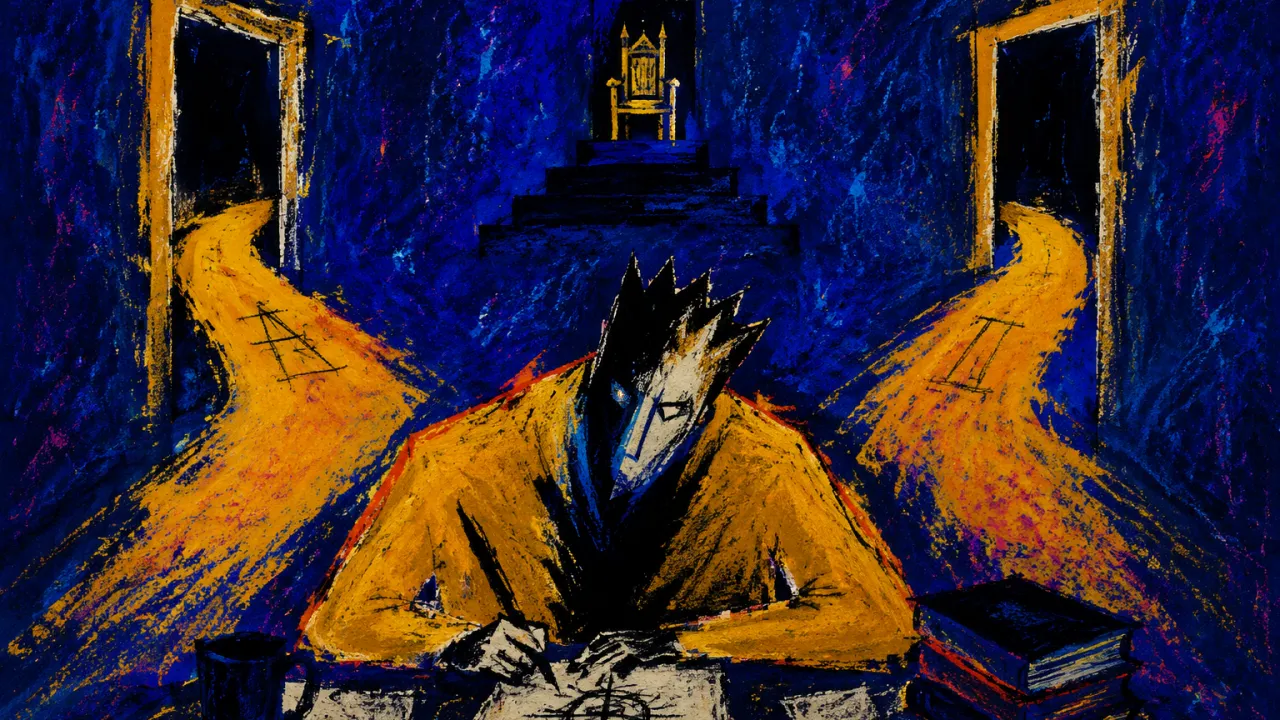
Power-Choice Split is what it feels like when a decision asks two questions at once: what do you want, and what will wanting it cost you in control? You are staring at a message offering something you asked for: a promotion, a commitment, a collaboration, a chance to lead. Your cursor hovers over the reply box, but your hand goes still because the offer has already become larger than the choice in front of you. One part of you leans toward the possibility; another starts checking who wrote the terms, what you would owe, whether you could change your mind, and how much of yourself you would have to place in someone else's hands. Your shoulders rise without permission. You press your palm against your chest, reread the same sentence, and try to work out whether the pressure you feel is a warning or simply the cost of wanting something that matters. A comparison list does not settle it because the hidden calculation is not only which option fits; it is which option lets you keep your leverage, dignity, and authorship. Saying yes can feel like being managed. Saying no can feel like abandoning a future you chose for yourself. Even compromise becomes hard to read: is it a freely chosen exchange, or the point where your preference quietly stops counting? From the outside, you may look undecided, but inside you are tracking several kinds of power at once, including who can withdraw access, who carries the consequences, and who gets the final word. You delay, qualify, seek guarantees, or keep both routes open because closing one door can feel less like making a choice and more like giving up a position you may need later. The cost is not only delay; when every desire must prove it will not leave you dependent, overruled, or unable to retreat, your life begins to feel like conditional space, with doors technically open but every route bending back toward who gets to steer. You remain at the contact point between drive and restraint, much like the woman in Strength, bending within the lion's reach and resting her hands where force could become action, neither denying its power nor letting it make the choice for her.
What's pulling at you?
You are trying to choose what fits your life while also protecting your ability to say no, change course, and remain the author of what happens next. An appealing option can still feel costly if taking it means owing someone, losing leverage, or carrying consequences without a full say, so you keep measuring the power built into each path alongside what you want.
How It Shows Up?
- On a quiet Sunday afternoon, you sit at the kitchen table with two options open on your laptop and a comparison sheet that has grown from five rows to twenty-three. The practical differences are already clear, but you keep adding columns for who would have the upper hand, how reversible each path would be, and whether accepting help would give someone a say later. Your eyes feel gritty, your shoulders angle toward the screen, and your fingertips rest motionless above the keys. The sheet is allowed to remain unfinished for the afternoon; you do not have to manufacture certainty from one more column.
- Your partner asks whether you want to move in together, and the question lands somewhere between intimacy and negotiation. You want to answer from closeness, yet your attention jumps to whose neighborhood, whose furniture, whose routines, and who would have less room to leave if the arrangement stopped fitting. Your chest holds tight while your hands smooth the same crease in your sleeve, and even a warm conversation begins to feel like a quiet contest over who will adjust more. The conversation can pause at the practical questions without becoming a verdict on the relationship.
- You reread a promotion email that makes you responsible for outcomes while leaving budget, hiring, and deadline decisions with someone above you. Your shoulders rise and one palm settles flat against your chest while the reply stays unsent. The office doors appear open, yet every route in the org chart bends toward the same elevated chair, and you cannot tell whether accepting would expand your influence or simply make you answerable for choices you cannot make. Leaving the message in drafts while the terms remain unclear is a complete response for tonight.
- At dinner with friends, someone asks where the group should go next, and a low-stakes decision suddenly feels charged. You hold back to avoid taking over, then feel yourself bristle when the loudest suggestion becomes the plan; when someone finally asks what you prefer, your smile tightens and your breath shortens because speaking now could look like a challenge. Your fingers turn the glass a few degrees at a time while every preference seems to carry a claim to the center of the table. A preference can remain a preference; it does not have to settle who leads the group.
- At 1:17 AM, you reopen a message you sent hours ago and study the wording as though it contains evidence about whether you kept or surrendered your position. Your eyes burn, your jaw stays set, and a dull pressure settles behind your chest while you rehearse alternate versions: softer sounds like giving in, firmer sounds like starting a fight, and silence would have left the door open. The glowing screen begins to resemble a field after everyone has defended their ground, even though the room is quiet. The message can remain sent while its meaning stays unsettled overnight.
Power-choice Split in Tarot Cards
Power-Choice Split becomes visible when choosing what fits your life is tangled with protecting your ability to refuse, renegotiate, or change course. You may feel it as your shoulders rising and one palm settling flat against your chest while a reply remains unsent. From an existential perspective, the structural framework shows how desire, access, and control can pull the same decision in different directions. The Tarot Cards below mirror the visible contours of that bind.
Power-choice Split in Tarot Card Reading Insights
Power-Choice Split also enters readings when a wanted path seems to change who holds the leverage or who gets to set the terms. Others have brought that same bind to the cards; the articles below gather Tarot Reading Insights from their sessions.

After Advisor Pushback: Three Closed Drafts, Then One Small Test
Topic:Study Tarot Reading
Struggle:Internal Authority Collapse
Context:Advisor Feedback Void

From Splitwise Anxiety to Clear Trip Rules: A Family Money Reset
Topic:Family Tarot Reading
Struggle:Power-Choice Split
Context:Unspoken Expectations Gap