The 'We're Family' Slogan Is Not the Scope: Ask, Then Choose

The 10:08 Glass-Room Flinch
If you're the mid-level designer who can handle a chaotic Figma file but feels your jaw lock when a lead says 'we're family,' you may know the workplace family red flag that turns one vague request into a forecast of permanent availability.
Jordan, a 29-year-old product designer in Toronto, brought me one exact moment. At 10:08 on a Tuesday, they were sitting in a glass meeting room near King Street when their lead used the phrase before mentioning a launch push. The HVAC hummed, a dry-erase marker left its sharp chemical smell in the air, and Jordan's coffee had gone bitter. Their pen stopped in the middle of a note. Their jaw tightened. Their shoulders rose while the actual launch request remained undefined.
'I wanted to help with a real problem,' Jordan told me. 'But the moment they called us family, I started defending every evening they might try to take. I can collaborate without handing over my personal life.'
That was the contradiction I heard beneath their question: Jordan wanted a functional team relationship, but feared that belonging language would convert ordinary teamwork into an unlimited emotional contract. Their irritation moved through them like a Slack notification preview wired directly to the jaw: one loaded phrase appeared, and their body reacted as if it had already read an entire thread of future demands.
'The moment you call us family, I start looking for the hidden invoice,' they said. Then they looked down at their hands. 'I'm not sure whether I'm protecting my boundaries or punishing the team for trying to get close.'
I told them I was not going to use tarot to decide whether their manager was trustworthy or whether Jordan should become more accommodating. Cards cannot establish another person's motives, and they should never be used to talk someone out of a legitimate boundary. I wanted us to examine the sequence between the slogan and the refusal, then find the point where Jordan's choice disappeared.
'Let's make a map of that sixty-second gap,' I said. 'Not so you can become easier for the team to manage, but so your yes and your no remain genuinely yours.'
Choosing a Map for the Hidden Contract
I invited Jordan to take one ordinary breath and hold the question in mind while I shuffled. I treat this part as a change of pace, not a supernatural performance: slowing the hands can help attention stop sprinting ahead of the facts.
I chose the Relationship Spread · Context Edition, a contextualized five-card relationship tarot spread for workplace boundaries and team dynamics. I use this spread when a problem is being created between a person's protective response, a group's implicit norms, and the practical relationship that has to continue between them. It explores interaction without pretending to predict an external outcome.
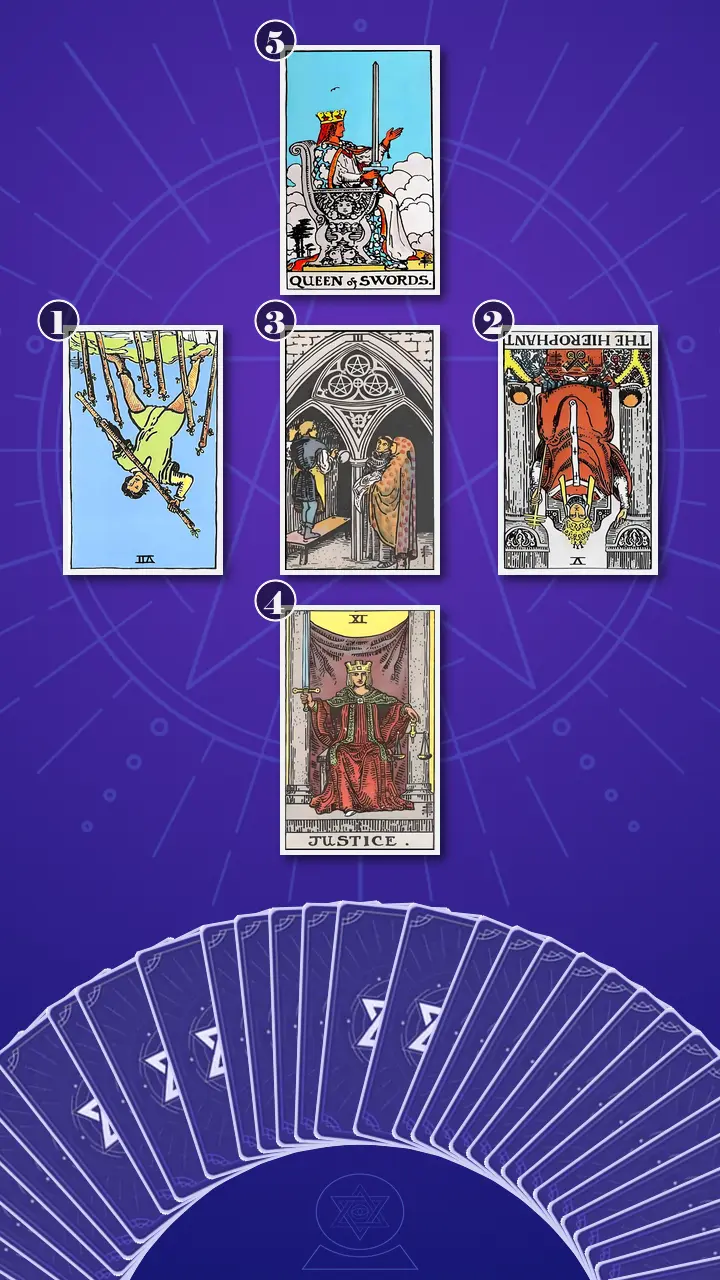
For anyone wondering how tarot works in a situation like this, the structure matters as much as the individual card meanings. The first position would show Jordan's observable stance when family-style management language appeared. The second would examine the authority or hidden rule they heard inside the team's language. The center card would show what the working relationship actually needed, stripped of its emotional packaging. Below it, the fourth position would test fairness, scope, reciprocity, and choice. Above it, the fifth would turn that discernment into a small communication experiment.
I laid the cards in a compact cross. The shape looked like a bridge under inspection: resistance on one side, group authority on the other, actual collaboration in the center, a fairness test beneath it, and clear speech above. I reminded Jordan that this was a reflection tool. The cards could help us name a pattern, but Jordan would remain the person who assessed the workplace, chose the boundary, and decided what happened next.
Reading the Heat Before the Ask
Position 1: The Defense That Arrives First
I turned over the card representing Jordan's current stance and their immediate response when 'we're family' language appeared. It was the Seven of Wands, reversed.
In the Rider-Waite-Smith image, one figure stands alone on high ground, holding a wand across the body while six more rise from below. Upright, I often read that fire as the strength to defend a position under real pressure. Reversed here, the energy had become an excess: the protective reflex was activating before the pressure had been measured.
I connected the image to a scene Jordan knew. A lead posts in Slack that everyone needs to pitch in before launch. Six replies stack under the message. Jordan's shoulders rise, they stop reading after the culture-heavy opening, and they begin drafting a broad refusal about unpaid availability. The actual task, Friday deadline, shared workload, and option to negotiate are still somewhere lower in the thread.
'I know where this goes,' I said, voicing the pattern Jordan had described. 'If I do not push back now, this becomes the baseline.'
The boundary awareness was not the problem. The overextension was. A useful defense had started behaving like a spam filter trained on earlier boundary violations: it blocked every message containing one loaded phrase, including messages that might contain information Jordan needed in order to make a proportionate decision.
Jordan gave one short, bitter laugh. 'That's so accurate it feels a little cruel.'
'Cruel would be calling your protection irrational and telling you to drop it,' I replied. 'I'm suggesting we update its job description. It can alert you without answering on your behalf.'
Their fingers tightened around the edge of the table, then released. I asked what part of the most recent request had still been unknown when they began composing their refusal. After a pause, they said, 'Honestly? Almost all of it.'
Position 2: The Rule Hidden Inside the Slogan
I turned over the card representing the team's implicit stance as Jordan experienced it: the group norm or authority signal that made belonging feel like obligation. It was The Hierophant, reversed.
The central teacher, the two kneeling figures, and the crossed keys traditionally speak to institutions, accepted teachings, and permission to belong. Reversed, that energy was blocked and contested. Jordan's independent judgment was healthy, but it had begun treating every shared value as imposed doctrine before the practical terms were known.
I described the all-hands meeting embedded in the card. A director says the company is a family, then praises the people who always step up. Jordan mentally leaves the agenda and starts testing the phrase: Who gets to define loyalty? Will declining affect performance reviews? What will count as commitment next month?
'It is like an app asking you to accept its community values before showing which permissions it wants from your phone,' I said. 'Your instinct is to reject everything because you cannot yet see whether it wants access to your calendar, your evenings, or your location.'
Jordan glanced up. 'Exactly. It feels like they introduced a policy but hid it inside culture.'
'That may sometimes be what is happening,' I said. 'The card does not require us to assume the language is harmless. It asks us to separate the language from the evidence. Which permission is actually being requested? Is participation expected, optional, or negotiable?'
I placed my finger beside the reversed card. 'The slogan is not the scope.'
The phrase caught them. Their thumb stopped rubbing the seam of their sleeve. Their focus drifted beyond the table for a few seconds, as if they were replaying the meeting and listening for the sentence that came after 'family.' Then they exhaled through their nose.
'I didn't hear the rest,' they admitted. 'I was already building the case.'
Position 3: Good Teamwork Names the Work
I turned over the center card representing what the team relationship actually needed in practical terms, separate from the emotional packaging that triggered Jordan. It was the Three of Pentacles, upright.
The atmosphere of the spread changed with it. The first cards had held a lone defender and an institutional gatekeeper. Here, an artisan worked while two collaborators consulted a visible plan. I read this Pentacles energy as balance: different people contributing distinct skills to one structure without pretending that they shared one private life.
I brought the card into Jordan's world through a Figma review. The product manager identifies the decision owner. Engineering names the technical constraint. Jordan is asked for one accessibility pass by Tuesday. Nobody asks for unlimited enthusiasm, personal disclosure, or after-hours availability. Each person can see what they own, what they need from the others, and where their responsibility ends.
'I can work with this because I can see where I fit and where I stop,' Jordan said quietly.
Their shoulders dropped by a fraction. I watched them picture a project meeting that had felt easier for precisely that reason. The shift was small, but it mattered: collaboration was becoming inspectable instead of symbolic.
'Good teamwork names the work,' I said. 'Belonging does not have to mean emotional fusion. It can mean that your contribution is visible, your limit is legible, and the shared plan does not require you to disappear inside it.'
I also noted that Cups were absent from the spread. I did not read that as proof that no one cared. I read it as a warning against using emotional language as a substitute for care that can be observed. Paid time, reliable cover, respect for a no, clear ownership, and reciprocal help would tell Jordan more about the quality of this team than any family slogan could.
When Justice Took the Director's Chair
Position 4: The Fairness Test Beneath the Trigger
The room became unusually quiet as I reached for the card below the center. The radiator clicked off, and a narrow bar of window light fell across the table, dividing the card space almost into two measured sides.
I turned over the card representing the boundary and fairness test Jordan needed: whether they could examine scope, reciprocity, and choice before treating a request as coercion. It was Justice, upright, the key card of the reading.
I brought Jordan back to 10:08 in the glass meeting room. Their lead had said 'we're family' before mentioning a launch push. Jordan's pen had stopped, their jaw had locked, and while everyone else kept nodding, they had already begun prosecuting a request nobody had defined.
Justice held a balanced scale in one hand and an upright sword in the other. I read this Swords energy as deliberate balance: the scales compare what the team is asking with the time, support, reciprocity, and flexibility it provides; the sword forms one clean question that cuts through vague language.
You do not have to accept 'we're family' as a contract; judge the actual request by clear, reciprocal standards, like Justice weighing one side against the other and holding the sword upright.
I let the sentence sit between us.
'The team label is emotional packaging, not a contract,' I continued. 'Your obligation begins with the actual scope, reciprocity, and choice, not with the word family. Respond to the request, not the emotional packaging.'
This was where I used the lens I call Workplace Typecasting Analysis. I could not know from a card whether Jordan's office had intentionally boxed them in, but I could examine the roles its vague culture language made available. Jordan was being invited to play the endlessly flexible supporting designer when they said yes, then the difficult office dissenter when they said no. Both roles kept leadership's undefined request at the center of the scene.
Through Leadership Narrative Construction, I offered Jordan a third role: the professional who sets the criteria by which the work can proceed. Justice did not ask them to become softer, more loyal, or less perceptive. It asked them to stop letting someone else's slogan direct their next line. As an artist, I thought of an editing room: one bad line can remain in the footage without being allowed to dictate the entire next act.
Jordan's inhale caught halfway. Their fingers froze above the table, and their pupils widened before their gaze slipped out of focus. Then their jaw set again, harder this time. 'But doesn't that mean I was wrong before?' they asked, a flash of anger sharpening their voice. 'That I created the conflict?'
'No,' I said. 'It means your alarm may have evidence behind it, but an alarm is not the assessment. The team is still accountable for vague expectations, pressure, and retaliation if those are present. Your responsibility is not to excuse them. It is to keep the alarm from spending your decision before you have the facts.'
The anger held for a beat. Then Jordan's fingers curled inward, loosened, and flattened against the table. Their eyes reddened slightly. A breath left them with a tremor that sounded almost like a laugh. Their shoulders descended, but the release was followed by a blank, unsteady pause, the moment after putting down a heavy bag and realizing they were now responsible for choosing where to walk.
'So I can hate the phrase,' they said slowly, 'and still ask what they actually want.'
'Now, using that new perspective, think back to last week,' I said. 'Was there a moment when this insight could have made you feel different?'
Jordan remembered a Thursday Slack message asking everyone to pitch in. They had posted a principle-based objection to weekend work, then discovered that the concrete request was a thirty-minute review on Friday afternoon. They pressed their lips together as the memory landed.
'The phrase can irritate me without deciding my answer,' they said.
I nodded. That sentence marked the central emotional transformation of the reading: not from skepticism to trust, but from reflexive opposition to self-directed evaluation. Jordan was beginning to protect autonomy through discernment rather than through automatic distance.
The Queen's Sword and Open Hand
Position 5: A Boundary That Stays in the Room
I turned over the final card, representing the communication experiment that could help Jordan remain self-directed while responding to an actual team expectation. It was the Queen of Swords, upright.
I pointed first to her upright sword, then to her raised open hand. The sword named the exact limit. The open hand remained available to relevant information. I read her energy as balanced clarity: she neither apologized for her independence nor used it to end every conversation before the facts arrived.
I staged the card as a calm exchange across a meeting table. Jordan could say, 'I can complete the accessibility review by Friday at three, but I cannot commit to ongoing after-hours availability. If Friday is too late, which part of the scope can move?'
That sentence did not debate whether the company was really a family. It named one contribution, one limit, and one point of negotiation. It allowed the team to respond to Jordan's actual capacity instead of forcing both sides into an argument about motives.
'A clear boundary does not need a prosecution case,' I said. 'Precision can be a bridge instead of an exit.'
Jordan repeated the sentence once, softly. They paused after the limit, as if their body expected an apology to follow. None came. Then they tried the open-hand question and looked surprised by how little it weakened the boundary.
'It feels exposed,' they said. 'I'm used to explaining enough that no one can argue with me.'
'You are allowed to explain less,' I replied. 'You can remain open to new facts without reopening the limit itself. And if the answer reveals a genuinely coercive expectation, you can document it, decline it, or seek appropriate support. Staying for one factual response is not surrender.'
Rewriting the Next Sixty Seconds
When I read the five cards as one sequence, I saw a coherent story. Earlier experiences of unpaid flexibility and blurred expectations had trained Jordan's protective filter to react quickly. The reversed Seven of Wands showed that filter firing before the present threat was measured. The reversed Hierophant showed why the phrase carried so much authority: Jordan heard an unwritten rule about loyalty inside it. The Three of Pentacles revealed the resource already available to them, because they collaborated well whenever roles and handoffs were explicit. Justice supplied the criteria, and the Queen of Swords turned those criteria into speech.
The cognitive blind spot was not that Jordan cared too much about boundaries. It was the belief that pausing for information meant allowing manipulation to pass unchallenged, and that one bounded yes might spend every future no. That belief left compliance, refusal, and confrontation as the only visible options. Clarification and negotiation had disappeared from the menu.
I gave the shift a simple direction: pause at the slogan, identify the concrete expectation and its limits, then answer the request rather than the emotional packaging. This would not guarantee that every request was fair. It would make unfairness easier to demonstrate and reasonable collaboration easier to recognize.
The Justice Note and the Protagonist Reframe
- Run the ten-minute Justice check.When the next vague request arrives in Slack or Teams, copy the exact wording into a private note before replying. Add three headings: Scope, Reciprocity, and Choice. Under them, write the task and deadline, who else is contributing or what support is offered, and what can be accepted, negotiated, or declined. Add one fact or unanswered question beneath each heading, then stop before deciding.Gathering information is not consent. If ten minutes feels agitating, use the minimum version: write only the exact request and identify one missing fact, such as the deadline.
- Use the Protagonist Reframe Directive.In the next cross-departmental meeting, speak once during the first ten minutes and replace the familiar reactive role with a defined professional position. Use: 'I can contribute X by Y; I cannot commit to Z; what is adjustable?' Then ask who owns the decision and where your handoff ends. This is one bounded act of collaboration, not a promise of ongoing availability.Draft the sentence in Notes first if saying it live feels too exposed. If the request carries retaliation, discrimination, or coercion risk, document the terms and choose the manager, HR, representative, or formal support channel appropriate to your situation.
I called the second practice a protagonist reframe because it changed more than the wording. Jordan would no longer enter the scene merely to oppose the manager's premise. They would name the work, set the boundary, and invite only the factual discussion needed to move the project forward. The team could accept, renegotiate, or reveal that its expectation was not reasonable. In every version, Jordan would have more usable information.
'One yes does not spend every future no,' I reminded them. 'Your consent belongs to the request in front of you, within the terms you actually agreed to.'

A Week Later, One Clean Question
Four days later, I received a message from Jordan. Their lead had posted another 'all hands on deck' note before a launch review. Jordan's jaw had still tightened. They had still disliked the wording. But instead of opening with a refusal, they had written: 'What does pitching in mean in terms of task, timing, and who owns what?'
The answer was specific: one thirty-minute accessibility review on Friday, during working hours, with another designer covering the remaining screens. Jordan agreed to that contribution and stated that they were unavailable after six. The lead replied, 'Works for me.'
Jordan did not tell me that the workplace had transformed or that the phrase no longer bothered them. They slept through the night, but their first thought the next morning was still, 'What if they push next time?' This time, they noticed the thought, smiled once, and made coffee before opening Slack.
I took that as the quiet proof of our Journey to Clarity. The contextualized Relationship Spread had not made the decision or declared the team safe. It had helped Jordan recover the moment in which a decision could be made. The real change belonged to them: one pause, one clean question, and one boundary that did not require either surrender or war.
I keep thinking about the instant when 'we're family' lands and the jaw locks before the request has even been named. It can feel as though letting one sentence pass will quietly spend every future no for you. But noticing the stopped pen creates a small space between the slogan and the answer, and that space is already yours.
If belonging did not require surrender, which part of the next team request would you place on Justice's scales first: its scope, its reciprocity, or the choice that keeps your no yours?