At 5:41 PM, "No Worries :)" Beat Honesty; Self-Respect Caught Up

Finding Clarity in the 5:41 PM “No Worries :)” Reply
When Maya sat across from me in my Toronto studio, I recognized the pattern before I touched the deck. She was 27, worked in marketing, and had that familiar downtown-worker exhaustion of someone who budgets her week in tiny pockets: commute, deadlines, one evening carved out for a date or a friend, then the whole thing gone in one line of iMessage.
She described Thursday, 5:41 p.m., down in the PATH. Cold air slipped through the glass doors behind someone rushing in. The fluorescent lights hummed. Her tote strap bit into her shoulder as she glanced at her phone near Shoppers and saw: “sorry, something came up.” She typed “No worries :)” before the elevator doors closed, then felt her throat pull tight and her stomach drop on the TTC home. By the time she got to her takeout, she was scrolling Stories of patio drinks and effortless-looking nights, rereading the thread for tone clues, and wondering why she felt so ridiculous.
Then she gave me the real question. “After they cancel last minute, what boundary am I avoiding?”
I could hear the contradiction immediately: she wanted reliability and respect in the connection, but she was afraid that if she named what the change cost her, she would sound high-maintenance and get pushed farther away. Her hurt felt like she had swallowed a flinch and it had lodged halfway between her throat and chest. I told her gently, “Calling it chill does not make it feel chill.” Then I leaned in a little and added, “The loneliest part is often not the canceled plan. It’s that split second where you start shrinking the impact so you can still feel easy to keep. Let’s make a map for that.”
Choosing the Bridge: A Five-Card Tarot Spread for Relationship Boundaries
I asked Maya to place one hand on her sternum, take a slow breath, and hold the question in plain language rather than trying to sound noble or detached. While I shuffled, I told her I do this not as theater, but as a way to slow the nervous system enough that the real question can come forward before the people-pleasing script does.
For her, I chose The Bridge, a five-card tarot spread for relationship boundary clarity after last-minute cancellations. I use this spread when the issue is not prediction—Will they change? Will this work out?—but translation. The Bridge maps the gap between what happened externally and what stayed unsaid internally. It is small, clean, and perfect for flaky-plan dynamics because it shows the immediate sting, the attachment pressure under it, the exact place the boundary collapses, the principle that restores self-respect, and the first realistic next step.
I laid the cards like a short crossing over a narrow ravine: one shore for her immediate reaction, one shore for what she was trying to protect, the exposed gap in the middle, the bridge beam above it, and the landing point beyond. Before I turned the first card, I told her what mattered most: “This reading won’t tell us whether someone else will become reliable. It will show us how tarot works as a structured mirror—where your own truth goes quiet, and how to bring it back in cleanly.”
Reading the Gap Between the Text and the Truth
Position 1: The Evening That Collapsed Onto One Screen
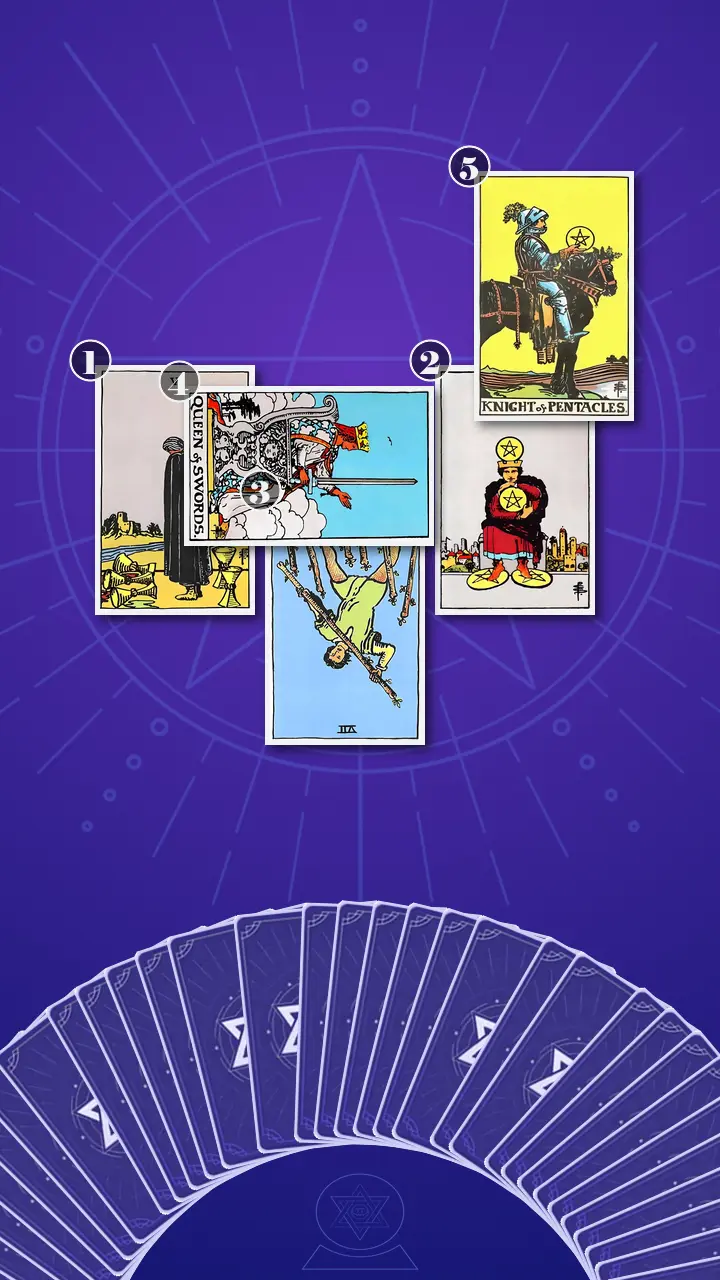
Now I turned over the card representing the immediate emotional and behavioral reaction after a last-minute cancellation. The card was the Five of Cups, upright.
I told Maya this was the exact moment of the PATH text: 5:41 p.m., the instant “No worries :)” reply, the reorganizing of an evening that had already been built around someone else. The energy here was excess Water—hurt flooding the frame so completely that the canceled plan filled the whole screen. Like zooming all the way in on one cracked notification, she could barely see the rest of her choices for the night, let alone the part of her dignity that was still intact.
In the Rider-Waite image, the figure stares at the spilled cups while a bridge stands in the background. That detail always matters to me. The bridge is there before the person can use it. In real life, that looks like the TTC ride home with takeout warming your hand, garlic and soy in the bag, Instagram Stories glowing in the window reflection, and your mind replaying the one sentence that hurt while forgetting the thread still gives you options. Hurt is real. But fixation is what makes it feel total.
Maya let out a short laugh that had a scrape in it. “Okay,” she said, looking down at the card, “that’s almost annoyingly specific.” Her fingers paused around the paper cup she was holding, then tightened once before loosening. I nodded. “Yes,” I said. “And it matters because your body knows it wasn’t fine before your text admits anything. Calling it chill does not make it feel chill.”
Position 2: What You Grip So Hard It Can’t Breathe
I moved to the card representing what Maya was trying to protect or not lose by staying agreeable. The card was the Four of Pentacles, upright.
This was not about greed. It was about grip. I explained that this card often appears when security has turned rigid—when a person starts protecting the connection by holding everything tightly inside. In Maya’s life, it looked like soft-booking Friday night from noon onward, declining the backup invite just in case, keeping Google Calendar holds labeled like they were real plans when they were still only maybe, and refreshing for confirmation because saying “I need firmer plans than this” felt riskier than losing the evening.
The energy here was excess Earth: contraction, control, and scarcity. The cancellation did not only disappoint her. It activated the old fear that asking for basic reliability might cost her belonging. So she clutched the bond to her chest and, without meaning to, left her own time unsecured. Like clutching a subway pole so hard your hand cramps, the attempt to feel safe was creating its own strain.
When I asked, “If you didn’t smooth it over this time, what are you afraid it would cost you with this person?” she answered almost instantly. “That they’d think I’m high-maintenance.” Her shoulders had climbed halfway to her ears before she finished the sentence. I noticed that, and I said softly, “There it is. Not drama. Not neediness. Just fear, moving faster than truth.”
Position 3: The Notes-App Boundary That Never Makes It to Messages
I turned to the card representing the avoided boundary and the hesitation that kept it unsaid. It was the Seven of Wands, reversed.
“This,” I told her, “is the exact point where the line disappears.” In modern life, it is the Notes app draft that says the real thing—‘I need more notice than this’—followed by the iMessage that says almost nothing—‘all good.’ She knew her standard. She just stepped off it the second she imagined tension. You know your line in private; you lose it in public.
Energetically, this was blocked Fire. Her self-assertion did not vanish because she was weak. It collapsed under anticipated disapproval. That distinction matters. This is the grip-and-retreat cycle so many people search about at midnight without having a name for it: fear of asking for reliability, instant cheerful rescheduling, short-term relief because conflict is postponed, and later a low, stale resentment that makes everything feel less trustworthy. Because the real boundary never lands cleanly, it leaks out later as distance, tone-reading, or a sudden hard cutoff that seems to come out of nowhere.
Maya went very still. First her breath caught. Then her gaze drifted off the card and somewhere past my bookshelf, as if she were replaying a dozen tiny scenes at once: one earring on, half-zipped dress, phone in hand; a Sunday coffee going flat while she waited for “let’s confirm later”; a train window reflecting her own face back at her while she reread the thread. Finally she exhaled through her nose and said, almost under her breath, “I literally do this every time.”
“I know,” I said, and I kept my voice matter-of-fact on purpose. “This card is not accusing you. It’s showing the exact hinge. The boundary you’re avoiding is not punishment. It’s the moment you stop muting your own mic before anyone asked you to.”
When the Queen Lifted Her Sword
Position 4: The Bridge Between Hurt and Self-Respect
When I turned the fourth card, the room changed. The small speaker on my shelf had been playing low instrumental piano, and just then the music thinned to a single clear note. It was only timing, but it sharpened the silence. This was the position that names the boundary principle restoring self-respect without turning the issue into a character judgment. The card was the Queen of Swords, upright.
Whenever this Queen appears in relationship readings, I think less about coldness and more about accuracy. Her gift is emotionally clean speech: direct enough to cut fog, open enough not to become an attack. In Maya’s real life, that looks like saying, “I can do reschedules sometimes, but last-minute changes are hard for me, so I need more notice going forward,” without overexplaining, apologizing for the need, or trying to control the other person’s reaction.
This is also where my own lens clicked in. After ten years of sound-energy work, I do something I call a Communication Dissonance Audit. I do not only listen to the words in a text thread. I listen for tempo. In Maya’s case, the cancellation landed on one beat, her soothing reply rushed in on the next, and her real hurt did not get a microphone until hours later on the TTC. That mismatch is the problem. The content says “easygoing.” The emotional rhythm says “I’m swallowing impact to keep the vibe.” For a second I flashed back to an old rehearsal room, hearing a singer rush half a beat ahead of the band; when the timing splits, even a beautiful lyric stops landing. Her relationships had the same dissonance.
I slowed down before I spoke again. “You know that moment on the train home,” I said, “takeout in your lap, rereading the thread and wondering why one small cancellation can make your whole body feel off? The sharpest pain is often not the canceled plan itself. It is how fast you talk yourself out of your own reaction.”
You are not preserving closeness by swallowing the truth; you create real connection by lifting the Queen’s sword and naming what last-minute changes actually cost you.
I let the sentence sit between us for a breath. Then I added, “The boundary you are avoiding is not ‘never cancel on me.’ It is ‘my time is not infinitely bendable just because I am afraid to seem difficult.’ A boundary is not a punishment; it is a reciprocity test.”
Her whole body reacted in sequence. First she froze—breath suspended, thumb hovering over the rim of her cup, eyes suddenly bright and a little wider. Then came the cognitive hit: her focus blurred past me, and I could almost see the replay begin—PATH lights, the half-ready Saturday outfit, the Notes draft, the fast smiley-face text. Then came the resistance. She frowned, not at me but at the pattern itself. “But if I say that,” she said, voice low and a little sharp, “doesn’t that basically mean I’ve been abandoning myself this whole time?”
“It means you were surviving the moment the best way you knew how,” I answered. “And now you know more. That’s different from being wrong.”
Her jaw unclenched first. Then her shoulders dropped so suddenly she almost looked surprised by the weight she had been carrying there. A breath left her in a shaky half-laugh. I’ve seen that moment often: the relief of clean clarity, followed immediately by the strange light-headedness of real responsibility. Once the path is visible, you cannot pretend you never saw it. I asked her, “Using this new lens, can you think of a moment last week when one clean sentence would have changed how you felt?”
She nodded slowly. “Thursday,” she said. “I could have just said it was hard to pivot last minute and left it there. I didn’t have to offer three new times.”
“Exactly,” I said. “That is the bridge. Not from conflict to perfect resolution. From swallowed disappointment and post-text rumination to calm self-respect and clearer discernment about reciprocity.”
Position 5: The Landing Point That Looks Boring on Purpose
I turned the final card, the one translating insight into a realistic next response she could practice the next time plans shifted. It was the Knight of Pentacles, upright.
I smiled when I saw him because this card is beautifully unglamorous. He is not a grand speech. He is follow-through. In Maya’s life, he looked like earlier confirmation, backup plans, no automatic reshuffle, and no instantly offering three new times after a day-of cancellation. The energy here was balanced Earth: steady, consistent, and grounded enough to stop renegotiating the same standard from scratch every single week.
“This is your calendar-first boundary,” I told her. “Your calendar is part of your self-respect. Not because a schedule is sacred, but because it tells the truth about what your time is worth. The Knight makes this boring on purpose: one rule, repeated. No drama. No manifesto. Just evidence.”
For the first time that evening, Maya smiled without wincing right after. “So I don’t need a perfect speech,” she said. “I need a default setting.”
“Exactly,” I said. “That’s how we move from vibe-protection to reality-testing.”
From a Clean Impact Text to a Calendar-First Boundary
Once all five cards were on the table, the story was very clear to me. First came the sting: a same-day cancellation hurt more than Maya liked admitting, and the immediate wound narrowed her focus to what had just been lost. Then came the grip: because asking for reliability felt risky, she protected the connection by clutching her feelings, her schedule, and her hope all at once. That compression set up the collapse. At the exact moment a boundary was needed, her fire went quiet, and she stepped off her own ground before anyone explicitly asked her to. The Bridge card changed the pattern by offering something cleaner than anger and stronger than minimizing: discernment, self-respect, and emotionally clean speech. The final card grounded that clarity into habit, because insight without repetition is only a mood.
I told her the cognitive blind spot was not “I care too much.” It was “I keep mistaking self-silencing for flexibility.” The transformation direction was simple, even if it would feel uncomfortable at first: move from protecting the connection by minimizing the impact to testing the connection by stating the impact and one clear limit. If honesty scares the connection, the fear is already telling you something.
Then I gave her practical next steps—small enough to use in real life, not just to nod at in a reading.
- The 10-Minute Reply GapThe next time a cancellation text lands, wait 10 minutes before replying if you can. For the first 3 seconds, use my Syncopation Pause: put both feet on the floor, inhale slowly, and name one sound in the room so your body can catch up before your thumbs do. Then check three things: your throat or stomach, your actual schedule, and whether you even want to reschedule.If 10 minutes feels impossible, do the 3-second pause plus one Notes draft. The goal is not to seem cold; it is to stop answering before your own nervous system has spoken.
- The Clean Impact TextDraft one sentence in Notes using this structure: impact + limit + optional next step. For example: “Last-minute changes are hard for me, so I need more notice going forward.” If you still want to see them, you can add a simple next step after that. If not, stop at the limit.You do not need a bigger case. You need a cleaner sentence. If writing it makes you flood, draft without sending and come back later.
- The Calendar-First BoundaryPick one rule for one person for one week: no holding an evening plan without same-day confirmation by 2 p.m., or no automatic reschedule from your side after a day-of cancellation. Put it in your Notes app or Google Calendar like a real setting, not a secret wish.Consistency is a tool, not a punishment. If the rule feels too strict or too loose after a week, adjust it. The point is to stop renegotiating your standard from zero every time.

A Week Later, the Quiet Proof
Six days later, Maya sent me a message. It was short, which I loved. “Used the line,” she wrote. “Didn’t offer a new time. Felt shaky for ten minutes. Then weirdly calm.” Later she told me she had let one vague Friday plan expire at 2 p.m., booked dinner with a friend instead, and still had a tiny morning-after thought—what if I was too much?—before rolling her eyes and making coffee. Clear, but still human. That was the proof I wanted for her.
I sat with that for a minute after reading it. Tarot had not created her boundary. It had simply made audible what her body already knew. That is what a real journey to clarity does for me: it returns the decision to the person living the life. The cards gave her a bridge. She was the one who crossed it.
If tonight you recognize that split second—the tight throat, the dropped stomach, the instant urge to type “No worries :)” before your own truth has even arrived—please remember this: if you let that moment be information instead of a referendum on your worth, noticing the gap is already one foot on the bridge.
So the next time a last-minute cancellation lands and your thumbs want to rush ahead of your reality, what one small limit—your Queen’s sentence, your 2 p.m. rule, your 10-minute reply gap—would make your next yes feel more solid?