Calling Comfort Peace After Betrayal—Then Naming What Failed

When a Comfortable Life Stops Feeling Trustworthy
You have the stable Toronto program-coordinator job, the comfortable apartment, regular hours, and dependable benefits everyone points to, yet one familiar promise still makes your chest tighten. That is safe-life anxiety, not a failure to appreciate what you have.
Jordan sat across from me at 8:47 PM on a Tuesday, their phone warm in one hand and a gratitude journal open beside a laptop. I watched their thumb type everything is unfolding for a reason, delete it, and reopen the same unanswered message while the laptop fan hummed into the comfortable quiet. The room looked settled; the broken promise did not.
Jordan looked at me and said, 'Why call a safe life peace after it let me down? I keep saying I am grateful because I do not know what I would do if I admitted this was not enough.' I heard the conflict clearly: honoring a structure that genuinely offered financial predictability while fearing that naming its failure might make the structure impossible to keep.
The disillusionment had a physical shape. It was like a calm weather app showing a clear forecast while your body kept bracing for a storm that had already happened: tight chest, heavy stomach, restless energy whenever the familiar routine went quiet. I told Jordan, 'You can genuinely appreciate what is stable and still know that something inside it failed you. We do not have to make that contradiction disappear tonight. We can give it a map. Our Journey to Clarity is about separating comfort, trust, and peace, then returning the next choice to you.'

Choosing a Map for Peace After Disappointment
I asked Jordan to take one slow breath and hold the question without trying to sound accepting. I shuffled the cards gradually, using the movement as a psychological threshold, a way to bring attention out of the looping message and into one observable conversation. Tarot would not deliver a verdict or predict whether Jordan should stay, leave, confront, or preserve the routine.
Today I used The Shadow Spread: Context Edition, a five-card RWS tarot spread for emotional clarity. It is suited to this question because the issue is not a single external event that needs a forecast; it is an inner meaning-making problem. The spread lets me examine how guarded comfort is being performed as peace, what heartbreak sits underneath it, how spiritual bypassing keeps the loop in place, what honest reckoning restores choice, and how grounded integration might look.
For you reading this, that is why a five-card shadow tarot spread can be useful when asking why a safe life no longer feels peaceful after betrayal. The positions create a linear passage rather than a dramatic prediction. The first card shows how the visible pattern is being defended. The second names the wound beneath it. The third exposes the hidden defense. The fourth is the truth that can restore agency, and the fifth turns that truth into a self-directed practice. This is card meaning in context, not a fixed sentence about your future.
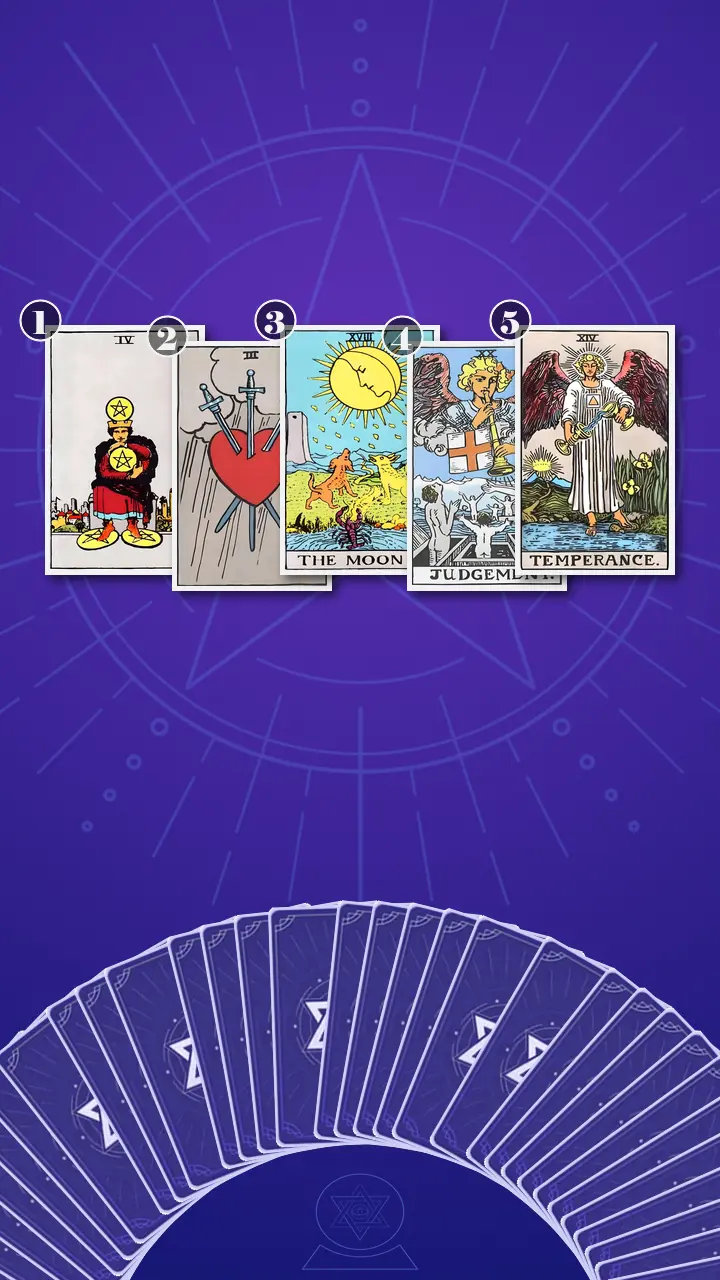
I placed all five cards in one horizontal line. The first three formed a dense, enclosed section; Judgement stood at the right-center like an opening call, and Temperance waited at the far end with a path still visible beyond it.
The Cards Along the Hallway
The Grip That Looks Like Peace
Now I turned over the card for position one, which shows how Golden Cage Comfort is being performed as peace through the habit of protecting a familiar routine and minimizing the fact that it let the querent down. The card was the Four of Pentacles, in upright position.
In the image, the seated figure presses one coin against the chest, keeps another above the crown, and plants two beneath the feet, with a city behind the body. I read the scene through Jordan's real life: the reliable program-coordinator job, the comfortable Toronto apartment, and the orderly weekly calendar genuinely reduce uncertainty. Yet the same stability has become a guarded grip. The routine is being protected more carefully than its trustworthiness is being examined.
The energy here is excessive containment, a contracted earth-based baseline. Comfort is present, but trust is deficient. The card does not say that the apartment, paycheck, or regular hours are bad. It asks which part of that comfort still supports Jordan and which part keeps the door closed on the disappointment. A quiet life is not automatically a trustworthy life.
Jordan gave a small, bitter laugh. 'That is a little too accurate. I have been treating predictability like evidence that I am fine.'
I did not rush to soften the recognition. I said, 'That laugh is useful information, not a failure of gratitude. When you say this is peaceful, which routine, benefit, or public explanation are you protecting from closer examination?' Jordan's shoulders rose toward their ears, then lowered by a fraction, as if the question had found the locked door without demanding that it be opened immediately.
The Red Notification Beneath the Calm
Now I turned over the card for position two, which names the pain beneath the Betrayal-Closure Lock, including what was trusted, lost, or left without acknowledgment. The card was the Three of Swords, in upright position.
The red heart hangs in open space beneath three visible swords and a dense gray cloud. I connected it to the scene Jordan had already described: after telling a friend that everything was fine, Jordan returned home, closed the chat, and felt the same sharp disappointment surface while the apartment stayed quiet. The orderly life remained around the wound, but polished acceptance had never included an honest account of what was broken.
The energy is painful clarity, an air-like fact that can pierce the Four of Pentacles' protection. This card does not require a verdict about anyone's motives, nor does it demand a dramatic ending. It asks what sentence about the letdown has been left unsaid, even privately. Gratitude can name what supports you; it cannot erase what failed you.
Jordan's breath caught. Their eyes stayed on the heart, then moved toward the window where rain had begun to stipple the glass. 'I keep saying I have accepted it,' they said, 'but I have not actually written what I lost.'
I watched their fingers loosen around the phone. 'Grief and anger can be information about what mattered,' I told them. 'They are not proof that you have failed at acceptance.' The room did not become lighter all at once, but the silence no longer had to perform peace on Jordan's behalf.
The Winding Route Through the Wellness Feed
Now I turned over the card for position three, which exposes how Spiritual Bypassing turns gratitude, forgiveness, or abstract meaning into a defense against naming the betrayal and feeling its consequences. The card was The Moon, in upright position.
The Moon's path winds between two towers while a dog and a wolf face the light, and a crayfish rises from the water before the route has become clear. I connected that image to Jordan watching an acceptance video and telling themselves the letdown was meant to teach them something, only to have the unanswered questions rise again as soon as the phone was put down. The explanation kept moving; the concrete destination remained unclear.
This energy is blocked and interpretively fogged. The Moon complicates the Three of Swords' painful clarity by making a soothing story feel easier to reach than a specific fact. One part of the mind says, trust the process; another senses that something is still wrong. My practical translation was simple: separate facts, feelings, and unanswered questions before assigning the experience a spiritual meaning.
I returned us to the Toronto apartment. 'The acceptance video keeps talking while the unanswered message stays open,' I said. 'This is the inner operating system underneath the loop: I can explain what this means, but can I say exactly what happened? The winding path is not a punishment. It is a sign that interpretation has arrived before acknowledgment.'
Jordan's thumb stopped above the screen. Their eyes went briefly unfocused, as though the same late-night sequence had started playing in another room. Then they exhaled through their nose and placed the phone face down. 'I know the lesson,' they said quietly. 'I do not know the sentence.'
When Judgement Called the Room Awake
The Sentence That Restored Choice
The room seemed to gain another layer of quiet as I turned over the card at the right-center. This was position four, which reveals the honest inner judgment needed to answer why the querent keeps calling this peace and what definition of peace would restore agency. The card was Judgement, in upright position. I treated it as the spread's Bridge, not as an external authority.
The angel's trumpet and the figures rising with open arms do not announce whether Jordan should keep or leave a life. They represent an inner call to review what happened honestly and respond to new information. In the modern scene, Judgement was Jordan opening Apple Notes and replacing everything is unfolding for a reason with a plain account of what failed, what it cost, and what now needed a boundary or question.
At this point I used my signature diagnostic lens, Pseudo-Growth Eradication. I strip away self-help fluff and audit the actual return on an insight: has it changed a concrete boundary, question, or routine? If it has not, the insight may still be content rather than growth. Then I apply Potential Actionability Assessment, translating the cognitive upgrade into one disciplined milestone that can be attempted without deciding an entire future.
At 8:47 PM on a Tuesday in the comfortable Toronto apartment, the gratitude journal was open, the acceptance video was playing, and Jordan's thumb had returned to the unanswered message. The room was comfortable; their chest was tight. This was where comfort and trust stopped meaning the same thing.
I let the plain version land first: You do not have to turn the betrayal into a spiritual lesson to keep your life. Name what failed, then let that fact revise the boundary, question, or routine around it. Peace is not the absence of conflict; it is a definition you are still allowed to examine and choose.
The old belief that safety must be called peace in order to be preserved cannot close the wound; let Judgement's trumpet wake the unedited truth, then choose boundaries and routines that make peace honest.
For one beat, Jordan's breathing stopped. Their eyes widened and then lost focus, as if the sentence had opened a file they had kept naming a lesson instead of reading. Their fingers tightened around the journal, released it, and rested flat on the table. When they finally spoke, the voice was low and uneven. 'But if I admit it failed me, does that mean I have to change everything?' I heard the fear inside the question, so I kept the next step deliberately small. I asked, 'Now, use this new perspective to think back to last week: was there a moment when this insight would have let you feel differently?' Then I offered a contained experiment. Set a ten-minute timer and open Apple Notes. Make three headings: Comfort, Trust, Boundary. Write one factual sentence beneath each, without explaining anyone's motives or deciding your whole future. Do not send a message or make a major change during the exercise. If your chest tightens or the note feels too exposing, close it and return only if and when you choose.
That was the crossing from performed gratitude toward honest acknowledgment. The old locked grip did not have to be smashed; it had to stop pretending that new information had not arrived. I told Jordan, 'Closure does not begin when the pain becomes beautiful; it begins when the truth becomes specific.' This was not a command to stay or go. It was the first movement from guarded comfort to discernment, from interpreting the wound to letting the wound inform a choice.
Two Cups, One Honest Week
The Peace You Are Still Allowed to Revise
Now I turned over the card for position five, which translates the truth into a self-directed and measurable experiment that lets genuine comfort and discernment coexist without deciding the querent's life for them. The card was Temperance, in upright position.
The angel has one foot on land and one in water, pouring between two cups, while a path moves toward distant mountains and a bright iris. I read this as practical balance: Jordan could keep regular work hours, a familiar home, or an evening routine while protecting a short period each week to name the disappointment and identify one modest adjustment. Emotional truth did not have to cancel financial stability, and comfort did not have to silence discernment.
The energy is balanced and deliberately paced. Temperance receives Judgement's awakening and brings it back into the body, the calendar, and the next ordinary decision. I said, 'I can value what supports me without using it to overrule what hurt me.' That sentence gave the two cups separate jobs. One could hold gratitude; the other could hold disappointment.
Jordan nodded, but not with the bright certainty people sometimes perform after a breakthrough. Their shoulders dropped, their jaw unclenched, and then they looked at the three blank headings in the Notes app. 'This feels less dramatic than I expected,' they said. 'Also more real.'
I agreed. 'Peace is not a verdict on the past; it is a relationship you are still allowed to revise. The goal is not to become perfectly calm. The goal is to make one part of the routine more trustworthy to you.'
The One-Page Peace Audit
I drew the five cards into one story. The learned protection of the Four of Pentacles made predictability carry the weight of trust. The Three of Swords showed the disappointment inside that protected container. The Moon revealed the blind spot: whenever the pain returned, spiritual explanations and gratitude content offered brief relief from anger, uncertainty, and the need to choose, but they left the concrete question untouched. Judgement supplied the missing call to name what failed. Temperance showed how to keep what genuinely supported Jordan while making one grounded adjustment.
I described the core metaphor this way: Jordan had been sitting in a locked room lined with cushions, calling the absence of conflict peace while the locked door kept the betrayal unspoken. The cognitive blind spot was treating the return of grief as evidence that more acceptance was needed instead of treating it as information about what had not been resolved. The key shift was to replace How do I make this feel peaceful? with a written distinction between what is comforting, what is trustworthy, and what now needs a boundary.
I also had a brief Wall Street flashback. On a trading desk, a green dashboard could hide a failing position; a favorable headline was never the same as a sound asset. In a life, a green calendar is not automatically trust. That was why I used my commercial logic as protection rather than pressure. We would measure execution, not perform another beautiful explanation.
Small Evidence, Measurable Next Steps
I placed the actions inside my Evolution KPI Framework, a 30-day strict execution challenge. The KPI was not permanent peace, emotional perfection, or an impressive journal entry. It was whether Jordan completed one small, observable act of honest discernment each week. The framework made the philosophy answerable to real life while keeping every choice reversible and self-directed.
- Run the Comfort-Trust-Boundary AuditOn Tuesday evening, open Apple Notes and title a page Comfort-Trust-Boundary Audit. Set a ten-minute timer. Write one factual sentence about what currently supports you, one about what you do not trust, and one about the boundary or question that deserves attention. Keep the note private for 24 hours, then read it once the next day and underline the most accurate sentence.Start with one observable event and do not guess anyone's intent. This is a private clarity exercise, not a requirement to confront anyone. The minimum version is one line under Comfort and one under Trust, stopping after two minutes if that is all you have.
- Separate Comfort from TrustChoose one familiar weekday routine this week, such as the commute, a recurring work meeting, or the Sunday reset. In a two-minute note, rate how comforting it feels and how trustworthy it feels separately from 1 to 5. Finish the sentence, This routine would feel more honest if, and name one modest change such as asking one question, adjusting one expectation, or protecting one period of time.Use one ordinary routine, not your whole life. A gap between the two ratings is information, not an order to change everything. If the exercise feels like overthinking, record the numbers and one reason, then stop.
- Draft One Private BoundaryBefore Friday, write one sentence in your phone using the frame I am no longer available for __; I am willing to __ instead. Fill the blanks with one concrete behavior or condition. Read it once with both feet on the floor and record what changes in your chest, stomach, or shoulders. You do not need to send it or share it.A boundary describes what you will participate in or protect; it does not control another person's response. If the draft feels too exposing, complete only the opening phrase and return to it when you choose.
At the end of 30 days, I asked Jordan to review completion rather than judge the outcome. Had the note been written? Had comfort and trust been measured separately? Had one boundary become clearer? This was Potential Actionability Assessment in practice: a philosophical realization became a set of small milestones, and the evidence belonged to Jordan, not to the cards.
No action on that page decided the entire future. The exercise simply made it harder for polished acceptance to speak over the facts. Jordan could keep the cushion without pretending the locked door was peace.

A Quiet Proof, Not a Perfect Ending
A week later, Jordan texted me: 'I did the audit. Comfort was a 4; trust was a 2. I drafted one boundary.' The apartment and job were unchanged. The next morning, the first thought was still, 'What if I am wrong?' Jordan opened the note anyway, then made coffee alone, steadier but not triumphant.
That was the first proof of the Journey to Clarity. The cards had not fixed the disappointment or chosen a life for Jordan. They had helped Jordan move from performed gratitude to honest acknowledgment, then from comfort-versus-trust confusion to one self-chosen adjustment. The authority returned to the person who had to live the answer.
Temperance gave us a way to hold practical stability and emotional truth in the same week. The Shadow Spread: Context Edition gave us a five-card reflection process for examining guarded comfort, heartbreak, spiritual bypassing, honest reckoning, and grounded integration. Neither tool asked for blind faith. Both made room for a peace that could be examined, measured, and revised.
When the room goes quiet after you say you are grateful, the tightness in your chest does not make you ungrateful or reckless. It may be the cost of protecting a safe-looking structure while a failed promise waits to be named. Clarity is sometimes the first thin place in the fog where comfort and trust separate, and where your own outline comes back into view.
If Comfort and Trust were allowed to be two different lines in the same Apple Note for one week, what is the smallest honest adjustment you would want to notice, without deciding your whole future tonight?