Why Keep Sadness So Close?

Explore Guarded Sadness, related Tarot Cards, and Tarot Reading Insights reflecting the quiet weight kept behind a calm, composed surface.

Guarded Sadness
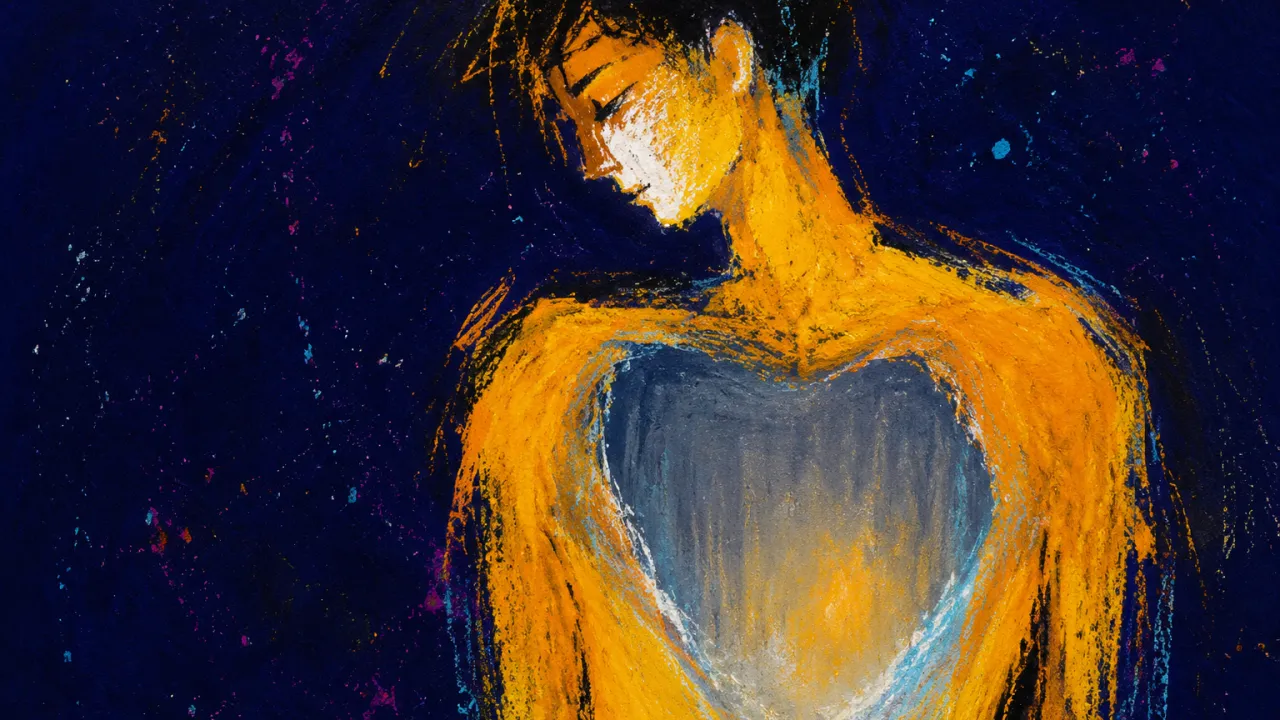
A solitary figure with a hollow space at the chest, warm amber fading through muted grey into deep indigo.

What does this feel like?

Guarded Sadness - you wake with a low, heavy feeling in your chest, before there is even a clear thought to attach it to. Your shoulders stay slightly raised, your face settles into something calm, and a quiet ache seems to sit just behind whatever you say. You answer messages, show up, laugh at the right moments, and keep the tender part of the feeling close, as if letting it show would make the whole day open wider than you can manage. Ordinary things feel muted: music reaches you but does not quite enter, conversation passes over you, and even a good moment can carry a grey edge. Inside, the words circle quietly: I am sad, but I do not want to explain it; I want to be seen, but I do not want to be looked at too closely. So you keep moving with that hollow, guarded weight, present in every room but carefully kept behind the surface, much like the figure on the Four of Cups, seated beneath the tree with arms folded and gaze lowered while a cup appears before them.

Why you're feeling this?

It makes sense that Guarded Sadness can stay quiet and protected while still feeling heavy. You do not have to show every part of it for the feeling to be present.

Guarded Sadness in Tarot Cards

Guarded Sadness is a universal emotional experience, and the heavy feeling in your chest can stay present beneath a calm surface. The cards below mirror its hollow stillness and held-back weight without asking it to become anything else. Here are the Tarot Cards that reflect this feeling.

Four of Cups
Upright
The figure remains folded beneath the tree while a new cup enters a field already occupied by three familiar ones. In personal growth, the image shows how sadness can make every invitation to change feel intrusive, hollow, or emotionally premature when the existing ache has not yet found a safe place in the self-understanding beneath it. The offered cup stays visible without erasing the need for stillness. Upright, the card preserves a modest opening between protection and possibility, revealing that growth can begin with accurately naming reduced receptivity rather than performing optimism or forcing a breakthrough.
Five of Cups
Upright
The black cloak surrounds the figure as attention narrows toward three spilled cups, hiding the face while making the emotional loss unmistakable. Internally, this is sadness that can be felt in weight and repetition but remains protected from the fuller meaning of what has been lost. The two standing cups and bridge sit outside the current line of sight. Upright, the image does not demand a positive reinterpretation; it reveals that the psyche is temporarily organised around the spill while preserving evidence that the inner landscape is larger than the grief currently in focus.
Eight of Cups
Upright
The cloaked traveller turns away from eight upright cups and enters difficult terrain beneath a darkened moon, carrying no visible audience for the departure. In personal growth, the hidden face captures the sadness of outgrowing an identity, belief, or coping pattern that once offered real emotional structure. The staff and forward step give the private grief a direction without demanding that it disappear. Upright, the card holds growth and sadness in the same movement, revealing that cognitive evolution can remain emotionally honest when the old self is neither shamed nor carried forward unchanged.
King of Cups
Upright
The King remains composed on a solid throne while the sea rises around him and living movement breaks the surface nearby. As an inner portrait, the scene captures a regulated public self holding a quieter sadness that is neither spilling outward nor receiving much direct attention. The upright cup provides a vessel for feeling, while the waves confirm that containment is not the same as emotional absence. Upright, the image frames composure as a genuine capacity that can hold sadness, even as it reveals the need to distinguish flexible containment from a permanent identity built around never appearing affected.
Two of Swords
Upright
The blindfold blocks visual input while crossed blades cover the heart and the sea holds feeling at the edge of the scene. Internally, this is the mind creating a controlled stalemate so sadness can remain present without becoming fully known, explained, or emotionally overwhelming. The figure's balance shows that the defence has a stabilising function, even though it demands constant tension. Upright, the card makes room to observe the protective strategy itself, revealing that numbness or uncertainty may be the gate around sadness rather than the whole emotional truth.
Three of Swords
Reversed
The heart, three blades, dark clouds, and rain expose an unmistakable structure of hurt while offering no face, voice, or behaviour through which it can be expressed. Reversed, the image turns into an internal cache of pain: sadness remains lodged beneath composure, separated from the words that could make it fully conscious. The blades do not simply disappear when the card turns. Their continued presence reveals the difference between containing hurt and integrating it, naming the numb, circling quality that develops when sadness is protected even from direct inner recognition.
Six of Swords
Upright
The cloaked passenger and child sit low in a narrow boat while six swords stand around them and a boatman controls the crossing. The covered head, crowded vessel, and water changing from rough to calm create the emotional texture of passing through a difficult interval without making the sadness public. The boat moves at a measured pace rather than leaping from one shore to another. Upright, the crossing gives protected grief a temporal container: the old turbulence has not vanished, but the sadness can travel through the transition without being forced to resolve before the far bank is reached.

Guarded Sadness in Tarot Card Reading Insights

Others have brought Guarded Sadness into readings too, carrying the same quiet ache behind a calm surface. Here are the Tarot Reading Insights from those sessions.
Psychological Emtions Related to Guarded Sadness