Conditional Help From a Friend: From Betrayal Alarm to Clear Terms

The TTC Text That Made Conditional Support Feel Like Betrayal
When someone says, “I can help, but only if you come to the event,” I know the mind can hear far more than a practical condition. It can start calculating whether refusing the plan will cost you your place in the friendship.
Maya, a 27-year-old communications coordinator in Toronto, brought me exactly that question. At 8:47 p.m. on TTC Line 1, she had pressed her phone against her coat and reread her friend's message while the fluorescent lights buzzed overhead. The train window was cold and streaked with rain; its reflection doubled the warm rectangle of the screen, her tight jaw, and the hand that kept reopening the same screenshot before the next station.
She had already checked an old group chat to see how easily this friend had helped other people. She had also drafted, “No worries, I don't need anything,” even though what she wanted to ask was much simpler: “What are you actually comfortable offering?”
“If I have to qualify for support, what exactly are we?” she asked me. “I can handle a no better than a maybe with strings attached.”
I heard the contradiction beneath her words. She wanted care to feel freely given, but the moment care came with a condition, her body treated the condition as evidence that the whole friendship had become conditional. The betrayal hurt moved through her like a subway car braking too hard: a drop in the stomach, a clamp around the chest, and both hands reaching for something solid before the mind had caught up.
“You are not only reacting to the condition,” I told her. “You are trying to calculate what refusing it will cost your place in the friendship. I am not going to use the cards to declare your friend loyal or disloyal. I want us to separate the hurt, the actual terms, and the fear about what those terms mean. Let's draw a map through that fog.”

Choosing a Bridge Across the Locked Channel
I invited Maya to put both feet on the floor, let one breath leave without forcing the next, and hold the question in plain language. I shuffled slowly, using the movement as a transition from investigating the text to observing the pattern around it.
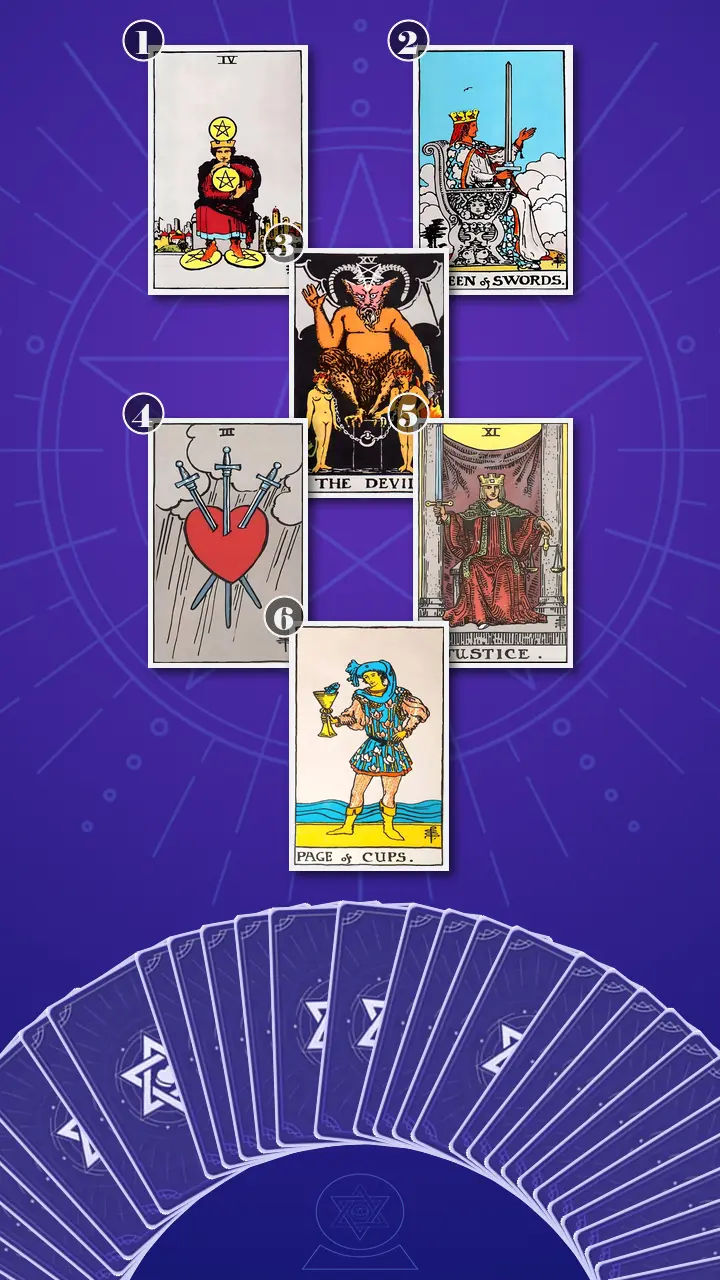
I chose the Relationship Spread · Context Edition, a six-card relationship tarot spread designed to examine two perspectives, the dynamic between them, the wound, the balancing resource, and a next response within the querent's control.
This is how tarot works in my practice: it does not read a friend's private motives or predict whether a relationship will survive. It gives us a structured set of images through which we can examine perception, behaviour, boundaries, and choice. For a question about conditional support and perceived betrayal, card meanings in context matter more than generic definitions.
I placed the first two cards across from each other like opposite ends of a bridge. The first would show how Maya was reading the offer; the second would show the friend's observable words and stated limit. The third would reveal the shared bargain forming between support and belonging. Beneath it, one card would name the wound, another would restore proportion, and the final card would show what Maya could actually do next.
Reading the Grip Before the Wound
Position One: The Phone Held Like a Boarding Pass
I turned over the card representing how Maya's fear of losing access shaped her perspective and response. It was the Four of Pentacles, upright.
The figure held one pentacle against his chest, pinned two beneath his feet, and balanced another above his head. I asked Maya to notice how completely the resource occupied the body: held over the heart, fixed under the feet, and suspended in the mind.
“This looks like your screenshot on Line 1,” I said. “You are holding the offer close while tracking every earlier ride, introduction, and favour. The help has stopped being one practical resource. It has become a boarding pass you keep checking to prove you are still allowed through the gate.”
I read the energy as an excess of protective earth: a reasonable desire for stability had contracted into monitoring and control. Every reread offered a second of certainty, but it also made support feel scarcer. The more tightly Maya tried to secure access, the harder it became to ask a direct question that might reveal the offer's actual limits.
She gave a brief, bitter laugh and looked away from the card. “That is so accurate it is almost rude,” she said. Her thumb rubbed the edge of her phone, then stopped.
I did not ask her to loosen her grip by pretending she did not need anyone. “Wanting dependable support in a new city is not the problem,” I said. “The question is whether you are protecting the friendship or trying to make continued access prove that the friendship is safe.”
Position Two: The Boundary Written in Plain Language
I turned over the card representing the friend's explicit offer and stated limit, where I could examine the boundary without guessing at private motives. It was the Queen of Swords, upright.
Her sword rose through a clouded sky while her free hand remained open. I saw a clean division between what had been said and everything Maya's betrayal alarm had added around it.
I brought the card into Maya's working life. At her communications desk, a message such as “I can make the introduction if you come to the networking night” contains observable terms: an introduction is being offered, attendance is being requested, and Maya is free to decide whether that arrangement works for her. The text does not automatically reveal whether the friend is punishing her, protecting professional credibility, seeking reciprocity, or simply bundling two plans together.
The Queen carried balanced air, but it was an underused resource in this exchange. Her discernment could interrupt the urge to search punctuation, read receipts, and Instagram Stories for a secret verdict. She asked three unglamorous but powerful questions: What is being offered? What is being requested in return? Can both people freely consent?
Maya's shoulders remained high, but her hands became still. “So I don't have to call the condition fair,” she said.
“No,” I replied. “Clarity is not automatic approval. The Queen does not certify every boundary as kind or reasonable. She asks us to identify the boundary accurately before deciding what you want to do about it.”
Position Three: The Loose Chain of the Unspoken Bargain
I turned over the card representing the shared dynamic, where support, compliance, and belonging had begun to merge. It was The Devil, upright, the spread's major blockage.
The two figures appeared chained to the same pedestal, but the links around their necks were visibly loose. I read the image as a blockage created by apparent compulsion: the exchange remained voluntary in theory, yet Maya's fear made every option feel like a trap.
I described the familiar scene. A friend offers a ride but only if Maya attends the full gathering. The condition lands like a platform's terms and conditions when declining seems to close the only door to the service, except the service here is practical help and emotional access at once.
“The loop sounds like this,” I said. “If I accept, I owe them. If I refuse, I lose them. If I ask what they mean, they can reject me.”
The offer had become a loose chain rather than a moral verdict. Maya could remove it by clarifying or declining the arrangement, but the underlying fear insisted that one person's help was the only route to the room, the introduction, or the feeling of being wanted there. Support had quietly become a loyalty test for both sides, whether or not either person had consciously designed it that way.
Maya's breath paused. Her eyes lost focus as if she were replaying a series of rides, introductions, and last-minute plans. Then she exhaled through her nose and said, “I keep waiting for the favour to become the price of belonging.”
“You can want care without making access a test of loyalty,” I told her. “And you can question a condition without reducing either of you to the pattern.”
Position Four: The Sentence That Became the Whole Story
I turned over the card representing the specific wound and the urge to close the conversation before a clearer answer could arrive. It was the Three of Swords, upright.
The red heart was pierced beneath gray cloud and rain. I linked the three swords to three injuries Maya had experienced at once: losing the practical help, feeling less chosen than someone she had seen in the group chat, and fearing that the friendship itself was ending.
I returned to the moment after the ride disappeared. Maya had replied, “Fine, I get it,” placed her phone face down, and turned it over again ten minutes later. No new notification appeared. The silence then seemed to confirm a conclusion that the unfinished exchange had never explicitly reached.
I read this as pain becoming a blockage. The card did not ask her to minimise the impact. The condition had pierced a real expectation of care. The problem began when the mind used that pierced feeling as complete evidence about intent, capacity, and the whole relationship.
“The hurt is real; the verdict is still a question,” I said. “Write the exact sentence that hurt. Beneath it, write the question you still do not have an answer to. Do not let the sentence impersonate the answer.”
Maya pressed two fingers lightly against her sternum. “Maybe I am protecting myself by ending the conversation first,” she said. Her voice was quieter now, with grief under the anger. “If I reopen it, I give her another chance to say I don't matter.”
“Or a chance to give you information you can use,” I said. “That information may still disappoint you. Clarity is not a promise that the answer will be comfortable. It is the chance to respond to what is real instead of only to what you fear.”
When Justice Refused a Premature Verdict
Position Five: Terms Before Verdicts
The room on Maya's side of the call went quiet. Her radiator clicked once and stopped, leaving a small metallic silence that seemed to echo the scales in the next card.
I turned over the card representing the resource that could test the condition against fairness, mutuality, consent, and self-respect. It was Justice, upright, the key card and antidote of the reading.
I brought Maya back to 8:47 p.m. on Line 1: the text reflected in the train window, her jaw locked, her stomach dropping, and her thumb hovering between a request for clarity and a message designed to disappear first. She had been trying to make a final decision about the friendship before the train reached the next station.
Justice held a level scale in one hand and an upright sword in the other. I explained that the card did not erase her hurt or automatically defend the friend. Its balanced energy restored proportion by separating impact from intent, an offer from entitlement, a boundary from betrayal, and one conditional exchange from Maya's worth.
You do not have to turn conditional support into a final betrayal verdict; weigh what was offered, what was requested, and what belongs to your own boundaries, like Justice balancing the scales before raising the sword.
I let the sentence remain in the silence.
For a beat, Maya stopped breathing. Her thumb stayed suspended above her darkened phone, and her eyes widened slightly, as if the words had interrupted a video playing behind them. Then her gaze drifted past the screen. I watched her replay the ride, the networking invitation, the quick “Fine, I get it,” and the later Instagram comparison. Her jaw tightened once more before beginning to release. Her fingers uncurled from the phone. A long breath left her chest, but the relief was followed by a blank, almost dizzy look, the expression of someone discovering that clarity brings responsibility as well as comfort.
“But doesn't that mean I was wrong about all of it?” she asked. A flash of anger sharpened her voice. “Like I created the betrayal because I am too much?”
“No,” I said. “You were not wrong about the impact. You felt hurt, and the condition may reveal a real mismatch in how care and reciprocity are understood. What remains unverified is the larger verdict about your worth and the entire friendship. We are correcting the scope of the conclusion, not putting you on trial.”
I leaned closer to the camera. “Now, using this new perspective, think back to last week. Was there a moment when this insight could have made you feel different?”
Maya looked down. “When she withdrew the ride, I could have said, 'I feel rejected, but I still don't know if she meant to punish me.' I could have asked if the ride was only available with the event instead of saying, 'Fine.'”
I asked her to open a private Notes page and set a 10-minute timer. She made four headings: What was offered, What condition was named, What I felt, and What I want clarified. Under them she wrote: her friend offered a ride if she attended the gathering; Maya declined; the ride was no longer available; she felt rejected; she still did not know whether the change was intended as punishment.
I told her she did not have to send anything, confront anyone, or keep investigating after the timer. If her chest tightened further, she could close the note and return only if and when she chose. Justice was a fact-check, not a demand for immediate contact.
With the four statements visible, I used a lens I call Gravity De-linking Analysis. I look for the friction that appears when two friends try to force one relational alignment while moving through different life phases. Maya's new-city life had made rides, introductions, and local access unusually heavy with meaning. Her friend's offers appeared to bundle practical help with shared plans or reciprocity. Neither orbit made one person superior, but forcing those two expectations into a single definition of care created painful gravity.
Seeing Justice, I also thought of the orbital calculations I had studied through years of working with the stars: one coordinate can describe a real pressure point, but one coordinate cannot define an entire trajectory. In the same way, one condition can reveal the shape of an exchange without defining the shape of the friendship.
This was the central movement of the reading: from betrayal-driven monitoring and possessive attachment toward proportionate boundary clarity, mutuality, and self-trust. Maya did not have to stop caring. She needed to separate “What can this friend freely offer?” from “What does this condition say about my worth?”
The Page's Small, Honest Message
Position Six: A Cup Left Open Without Demanding an Answer
I turned over the final card, representing the small response Maya could choose for herself: name the emotional impact, ask for clear terms, and widen her support without making one friend decide her worth. It was the Page of Cups, upright.
The Page watched a fish rise unexpectedly from the cup. To me, the image showed open emotional water returning to balance after the contracted earth, binding chain, and sharp wound of the earlier cards. Curiosity did not cancel discernment; it made discernment speakable.
I pictured Maya at the table in her Toronto apartment, a mug cooling beside her phone while the radiator clicked. The Queen of Swords could provide plain language, and the Page of Cups could carry the vulnerable feeling: “I felt hurt when the help depended on that condition. Can we clarify what you are comfortable offering and what you need from me?”
The message did not accuse the friend of betrayal, ask for unlimited access, or demand proof of the whole friendship. It also did not pretend the exchange had been fine. It named one impact and asked one answerable question.
Maya read it twice. The first time, her mouth tightened at the vulnerability. The second time, her shoulders lowered and she nodded. “That sounds like me on a day when I am not building a court case in my head,” she said.
“Clear terms leave more room for honest care than a perfect guess about someone's motives,” I replied. “You may send the message, save it, revise it, or decide the friendship is not available in the way you need. The cards cannot choose for you or guarantee her response. They can show you where your agency begins.”
Terms Before Verdicts: A Path Back to Self-Trust
When I read the spread as one story, its structure was precise. The Four of Pentacles showed Maya gripping support because one friend's availability had come to carry too much practical and emotional weight. The Queen of Swords showed a stated condition that needed examination, not mind-reading. The Devil exposed the unspoken bargain linking help, compliance, and belonging. The Three of Swords named the genuine wound and the protective exit. Justice separated the facts from the feared meaning, and the Page of Cups turned that clarity into one honest question.
The friendship had begun to resemble Ariadne's thread through a maze: useful guidance had become confused with ownership of the exit. Maya's cognitive blind spot was not that she cared too much or needed too much. It was asking one practical offer to answer a global question about whether she deserved belonging, then treating the emotional impact as complete evidence when the answer felt threatening.
The transformation direction was equally clear. Before asking, “Do I matter?” she could ask, “What was actually offered?” She could assess whether the terms were mutual, decline what did not work for her, grieve a real mismatch if necessary, and build additional routes to support. That was actionable advice, not a command to preserve or end the friendship.
- Make the 10-Minute Terms Before Verdicts NoteWithin ten minutes of a conditional-support exchange, put the chat down and open a private Notes page. Set a timer and write one sentence beneath four headings: What was offered, What condition was named, What I felt, and What I want clarified. Copy the exact wording without adding motive labels such as punishing, fake, or controlling.Minimum version: write only the offer and one question. Stop when the timer ends, and do not use the note to recruit a group chat into the case.
- Draft the Two-Sentence Page of Cups MessageChoose one exchange this week and draft: I felt hurt when the help depended on that condition. Can we clarify what you are comfortable offering and what you need from me? Read it once for accuracy, then remove any sentence that asks the friend to prove the entire relationship through this one response.Sending is optional. If vulnerability feels too activating, save only the clarification question and return to the emotional sentence later.
- Use the Constellation Release ProtocolCreate a three-row support map in your phone for emotional support, practical help, and career or community information. Add one person, service, or local resource to each row. For seven days, let this friend occupy only the roles she freely chooses instead of asking her to carry the whole constellation. This is not an automatic breakup; it is permission to leave the bond in its actual orbit while you observe what remains mutual.Start with one low-stakes request elsewhere, such as asking a colleague to review two lines of a portfolio bio or checking a community event's public information yourself.
I told Maya that none of these next steps were loyalty tests. Their purpose was to make her support system wider and her choices more legible. If the friendship could hold clearer terms, the conversation would have room to show that. If the bond was naturally fading or unable to meet an important need, she could acknowledge the grief without turning the ending into proof that she had never belonged.

A Week Later: The Quiet Proof
Six days later, I received a message from Maya. She had sent the two-sentence clarification and left her phone in another room while she made dinner. Her friend replied that the professional introduction was only available through the networking event because she wanted to make introductions in context; she was not willing to offer it separately.
The answer still disappointed Maya. It did not give her the access she wanted, and it did not transform the friend into an unlimited source of care. But it gave her something the old loop had not: an actual boundary she could accept, negotiate, or decline without inventing the rest of the verdict.
She declined the event, thanked her friend for clarifying, and asked a colleague to review two lines of her portfolio bio. The next morning, her first thought was still, “What if this means we are drifting apart?” This time she noticed the thought, smiled faintly, and did not open the chat.
I have come to see lives and relationships as moving orbits. A season of relational friction can be painful without being a cosmic sentence about anyone's worth. Maya's Journey to Clarity did not end with certainty. It began when she stopped handing one conditional offer the authority to define the whole sky.
If a friend's qualified offer makes your chest tighten and your hand reach for the phone, I hope you remember that the body can sound a real alarm before the mind has enough evidence for a final judgment. The hurt deserves care, and the scales deserve facts.
If you let the offer rest on Justice's scales as information before it becomes a verdict, what one Page of Cups sentence might you send, or quietly keep for yourself?