Rereading an Apology After Betrayal, Then Keeping the Boundary

The 11:40 p.m. Apology Loop
I recognized the particular trap in Alex before she explained it: she was a 28-year-old junior UX researcher in London who could map every possible interpretation of a betrayal, yet still reread the apology after midnight when the kinder version felt easier to hold than the evidence. I knew this was not a lack of intelligence. It was a closure lock built from attachment, hope, and the fear of making the loss real.
At 11:40 p.m. in the small bedroom of her shared East London flat, Alex had moved between a WhatsApp thread, a Notes draft, and a Spotify meditation podcast. Blue light washed over the duvet; the radiator clicked in the silence, and her palm had grown warm around the phone case. She wrote a boundary, saw a more hopeful explanation in the apology, and deleted the boundary before the meditation voice finished its sentence.
When she told me this, she looked down at her hands. 'I can see what happened, but I keep looking for a version that makes it less final. Why do I choose the comforting story over what the betrayal showed me? If I set the boundary too soon, I will never know whether I misunderstood them.'
Her ambivalence seemed to move through her body like a browser with seven tabs open and one of them playing sound she could not locate. Her chest tightened, her stomach shifted, and her thumb seemed to remember the checking motion before her mind had chosen it. Grief, longing, and self-doubt were all asking for the same thing: one more explanation.
I told her I would not decide whether the other person was good or bad, predict whether the relationship would return, or turn forgiveness into a test she had to pass. I wanted to help her look closely at the scene without abandoning either the meaningful parts or the observable breach. As Juniper Wilde, and as an artist who sees lives as films still in production, I knew my task was to sit beside the painful frame and gently hand her the pen again. 'We can use the cards as a clear map,' I said. 'The aim of our Journey to Clarity is not certainty about someone else. It is enough self-trust to choose what happens next.'

A Map with Room for What Happened
I asked Alex to place her phone face down, take three unforced breaths, and hold one question in mind: what did the behaviour show, and what would protect her while the answer was still difficult? I shuffled slowly, treating the preparation as a practical transition from checking and explaining into observing.
For this relationship betrayal and closure question, I chose the Transformation Path Grid (6), Context Edition. This is a six-position tarot spread designed to make a self-reinforcing pattern visible: the wound, the tempting interpretation, the root fear, the turning point, the next action, and the form of self-trust that can be integrated. A broader spread could offer more atmosphere, but this structure keeps the causal sequence in view.
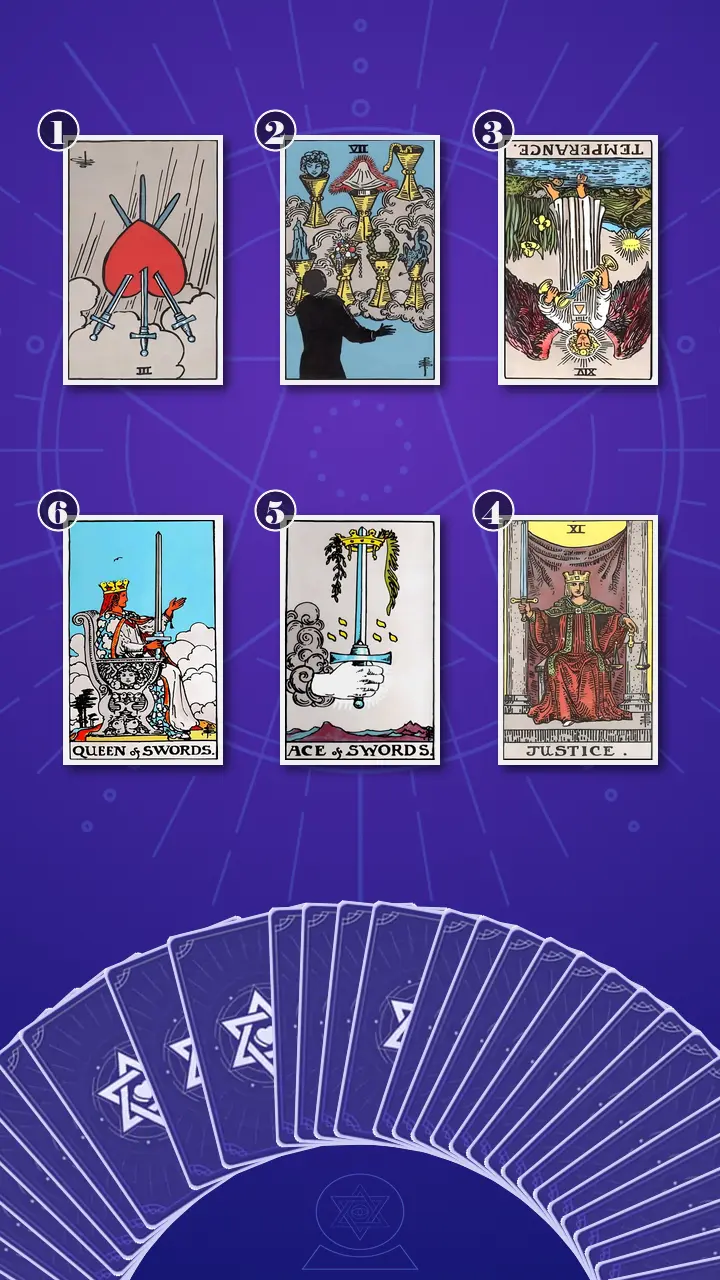
For anyone wondering how tarot works in a reading like this, I was using the cards as an objective reflection tool, not as a verdict or a source of supernatural proof. The top row would show the present wound, the blockage, and the deeper pattern. The lower row would turn at Justice, move through precise language with the Ace of Swords, and finish with the Queen of Swords as a boundary that could hold grief and truth together. I told Alex that the cards could suggest questions, but she remained the person who chose the meaning and the next step.
The Pierced Heart Before the Lesson
The Reversed Three of Swords: The Line She Keeps Renaming
For the current-state position, I was looking for the observable closure-lock behaviour that appeared when Alex met the evidence and reached for comfort. The card was the Three of Swords, in reversed position.
The RWS image showed a red heart pierced by three swords beneath rain and a grey sky, suspended in open space. I connected it directly to the late-night scene: after rereading the message that confirmed an agreement had been broken, Alex felt the sharp drop in her chest and opened a meditation podcast before writing down the behaviour. The wound was visible, but the comforting story arrived first, allowing the relationship's meaningful version to survive without requiring her to name what had changed.
Reversed, the Three of Swords carried a blocked movement toward release. There was a real healing impulse in it, but it was being overcorrected into premature forgiveness. I said, 'The question is not whether you are allowed to feel compassion. The question is whether compassion is arriving before recognition has finished its work. What does the behaviour show you even if you are not ready to decide what it means for the relationship?'
I used the 11:40 p.m. bedroom scene as a close-up. The blue phone light, the deleted boundary draft, and the meditation audio beginning again made the inner sentence easy to hear: 'I know what I saw, but maybe I am being too harsh if I call it what it was.' The contrast mattered because the pain was not absent; it was being renamed as a lesson before it could become information.
Alex gave a small, bitter laugh. 'That is almost embarrassingly exact.' Her thumb rubbed the edge of the phone case, then stopped. I let the silence stay ordinary. 'Recognition does not require you to make a permanent decision tonight,' I said. 'It only asks you to stop erasing the first line of the record.'
The Seven of Cups: Seven Tabs for One Betrayal
For the blockage position, I needed to show how Temptation Bias and emotionally appealing interpretations made the comforting story easier to choose than direct recognition. The card was the Seven of Cups, in upright position.
Seven separate cups rose from a cloud, each offering a different image to the silhouetted figure standing before them. I translated them into the seven explanations Alex could generate from one ambiguous apology: they were overwhelmed, they were scared, they misunderstood, they were protecting themselves, they loved her in their own way, the timing was wrong, or the universe was teaching her something. Each explanation kept another door open.
I told her that this was interpretation overload, not evidence that she was incapable of making decisions. It was like an algorithmic recommendation feed after a breakup: every swipe offered another explanation, and the one that gave instant relief kept getting promoted. In her case, the original message sat underneath seven browser tabs, each tab titled with a different possible motive.
The upright Cups showed an excess of emotional possibility. Hope, imagination, and empathy were useful capacities, but they had become a blockage when every possibility was treated as equally relevant. I suggested a small distinction: label each thought as evidence, hope, or unknown. A kinder motive might belong under hope or unknown. It did not need to be promoted to evidence simply because it felt soothing.
'Relief is not evidence,' I said. 'It is information about what your nervous system wants to escape for a moment. It can be welcomed without being allowed to settle the question.'
Alex slowly nodded, then looked away toward the window. The relief in her face appeared and disappeared quickly, like a notification preview. When it faded, her stomach tightened again. The same question had returned, proving that temporary calm and settled clarity were not the same thing.
Temperance Reversed: When Meaning Arrives Too Soon
For the root position, I was uncovering the spiritual bypassing pattern and the fear that accepting the evidence would make the loss final or threaten Alex's sense of belonging and safety. The card was Temperance, in reversed position.
The angel on the card moved liquid between two cups, one foot on land and one in water, with a path leading toward distant mountains. Upright, the image speaks of balance and patient integration. Reversed, the flow became uneven. Alex was pouring factual hurt, grief, anger, and spiritual meaning into the same glass before each part had been acknowledged on its own.
She described opening a note about unconditional love while the note containing the exact boundary violation remained unfinished. I compared it to an affinity map where the soothing interpretation had been placed over the contradictory sticky note, so the board looked coherent while the key data stayed hidden. I mentioned the familiar emotional compartmentalising of Severance: the painful facts placed in one mental room while a more acceptable story was allowed to run the rest of the day. Spirituality was not the problem. The sequence was the problem.
'Name the behaviour before you name the lesson,' I said. 'You can ask what it means later. First, let grief, anger, and discernment have equal standing with hope.'
Her shoulders rose toward her ears. She stared at the two cups, swallowed, and pressed her fingertips into the table. Then she released them and said, 'Maybe I have been calling avoidance compassion because I am scared that accepting the breach means I cannot belong anywhere safely.'
I did not argue with the fear or try to turn it into a neat spiritual insight. I asked which specific fact the comforting interpretation was helping her postpone. Her gaze dropped to the notebook, and she wrote the sentence she had deleted the night before. The writing was small and slanted, but it stayed on the page.
When Justice Separated the Story from the Record
The Justice Threshold: A Sword for Proportion, Not Punishment
Before I turned the fourth card, I paused. The room seemed to narrow around the spread. Rain traced thin lines down the window, and the traffic outside softened until I could hear the clock on my shelf keeping an even beat.
For the key-trigger position, I was looking for the truth-facing quality that could help Alex acknowledge what the betrayal showed without deciding the other person's future or demanding emotional certainty. The card was Justice, in upright position.
Justice sat squarely between two pillars, holding an upright sword in one hand and balanced scales in the other. The frontal gaze was clear without being cruel. I asked Alex to imagine a simple evidence matrix in her Notes app: the actual words or behaviour in one column, the effect on her in a second, and the boundary under consideration in a third. There was no fourth column called the explanation that makes everyone look good.
Because Alex worked in UX research, the structure was familiar. I watched her hand move as she drew the lines. I had a brief artist's flash of a storyboard: the betrayal was one painful frame, not the whole film, and one frame could be examined without being allowed to write every later scene. I use this visual turn in my Hero's Journey Alignment work. When someone has stayed in a painful scene while calling the waiting wisdom, I look for the classic Refusal of the Call before a major character evolution. That is not a moral failure. It is the moment when the next act feels dangerous because it asks the protagonist to trust a new internal standard.
The call here was not automatically to leave, reconcile, confront, or condemn. It was to believe her own perception enough to record it. That was the first act of Vision Actualization too: rewriting the limiting narrative that said she was not ready to move forward until another person's explanation made the truth acceptable.
What the Scales Asked Her to Hold
By the time I reached the fourth position, Alex was caught between two demands: keep the warm version alive, or let the evidence make the loss real. She was trying to be fair to someone else before being fair to the fact that her body had already registered the breach.
The scales do not ask you to make the betrayal meaningful before you name it; let Justice's sword separate observable behavior from the story, then choose a proportionate boundary that fits the evidence.
I let the sentence settle, then added, 'You do not have to turn the betrayal into a spiritual lesson before you are allowed to believe what it showed you. Weigh the behavior, its impact, and your boundary with the same honesty you offer the comforting story.'
First, Alex's breath stopped halfway through an inhale. Her fingers hovered above the notebook, pen still in hand, and her face went still. Then her pupils widened as she looked from the card to the apology on her phone, replaying the line that acknowledged her hurt without naming the act. Her jaw tightened; for one beat she looked angry, as if the sentence had taken away her last argument with reality. Finally, her fist loosened, finger by finger. A long breath moved through her chest with a small, unsteady sound. Her shoulders dropped, and her eyes grew wet without spilling. The relief was real, but it brought vertigo: with no comforting puzzle left to solve, the next choice belonged to her. She placed the phone face down and touched the three empty columns I had drawn. I did not treat the tears as a prediction. I saw truth and grief occupying the same room. 'So I can care about what it meant and still record what happened,' she said. 'Yes,' I replied. 'Now, use this new perspective to think back to last week. Was there a moment when this distinction might have let you feel even slightly different?'
Alex looked again at the polished rooftop Story she had saved and the apology that acknowledged her hurt without naming the behaviour. Justice did not ask her to erase the warm history. It asked her to stop letting that history edit the record. 'Compassion can remain in the room without being allowed to edit the evidence,' I said. This was the first movement from attachment-protecting spiritual reframing toward evidence-based self-trust, proportionate boundaries, and grief-aware clarity.
The Ace of Swords: One Clean Sentence
For the action-plan position, I was asking how clarity could become a written practice before reassurance, confrontation, or a larger spiritual explanation took over. The card was the Ace of Swords, in upright position.
A hand extended from a cloud, presenting an upright sword crowned against a clear sky and distant mountains. The sword did not represent aggression. It represented the first precise thought that could cut through narrative fog. I connected it to the paragraph Alex had been drafting and redrafting. She replaced twelve caveated sentences with two plain ones: 'That behaviour broke the agreement I believed we had,' and, 'I am taking space before I decide whether to respond.'
I reminded her that she did not have to send either sentence. The breakthrough was not a confrontation. It was having language accurate enough to honour the evidence without exaggerating it, minimising it, or assigning motives she could not verify. The Ace of Swords turned Justice's proportion into a small next step.
Alex read the sentences once. Her jaw relaxed, although her hand still hovered near the phone. 'It feels colder than the explanation I was writing,' she said. 'It feels more honest,' I replied. She moved the phone to the far side of the table, a small action that gave the sentence time to exist on its own.
The Queen of Swords: Meaning in Read-Only Mode
For the integration position, I was looking for the way self-trust and chosen boundaries could coexist with grief, without promising a relationship outcome or requiring another person's changed behaviour. The card was the Queen of Swords, in upright position.
The Queen held her sword upright at the centre of her body and extended an open hand. She sat on a stone throne beneath a clouded sky, receptive but not unguarded. I saw the distinction Alex needed: discernment could be firm without becoming punishment, and a boundary could protect the truth without turning her into someone bitter.
I offered the modern image of a phone permission setting. Meaningful history could remain in read-only mode without keeping the other person on full access. When a nostalgic message arrived, Alex could admit that the relationship had contained something real, leave the chat archived, and choose not to reply that night. Grief could stay. The evidence would no longer have to negotiate for its place.
'Your boundary is a response to the evidence, not a verdict on their soul,' I said. 'What boundary would let you honour the truth without needing the other person to validate it?'
Alex placed her palm flat beside the Queen. The gesture was quiet, almost practical. She did not look suddenly certain. Instead, her breathing became easier to follow, and she wrote, 'I can keep the good parts as memories without reopening the channel that changed.' The sentence left room for sadness, which was exactly why it felt trustworthy.
The Three Lines That Make Clarity Usable
When I laid the six cards in sequence, the story was simple without being simplistic. The reversed Three of Swords showed an injury that Alex felt but softened before naming. The Seven of Cups multiplied explanations and preserved hope. Temperance reversed showed how spiritual meaning had been poured in too early, creating a polished blend while grief, anger, and discernment remained separate underneath. Justice restored proportion. The Ace of Swords gave that proportion one accurate sentence. The Queen of Swords turned the sentence into a boundary that belonged to Alex.
The blind spot was not that Alex cared too much or lacked wisdom. It was the belief that uncertainty made self-protection unfair, and that accepting evidence meant declaring the entire relationship false. She had been treating relief as a verdict and compassion as a requirement to keep access open. The shift was Evidence Before Meaning: separate observable behaviour, personal impact, and chosen boundary first, then decide whether any larger meaning still serves her.
I also told her that the spread did not require a final judgment about the other person. It offered a way to set a boundary without closure, at least for now. Closure could begin when their explanation stopped having to certify what she had seen.
I used my Character Bible Directive to make the next move tangible. Rather than asking Alex to become an imagined perfectly detached version of herself, I asked her to write the exact psychological and behavioural specifications of a future self who could hold grief and evidence together. What would that version do when a polished Instagram Story appeared? What would she refuse to do while her chest was tight? What small act would show that she trusted her own record?
- Run the Fact-Impact-Boundary CheckAfter the next betrayal reminder, before reopening WhatsApp, spend ten minutes in the Notes app and create three headings: What happened, What it did to me, and What I choose for now. Under the first, copy only the observable words or action. Under the second, name one emotional or physical effect. Under the third, choose one temporary boundary to review later.Use bullet fragments and keep the exercise private. If ten minutes feels like too much, write one factual sentence and take one pause from checking.
- Take the 24-Hour Reassurance PauseWrite one sentence beginning with The behaviour I observed was and another beginning with For now, I will. Read them once, then place the phone face down for 24 minutes before checking the thread, asking friends to interpret the apology, or adding a spiritual explanation. Nothing has to be sent.Remove sentences beginning with maybe, perhaps, or they must have from the draft. This is a clarity exercise, not a message, and the five-minute version still counts.
- Write the Future-Self Character BibleFor fifteen minutes tonight, write a seven-day specification for the version of you who protects perception without using punishment: when a nostalgic message arrives, she reads it once, records behaviour and impact, archives the chat, and waits before choosing access. Add one line describing how she speaks to herself when grief appears.Keep the boundary adjustable: mute rather than block, archive rather than delete, or pause late-night replies. The future self is a practice, not a performance you have to perfect.
I watched Alex read the list. 'The boundary can be temporary,' I said. 'You are choosing your participation and access, not issuing a sentence. New information or a change in your capacity can change it later. For tonight, the smallest workable action is enough.'

A Boundary in Read-Only Mode
I did not expect the reading to remove Alex's grief. That would have been another comforting story, another promise that clarity must feel clean. I wanted something more reliable: a small proof that she could notice the cue, record the evidence, and choose a pause before the old loop took over.
Four days later, I received a WhatsApp message from Alex: she had written the three headings, muted the Stories for seven days, and slept through the night. In the morning, What if I am wrong? still arrived first. This time she smiled, put the phone down, and made tea.
That was the first visible turn in our Journey to Clarity. The six-position Transformation Path Grid tarot spread for betrayal, closure, and boundaries had not chosen Alex's fate. It had helped her see the sequence clearly enough to choose her own next scene. Evidence-based self-trust did not replace grief; it gave grief a steadier place to sit.
When a betrayal reminder tightens your chest and makes your thumb hover over the chat, you may be grieving both the person and your trust in your own judgment. The warm story can keep its meaning without being allowed to abandon what you saw.
If you let the behaviour stay true without forcing it to erase every meaningful part of the story, what tiny pause or boundary would feel like yours tonight: the muted Story, the phone face down for 24 minutes, or one clean sentence in your Notes app before the meaning arrives?