Post-Breakup Friend Group Anxiety: From Group Fear to Clear Boundaries

The Quiet Chat on Line 1: When One Breakup Feels Like Losing Everyone
I met Alex (name changed for privacy), a 27-year-old non-binary junior UX designer riding the TTC home after a breakup and reading a three-hour pause in the shared group chat as proof that everyone had picked a side: post-breakup friend group anxiety in real time.
At 8:47 PM on Line 1, Alex had been scrolling through the chat and counting reactions while the carriage brakes squealed. The phone felt warm against their palm; the tunnel lights flashed across the glass, and their stomach dropped each time the screen stayed quiet. The former partner was listed on an upcoming plan, but nobody had said clearly who would be there.
Alex showed me the screenshot and said, If the breakup changed the group, maybe I was only included because of the relationship. I want to know which friendships are mine, but I am scared to ask without making the question real.
I heard fear of losing belonging beneath those words, but it did not arrive as an abstract idea. It arrived as a tight chest, restless fingers reaching for the phone, and a mind treating one quiet thread like a system-wide outage. One changed relationship had begun to darken the whole network.
I did not tell Alex what the friends would do, because tarot cannot and should not make that decision. I said, The grief is real, and we can give it a precise address. Let us draw a map that keeps the romantic rupture in its own place and lets each friendship answer for itself. I want to hand the pen back to you, so we can begin this Journey to Clarity together.

Choosing a Smaller Map for Mutual Friends
I asked Alex to place the phone face down and take one slow breath before I shuffled. The small pause was not meant to summon anything mysterious. It gave the nervous system a clean transition from scrolling and interpreting to observing.
Today, I used the Relationship Spread · Context Edition, a six-position relationship tarot spread designed for a romantic bond that overlaps with a wider social network. For anyone wondering how tarot works in a situation like this, the cards offer a structured cognitive frame: they slow the jump from an ambiguous cue to an all-or-nothing conclusion, then give each layer of the problem its own place.
A larger spread, such as a Celtic Cross, could have added more history and future-focused positions, but that would have diluted the exact distinction Alex needed. This smaller map was enough to show the current emotional stance, the changed romantic bond, the independent friendship history, the post-breakup group limbo, the hidden attachment pattern, and one concrete route toward clarity.
I explained the viewing path. The first card would show what Alex was doing when the social field felt uncertain. The next would locate the real change inside the former relationship. The third would look for friendship memories that existed independently of the romance, while the fourth would show the group environment. The fifth would expose the meaning-making chain, and the sixth would offer a direct boundary or reality check that belonged to Alex alone.
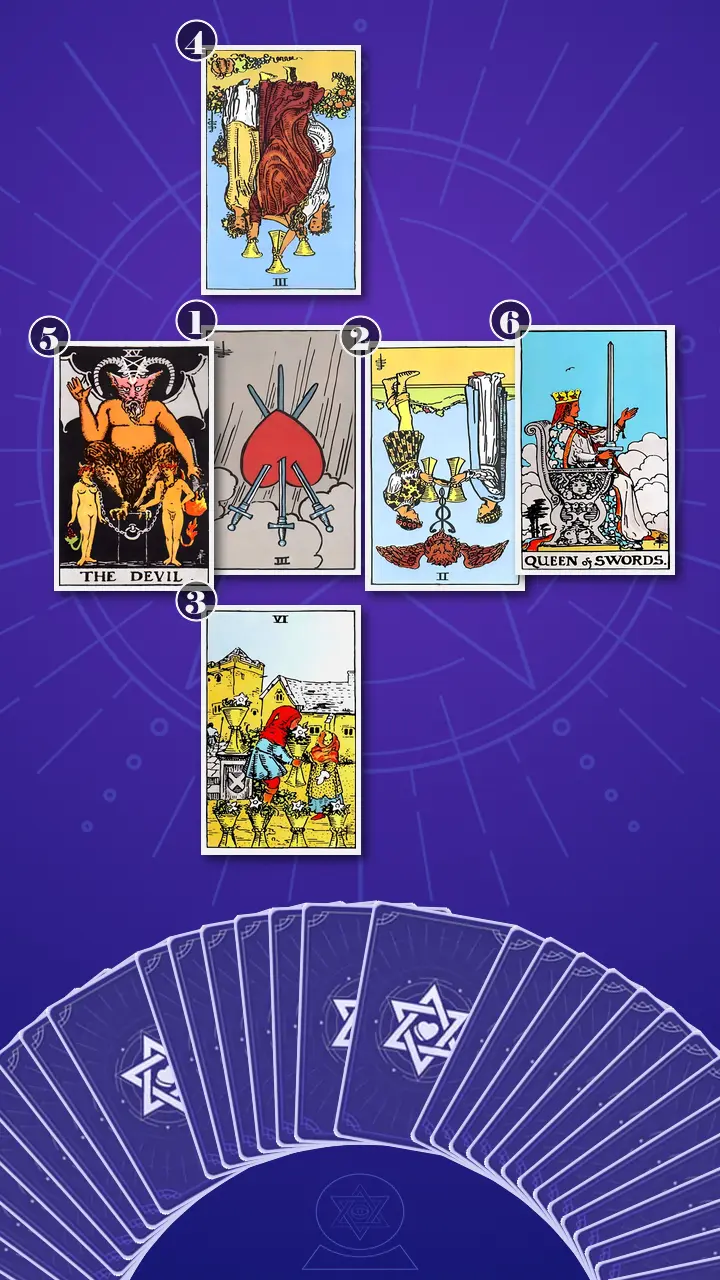
Reading the Bonds, Not One Verdict
Position 1: The Heart Carrying the Whole Network
Now I turned over the card for the querent's present emotional stance: the observable post-breakup behavior of checking, withdrawing, or seeking reassurance whenever the group felt uncertain.
The card was the Three of Swords, in reversed position.
The red heart pierced by three blades hung against an open, storm-gray sky. In reversed energy, the wound was turned inward and still being processed. That was not a punishment and not a forecast. It was a blockage: grief had become emotional weather, and that weather was tinting every ordinary interaction. On the TTC after work, a neutral group message could meet the same private ache as an old breakup text, so a delayed reply started to look like collective rejection.
This is why I read card meanings in context rather than treating a symbol as a fixed verdict. The pain was real, but pain was not evidence that every friendship had ended. I said, A quiet chat is a cue, not a verdict. For one week, try to record the breakup grief separately from one observable fact about each friendship.
Alex did not nod. They gave a short, bitter laugh, rubbed the edge of the phone case with one thumb, and said, Damn, this is exactly my brain. One delayed reply becomes a group decision, and I keep checking because I am scared the moment I stop looking is the moment everyone moves on without me.
I let the recognition settle without turning it into a diagnosis. I told Alex that noticing the loop was already useful data. The card was naming the place where the story had become total, so the next card could help us make the heartbreak specific again.
Position 2: The Pair That Actually Changed
Now I turned over the card for the changed romantic bond: the part of the breakup that had genuinely altered the connection between Alex and the former partner, without claiming either person's private thoughts or deciding what either person should do next.
The card was the Two of Cups, in reversed position.
In the image, the two figures no longer exchange their cups in the same balanced way. Reversed, the energy showed disrupted reciprocity and a relationship whose old emotional exchange could not simply continue unchanged. That was a clear acknowledgment of loss. It also supplied a boundary around the loss: two people can have a broken or misaligned bond without the surrounding contact list being deleted.
Alex had told me about seeing the former partner's name on a shared birthday plan and immediately feeling as if access to the entire group depended on that one person. I pointed to the separate cups. What belongs to the romantic dyad itself, and what has been added by interpretation? The former relationship can be over or difficult without becoming the administrator of every friendship around it.
One breakup can change the group chat without becoming the group chat's meaning.
Alex's thumb stopped moving. Their shoulders remained lifted, but their gaze moved from the card to the list of contacts they had written on the table. So the breakup is real, they said, but the group loss is an inference I have been attaching to it.
I said that an inference could feel convincing without being foolish. The purpose of the card was not to argue Alex out of grief. It was to keep one changed bond from speaking for every bond that happened to share a calendar, a group chat, or a rooftop photograph.
Position 3: The History That Came Before the Romance
Now I turned over the card for independent shared history: the memories, acts of care, and friendship ties that could exist beyond the romantic dyad and help Alex separate one loss from the meaning of the whole group.
The card was the Six of Cups, in upright position.
The upright cups carried familiarity, kindness, and emotional history. I focused on the child offering a flower-filled cup, not as a demand to live in the past, but as a small act of recognition that did not require a dramatic speech. The energy here was available and balanced. Belonging could be made of ordinary evidence accumulated over time: a friend helping with a move, checking in during a brutal work week, remembering a tradition, or knowing exactly which noodles Alex would eat when too tired to cook.
I asked Alex to name one memory with a mutual friend that existed before, outside, or independently of the relationship. They told me about a moving day when that friend had shown up before the romance began, carrying a box of dishes up three flights of stairs and staying for takeout afterward.
Alex's mouth softened, then tightened again. They glanced at the phone as if a new like from the former partner could invalidate the memory. I keep deciding those things do not count anymore, they said.
You can miss the relationship without outsourcing every friendship to it, I replied. The past can stay specific. That friend helped you move. That tradition has its own history. Neither fact promises that nothing will change, but neither disappears because one romantic bond did.
Position 4: The Group Chat at the Edge of the Frame
Now I turned over the card for post-breakup group limbo: the way shared chats, invitations, social media, and overlapping plans were influencing Alex's interpretation of belonging.
The card was the Three of Cups, in reversed position.
Upright, the three figures raise their cups in a circle of friendship and celebration. Reversed, the communal ease was disrupted. Plans could be awkward to coordinate, invitations could be vague, and the former partner's presence could make a normal gathering feel like a loyalty test. The energy was social uncertainty and isolation, but it was not proof that the friends had secretly chosen sides.
Alex described a Friday birthday invitation with a vague note that everyone was welcome. They had checked the guest list, reread the group chat, noticed a neutral emoji, drafted a question to one mutual friend, deleted it, muted the conversation, and considered declining before anyone had excluded them. I said, The actual facts may be incomplete, but the story your mind supplies is arriving fully edited.
The card invited a bounded experiment rather than forced exposure. Alex could attend for one hour with an exit plan, ask one friend to meet outside first, or choose not to attend and refuse to treat that choice as evidence of rejection. I wanted the decision to be a boundary, not a test of courage.
Alex traced the birthday details with a fingertip. The invitation had not become clearer, but their breathing became less shallow. I watched the distinction begin to form between an uncertain room and a verdict about whether they belonged in every room.
Position 5: The Hidden Permission Setting
Now I turned over the card for attachment-based meaning collapse: the hidden belief and belonging fear that could turn a single breakup into an assumed loss of the whole friend group.
The card was The Devil, in upright position.
I said this plainly because the name can sound harsher than the work the card was doing. The Devil was not a curse, a warning that Alex was doomed, or a statement that anyone in the group was bad. It showed attachment, perceived bondage, and a habit of treating one connection as if it controlled access to every other connection. The loose chains around the figures suggested that the captivity felt absolute while still being available for examination.
I used the modern scene Alex had brought into the room. They opened an Instagram Story, saw mutual friends together on a Toronto rooftop with the former partner near the edge of the frame, and checked the group chat before the Story had even finished. In the silence, the inner script ran: If they are together, then I am out. If I ask, I will look needy. If I stop checking, I will miss the verdict.
The Devil's energy was an excess of attachment-driven interpretation and a deficiency of separation. One notification became proof about the whole social network. One friend became a spokesperson for everyone. With every check, Alex received a few seconds of relief, then more ambiguity, because the checking had replaced direct contact. I said, The chain is the equation itself. It is not the fact that your friends are separate people.
At this point I brought in my Clique Power Dynamics lens. I use it to examine subtle jealousy, micro-aggressions, and implicit hierarchies in close-knit groups, but I do not use it to manufacture enemies from missing information. I had no evidence that the former partner was a gatekeeper or that the friends were running a private loyalty vote. I could, however, ask whether the old couple had become the group's default center and whether Alex had been placed in a role that kept everyone else comfortable.
That was where my Sidekick Syndrome Diagnosis became useful as a question rather than a label. Had Alex been boxed into the low-maintenance translator, the peacemaker, or the person expected to absorb awkwardness so the group could keep its old shape? Alex looked down at their hands and said, I keep trying to be easy so nobody has to deal with my feelings.
I answered, You are allowed to care about the group without becoming responsible for making the breakup easy for everyone. No friend needs to be a villain for you to stop playing a role that costs too much. Alex's fingers tightened once, then released. Their chest was still visibly tense, but the urge to reach for the phone no longer looked like the only available action.
When the Queen of Swords Cut Through the Notification Noise
The room grew quiet when I reached for the final card. Outside the window, rain drew thin lines down the glass, and the phone screen, face down beside the spread, gave off no new evidence. For a moment, the silence itself became part of the reading: nothing had been decided by the absence of a notification.
Position 6: The Sentence That Gives Each Friendship Its Own Voice
Now I turned over the card for concrete relational clarity: the self-chosen boundary, direct observation, or low-pressure conversation that could let Alex participate without asking the entire group to settle the fear.
The card was the Queen of Swords, in upright position.
Her sword rose cleanly through open air. The upright energy was discernment, self-trust, honest language, and a boundary that protected connection without becoming punitive. The butterfly motifs on her throne mattered to me too. Clarity could change the shape of the situation without requiring emotional erasure.
Alex works in Figma, so I gave them an image from their own world. The Queen felt like the layer panel: separate the romantic layer, the group layer, and Alex's own needs before editing the entire design. A clear boundary was a filter, not a deletion button. It could answer what Alex was available for without asking mutual friends to choose between people.
In my practice, I call the language pivot that follows The Role Resignation Act. If Alex had been cast as the person who smooths tension, translates everyone's feelings, or stays unusually easy to avoid making the room uncomfortable, they could resign from that character without resigning from friendship. The sentence could be simple: I would like to keep our friendship separate from the breakup. I am not asking you to choose sides. Would you like to grab coffee Thursday?
At 8:47 PM on the TTC, Alex checks the quiet shared chat, counts reactions, sees the former partner on the plan, and feels the whole social world tighten around one changed relationship. The body wants a verdict before contact; the mind calls vigilance protection.
You do not need to treat one breakup as proof of total social loss; separate the romantic story from each friendship through clear, direct observation, like the Queen of Swords using one upright blade to distinguish fact from assumption.
First, Alex's breath stopped, and their thumb froze above the phone. Then their eyes moved from the blade to the blank space around it and lost focus, as if the quiet chat, the birthday invite, and the rooftop Story were replaying in a new order. I watched their shoulders lower by a fraction; the hand gripping the phone case loosened, curled once, and opened. Their eyes grew bright, not with a neat movie-ending release, but with the strain of seeing something clearly. Finally, a shaky breath left their chest. So I can ask for contact without asking for a verdict, Alex said. I slid over a sheet of paper and asked them to write one fact, one assumption, and one boundary. Then I asked, Now, using this new view, was there a moment last week that might have felt different if you had separated the fact from the story?
Alex did not suddenly feel fine. The change was smaller and more important: the whole group no longer had to answer one question at once. This was the first movement from threat scanning, reassurance-seeking, and all-or-nothing social fear toward differentiated belonging, self-trust, and clear boundaries. The grief remained, but it had stopped pretending to be a complete map.
One Clean Blade, One Real Message
I laid the cards in sequence and told Alex what story they made together. The reversed Three of Swords showed a private heartbreak being carried into every social cue. The reversed Two of Cups located the genuine rupture inside one romantic dyad. The Six of Cups restored the independent history of friendship, while the reversed Three of Cups showed real group awkwardness without turning it into a hidden verdict. The Devil revealed the attachment-based equation that fused all those layers. The Queen of Swords offered the exit: facts, direct language, and a boundary chosen by Alex.
The cognitive blind spot was not a lack of information. Alex had more notifications, screenshots, guest lists, and timestamps than any person could usefully process. The blind spot was treating group-wide certainty as a prerequisite for one honest point of contact. By waiting for every friendship to declare itself, Alex was losing the chance to experience friendships one at a time and then using that lack of experience as evidence that the whole network was disappearing.
I said, The goal is not to force the group back into its old shape. The goal is to stop making one relationship carry every other relationship's meaning. You are the querent, but more than that, you are the author of the next act. The cards can help you see the pattern; they cannot choose your boundary, send your message, or decide who belongs in your life.
This is where finding clarity becomes actionable advice. I offered three small experiments, each optional, each designed to create local data instead of a group-wide referendum.
- The Fact, Story, Need noteAt the next quiet group chat, delayed reply, or unclear invitation, open a note titled Fact, Story, Need. In ten minutes, write one breakup fact, one assumption about the group, and one need that belongs to Alex alone. For example: Fact, the former partner is attending Saturday's party. Story, everyone will follow them. Need, I want to leave early without explaining myself.Set a ten-minute timer and write only one sentence per line. If the exercise raises the intensity, stop and return to a neutral activity; no final interpretation is required today.
- The One-Friend Reality CheckWithin the next week, choose one mutual friend who feels relatively safe and send a normal, low-pressure invitation tied to a concrete time and place, such as coffee near the office after work. Alex can write: I would like to keep our friendship separate from the breakup. I am not asking you to choose sides. Want to grab coffee Thursday? Then wait for that actual response before checking other chats.Keep the experiment to one person, one message, and one observable response. A two-line text or a ten-minute coffee is the smallest version, and Alex can pause or decline further discussion at any point.
- Boundary-First Group Re-entryFor one shared plan within seven days, decide in advance what level of contact feels workable. Alex might arrange their own transport, tell one trusted friend they may leave early, avoid discussing the breakup in the group, or set a one-hour limit. Afterward, write down two things that actually happened and one thing the mind predicted.Attendance is an option, not evidence of belonging. A bounded visit, a shorter meeting, or choosing not to go can all be self-directed boundaries rather than proof of rejection.
The Role Resignation Act held the three experiments together. It let Alex say, with warmth and firmness, I care about this friendship, and I am no longer available to be the person who makes everyone else comfortable by disappearing or translating the whole situation. That was not a confrontation. It was a small change in character assignment, made before the next scene began.

A Week Later, One Thread at a Time
Five days later, Alex texted me from Queen Street: I asked one friend for coffee and talked about work for ten minutes. They left before the former partner arrived at the larger plan. The next morning, What if I am wrong? appeared, but Alex answered, I can check one thread.
That message did not tell me the whole friend group would remain unchanged, and I did not need it to. It showed a first piece of evidence that belonged to Alex rather than to the notification cycle: one friendship had been approached directly, one boundary had been chosen, and one ordinary conversation had been allowed to be ordinary.
I thought again of lives as films in production. The reading had not rewritten the ending or promised that every scene would be comfortable. It had helped Alex stop filming the breakup as a wide shot of total social loss and return to the close-up, where each relationship could show its own texture. That is the practical movement of a Contextualized Relationship Spread and a one-friend reality check: from threat scanning to differentiated belonging, from borrowed certainty to self-trust.
When one relationship ends, your chest can stay braced for a group-wide verdict, as if the person you lost was also the proof that you belonged.
If you let each friendship answer for itself, what small, low-pressure moment of contact would you feel curious enough to notice this week, opening one specific ticket instead of refreshing the entire social dashboard?