When a Just-Us Catch-Up Quietly Became a Group Hang
If you can write a whole client deck faster than you can send ‘I’d actually love for this one to be just us,’ and one last-minute add-on text can wreck your mood, you are not alone in the friendship boundaries spiral.
When Maya sat across from me, she did not start with a dramatic story. She started with a timestamp. ‘Friday, 4:18 p.m.,’ she said. I could practically hear the downtown Toronto meeting room around her: the HVAC humming overhead, Slack still pinging on her laptop, glass walls holding that flat late-afternoon office light. She had just stepped out of a content strategy call when her phone lit up with Should we invite Jess and Noor too? The screen felt warm in her palm. Her jaw locked. She typed, deleted, typed again, and sent a cheerful thumbs-up instead.
‘I don’t want to be the difficult friend,’ she told me. ‘I just want one plan that stays ours.’ That was the whole knot in one line: she wanted one-on-one closeness, but the second she imagined naming it, her body treated the ask like social danger. By the time the extra people arrived, she had that Severance split so many people know too well—outwardly smiling, inwardly already clocking out. Nothing bad happened. And still she went home feeling weirdly alone after a technically nice night.
I told her what I tell a lot of late-20s city women with a packed Google Calendar and a half-written boundary text: wanting one-on-one time does not make you intense. It makes you specific. The resentment she was carrying felt to me like holding a full coffee cup with the lid screwed on too tight—nothing visibly spilling, everything sloshing inside. ‘Let’s draw a map of this,’ I said. ‘Not so tarot can decide for you, but so we can see exactly where the discomfort turns into silence, and where silence turns into guesswork. That’s how we get to clarity.’

Choosing the Bridge: A Relationship Spread for Friendship Boundaries
I asked Maya to take one slow breath and hold the question in its cleanest form: what boundary does she need when a friend keeps turning their catch-ups into group hangs? Then I shuffled slowly. Not as a mystical performance, but as a reset. A pause. A way of stepping out of the speed of the group chat and into something more readable.
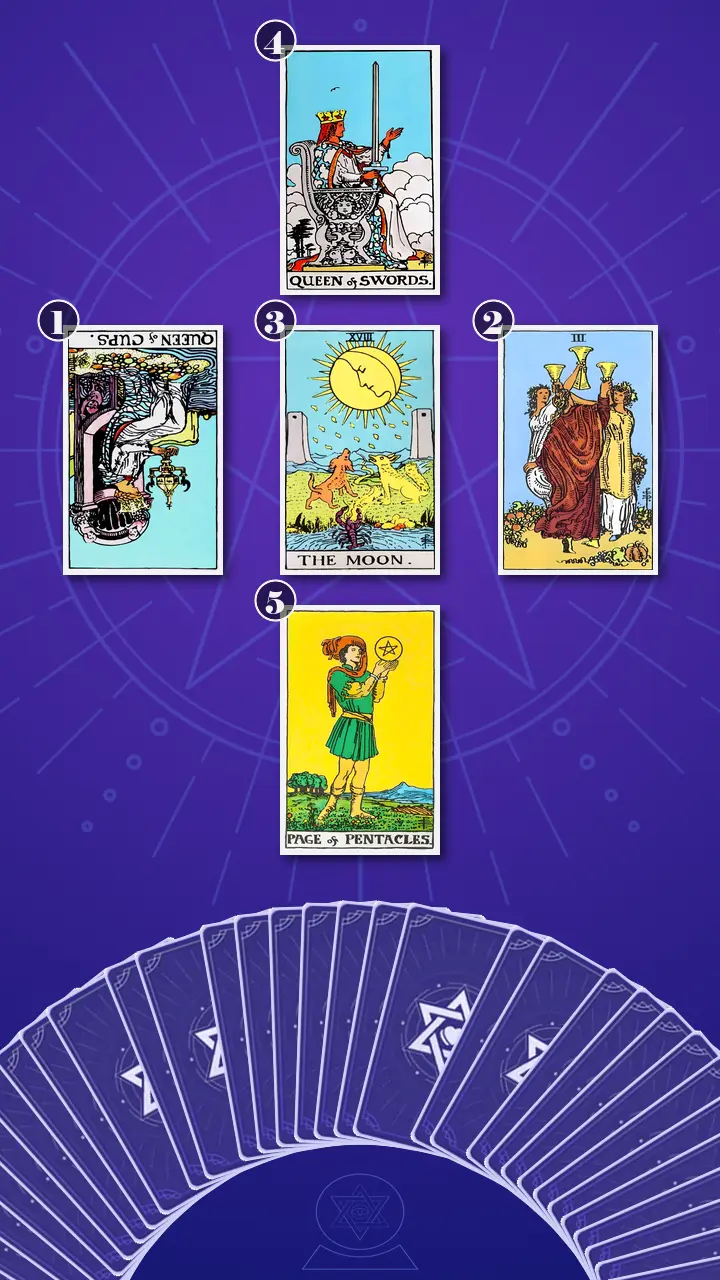
For this reading, I used a classic five-card Relationship Spread for friendship boundary clarity. I like it because it is the smallest structure that still shows the whole arc: Maya’s need, her friend’s likely style, the shared dynamic, the core lesson, and the next step. In a friendship question like this, that matters. Good tarot does not reward motive-reading. It separates hurt from assumption, and assumption from action.
I told her how I would read it. The first card would reveal her side of the connection, especially the part of her that protected the mood before naming her need. The center card would show the live dynamic—the fog, the mixed signals, the place where the same disappointment kept recycling. The fourth card, placed above the center, would show the boundary principle that could restore self-respect. And the fifth would bring it all the way down into one grounded move she could make this week.
Reading the Noisy Middle
Position One: The Sealed Cup
Now I turned over the card representing her unspoken wish for more attuned one-on-one connection and the part of her that over-manages the other person’s comfort. It was the Queen of Cups, reversed.
I told Maya this card had the exact energy of the Notes app draft followed by the watered-down iMessage version. The Queen of Cups is emotional attunement at her best; reversed, that attunement becomes overextended and self-silencing. Not balance, but excess. Not listening inward, but scanning outward so fast that your own preference barely gets a turn. ‘You clock the shift instantly,’ I said, ‘then start managing how your friend might feel before you ask how you feel.’
I pointed to the Queen’s lidded cup. The feeling is real, but it stays sealed. In modern life, that looks like typing the honest thing, deleting it, and sending the agreeable version so no one has to sit in awkwardness but you. Warm on the outside. Closed on the inside. Like muting your own tab in the group chat so everyone else can keep speaking comfortably.
Maya gave a short laugh that had more sting than humor in it. ‘That is annoyingly accurate,’ she said. Her fingers tightened around her paper cup, then loosened. I nodded. ‘This is not a character flaw,’ I told her. ‘It’s a survival reflex. But it is also where the resentment starts forming.’
Position Two: The Circle of Raised Cups
Next I opened the card showing her friend’s likely social pattern of expanding plans outward into group energy without turning the reading into a character indictment. It was the Three of Cups, upright.
This card did not read as villainy to me. It read as a genuinely group-friendly person. Three raised cups. Shared celebration. The kind of friend who thinks adding two more people makes the night lighter, easier, more fun, and frankly more efficient in a city where every plan competes with work deadlines, dates, workouts, and family group chats. In energetic terms, this is balanced for inclusion, but a little excessive for intimacy if what you wanted was depth.
‘So I’m not making it up,’ Maya said, ‘but she’s not necessarily trying to distance herself either.’
‘Exactly,’ I said. ‘What feels warm and communal to her can still feel diluted and impersonal to you. That’s a format mismatch, not automatically a rejection.’ I watched some of the tension leave her shoulders then. The cards were doing what I most wanted them to do: making the pattern fairer, not harsher.
Position Three: The Moon on the Ride Home
Then I turned the center card—the one mapping the fog, assumptions, and mixed signals keeping the same catch-up disappointment alive. The Moon, upright.
I did not have to reach far for its translation. I could see the eastbound TTC ride home in it immediately: the fluorescent light, the train rattling under your feet, your coat still smelling like cold air and bar citrus while you scroll back through the chat as if punctuation might reveal your actual standing in the friendship. The Moon is ambiguity. A blockage made of too much feeling and not enough language. It is what happens when a widened plan stops being a scheduling change and starts feeling like a verdict on belonging.
Years ago, sitting in an editing suite and watching a scene stay unresolved one beat too long, I learned how quickly silence gets filled with invention. The Moon always brings that memory back to me. Here, I told Maya, the facts were simple: the plan changed, extra people came, the night was fine enough. The story her nervous system auto-completed was louder: maybe I matter less than I thought. Like staring at a blurry night-mode photo until your brain invents details the image never actually gave you.
‘Maybe I’m overreacting,’ she said, and then immediately pressed her lips together. After a beat she added, ‘But then why do I feel so flat after?’
‘Because your body knows when something important stayed unspoken,’ I said. ‘Clarity is kinder than performing chill. The Moon doesn’t say your hurt is false. It says your interpretation is doing the work that one direct sentence never got the chance to do.’
When the Queen of Swords Drew One Clean Line
Position Four: The Card Above the Fog
When I reached for the fourth card, the room seemed to sharpen around us. Even the café noise outside the studio window felt farther away. This was the position that identifies the boundary restoring self-respect by naming what kind of time she wants instead of hoping her friend guesses. The card was the Queen of Swords, upright.
This was the antidote: discernment, self-respect, and clean honesty. The opposite of sending the emoji version of the truth.
I gave Maya the setup plainly. ‘You know that moment when the plan was supposed to be yours for an hour, then the chat shifts, extra names appear, and suddenly your body reacts before you have even decided what you think? That is where this pattern usually starts.’ She nodded once, but I could already see the resistance flicker across her face—the old fear that if she became clearer, she would become harder to keep close.
You do not need to keep dissolving into the group to prove you are easygoing; let the Queen of Swords draw one clean line so real closeness can breathe.
I let that sit between us for a second.
My Sidekick Syndrome Diagnosis
This was where I brought in one of my own diagnostic lenses. I call it Sidekick Syndrome Diagnosis. In tight social worlds, people often get assigned roles without anybody announcing them: the planner, the therapist, the funny one, the chill one. Maya had been getting cast as the woman who would absorb the format change so the night could stay frictionless. The Queen of Swords was not asking her to become colder. She was asking her to resign from that role.
Her reaction happened in three visible beats. First, a freeze: her breath caught halfway in, and her thumb stopped against the cardboard seam of her cup. Then the thought landed: her eyes lost focus for a second, the way they do when somebody is replaying five old scenes at once. Then came the release—small, honest, physical. Her shoulders dropped. Her jaw unclenched. Her next exhale sounded shaky, almost irritated. ‘But if I say it that clearly,’ she said, ‘doesn’t that mean I’ve been turning it into this whole secret test?’
‘Yes,’ I said gently. ‘And that doesn’t make you manipulative. It makes you scared.’ I leaned in a little. ‘A one-on-one plan is a request, not a secret test. Your resentment is not proof that you are needy. It is what happens when a clear preference keeps being forced to live as a hint.’
She looked back down at the Queen’s open hand and upright sword. Right then, outside the window, a streetcar bell cut through the traffic noise—bright, brief, almost perfectly timed. ‘So what would I even say?’ she asked.
‘Something almost boring,’ I told her. ‘The same way you would edit a rambling Slack message down to the one line that finally names the task: I’d actually love for this one to be just us if you’re up for it. That’s it. No courtroom speech. No three-apology preamble. Honest, warm, exact.’
I asked her one more question. ‘Now, with this lens, think back to last week. Was there a moment when one clean sentence would have given you different information?’ She did not answer right away. She just nodded slowly, with that slightly dizzy look people get when relief arrives before they feel fully ready for it. That was the real turning point in the reading for me: not certainty, but movement—from swallowed resentment and social mind-reading to clean honesty and steadier self-respect.
Position Five: The Small, Earthy Experiment
The last card translated the boundary into a grounded, low-drama action she could actually take this week. It was the Page of Pentacles, upright.
I smiled when I saw it. After all that water and air, here came earth. The Page of Pentacles never asks for a giant friendship summit. It asks for one specific experiment. One coffee. One walk. One lunch break. One date and time. For a content strategist like Maya, I put it in language she would feel instantly: this was not a theory deck. It was a tiny A/B test in real life.
‘Send one clear invite,’ I said. ‘Just-us plan. Simple logistics. Then watch what actually happens: yes, no, reschedule, vague answer, no answer. Friendship data, not guesswork.’
She reached for her phone at that. Not to spiral. To open her calendar.
The Format-First Boundary
When I pulled the whole reading together for Maya, the story was unusually clean. On the left sat the reversed Queen of Cups: a private hope kept inside a lidded cup while she managed the emotional weather for everyone else. On the right sat the Three of Cups: a friend whose social instinct may be genuinely warm, but tuned toward widened plans and group energy. At the center sat The Moon, where silence filled with projection and a scheduling shift started carrying the weight of belonging. Above it, the Queen of Swords cut through the fog. Below it, the Page of Pentacles turned the truth into something observable.
I told her the blind spot was not that she wanted too much. The blind spot was that she had been using disappointment to measure closeness instead of giving the friendship one clear chance to respond to her. That is why the direction of change in this reading was so specific: shift from hinting and accommodating to stating the format you want before the plan hardens into the group-chat version of the night. Do not measure friendship by how much disappointment you can swallow.
I gave her three low-drama next steps. I framed the first as my Role Resignation Act—the conversational pivot where she stops performing the part of The Chill One and speaks from the front of herself instead.
- Save the One Clean Line TextToday, in your Notes app, save this exact sentence: ‘I’d actually love for this one to be just us if you’re up for it.’ Use it the next time a private catch-up starts widening, ideally before the group momentum fully forms.The first resistance will probably feel like cringe, not danger. Send the short version before you add disclaimers.
- Make a Facts vs Story NoteBefore you reply to a changed plan, take one minute and create two headers in your phone: Facts and Story I’m telling myself. Under Facts, write only what happened. Under Story, write the meaning your mind jumped to.Keep it to three bullets max. This is for clarity, not for building a more sophisticated spiral.
- Run a Low-Drama Reciprocity CheckThis week, send one specific one-on-one invite with a place and time, like ‘Want to grab coffee at 6:30 on Thursday, just us?’ Offer only one backup option, then observe the response for what it is: yes, no, reschedule, vague, or silence.Allow one follow-up at most. The goal is not to force closeness; it is to gather cleaner friendship data.
I reminded her that this is why I trust a five-card relationship spread for a friendship question. It does not make the choice for you. It shows you where the choice already is. In this case, the cards were not asking Maya to become less caring. They were asking her to give her care structure, so it could finally be heard.

A Week Later, the Proof Was Small and Real
A few days later, Maya sent me a message. It was brief, which is often how I know something has landed. ‘I used the line,’ she wrote. ‘I asked for Thursday coffee, just us. No apology paragraph. She said yes.’
What moved me was not the yes alone. It was the sentence after it: ‘My chest was tight when I hit send. Then I slept through the night.’ That was enough. Not a perfectly solved friendship. Not a new life in one text. Just one clean sentence where there used to be a thumbs-up and a quiet ride home. Clear but still a little tender: the next morning her first thought was did that sound weird? This time, she smiled at herself and got up anyway.
That is how I think a real journey to clarity works. Not as a magical ending, but as authorship returning to the person who has been living inside the scene for too long. When Maya stopped making one-on-one time a private hope and turned it into language, she gave the friendship a fair chance to answer honestly. If the friendship can hold closeness, it can hold one clean sentence.
If tonight you recognize that old moment—the group chat widening before your sentence has even become language—remember this: that tight throat is not drama. It is the feeling of wanting closeness and fearing the ask might cost you your place.
If one-on-one time did not have to stay a private hope inside a lidded cup, what is the smallest clean ask you would want to make first?
This story is adapted from psychological research, written so that those in a similar struggle can see their own pattern in it — and find their next step clearly.These insights are not a substitute for professional psychological, medical, legal, or financial advice.
Learn more about our Journey to Clarity.
How did this insight land for you?
🫂 This Resonates Deeply
🌀 Living This Story
✨ Now I See Clearly
🌱 Seeing New Possibilities
🧰 Useful Framework
🔮 The Confirmation I Needed
💪 Feeling Empowered
🚀 Ready for My Next Step
Author Profile
 AI
AI“I’ve always felt our lives are films currently in production. As an artist, I know that when you feel stuck, it’s often because you’ve bravely stayed in a painful scene for just a little too long. I’m not here to coldly analyze you. I want to sit closely with you, look at those difficult moments with profound empathy, and gently hand you the pen so you have the courage to write your next beautiful act.”
In this Friendship Tarot Reading :
Core Expertise
- Clique Power Dynamics: Deconstructing the subtle jealousy, micro-aggressions, and implicit hierarchies hidden within tight-knit friend groups.
- Sidekick Syndrome Diagnosis: Identifying how your friend group has boxed you into a specific, restrictive role (e.g., the clown, the therapist) to maintain their status quo.
Service Features
- The Role Resignation Act: A creative conversational pivot designed to gracefully but firmly refuse your assigned 'character' during your next group interaction.
Also specializes in :
Explore Related Patterns:
Boundary DiffusionWhen a one-on-one catch-up quietly turns into a group hang, the issue is not only the extra names. The original two-person frame never gets verbally held, so the plan keeps expanding before your preference has any chance to set the shape. That is Boundary Diffusion: the line between a private plan and a shared plan stays porous, and you end up absorbing the mismatch alone. The night can still be technically nice, but it no longer lands as the connection you actually asked for.
Self-SilencingYou type, delete, type again, and send a cheerful thumbs-up instead of the sentence you actually wanted to send. The move is not confusion; it is the decision to protect the mood by shrinking your own request. That is Self-Silencing in real time. The preference stays alive, but it gets kept private long enough for resentment to build where directness should have been.
Rejection SensitivityThe moment you imagine saying that you would actually love for this one to be just us, your body treats it like social danger. The request suddenly feels bigger than the request because it seems to put your place in the friendship on the line. That is Rejection Sensitivity at work. A clean boundary starts to sound like a possible loss, so the nervous system reaches for softness, delay, or silence instead of the sentence that would give you real information.
Mind ReadingAfter the plan widens, you start scrolling back through the chat as if punctuation could reveal what the change really means. A simple scheduling shift turns into something you have to decode. That is Mind Reading in a friendship setting. Silence gets filled with a story before anyone has said one out loud, and guesswork starts doing the job that direct data should have done.
Explore Related Struggles:
Boundary Ambiguity LockThe catch-up changes shape before Maya has given the friendship one clear sentence to respond to. Her preference is real, but it stays in the space between the draft she deletes and the emoji she sends. Boundary Ambiguity Lock forms when the line exists internally but never becomes usable information in the relationship. You keep measuring closeness through whether the other person guesses correctly, while they may only be responding to the plan you appeared to accept. The way out is not a bigger emotional speech. It is a cleaner data point. When you name the format before the group-chat momentum hardens, the friendship can answer the actual request instead of being judged against an invisible one.
Low-Maintenance Worth LockMaya's first explanation is not that she lacks a preference. It is that she does not want to be the difficult friend. That detail matters because the boundary gets filtered through a role before it ever becomes a sentence. Low-Maintenance Worth Lock appears when being easy to include starts feeling like the condition for being kept close. You learn to swallow the specific ask, accept the changed plan, and prove you are chill enough not to interrupt the group rhythm. The cleaner line lets you resign from that role without rejecting the friendship. You are allowed to be warm and specific at the same time. A friend who can hold real closeness needs access to your actual preference, not only the version of you that never complicates the plan.
Performative HarmonyMaya's night looks fine from the outside: the extra people arrive, nothing dramatic happens, everyone gets through a technically nice hang. Underneath that surface, she has already muted her own preference so the group can keep moving without friction. Performative Harmony shows up when peace is maintained by making your own truth smaller. You become the person who can absorb the format change, send the agreeable reply, smile through the diluted plan, and then carry the flatness home by yourself. The boundary here is not about becoming harsh or less caring. It is about refusing to make your silence the price of an easy atmosphere. You can keep warmth in the friendship while still naming the structure you need the plan to hold.
Voice-Safety FusionMaya knows the exact sentence she wants to send, but the moment her friend suggests adding Jess and Noor, her body gets there before her words do. She types, deletes, and lands on the cheerful thumbs-up, even though the clean request is sitting right behind it. That is the pressure point of Voice-Safety Fusion. You are not just deciding whether to ask for one-on-one time; you are deciding whether your honest voice might put your belonging at risk. The boundary feels bigger than a text because the act of speaking it seems to threaten the social ease that has been keeping the connection intact. The shift happens when the sentence becomes simple enough to survive the fear around it: “I’d actually love for this one to be just us if you’re up for it.” You are not making closeness into a demand. You are separating your voice from the old reflex that treats clarity as social danger.
Triangulated BelongingMaya is not asking for a grand declaration of loyalty; she wants one plan that stays theirs. Each time the catch-up widens, the friendship gets rerouted through other people before the private connection has a chance to breathe. Triangulated Belonging captures that specific distortion. You may be included in the group and still feel displaced from the one-on-one bond you were trying to access. The extra people are not automatically the problem; the problem is that the format starts deciding what kind of closeness is available. A format-first boundary gives the connection a clearer container. “Just us” is not a rejection of the wider circle. It is a request for the friendship to hold a direct line without needing an audience around it.
Projection-Connection SplitOn the ride home, Maya scrolls back through the chat as if the answer might be hidden in punctuation, timing, or the casual way the extra names appeared. The facts are limited: the plan changed, people came, the night was pleasant enough. Projection-Connection Split opens when the relationship does not have enough language, so interpretation has to do the work of contact. You are trying to locate your place in the friendship through clues that were never designed to carry that much meaning. The repair is not to shame the interpretation. It is to give your mind better evidence. A direct one-on-one invite turns the question from “What does this mean about me?” into “How does this friendship respond when I ask clearly?”
Explore Related Emotions:
Boundary GuiltMaya can build a client deck faster than she can send the sentence, 'I'd actually love for this one to be just us.' The body of the story sits in that delay, where a clear preference starts collecting apologies before it has even left the phone. Boundary Guilt forms when your need feels valid in private but disruptive the second it has to meet another person. You are not only deciding what to ask for; you are pre-living the possibility that the ask will make you less easy to like. The boundary question matters because guilt has been doing the talking for her. It turns a simple format preference into a moral problem, and the emotional work is to see that asking for one-on-one time is a clean piece of information, not an accusation.
Conditional Belonging FearOn the ride home, the facts are small: the plan changed, extra people came, the night was fine enough. The louder inner story is the one Maya almost names when the shift starts feeling like proof that she matters less than she thought. Conditional Belonging Fear appears when closeness feels dependent on staying low-friction. You keep your place by not asking for too much, not slowing the group down, not becoming the person whose needs require a separate answer. The boundary she needs is not only logistical. It is a way to test whether the friendship can hold her specificity without making her feel less keepable.
Diluted Intimacy AcheThe plan was meant to be a just-us catch-up, then Jess and Noor entered the chat before Maya's preference had a place to stand. Nothing overtly bad happened, which is exactly why the ache becomes harder to justify out loud. Diluted Intimacy Ache names the specific drop in texture when a private bid for closeness gets widened into group warmth. You can enjoy the people and still feel the original point of the plan slipping out of reach. This is not about rejecting the group. It is about noticing that the format changes the emotional oxygen in the room, and that one-on-one attention is a real relational need rather than a dramatic extra.
Grounded AgencyAt the end, Maya reaches for her phone to open her calendar, not to spiral through the chat again. The move is small, but it changes the whole emotional posture of the situation. Grounded Agency arrives when the question becomes observable. You send one specific invite, watch the response, and let real friendship data replace the exhausting work of guessing. This matters because the boundary is not a performance of certainty. It is a practical way of returning authorship to the person who has been living too long inside the unsaid version of the scene.
Hidden ResentmentThe lidded cup image fits because Maya is not spilling anything in the room. She sends the agreeable version, shows up, smiles, and lets the night keep moving while the unsaid part sloshes where no one else has to see it. Hidden Resentment grows when your outer yes keeps protecting the atmosphere and your inner no never gets a fair hearing. You can look generous from the outside while privately tracking every moment where your preference disappeared. The boundary matters because resentment is already a message. It is the stored pressure of a clear preference being forced to live as a hint.
Low-Maintenance ShameMaya says she does not want to be the difficult friend, and the whole scene tightens around that sentence. The honest ask is short, but the identity risk around it feels much larger than the logistics. Low-Maintenance Shame is the sting of believing you must be easy to keep in order to be kept at all. You start treating your own specificity as a social inconvenience, even when the request itself is warm and reasonable. That shame is why the boundary has to be simple. A clean line lets her stop auditioning for the role of the chill one and speak from the part of herself that actually wants closeness.
Quiet Self-RespectWhen the boundary moment arrives, the line is almost boring: 'I'd actually love for this one to be just us if you're up for it.' No courtroom speech, no apology paragraph, no dramatic friendship referendum. Quiet Self-Respect is the feeling of giving your need a clean shape without making it heavier than it is. You are not making the friend wrong; you are making your own preference visible enough to be answered. That is why this tag belongs to the repair side of the story. Self-respect shows up not as coldness, but as the calm edge that lets real closeness breathe.
Relational FogAfter the widened plan, Maya scrolls back through the chat as if punctuation might reveal her actual standing in the friendship. The facts are readable, but the meaning has become slippery because the direct sentence never entered the conversation. Relational Fog appears when silence has to carry too much interpretive weight. You are not only asking what happened; you are trying to infer intention, closeness, priority, and future safety from a scheduling change. The clean boundary cuts through the fog because it gives the friendship something real to answer. Without that sentence, the mind keeps filling the blank space with guesses that feel persuasive but remain untested.
Performative LonelinessBy the time the extra people arrive, Maya is still there in the room, still socially functional, still pleasant enough for the night to count as technically nice. The split is that part of her has already clocked out. Performative Loneliness is the loneliness that hides inside visible inclusion. You are not left out of the hang, but you are left out of the kind of contact you were quietly hoping for. That makes the flatness afterward feel confusing. The room had people in it, the conversation happened, nothing exploded, and still the version of closeness you wanted never quite arrived.
Self-Betrayal AcheShe types the honest request, deletes it, types again, and sends the cheerful thumbs-up. The betrayal is quiet because nobody else sees the moment where her real preference gets edited out. Self-Betrayal Ache comes from watching yourself leave your own side to keep the room comfortable. You may still care about the other person, but the cost lands in your body as a small internal split. The clean sentence matters because it brings her back into alignment with herself before the plan hardens. It does not guarantee the friend's response, but it stops the conversation from beginning with her own disappearance.
Cautious VulnerabilityA week later, Maya writes that she used the line, asked for Thursday coffee just us, and sent it without the apology paragraph. Her chest was tight when she hit send, then she slept through the night. Cautious Vulnerability holds both parts at once: the ask is brave, and the tenderness does not vanish just because the friend says yes. You can make a clean request and still wake up wondering whether it sounded weird. That is what makes the moment emotionally honest. She is not forcing closeness or pretending not to care; she is letting the friendship meet a real sentence and seeing what it can hold.
Explore Related Contexts:
Friendship Boundary CreepMaya planned for a just-us catch-up, then a late Friday add-on text shifted the format by asking whether Jess and Noor should come too. She typed the honest response, deleted it, and sent the cheerful thumbs-up, so the external plan changed while her actual preference stayed outside the conversation. That is the structure of Friendship Boundary Creep: the boundary is not violated through one dramatic act, but through a small widening that becomes socially harder to reverse once group momentum forms. The friendship format starts as private time, then quietly becomes shared social time, and Maya is left managing the difference without having clearly agreed to it. The practical tension is that You are not trying to control who your friend sees; You are trying to protect the kind of connection a specific plan was supposed to hold. The boundary now needs to name the format before the plan expands, because the cost of staying agreeable is that your one-on-one need keeps getting treated as optional background noise.
Friendship Privacy NegotiationMaya is not asking for secrecy or exclusivity across the whole friendship; she is asking for one specific kind of time to remain one-on-one. The issue becomes clearer when the reading separates the friend’s group-friendly style from Maya’s need for a more private format. Friendship Privacy Negotiation fits because the real boundary is about the social container: who is in the room, what kind of attention is possible, and whether closeness gets enough space to exist without extra guests. The negotiation is practical, but it carries emotional weight because the format determines whether the catch-up feels personal or diluted. For You, the empowering move is to make the desired container visible before the friend has to guess. A line like “I’d actually love for this one to be just us if you’re up for it” protects the private shape of the plan while still leaving the other person free to answer honestly.
Group Chat MomentumThe add-on text arrives while Maya is still half inside the workday, and the plan starts moving before she has a clean sentence ready. By the time she has typed, deleted, and softened her reply, the group-chat version of the night is already becoming the default. Group Chat Momentum captures the way a plan can become socially pre-decided through speed, convenience, and the subtle pressure to keep the chat light. No one has to openly pressure Maya for the structure to become difficult to challenge; the medium itself rewards quick agreement and makes a quieter preference feel like an interruption. For You, the useful boundary is time-sensitive rather than dramatic. The clean ask has to enter before the widened plan gains social weight, because once extra names are attached, the issue stops feeling like a simple preference and starts feeling like You are undoing a group expectation.
Low-Maintenance Friendship PressureMaya names the bind directly when she says she does not want to be the difficult friend, even though what she wants is simple: one plan that stays theirs. Her silence is not random; it is attached to the social role of being easy, flexible, and low-friction. Low-Maintenance Friendship Pressure shows up when a person becomes valuable in the group because they rarely make needs visible. Maya is being treated, and has partly learned to act, like the friend who will absorb the change so nobody else has to sit in awkwardness. The boundary is not about becoming harsh. It is about refusing the hidden contract that says You must stay endlessly convenient to remain close. A warm, exact line gives the friendship a chance to meet You without requiring You to keep performing chill while resentment builds underneath.
Direct Communication TrialMaya’s turning point is small and concrete: she sends a Thursday coffee invite, just us, without the apology paragraph. The friendship finally receives a clear request instead of a hint, a thumbs-up, or a private test of whether her friend will intuit the need. Direct Communication Trial is the right frame because the next move is not a final verdict on the friendship. It is an observable experiment inside the actual relationship: one clean sentence, one specific plan, and one real response that can be read without filling in the blanks. For You, this matters because clarity returns agency to the part of the situation You can control. You cannot control whether a friend prefers group energy, but You can stop letting the format be decided entirely by momentum and start gathering cleaner friendship data from what they do with a direct ask.