When Both Options Feel Wrong

Explore a narrowed choice situation through grounded context, related tarot cards, and tarot reading insights on hidden route pressure.

Third Path Search

What is this situation?

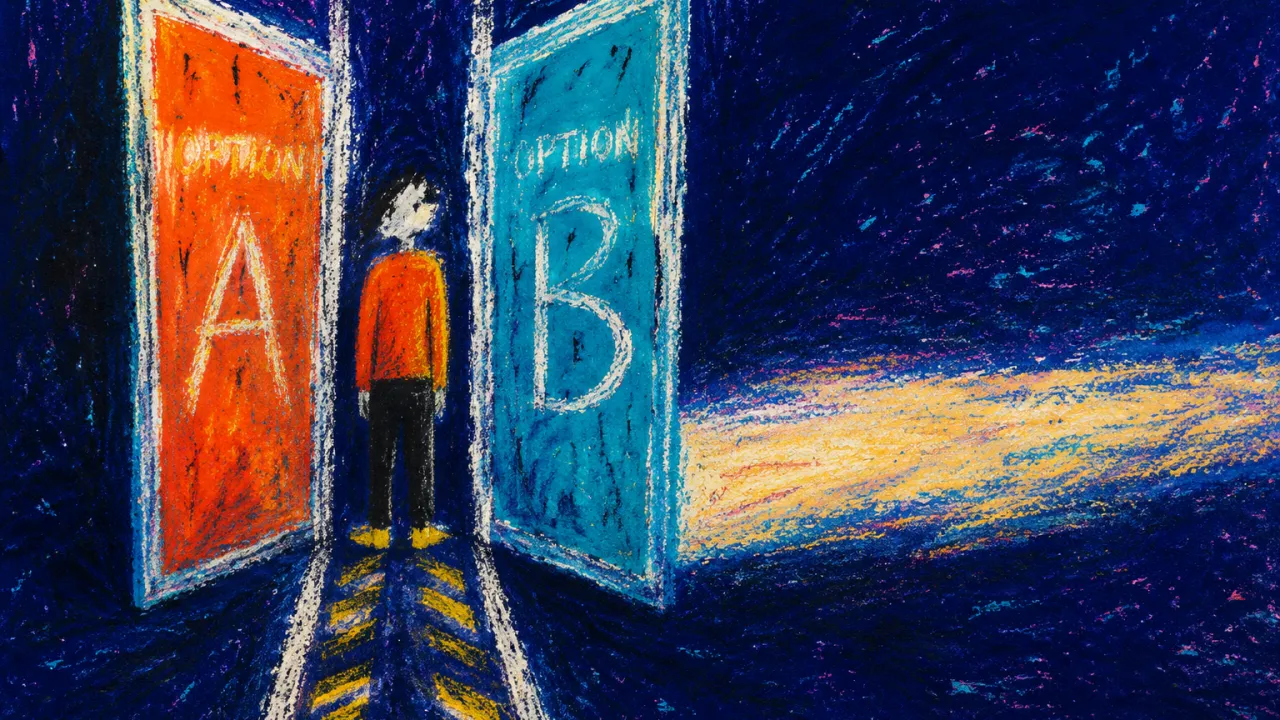
Third Path Search — you land in this situation when the world around you keeps handing you a decision in two boxes, and neither box can hold the whole shape of your life. It might start with an offer deadline, a lease renewal, a degree plan, a relationship conversation, a job path, or a move to another city, and suddenly every person around you is asking the same simplified question: are you doing this, or are you doing that? The options are not imaginary; they may both be sensible, visible, and easy for other people to understand. One side may look stable but airless, the other may look freer but poorly supported; one may satisfy the institution, the family group chat, the hiring manager, or the friend who wants a clean answer, while the other protects something you cannot explain in one sentence. You start building private spreadsheets, Notes app lists, late-night voice memos, half-drafted messages, and calendar reminders, trying to test whether there is a phased move, a hybrid arrangement, a delayed commitment, a smaller experiment, or a renegotiated term that no one has put on the menu. But the outer system keeps behaving as if the only respectable answer is a clean pick, so your jaw tightens every time someone says, "You just need to choose," because the pressure is coming not from a lack of seriousness, but from a decision frame that has been made too narrow too early. The daily drain comes from explaining complexity to people who keep converting it back into yes or no, stay or leave, safe or risky, practical or reckless, until the choice starts to feel less like a doorway and more like a corridor with the side exits painted over, much like The Magician's table, where the cup, pentacle, wand, and sword sit together in one field, showing that the next move may come from combining what is already present rather than obeying a preset lane.

Why it's not you?

The problem is not that you are unable to choose; the problem is that the situation has been framed as if only two clean options deserve to exist. Deadlines, institutions, social expectations, and other people's need for a simple answer can flatten a complex decision into a forced binary. That pressure belongs to the structure around the choice, not to a personal flaw in you.

Third Path Search in Tarot Cards

In a Third Path Search, the pressure is not only the decision itself; it is the way the surrounding environment keeps shrinking the field to A or B. That tightness in your jaw when someone asks for a clean answer is part of the signal that the map being handed to you may be too narrow. This is an environmental, structural dynamic where the available options are shaped by deadlines, institutions, social scripts, and other people's need for simplicity. The Tarot Cards below reflect the outline of that narrowed field and the hidden route that may sit outside it.

The Fool Upright
The Fool does not stand inside a corridor with only two doors. The forward ground breaks open into a cliff, while the wide space around the figure suggests that the obvious route may not be the only route available. In a choice reading, this points to a decision that has been framed too narrowly. You may be treating the problem as stay or go, accept or reject, risk or safety, when the image is asking whether the actual leverage lies in stepping sideways out of the binary. The cliff is useful because it exposes the flaw in the current map. When the presented path ends abruptly, the task becomes spatial rather than purely emotional: redraw the field, identify the constraints that are real, and locate the option that the original framing left unnamed.
The Magician Upright
The wand, cup, sword, and pentacle sit together on one table, not in separate rooms. The Magician’s raised and lowered hands create a transfer line, suggesting that the real power of the scene comes from combining available resources rather than accepting a single predefined route. This is the visual logic behind a third path search. The pressure is not that there are no choices; it is that the visible choices may be framed too narrowly. When every tool is on the table, the important question becomes whether the decision has been reduced to A or B before the full set of variables has been tested. For a user at a crossroads, this card points to the external structure of a false binary. You may be facing two legitimate options, but the Magician asks which overlooked combination, smaller experiment, or hybrid route could turn the decision from a forced pick into a designed move.
The High Priestess Upright
The black and white pillars make the scene look binary at first glance, but the High Priestess does not merge with either side. She holds the middle axis, with the cross on her chest and the veil behind her turning opposition into a structured center rather than a simple split. That center is the logic of Third Path Search. You may be receiving a decision as A or B, stay or leave, accept or reject, but the card's architecture shows that the visible polarity is not the whole system. The hidden passage behind the veil matters because a third path is rarely obvious at the surface level. It usually appears only when the rules, timing, stakeholders, and unspoken assumptions behind the choice are mapped instead of obeyed as given.
The Emperor Upright
The river is visible only at the lower sides because the throne blocks most of its flow. Behind the public geometry of crown, stone, and scepter, a quieter route still runs through the terrain. For you, this points to a decision that has been made to look like two official doors. The image asks where the blocked channel is, what option has been hidden by the dominant frame, and how much authority the visible choices actually deserve.
The Hierophant Upright
The crossed keys do not form a straight road; they create an X between two followers and two symbolic poles. The temple scene is structured around pairs, but the keys themselves suggest that access may come through an intersection rather than through choosing one side. In a decision reading, this visual pattern supports the search for a third path. The current options may be real, but their framing may be too narrow to hold the full problem. This context names the work of finding the hidden route inside the structure. The Hierophant points to the rules, symbols, and thresholds that can be recombined once the user stops treating the visible binary as the whole field.
The Lovers Upright
The scene offers two trees, two human figures, and a mountain rising between them, but the composition is not a simple left-or-right map. The central peak creates another axis: upward, harder, and not fully marked by either side. In academic life, that visual structure fits the search for a route outside the obvious program, degree, or grad-school script. You may be comparing options that both feel incomplete because the real question is whether a third structure can be built from the values each option only partially holds. The card does not flatten the choice into preference. It frames the search as a threshold where intellectual direction, institutional rules, and personal alignment have to be reorganized into a path you can actually study inside.
The Chariot Upright
The two sphinxes mark a visible polarity, but the driver does not steer them with reins. Control is not shown as pulling one side harder; it is shown as holding the center strongly enough for separate forces to become one route. You may be facing a decision that has been presented as A or B, stay or go, accept or refuse, when the real leverage sits outside that frame. The Chariot points toward a third path search because the card's movement depends on integration, not obedience to the most obvious split. The charioteer stands between the established city and the forward gate, turning the whole scene into a negotiation between inheritance and expansion. The useful question is not only which path wins, but what route can be built when the hidden function of each option is brought into the same operating system.
Strength Upright
The woman does not fight the lion from a distance, and she does not surrender her body to it. The contact is close, deliberate, and structured enough to create a third relationship between force and control. That visual logic maps cleanly onto a decision where the available options feel falsely extreme. Stay or leave, accept or reject, obey or rebel may be the visible menu, but the card shows a negotiation space that is not contained by those terms. You gain leverage by asking what form of contact changes the problem itself. The third path is not a compromise that weakens both sides; it is a redesigned container where the raw force of the choice can be used without letting the old binary define the outcome.
The Hermit Upright
The lantern does not flood the whole mountain; it opens one precise corridor of visibility from a higher vantage point. The staff keeps the figure connected to the ground, so the search is not fantasy, escape, or wishful thinking, but a grounded scan for what the obvious map has missed. For a choice between two acceptable but costly options, this card points to the unlit part of the decision architecture. You may be facing a frame that looks complete because only two routes are named, while the real leverage sits in a third arrangement, a delayed move, or a redesigned condition that has not yet been brought into view.
Wheel of Fortune Upright
Hermanubis rises on one side of the wheel while the serpent descends on the other, and the sphinx steadies the top with a blade. The image does not show one body winning and another losing; it shows multiple positions belonging to the same rotating structure. That layered movement makes Third Path Search a strong fit for choice work. You may be looking at two visible tracks because the surrounding system has trained the decision into a narrow shape, while the actual leverage sits in a less obvious adjustment. The connected letters and inner symbols suggest that the third path is found by linking causes to outcomes across layers. The card does not hand you a shortcut; it makes the hidden architecture of the choice available for inspection.
Justice Upright
Justice sits between the pillars rather than merging with either one. The central step, outward-held tools, and measured posture create a middle chamber where a decision can be shaped before it becomes final. That visual structure fits a third path search when the obvious choices both feel incomplete. The solution may not be a dramatic escape; it may be a staged transition, trial period, boundary condition, hybrid route, renegotiated agreement, or smaller move that changes the geometry of the problem. The card’s fairness is practical here. It asks the choice to be redesigned around real constraints, so you can stop treating two inadequate options as the full map.
The Hanged Man Upright
The inverted body turns the ordinary map upside down, and the white background removes the usual road, gate, and horizon. Yet the figure remains centered, held by the living tree rather than erased from the scene. For personal growth, this is the pressure of realizing that the standard script no longer explains where you are going. You may be between labels, timelines, or identity models, but the card shows that the absence of a normal path can become a workable coordinate system once the old angle stops being treated as the only angle.
Death Upright
Beyond the rider and the fallen figures, a river or road continues toward the twin towers at the horizon. The foreground is severe, but the image does not seal the world shut; it leaves a passage running behind the obvious drama. That background route matters in a decision reading because it interrupts the illusion that the only choices are the ones placed directly in front of you. The card's pressure clears away a decaying frame so that the hidden architecture of the choice can be seen. You may be treating A and B as the whole board because both are loud, urgent, or socially legible. The card points toward the quieter question: what option becomes visible only after you stop trying to preserve the structure that created the dilemma?
Temperance Upright
The liquid does not stay in one cup or abandon the other; it becomes a controlled stream between them, while a narrow path rises behind the figure toward two peaks. The card's architecture is not a fork where one side must defeat the other, but a mixing station placed before a longer route. For a decision spread, this points to a stage where the stated options may be too crude to hold the real problem. You are looking for the configuration that preserves the necessary elements of each side while releasing the false pressure to choose only the package presented to you.
The Tower Upright
The struck crown and broken tower wall create an opening where the architecture offered no ordinary door. The scene is harsh, but it also shows that a rigid vertical route is not the only way movement can occur. You may be facing a choice where A and B both inherit the same unstable premise. The card reframes the break as a point of map revision, where the useful question becomes what route appears only after the official structure stops controlling the frame.
The Star Upright
Two vessels pour in two directions, yet the figure is not choosing one stream and abandoning the other. One flow enters the pool, the other enters the land, turning the scene into a design of distribution rather than a simple split. In a decision spread, that visual logic fits the moment when the given options are too narrow for the actual problem. You may be facing an A/B frame that hides a third configuration: a staged exit, a hybrid commitment, a renegotiated timeline, or a smaller experiment that keeps the living value from both sides without accepting the cost structure of either.
The Moon Upright
The winding road begins at the waterline rather than inside the guarded towers, giving the scene a route that is present but not immediately owned by either side. The crayfish touches the start of that road from a marginal place, and the moonlight makes the path visible without making it simple. That is the structure of a third path search. You are not only deciding between two displayed options; you are testing whether the frame itself is too narrow, whether the real movement begins at the edge of the obvious comparison. The card keeps agency in the act of mapping. It does not promise an easy alternative, but it shows that the route worth investigating may begin where the current decision language has no clean category yet.
The Sun Upright
A single child, not a divided pair of figures, moves beyond the garden wall while the wall remains intact behind them. The picture does not destroy the old structure; it shows movement that leaves the protected space without denying that protection ever mattered. That is the shape of a third path. The decision may be presented as staying safe or breaking free, but the visual field offers a more precise structure: carry the boundary's lesson forward without letting the boundary define the whole future. You are looking at a choice where the visible options may be too narrow. The Sun gives enough light to inspect what each side is trying to protect, then asks where a new route could preserve the real value without repeating the old constraint.
Judgement Upright
The ground offers no visible road between the coffins, but the trumpet creates another axis through the scene. The mirrored groups could lock the eye into two sides, while the upward call redraws the map around a route that is not simply left or right. In a decision reading, this fits the search for a third path when A and B both preserve the same constraint. You are not looking for a loophole; the structure points toward changing the frame, the timing, or the stakeholder map so a new option can become real.
Two of Cups Upright
The caduceus rises between the two cups as a third presence in the exchange. It is not another person, but it changes the entire scene by adding terms, mediation, language, and structure to what first looks like a simple choice between two sides. For decision work, this points to a hidden leverage point. You may be treating the situation as A versus B, while the actual opening sits in renegotiating the frame, changing the conditions, or designing a third arrangement that the original binary did not offer.
Three of Cups Upright
Three distinct figures form a circle instead of a straight line. The scene gives no throne and no winner; the power sits in the arrangement between them. For a choice that feels trapped between two correct options, this image opens a different decision geometry. You may be looking at A versus B while the card highlights a third configuration: a blend, sequence, pause, or shared arrangement that changes the rules of the choice. The value here is not escape from responsibility. It is a clearer map of the decision field, where agency returns because the available structure is wider than the loudest binary.
Five of Cups Upright
The two upright cups and the bridge sit in the same image as the loss, not outside it. The card does not create a clean escape from disappointment; it shows a route that becomes visible only when the remaining cups are treated as usable resources. This is the anatomy of a third path search. You may be trying to decide between preserving the old situation exactly as it was or cutting away from it completely, while the actual crossing requires a more selective move. Something can be left on the ground, something can be carried, and the bridge can turn that combination into a viable next step. For a choice reading, the card points to a route built from remnants, not certainty. The path forward is likely to be practical, partial, and assembled from what still stands rather than from the fantasy of starting with untouched conditions.
Eight of Cups Upright
The absent cup creates a question inside an otherwise orderly structure, and the figure answers by moving toward the mountains rather than rearranging the same foreground. The moonlit route is not fully explained, but it opens a direction beyond the old container. In personal growth, this is the search for a path that is not just staying with the known system or burning it down. You are being shown the shape of a third option, one built around the value that the old plan could not hold.
Page of Cups Upright
The fish is neither fully in the sea nor simply contained by the cup; it occupies an impossible middle position between release and possession. The Page studies that middle space instead of turning it into an immediate yes-or-no command. That is the reality structure of a third path search: the official options are too narrow for the signal now in front of you. You may be trying to choose between two visible routes, but the card's physical arrangement shows that the real direction problem is the absence of a container for the option that has not been socially named yet.
Knight of Cups Upright
The horse arrives at the stream, but the land beyond it does not lock the knight into a single visible road. The cup is still being carried, the reins are still active, and the open hills make the crossing feel like a threshold rather than a final answer. That is the visual logic of a third path search. The decision may appear to be between two clean options, yet the card shows a live margin where pace, route, and intention can still be recombined. For You, this context matters when both available choices feel incomplete. The card draws attention to the unclaimed route created by asking what must be preserved, what can be renegotiated, and which assumption is making the choice look narrower than it is.
King of Cups Upright
The throne is not on shore, and the only moving markers are the sailboat on one side and the dolphin on the other. The King sits between them rather than inside either route, turning the ocean itself into a decision field instead of a simple road. That composition fits a choice where the offered A or B frame is too small. You are being shown a board with more than two moving pieces, and the real leverage may be a route that changes the terms of the decision rather than selecting the least uncomfortable option.
Two of Pentacles Upright
The two coins dominate the scene, but the open stage around the figure prevents the image from becoming a sealed box. The body is not absorbed by either endpoint; it is positioned as the mediator of a system that could potentially be reconfigured. That is why this card can surface a third path search. You may be facing two loud options, but the more useful question is whether the entire setup can be redesigned so that the choice is no longer limited to swapping one visible burden for another.
Three of Pentacles Upright
Three people stand at the threshold, and none of them alone contains the whole project. The plan, the labor, and the reviewing gaze are distributed across the scene, making the finished structure depend on configuration rather than a single heroic move. When a decision has been framed as A or B, this card opens the architecture of the choice itself. You may not need to pick between two fixed doors; the clearer question is whether a third arrangement can be built by changing timing, roles, support, or the terms of entry.
Five of Pentacles Upright
The figures do not stop in the storm, but they also do not enter the lit sanctuary. Their route runs beside the obvious source of shelter, creating a narrow strip of movement between exposure and institutional protection. That in-between lane is the card's decision architecture. The visible options may look like endurance on one side and surrender to a fixed structure on the other, but the image keeps the bodies moving through the margin, where a less obvious route can still be found. In this context, the question is not only which option is better. The deeper audit is whether the options have been framed too tightly, and whether a third path exists through timing, negotiation, partial exit, shared support, or a staged transition.
Ten of Pentacles Upright
The archway gives the eye one obvious passage, but the separate pentacle pattern creates another organizing frame outside the family drama. The scene is not only a doorway; it is also a map of systems layered over systems. When a choice has been narrowed to two inherited routes, this card keeps attention on the frame itself. A third path appears when you stop asking which visible gate to enter and start examining who built the gates, what they protect, and what movement they leave unpriced.
Page of Pentacles Upright
The landscape around the Page is open, but no paved road dictates a single route. He stands diagonally on a slight rise, with trees and mountains creating layers of possible terrain rather than a locked corridor. That absence of a fixed road is the visual basis for Third Path Search. When a decision has been presented as A or B, the card asks You to examine whether the structure itself is too narrow, not whether You have failed to pick quickly enough. The Page’s position keeps the coin in view without making the entire world identical to it. This is the decision space where a hybrid route, phased commitment, renegotiated term, or delayed sequence may be more accurate than either obvious option.
Knight of Pentacles Upright
The rider has one pentacle in hand, but his gaze does not stop at the object. It moves across a wide field without a marked road, suggesting that the visible option is real without being the entire landscape. This is the logic of a third path search. You may be facing an A or B decision that looks closed on the surface, while the deeper structure still allows a staged move, a renegotiated term, a delayed commitment, or a designed alternative that has not been given language yet.
Ace of Swords Upright
The blade rises through open sky above a barren terrain, creating a route that is not drawn on the ground. Olive and palm hang to either side, but the sword itself forms a third axis through the center. That is the visual logic of Third Path Search. The obvious options may be real, but they are not necessarily the full field; the missing move sits above the frame that made the decision look like a forced pair. The Ace of Swords supports this context because it cuts through the presented structure rather than merely ranking the choices inside it. You are invited to examine whether the decision is hard because the options are difficult, or because the option architecture is incomplete.
Two of Swords Upright
The blades form a V rather than a closed wall, and the horizon behind the woman contains an island, a distant shore, and tidal movement. The visible setup says two options are present, but the wider scene keeps quietly refusing to become only two. A Third Path Search emerges when the official menu of choices is too narrow for the life you are trying to build. You may be standing between familiar routes, but the geometry points to the unclaimed space between them, where a less obvious direction can be mapped.
Three of Swords Upright
Three swords do not form a neat either-or. Their angles create a triangular pressure system, where the eye is pulled toward the center because the visible structure has more than two lines of force. This is why the card can map the search for a third path in a direction reading. The obvious options may both carry pain or compromise, but the image suggests that the deeper coordinate is not found by choosing the least painful side; it appears when the whole three-part tension is named. The pressure here is not indecision for its own sake. It is the demand to stop treating an inherited binary as the full map and to recognize that the future may require a route with a different logic than either option currently on the table.
Four of Swords Upright
The stained-glass window glows off to the side of the gray sword chamber, creating a second visual channel that does not belong to the wall of blades. The resting figure cannot reach it yet, but the image refuses to let the decision field be reduced to the obvious weapons above the body. In a choice spread, this supports a search for a route that is not currently listed as an official option. You may be staring at the visible menu while the real leverage sits in a reframed condition, a delayed move, or a path that only appears once the immediate conflict is paused.
Six of Swords Upright
The boat is not locked between two fully drawn destinations. It moves toward the right edge of the image, where the route continues beyond the visible frame and the far shore remains only partly defined. That open edge matters in a decision reading. You may be treating the situation as a contest between two named options, while the card shows a crossing that can only be understood by mapping the route outside the current frame.
Seven of Swords Upright
Moving sideways out of the camp rather than facing the army head-on, the figure creates a route that does not belong to the official battlefield. The action is risky, but it changes the terms of the encounter. That sideways movement matches a choice where the visible options are not enough. You may be asking whether the real move is not A or B, but a different configuration of timing, leverage, and exposure. The card gives form to the search for a route that the original frame did not name.
Eight of Swords Upright
The sword line looks intimidating at first, but the enclosure is uneven and the castle remains beyond the low ground. The card's space is not a clean fork in the road; it is a constrained field with gaps that require a different angle of reading. For a crossroads question, this points to the search for a third path that is not being named by the obvious A-or-B frame. You are not being pushed toward clever escape for its own sake; the structure asks which unpriced route becomes visible once the false boundary of the current menu is examined.
Nine of Swords Upright
The black background gives no road, but the bed itself contains overlooked information: a patterned quilt, an exposed carving, and a body positioned between layers. The obvious field is closed, yet the structure beneath it is still readable. A third path search begins when the visible options are too narrow to hold the real problem. The card points you below the first two choices, toward the assumptions, stakeholders, and constraints that may reveal a route neither option currently names.
Ten of Swords Upright
The figure is pinned in the foreground, but the composition refuses to make the foreground the whole world. River, mountain, and dawn sit beyond the fallen body, giving the eye a route that is not identical with the site of impact. A Third Path Search begins when the obvious choices have absorbed too much damage to keep pretending they are the full decision field. You can read the card as a demand to stop choosing only between the two visible wounds and start scanning for the route that was hidden by urgency, sunk cost, or a false binary frame.
Page of Swords Upright
The sword points one way while the Page's face turns the other, and the whole body twists between two lines of attention. The landscape does not reduce the situation to a single road; it gives a high, windy view with several possible coordinates but no automatic route. That split posture fits the moment when the available options feel too narrow for the future you are trying to build. You are dealing with a structure that asks for a third route to be named, one that is not just obedience to the old path or a reactive escape from it.
Queen of Swords Upright
The queen sits above the thickest clouds while a single bird moves through the open sky. The scene is not crowded with roads, yet the height of the throne creates a view that is wider than the immediate ground. That spatial distance fits the search for a third path. You may be staring at two visible options because the decision has been framed too tightly, while the real leverage sits in timing, sequencing, negotiation, or a route that has not yet been named. The card does not erase the pressure of choosing. It gives the pressure an aerial perspective, showing that the next useful move may be to redraw the decision map before accepting the binary that has been handed to you.
King of Swords Upright
The birds and clouds widen the air around the raised sword, and the distant trees keep another layer of life visible beyond the throne. The king is not walking down a road; he is positioned high enough to inspect the whole field before naming the route. That spatial logic fits a decision that cannot be solved by forcing A or B to win. You may be staring at the visible options because they are loudest, while the actual leverage sits in a third configuration that only appears once the frame of comparison is widened.
Ace of Wands Upright
The river does not run straight toward the castle; it bends through the green terrain while the hills rise in layers. The wand arrives above this landscape as a spark, but the ground below offers more than one possible line of movement. In a decision reading, that matters when the presented options feel too narrow. You may be treating the choice as A or B because those are the visible banks, while the card shows energy moving through the space between them. Third Path Search is anchored in that layered geography. The image suggests that the real leverage may not be choosing one bank over the other, but finding the sequence, hybrid, delay, or reframing that lets the living impulse move without surrendering the whole field.
Two of Wands Upright
The two wands form an uneven frame rather than a clean gate, and the landscape behind them is more complex than a single road. Land, sea, mountains, fields, and castle wall all occupy the same decision map. For you, the choice may be stuck because the available framing is too small. The card opens the possibility that the real move is not Option A or Option B, but a redesigned path that changes the terms of the decision itself.
Three of Wands Upright
From the cliff, the man can see more than the ground directly beneath him. Land, water, ships, and distant hills all sit in the same field of vision, and the three wands create a wider frame than a simple two-door choice. That elevated composition fits a Third Path Search because it shows the decision space expanding when the view becomes strategic enough. The card does not erase the existing options; it changes the scale of the board so that combinations, phased moves, and indirect routes can become visible. In a choice reading, this context is especially useful when the available options feel artificially narrow. The image asks you to inspect whether the current frame was inherited from pressure, convenience, or fear, and whether a route outside the obvious pair is already moving in the distance.
Four of Wands Upright
The bridge sits to the side of the festive frame, and the castle remains beyond the immediate celebration. The scene does not force one straight corridor; it shows a threshold in front, a route at the edge, and a larger structure beyond both. For your decision, that spatial layout points to a choice architecture that may be wider than the visible binary. You may be staring at two socially legible options while a staged, conditional, or hybrid route sits off to the side. The card helps name where the hidden passage is likely to appear: between public commitment and long-term belonging.
Five of Wands Upright
The open lawn and clear sky keep the clash from becoming a sealed room. Even with five wands crossing, the field has no fixed victor, no locked hierarchy, and no wall that says the current arrangement is the only arrangement. Third Path Search emerges when the loudest alternatives have started to define the entire choice. You are not looking for a magical extra option; you are looking for the overlooked route that becomes visible once the contest itself is mapped instead of obeyed.
Seven of Wands Upright
From the high ground, the young man is not only exposed; he also has a wider angle on the six wands below. His diagonal staff creates a line that does not simply mirror the incoming pressure. In a decision spread, that geometry points to a route outside the obvious fight. You may not need to answer every force on its own terms; the useful move may be to redesign the field so the available choices stop being organized by opposition.
Page of Wands Upright
The desert around the Page is open rather than fenced, and the distant pyramids create coordinates without drawing a road. The single wand is prominent, but the wider field contains more space than the first visible option. That makes Third Path Search a grounded fit for this card. You may be facing an A-or-B frame that feels too narrow, while the actual environment has unclaimed room for redesign, sequencing, or a hybrid route. The card does not make the hidden route look effortless. It shows a young figure with one tool in a large field, which turns the decision audit toward what can be built from constraints rather than which prepackaged option deserves automatic priority.
Queen of Wands Reversed
The black cat at the foot of the throne does not compete with the wand or sunflower; it occupies a different layer of the image. Its placement shows that the most important signal may not be one of the two objects held up for public view. That is the terrain of a third path search. Neither visible option may be wrong, but both may be operating inside a frame that leaves out your actual leverage, timing, or boundary condition. The distant pyramids make another route imaginable without making it immediately accessible. The card does not promise an easy alternative; it shows why the search matters, because the decision regains agency only when the map includes more than the options already placed in your hands.
King of Wands Upright
The desert around the throne is wide but unmarked, with no road, city, or ready-made gate. The only living vertical line is the wand in the king's hand, suggesting that movement may have to be generated rather than found. That structure fits the moment when the offered options feel too narrow for the actual problem. You are being shown a decision field where the most useful move may not be choosing A or B, but using your current leverage to create a third route that the existing map has not named yet.

Third Path Search in Tarot Card Reading Insights

When a Third Path Search starts showing up in a reading, it usually carries the texture of being asked to choose before the whole field has been named. Others have brought this same narrowed-choice pressure into readings, looking at what appears when the binary stops being treated as the full map. Tarot Reading Insights for this kind of decision field are gathered below.

Psychological contexts related to Third Path Search