The 8:47 p.m. WhatsApp Draft
I have seen the pattern in people who are brilliant at making messy work problems legible: after one warm-but-brief WhatsApp reply, the relationship becomes a problem to define, scope, and ship. On a Tuesday evening, Olivia, a 29-year-old UX designer in London, sat opposite me with her phone face down beside her tea.
She had described the scene that brought her in. At 8:47 p.m., blue laptop light pooled across her flat while the radiator clicked in short metallic bursts. A warm message from her partner sat at the top of WhatsApp, kind but brief. Olivia opened a Note called “What I need to ask,” drafted a question about exclusivity, deleted it, then drafted a softer version. Her phone was warm in her palm. Her thumb hovered over Send.
“I do not need a grand gesture,” she told me. “But I need to know what this is. I can handle a difficult answer better than an unclear one.”
What she wanted was genuine closeness and intentional commitment. What kept hurting her was the belief that the relationship could not feel right until the next label, plan, or promise arrived quickly. The feeling had the physical texture of trying to breathe through a buttoned-up coat: a tight chest, lifted shoulders, and a restless hand looking for one sentence that might finally make the air easier to take in.
“The rush is not proof that you want too much,” I said. “It may be the moment a need for reassurance gets translated into a demand for a milestone. We are not here to decide your future for you. We are here to make a map of what happens before you reach for certainty.”

Choosing a Map for Relationship Timeline Anxiety
I asked Olivia to put both feet on the floor, breathe normally, and hold the question in her mind without trying to solve it. Then I shuffled slowly. I use this small pause as a threshold, not as a performance of mystery. It gives the nervous system a moment to arrive before the mind begins building its case.
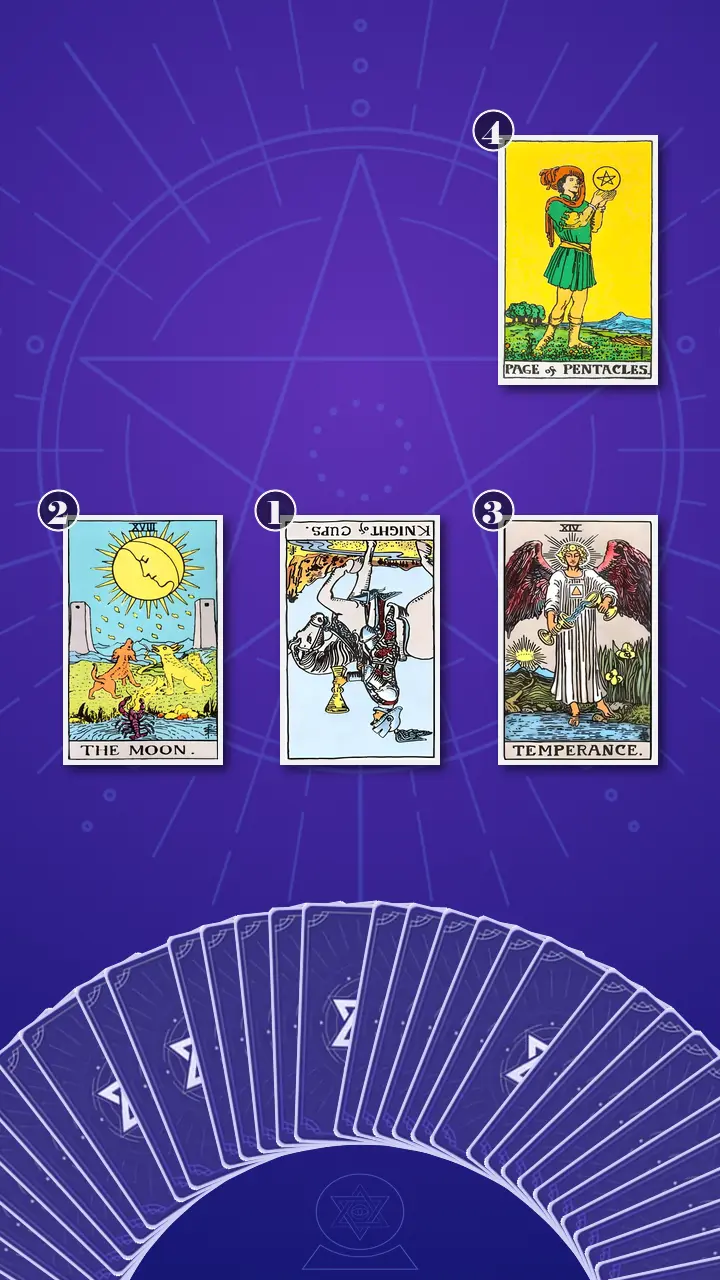
For this reading, I chose The Shadow Spread, a four-card tarot spread for relationship uncertainty. It is useful when the question is not simply, “Should I commit?” but, “Why do I keep rushing commitment to make my relationship feel safe?”
The Shadow Spread follows a clean path: first, the visible reassurance move; then the fear beneath it; then the balancing reframe; finally, one grounded practice. It does not predict whether a relationship will last. It helps me distinguish the facts of a relationship from the story fear writes in the gaps.
I explained the shape of the cards as I placed them in a cross. The centre would show where Olivia rushed labels, timelines, or future plans. The card to the left would show the safety-based fear feeding that rush. The card to the right would reveal the capacity that could hold longing and uncertainty without turning either into a verdict. Above it, the final card would offer one small practice for lived clarity.
Reading the Map, One Present Feeling at a Time
The Raised Cup and the Unsent Message
“Now I am turning over the card that represents the observable reassurance move: where you rush labels, timelines, or future plans after relational uncertainty,” I said.
It was the Knight of Cups, reversed.
In the Rider-Waite-Smith image, the Knight carries a golden cup forward on a white horse. His offering is sincere. Reversed, though, that forward motion can outrun emotional clarity. I saw Olivia’s Notes draft immediately: the future-facing message held out toward a relationship before the present feeling had been given a name.
“After a close weekend or a slightly unresolved text exchange, you open a draft about exclusivity, a shared holiday, or where this is going,” I said. “You refine it until it cannot possibly be misunderstood. The desire is real. But the card suggests that the message is being asked to do two jobs: communicate honestly, and calm you immediately.”
I laid out the sequence as plainly as I could: a quieter text; her chest tightening; a question about the future; rereading the wording; then the imagined relief of an immediate yes. “I want to be honest,” I said, “and, at the same time, ‘I need the answer to calm me now.’ Those are not the same need.”
Olivia let out a small, bitter laugh. “That is painfully accurate. I keep telling myself I am just being direct.”
“Directness is not the problem,” I said. “The blockage is that romantic momentum has become an emergency tool. You turn uncertainty into future planning because planning is a language you trust. At work, you can define the problem, set a milestone, and measure progress. Intimacy is not a product roadmap, though. It has two people, two nervous systems, and information that only arrives through time.”
Her fingers stopped circling the edge of her cup. The shame in her expression softened into recognition. The card was not calling her manipulative or too intense. It was showing a protective move.
The Moonlit Space Between Fact and Fear
“Now I am turning over the card that represents the fear script beneath the rush: the belief that uncertainty means you lack safety unless commitment arrives quickly,” I said.
It was The Moon, upright.
The Moon is not a warning that the relationship is wrong. It is a card of incomplete perception: the narrow path between two towers, the familiar dog and the wilder wolf calling beneath a bright but limited light, the creature rising from dark water. It shows what happens when a small piece of data becomes a whole story.
“A blue tick is data, not a relationship verdict,” I told Olivia. “But when you are activated, your mind treats it like a complete user journey.”
I could picture her on the Northern line at 6:18 p.m., moving between WhatsApp and Instagram while train brakes scraped through the carriage and wet coats pressed their damp wool smell into the air. Her partner had read a message two hours earlier. That was the fact. The story that followed was: If this were secure, I would not be waiting.
“The Moon asks you to separate what you know from what fear is supplying in the dark,” I said. “It is like navigating a London side street in fog using yesterday’s fear as Google Maps. The path exists, but you cannot see its entire length from here.”
Olivia looked down at the card. Her breath paused. Her fingers curled once around the cup, then loosened. Her gaze moved past the table as if replaying every Sunday night when a good weekend had ended, Deliveroo had gone cold, Instagram had served an engagement dinner or a new-flat soft launch, and suddenly her own relationship seemed behind.
“I keep mistaking certainty for closeness,” she said quietly.
“That sentence matters,” I replied. “Wanting commitment is valid. Wanting clarity is valid. The Moon only asks whether the urgency belongs to the relationship as it is, or to the fear that an undefined moment means you are not safe.”
When Temperance Poured Between Two Cups
The Balancing Reframe
The room seemed to quiet around the next card. Rain traced a pale line down my window, and the radiator had stopped clicking. “Now I am turning over the card that represents the balancing reframe: the capacity you can use to hold longing and uncertainty without turning either into a verdict.”
It was Temperance, upright.
The angel stands with one foot in water and one on land, pouring slowly between two cups. I have spent enough years studying planetary cycles to recognise a familiar mistake: treating a natural in-between phase as a personal failure. My Macro-Cycle Phase Identification is simply a way of naming that distinction. Not every period of resistance means the route is wrong; sometimes a relationship is in the unglamorous middle where lived patterns are still becoming visible.
Olivia’s current cycle was not “waiting helplessly for someone to choose her.” It was a calibration phase. Her emotional need for reassurance was real water. The relationship’s observable pace, consistency, and capacity for direct conversation were solid ground. The work was not to silence either one. It was to let them meet slowly enough that she could tell what was actually there.
At first, she sat very still, caught inside the old binary: either I get a promise now, or I am ignoring a danger. I could see the objection forming before she said it. “But if I slow down,” she said, her voice tightening, “doesn’t that mean I have been wrong about all of this? Like I have made every conversation too much?”
“No,” I said. “It means you were trying to create safety with the tools you had. We can respect the need and change the tool. A deliberate pause is not obedience, and it is not an agreement to wait indefinitely. It is space to ask a clearer question and to notice whether the relationship can answer it with honesty.”
You do not need to outrun uncertainty with another promise; Temperance asks you to let the two cups be poured slowly until your needs and the relationship’s lived pace can meet.
I let the sentence rest between us.
Olivia’s reaction arrived in layers. First, her breathing stopped for the smallest beat, as though her body had been bracing for a verdict. Then her eyes lost focus and returned to the card; I could almost see the old scenes moving behind them: the blue ticks, the edited Notes drafts, the private calculations after a lovely weekend. Her pupils widened. The hard line in her jaw trembled and released.
“Oh,” she said, barely audible. Her hand opened flat on the table. “I have been asking every answer to settle the whole future.”
Her shoulders lowered on a long exhale, but there was a brief, unsteady blankness after it, the feeling that can come when a burden is put down and one realises there is now room to choose. Her eyes shone, not because she had been promised an outcome, but because she could finally see that the choice was hers: she could name a need, listen to the answer, and decide what the evidence meant for her.
“Now, with this new perspective,” I asked, “can you think of a moment last week when this might have made you feel differently?”
“Sunday,” she said. “We had a genuinely great weekend. Then I got home and saw someone’s engagement Stories. I wanted to ask whether we were moving in together. But what I actually wanted was reassurance that the weekend had meant as much to them as it did to me.”
That was the crossing point: from urgent uncertainty and future-focused reassurance seeking toward calm self-trust and balanced communication. Temperance did not ask Olivia to become detached. It asked her to become more accurate.
The One Pentacle in the Field
“Now I am turning over the card that represents the grounded integration practice: one modest, observable way to communicate a current need and assess consistency over time,” I said.
It was the Page of Pentacles, upright.
The Page studies one pentacle with full attention. Behind them is a green field and, farther away, a mountain range. This is the antidote to demanding the whole five-year roadmap during one activated conversation. One present piece of evidence can teach more than another dramatic promise.
“Think of it as opening one Jira ticket, not trying to ship the entire relationship,” I said. “Ask one clear, non-ultimatum question about a current need, then observe how it is handled across ordinary days.”
For Olivia, that could sound like: “I am feeling unsettled after our weekend, and I would like to talk about how we are approaching exclusivity. Could we make time this week?” It is direct. It does not disguise her need. And it does not make one response carry the whole future.
The Page’s energy is balanced earth: beginner-minded, practical, and willing to learn. It replaces monitoring response times with noticing whether plans are kept, difficult conversations receive follow-up, and both people make room for each other’s needs. Olivia nodded, slower this time. The future remained distant on the horizon, but it no longer had to be dragged into the room tonight.
Evidence Before Escalation
I gathered the story the cards had told. The reversed Knight of Cups showed Olivia’s visible coping pattern: after a small wobble, she offered a future plan before she had met the present feeling. The Moon showed why the move felt urgent: incomplete information quickly became a story that uncertainty meant she was unsafe. Temperance offered a different rhythm, where reassurance and reality could be held together. The Page of Pentacles gave that rhythm a practical form.
Her cognitive blind spot was not that she cared too much. It was that she had been treating relief as proof. A fast answer can quiet a tight chest for an evening, but it cannot replace observing whether affection, communication, boundaries, and mutual pace are workable over time.
I called the next 72 hours the Orbital Sync Protocol. It is not a rule to suppress a real relationship need. It is a short recalibration: enough time to stop forcing action through an emotional low tide, identify the need beneath the urge, and choose whether a conversation still serves that need.
- The 24-Hour Future-Plan PauseWhen you want to send a label, timeline, move-in, or future-plan message after a delayed reply, save it as a draft and set a phone reminder called “Name the need first.” Do not send the milestone message for 24 hours.If 24 hours feels impossible, begin with ten minutes, put the phone down, and take three slower breaths. The pause belongs to you; it is not a debt you owe the relationship.
- The Two-Cup NoteIn your Notes app, write only two lines: “What I know from the facts is...” and “What I need right now is....” Name something concrete: reassurance, a plan for the next date, clarity about exclusivity, time to settle, or a boundary.Do not turn this into a perfect script. One honest sentence is enough. If writing makes your body feel more activated, stop and return to an ordinary grounding task.
- One-Need Relationship AskAfter the pause, choose one current question and raise it in a calm conversation, not immediately after a disagreement or a read receipt. For the following seven days, note up to three facts about consistency: keeping plans, following up, or making room for each other’s needs.Keep the list factual, not surveillance. Do not use last seen, read receipts, or Instagram as substitutes for direct information. You can ask clearly, and you can decide what the response means for you.

A Week Later, the Quiet Proof
A week later, Olivia sent me a message. She had muted Instagram Stories after another engagement post made her stomach drop. She had saved, rather than sent, a late-night future-planning text. In her Notes app, she wrote: “What I need right now is reassurance that we are both taking this seriously.”
The next evening, she asked her partner for a calm conversation about exclusivity. She told me the conversation did not produce a cinematic, final answer. It did produce clarity: an honest discussion, a plan to see each other, and more information about what they each wanted. The following morning, she still woke with the small thought, What if I get this wrong? Then she smiled a little, made coffee in her quiet flat, and remembered that she did not have to solve every mountain before taking the next step.
That was Olivia’s Journey to Clarity. Tarot did not make the decision for her, and it did not promise that uncertainty would disappear. It helped her move from trying to pin a moving feeling to a calendar date toward naming what was true, asking directly, and trusting herself to observe the answer.
When a warm weekend ends and your chest tightens at the first unanswered question, it can feel safer to schedule the future than to sit with the fear that an uncertain relationship might mean you are not safe. But you can ask clearly without making one response decide what the entire relationship means.
If you let one clearly named need meet one piece of relationship evidence at a time, what small conversation or pause might feel more honest to imagine this week?
This story is adapted from psychological research, written so that those in a similar struggle can see their own pattern in it — and find their next step clearly.These insights are not a substitute for professional psychological, medical, legal, or financial advice.
Learn more about our Journey to Clarity.
How did this insight land for you?
🫂 This Resonates Deeply
🌀 Living This Story
✨ Now I See Clearly
🌱 Seeing New Possibilities
🧰 Useful Framework
🔮 The Confirmation I Needed
💪 Feeling Empowered
🚀 Ready for My Next Step
Author Profile
 AI
AI“After a decade of guiding people through the stars, I’ve come to see life much like the orbits of planets: everything has its inevitable cycles. When you feel lost, please don't blame yourself; you might just be in a natural low tide. I’m here to sit under the night sky with you, offering a gentle cosmic perspective to distinguish temporary pain from the beautiful breakthroughs just around the corner.”
In this Timing Tarot Reading :
Core Expertise
- Macro-Cycle Phase Identification: Objectively locating your current position within inevitable long-term cycles to explain current resistance.
- Systemic Friction Auditing: Stripping away the illusion that 'hustle' can override a cyclical low tide or structural pause.
Service Features
- The Orbital Sync Protocol: A 72-hour exercise to intentionally pause forced actions, aligning your psychological expectations with your actual cyclical reality.
Also specializes in :
Explore Related Patterns:
Certainty SeekingA two-hour-old read receipt is a limited fact, yet your mind quickly turns it into a verdict: if the relationship were secure, you would not be waiting. The next label or promise then appears to offer something larger than information; it seems capable of ending the ambiguity itself. This is how certainty becomes a coping mechanism rather than simply a reasonable preference. You try to settle the entire future through the next answer because a definite answer feels safer than an incomplete reality, even though lasting clarity still depends on consistency, mutual pace, and information gathered over time.
Milestone IdealizationAfter a genuinely good weekend, an engagement Story makes your own relationship appear behind and creates an urge to ask whether you are moving in together. The proposed milestone is not responding only to what happened between you and your partner; it is also being recruited to restore a sense of progress and legitimacy. Milestone idealization makes exclusivity, holidays, cohabitation, or engagement carry symbolic proof that the relationship is real and safe. Wanting those commitments remains valid, but treating the next milestone as the condition for feeling right can obscure the quieter evidence of whether care, honesty, boundaries, and follow-through are already present.
Productivity as SafetyThe relationship becomes a problem to define, scope, and ship: you draft the question, refine its wording, identify a milestone, and search for an answer that can make progress measurable. These are effective tools in your design work, so reaching for them under relational pressure is a coherent protective move. Productivity becomes a form of safety when the competence model from work is used to control intimacy's incomplete timeline. A relationship cannot be resolved like a product roadmap because two people's needs and capacities emerge through time; the shift is from trying to ship the whole future to gathering one honest, present piece of information.
Reassurance SeekingAt 8:47 p.m., one warm but brief WhatsApp reply leads you to draft an exclusivity question, refine it, and imagine how an immediate yes might loosen your chest. The need for commitment is genuine, but the message has acquired a second function: it is expected to regulate the discomfort created by uncertainty. When labels, holiday plans, or move-in questions repeatedly follow a relational wobble, the ask becomes a reassurance loop. You are not asking for too much by wanting clarity; the useful distinction is whether you are communicating a durable need or asking a milestone to make the feeling stop right now.
Emotional ReasoningThe tight chest, lifted shoulders, and restless hand arrive before the future-planning question, while an unanswered message starts to feel like evidence that the relationship is unsafe. Your body is reporting activation, but the activated feeling is then used to determine what the relationship means. Emotional reasoning turns the intensity of a feeling into proof of an external conclusion. The discomfort is real and deserves attention, but it cannot establish whether the relationship is secure; separating the bodily signal from the relationship verdict lets you investigate both without dismissing either.
Uncertainty ToleranceAfter another engagement post activates the familiar rush, you save the late-night future-planning text and wait until the next evening to speak. The eventual conversation does not deliver a cinematic final answer, yet you can receive its honesty, practical plan, and partial clarity without forcing them to settle everything. Uncertainty tolerance means holding a valid desire for commitment alongside information that is still emerging. It is not passive waiting or permission for indefinite ambiguity; it gives you enough space to ask accurately, observe the response, and decide what the accumulating evidence means for you.
Relational HypervigilanceOn the Northern line, you move between WhatsApp and Instagram while a two-hour-old read receipt becomes the dominant piece of relationship information. Blue ticks, response timing, and post-weekend gaps receive intense attention because they seem capable of revealing danger before a direct answer arrives. Relational hypervigilance narrows attention around ambiguous signals and keeps the nervous system searching for the next clue. The scanning promises preparedness, but fragments of digital data cannot provide the context that comes from direct conversation, kept plans, follow-up, and a partner's behavior across ordinary days.
Boundary DiscernmentIn the calm exclusivity conversation, you name the need directly without demanding that one response guarantee the entire future. Your partner remains free to answer honestly, and you retain the separate right to decide whether that answer and the relationship's ongoing behavior work for you. Boundary discernment distinguishes self-advocacy from control and a deliberate pause from indefinite waiting. You do not have to minimize your need to respect another person's pace; the clearer boundary is that you can ask, listen, observe, and make your own decision without assigning either person total responsibility for the other's internal certainty.
Reality TestingThe blue tick is reduced from a relationship verdict to one piece of data, and your Note separates what you know from what you need. You then ask about exclusivity directly and receive an honest discussion, a plan to meet, and more information about what each person wants. Reality testing does not require you to suppress intuition or pretend that ambiguity feels comfortable. It asks you to compare fear-supplied conclusions with observable evidence, making it easier to decide from patterns of consistency rather than from whichever signal feels most urgent in the moment.
Upward Social ComparisonA genuinely good weekend is recast as insufficient after Instagram serves an engagement dinner or new-flat announcement. Your attention shifts from what occurred in your relationship to where someone else's curated timeline implies you should already be. Upward social comparison imports urgency from an external benchmark and makes commitment feel like evidence that you have caught up. Muting the Stories does not answer the relationship question, but it removes one source of borrowed pressure so that your next conversation can be based more accurately on your needs and the relationship's own evidence.
Explore Related Struggles:
Certainty-Safety FusionA blue tick, a quieter message, or the end of a good weekend becomes enough for Olivia to ask what the whole relationship means. The next label or promise is then given a physical job as well as a relational one: it must answer the question and make her chest loosen immediately. When you need certainty to restore safety, incomplete information cannot remain incomplete for long. Each gap acquires the weight of a verdict, and commitment becomes an emergency source of steadiness rather than one conclusion drawn from mutual evidence. Seeing that fusion gives you room to name the reassurance you need without requiring a single answer to regulate the entire future.
Clarity-Timing SplitA warm but brief WhatsApp reply leads Olivia to draft an exclusivity question, delete it, soften it, and stop with her thumb over Send. Her wish for clarity is genuine, yet the question reaches the relationship before the present need and the available evidence have had time to become distinct. You can feel this split whenever directness seems necessary and the current moment seems unable to hold it without becoming a verdict on the future. The struggle is not whether you deserve clarity; it is how to honor that need while choosing a time and scale that let the answer reveal something accurate.
Milestone-Foundation SplitOlivia reaches for exclusivity, a holiday, or a move-in conversation before she has identified that she wants reassurance the weekend mattered equally to both people. The milestone becomes the visible proof of seriousness, while quieter foundation-level evidence such as kept plans, honest follow-up, workable boundaries, and room for both people's needs receives less authority. When you ask a milestone to function as a foundation, the symbol has to carry what only repeated behavior can establish. A promise can clarify intention, but it cannot contain the entire lived structure of the relationship. Rebalancing those forms of evidence lets you value commitment without asking its language to substitute for what the connection does over time.
Relational Pacing CollapseAfter a close weekend or a slightly unresolved exchange, Olivia jumps from the immediate interaction to exclusivity, a shared holiday, moving in, or where the relationship is going. A small wobble and a distant milestone become adjacent steps, leaving almost no room for the relationship's ordinary pace to show what is actually developing. You become trapped in compressed time when tonight's need must be settled by tomorrow's promise. The present conversation carries more weight than either person can realistically answer in one sitting, while repeated escalation keeps slower evidence from registering. Separating one current ask from the entire trajectory restores your ability to observe pace instead of forcing it.
Relief-Progress FusionWhile rereading her draft, Olivia imagines the immediate relief of receiving a yes, and she later recognizes that she has been asking every answer to settle the whole future. The change in her body is real, but the quieter chest records that uncertainty has briefly decreased; it does not yet show how the relationship handles consistency, boundaries, or mutual pace. You lose access to accurate evidence when internal relief is counted as external progress. The answer feels decisive because it changes the moment so quickly, even though the relationship itself still has to demonstrate what the answer can support. Distinguishing relief from progress allows comfort to matter without making it carry more proof than it contains.
Competence-Connection SplitOlivia is skilled at making messy work problems legible, so an uncertain relationship quickly becomes something to define, scope, and ship. Milestones give her a dependable way to organize complexity, while intimacy keeps producing information through two people, ordinary days, and conversations that cannot be completed like a product roadmap. When you bring a proven competence into connection, the friction appears because the tool still works well in one domain and only partially in the other. You are left between the efficiency of planning and the slower reciprocity of knowing someone, with clarity depending on your ability to recognize what planning can organize and what only lived interaction can disclose.
Explore Related Emotions:
Ambiguity DreadOn the Northern line, your partner has read the message two hours earlier, and you move between WhatsApp and Instagram while the train carries you through the city. The read receipt is the fact. The thought that follows is much larger and says that a secure relationship would never leave you waiting. Incomplete information begins occupying the space that evidence has not yet reached. A brief reply, an unanswered question, or the end of a good weekend can become a total account of how safe the relationship is, even while the observable picture remains unfinished. Ambiguity Dread is the heavy inner atmosphere created when an open question feels more like a threat than a temporary absence of information. Naming it allows you to separate the discomfort of not knowing yet from the conclusions that discomfort tries to supply.
Cautious Self-TrustA week later, you save the late-night future-planning text, write that you need reassurance that the relationship is being taken seriously, and ask for a calm conversation about exclusivity the next evening. These are small choices, but each one keeps your need visible while leaving you free to assess the response. The following morning, the thought that you might get it wrong still appears. You make coffee in the quiet flat and remember that you do not have to solve every mountain before taking the next step. Confidence is being built through contact with evidence, not through the absence of doubt. Cautious Self-Trust describes that careful return to your own judgment. You can ask clearly, listen closely, and decide what the relationship's behavior means for you without demanding perfect certainty before you act.
Certainty HungerAfter a warm weekend ends, you reach for a question about exclusivity, a shared holiday, moving in, or where the relationship is going. The wish for commitment is genuine, and the next answer also begins to look like the one thing that could settle every open part of the future. A current need for reassurance has been compressed into a request for a milestone. The label or promise is expected to communicate mutual intention, regulate the tightness in your body, and remove the wider uncertainty in one movement. No single answer can reliably carry all three functions for long. Certainty Hunger describes the deep pull toward a definitive answer when gradual evidence feels emotionally insufficient. Seeing that hunger clearly helps you ask for the reassurance or information you need without requiring one response to resolve the entire relationship.
Clarity ReliefYour fingers stop circling the cup when the rushing pattern is described accurately, and your shoulders lower on a long exhale when you realise that one answer has been carrying the whole future. A week later, the conversation about exclusivity produces an honest exchange, a plan to meet, and more information about what each person wants. The future remains open, but the present is no longer shapeless. Clear facts, a directly named need, and an observable response give you enough structure to decide what deserves attention next. Your body no longer has to wait for a complete conclusion before registering usable information. Clarity Relief is the spacious internal release that arrives when confusion becomes legible. It comes from seeing what is known, what is needed, and what still requires time, while retaining your authority to interpret the evidence.
Liberating UncertaintyThe conversation about exclusivity does not produce a cinematic final answer. It gives you an honest discussion, a plan to see each other, and more information about what both people want, while the larger future remains open. That unfinished space now contains choices. You can name a current need, observe whether plans are kept, notice whether difficult conversations receive follow-up, and decide what those facts mean over time. The distant horizon can remain distant without taking away your ability to respond in the present. Liberating Uncertainty is the openness that appears when not knowing everything no longer feels like surrendering control of your life. It gives you breathing room to stay connected to your needs and agency while the relationship continues revealing what it can actually hold.
Relational UrgencyAt 8:47 p.m., a kind but brief WhatsApp reply leaves your chest tight, your shoulders raised, and your thumb hovering over a carefully softened question about exclusivity. After a close weekend or a slightly unresolved exchange, the impulse is to move the relationship forward fast enough that your body can stop bracing. The milestone is carrying two loads at once. It has to express a real wish for commitment and produce immediate internal settling. That fusion makes ordinary gaps in information feel time-sensitive, so future planning starts to function like an emergency exit from the present moment. Relational Urgency names the pressured inner weather behind the rush. It preserves the validity of wanting commitment while making visible the moment that wanting becomes a demand for instant resolution, giving you a clearer place from which to choose your next ask.
Timeline PanicOn Sunday night, a genuinely great weekend is followed by cold Deliveroo and an engagement Story on Instagram. Your stomach drops, and the urge to ask about moving in appears before you have identified that what you currently want is reassurance that the weekend mattered equally to both of you. Someone else's visible milestone becomes an unofficial clock for your relationship. The quality of what just happened recedes while the apparent distance to engagement, cohabitation, or another public marker takes over the frame. The relationship begins to feel late even though its lived pace has not changed during that scroll. Timeline Panic names the sudden internal compression produced by that comparison. It helps distinguish a valid conversation about commitment from the urgent belief that you must accelerate now to avoid being left behind.
Timeline ShameWhen you consider slowing down, the first objection is that you may have been wrong about every previous conversation or made each one too much. Engagement dinners and new-flat announcements then make your own relationship appear behind, turning pace into a judgment about both the relationship and your way of asking for reassurance. The timeline becomes personal evidence. Moving slowly can seem to say that you misread the connection, while wanting clarity can seem to say that you are excessively demanding. That double judgment leaves little room for a valid need to exist without becoming a verdict on your character. Timeline Shame names the self-conscious ache beneath those comparisons and revisions. Recognising it gives you space to evaluate the relationship's actual pace without treating that pace as proof that your needs are embarrassing or illegitimate.
Read Receipt AnxietyA blue tick sits beneath the message while you check WhatsApp and Instagram on the Northern line. Two hours of silence remain physically present in your hand, and the read receipt starts carrying information about commitment, care, and security that it cannot actually verify. Repeated checking keeps the unresolved cue active. Attention narrows around response time, leaving less room to notice the more precise need underneath, such as reassurance after a meaningful weekend or clarity about exclusivity. The digital signal becomes a stand-in for a conversation that has not yet happened. Read Receipt Anxiety is the sharp inner activation attached to that tiny piece of interface data. Naming it restores the distinction between what the app can show and what only direct communication and consistent behavior can reveal.
Explore Related Contexts:
Chemistry to Consistency TestOlivia and her partner have genuinely good weekends, and the warm WhatsApp message is real, even though it is brief. She later replaces the proposed move-in question with a direct request for reassurance and an exclusivity conversation, then receives a plan to meet and clearer information about what each person wants. Chemistry becomes usable relationship evidence only when it is considered alongside ordinary consistency. Keeping plans, following up after difficult conversations, and making room for both people's needs reveal more about practical compatibility than either an affectionate weekend or a dramatic promise can reveal alone. You can value the warmth without asking it to certify the whole future. Watching how the connection operates across ordinary days gives you a stronger basis for deciding whether commitment is developing at a pace and in a form that works for you.
Premature Commitment PressureAt 8:47 p.m., Olivia drafts, deletes, and softens an exclusivity question after one kind but brief WhatsApp reply. After another genuinely good weekend, an engagement Story prompts her to consider asking whether she and her partner are moving in together. The recurring pressure comes from asking a milestone to perform two functions: communicate a valid need and make an incomplete relationship feel settled immediately. Labels, holidays, and cohabitation plans are pulled forward before ordinary consistency has supplied enough evidence, turning commitment into an accelerated response to a present information gap. You can preserve the wish for a committed relationship while separating it from the deadline created by a single text, read receipt, or social post. That distinction creates room to ask one present question and judge the relationship by the quality of the answer and the follow-through that comes after it.
Situationship AmbiguityOlivia says, "I need to know what this is," while drafting a question about exclusivity after a warm but brief reply. The relationship contains genuinely good weekends and affectionate contact, yet its label, exclusivity, and longer-term pace have not been fully agreed. That combination places closeness and status on different timelines. Because the available evidence is meaningful but incomplete, every quieter message or ending weekend can become a referendum on whether the relationship has a legitimate position. You do not have to treat ambiguity as proof that the connection is invalid, and you do not have to accept it indefinitely. Naming the undefined terms directly lets you evaluate whether both people can participate in creating clarity rather than asking one promise to erase every open question.