The New Tab Before Page One: Learning to Read Without a Permission Sl
The New Tab Before Page One
If you are the kind of postgrad who sounds sharp in seminar but still types the title plus “summary” before paragraph one at your Toronto kitchen table, this may be reading comprehension anxiety wearing an efficiency outfit.
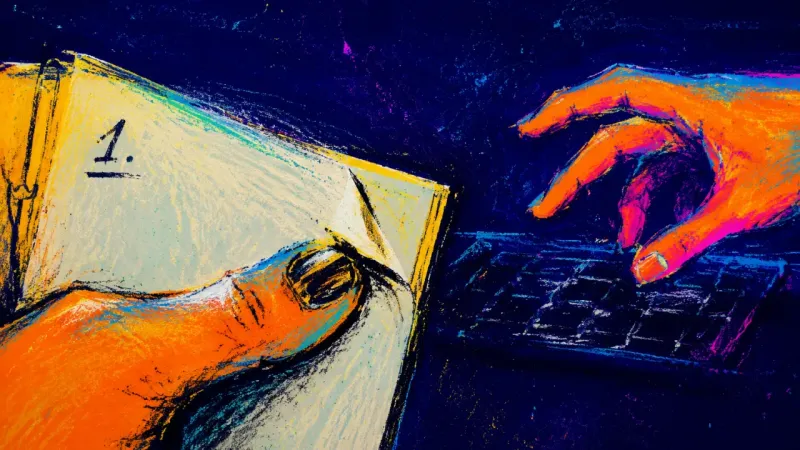
That was how Maya arrived with me: 8:43 on a Tuesday, a JSTOR PDF open on her laptop, a mug of peppermint tea gone lukewarm at her elbow, the radiator hissing under the window like a second nervous system in the room. Before she had even finished describing the article, her fingers mimed Command+T on the tabletop. The blue-white screen light made the kitchen feel too bright and too small, and her eyes kept doing that familiar jump between tabs, as if the answer might be hiding in the next window instead of the next sentence.
She said, “I know I can read it. I just want the map first.”
I hear this exact pattern often: looking for summaries, reviews, or explainers before reading the first page of a dense or important text. On the surface it sounds efficient. Underneath, it is usually a much more intimate split: wanting a real first encounter with the text, while also wanting protection from the raw little sting of not understanding right away. You call it efficiency; your body calls it danger.
In Maya, that apprehension sat visibly in a tight forehead, shallow breath, and the restless flick of her gaze. It felt like watching someone try to read road signs in a sleet storm while also pretending she was just being organized. The shortcut is often a shield. A lot of smart people do this in private.
I told her, gently, “Nothing here says you’re lazy or incapable. It says your mind has learned to secure the room before it lets itself enter. Let’s make a map of that fog, and then we can look for clarity without handing your agency over to the habit.”
Choosing the Compass: Situation-Obstacle-Advice-Outcome
I asked Maya to take one slow breath with both feet on the floor and hold the question in plain language: Why do I keep looking for summaries before I even start the reading? Then I shuffled slowly, not as theater, but as a way of helping both of us move from mental static into attention.
For this session, I chose a Situation-Obstacle-Advice-Outcome spread, a classic four-card tarot structure for self-trust under uncertainty. When a habit is psychologically dense but outwardly simple, I prefer a clean line over a crowded spread. One card names the symptom, one card names the block, one card carries the reframe, and one card shows how the shift becomes behavior. Anything bigger would have echoed the exact spiral Maya was already trapped in: more tabs, more context, more noise.
I told her what I tell readers who are new to how tarot works: the cards do not confiscate your free will or hand down a verdict. They give us an organized symbolic mirror. In this layout, the first position would show the visible habit of searching for a summary before direct contact. The second would reveal the underlying fear that makes the page feel risky. The third, the turning point, would show the attitude that interrupts the certainty-first pattern. The fourth would ground that shift into a practical next step.
Reading the Map of Defensive Intelligence
The Sideways Scout in a Tab Farm
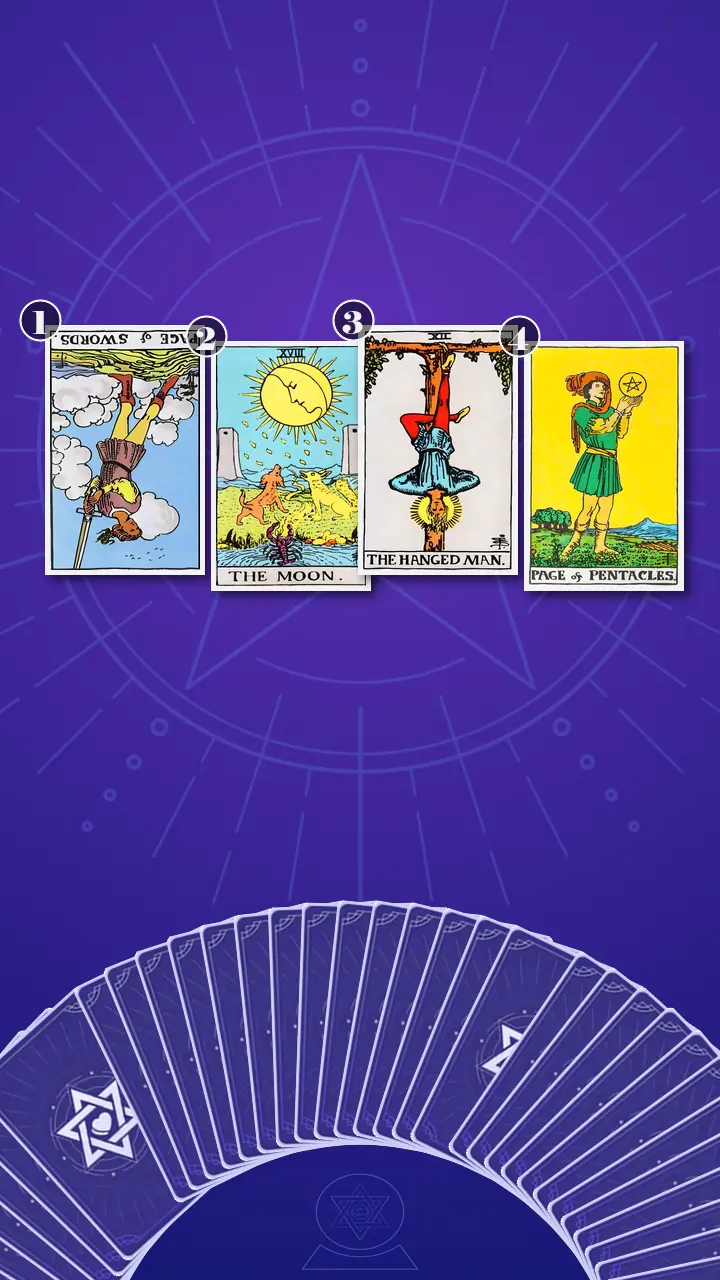
I turned over the first card and said, “This card stands in the position of the visible symptom from the diagnosis: the specific habit of searching for a summary before directly engaging the text.”
Page of Swords, reversed.
This is the card of the restless scout when her curiosity has curled into vigilance. In modern life, it looks exactly like this: you open a course PDF, immediately start a side search for “summary,” “main argument,” or a recap thread, and spend the first ten minutes assembling a safety kit of other people’s takes instead of having a first encounter of your own. It is the academic version of reading spoiler threads before you watch the episode because not knowing feels worse than losing discovery.
The energy here is blocked Air with a touch of excess. Too much mental movement, not enough grounded contact. The raised sword and sideways stance in the card always make me think of a mind entering the room already braced, ready to fend off confusion instead of receive meaning. So the habit keeps repeating: three tabs for context, one tab for the actual article, and the strange feeling of having worked hard without really arriving.
Using a Jungian lens, I read this as defensive intelligence. The psyche is clever; it can disguise fear as strategy so convincingly that even the person living it says, “I’m just being efficient.” But the pattern gives itself away in the body. The shoulders lift. The breath gets clipped. Attention fragments.
It is also a cousin of what I call Draft Paralysis Deconstruction: perfectionism turning itself into a defense mechanism long before the real task has even begun.
Maya gave a short, almost offended laugh. First her fingers froze over the mug handle. Then her focus slipped past the card and fixed on a point near the window, as if replaying a dozen identical study nights. Finally she shook her head and said, “That is literally my JSTOR ritual. That’s… kind of rude, but accurate.” Her smile carried that little bitter edge people use when they feel seen and exposed at once.
When the Article Starts Feeling Like a Test
I turned to the second card. “Now we’re looking at the position that reveals the underlying block: the fear and inner discomfort that make direct reading feel threatening.”
The Moon, upright.
This card names the real weather system underneath the habit. A dense paragraph lands, your body reacts before your mind catches up, and the article stops feeling like a text and starts feeling like a referendum on whether you are actually as capable as people think you are. That is the moment you reach for a recap video, a course Discord, a Goodreads review, or a YouTube explainer with the volume low. Not because you are unserious, but because ambiguity suddenly feels socially and emotionally loaded.
The Moon is not bad news; it is honest news. Its energy is overactive Water: projection, uncertainty, instinct, and the old human habit of filling partial light with frightening conclusions. The winding path between the towers tells me the route is real, but not fully visible at the start. The dog and wolf tell me both the domesticated self and the wild self react when the light is incomplete. In plain terms: confusion is not a verdict; it is the hallway. But when shame-sensitive parts of us are activated, we misread the hallway as the courtroom.
For a moment I had one of those quiet inner associations I trust. The card pulled me back to museums I’ve wandered in cities far from home, where people spend longer reading the wall plaque than standing in front of the painting itself. I never judge them; I understand the urge. Context can feel safer than contact. But meaning still has to happen in the encounter.
I asked Maya, “When your eyes leave the paragraph for another tab, what is the feared sentence underneath it? Is it ‘I’m behind’? ‘I’m missing the point’? Or ‘maybe I’m not actually good at this’?”
Her jaw tightened before her voice did. “The last one,” she said quietly. “If it’s taking too long, I start thinking maybe I’m not as sharp as I sound in class.” She didn’t look embarrassed after saying it. She looked tired, which is often the more honest thing.
When The Hanged Man Lit the Halo
The Card That Refused to Rush
When I turned over the third card, the room changed in that small, physical way it sometimes does. The radiator clicked off. The kitchen got still. Even the laptop light looked less like an interrogation lamp and more like a square of weather.
“This is the card in the position of guidance,” I said, “the one that identifies the core transformation and the attitude that interrupts the certainty-first pattern.”
The Hanged Man, upright.
This is the antidote in the spread. In modern life, it looks like reading two pages without opening another tab, letting the confusing sentence sit there, and instead of translating it into proof of failure, writing down the question it creates. The shift is not that the text becomes instantly easier. The shift is that you stop demanding certainty before contact. That is receptive intelligence, not passive struggle. It is the opposite of skipping to the ending on Wikipedia; you let the story reveal its logic in sequence.
The energy here is balanced suspension. Not deficiency, not collapse, not passivity. A chosen pause. The relaxed face and halo matter more to me than the hanging body. This card says insight is often born in the exact pause you have been labeling unproductive.
I asked her, “What if the pause is where your mind comes online, not where you prove you are behind?”
This is also where I used one of my own diagnostic lenses, something I call Performance Anxiety Decoupling. I said to Maya, “Right now, your reading speed and your self-worth are wired together like two tabs that keep auto-refreshing each other. The Hanged Man cuts that wire. Not understanding immediately is frustrating, yes. But it is not evidence. It is not a grade. It is not your value.”
At her kitchen table with a class PDF open, tea cooling beside her, and her fingers already reaching for a new tab before the second paragraph, the panic was never just about the paragraph. It was about what not understanding immediately might seem to say about her.
Stop mistaking immediate certainty for intelligence; let yourself hang in the unknown long enough for the halo of insight to form.
I let the sentence sit between us. Then I added, more quietly, “The summary is not your permission slip.”
Her reaction did not arrive as instant relief. First her breath caught and held, suspended with her. Then her eyes lost focus for a beat, as if some memory from Robarts Library had started replaying behind them: highlighter uncapped, half the first paragraph underlined, the other tab already open to someone else’s explanation. Then came the resistance. She frowned and said, “But if that’s true, doesn’t that mean I’ve been doing this wrong the whole time?”
I shook my head. “No. It means you’ve been protecting yourself with the best tool you had. But protection and permission are different things.” Her shoulders dropped a fraction. She pressed her thumb into the edge of the table, then let go. Another breath. A slower one. I could actually see the muscles around her eyes unclench, and with that release came the softer, stranger feeling that often follows a real insight: not triumph, but a little dizziness, like the floor has widened and now you have to stand on it.
I asked, “Now, with this angle, think back to last week. Was there a moment when this would have changed how you felt?”
She nodded without speaking at first. Then: “There was this article where I kept thinking I needed the main argument before I could even start. If I’d just stayed with it long enough to write my own question, I think I would’ve been less panicked. Maybe still uncomfortable. But less… ashamed.”
That was the crossing. Not from confusion to certainty, but from apprehensive pre-control to the beginning of grounded self-trust in direct reading. In Jungian terms, the frightened part had stopped impersonating the whole personality. Her curiosity had room to come back online.
The Grounded Beginner Study Loop
One Page, One Note, One Honest Contact
I turned the final card. “This last position shows the practical way the shift gets rebuilt through action.”
Page of Pentacles, upright.
This card is beautifully unglamorous. In real life, it is a 10-minute timer, one text open, one note in your own words after each page, and the willingness to let that count as real study. No mastery performance. No intellectual cosplay through fifteen tabs. Just one concrete rep of attention. It works more like Duolingo or strength training than a genius test: the win is the rep, not instant fluency.
The energy here is balanced Earth. Stable, beginner-minded, embodied. The Page’s steady gaze on the pentacle mirrors the exact opposite of frantic scanning. Instead of trying to secure the whole argument before page one, you build trust paragraph by paragraph, question by question. Nothing dramatic happened except the extra tabs stayed closed for two pages, the phone was face-down, and the first note on the page came from your own brain. But sometimes that is how a new pattern begins: quietly enough that the inner critic has nothing theatrical to fight.
Maya sat a little straighter at this card. Not cured, not suddenly fearless. Just more specific. And specific is often the moment change stops feeling mystical and starts feeling possible.
From Summary-Seeking to First Contact Reading
When I laid the four cards together, the story became very clear. First came Page of Swords reversed: the open-tab reflex, the defensive scout, the habit of searching for a summary before first contact. Then The Moon showed why the habit has so much force. The page is not just a page; it becomes a test, a social mirror, a place where delay gets mistaken for inadequacy. The Hanged Man interrupted that whole chain by refusing the premise that certainty must come first. And Page of Pentacles translated the insight into a method: small, grounded reps that rebuild trust instead of demanding proof.
The blind spot was not a lack of discipline and not a lack of intelligence. It was the quiet fusion of self-worth with speed of understanding. What looked like efficiency was often exposure management. The transformation direction was simple, but not shallow: move from using summaries to avoid uncertainty toward using direct reading to build tolerance for not knowing yet. Or, more plainly: read first. Interpret second.
I also told her something that matters in every academic or creative spiral I see: support is allowed; outsourcing your first contact is optional. Secondary sources are not the enemy. Timing is the boundary.
- Run the Inner-Critic Mute Protocol Before you open one assigned reading this week, take three slow breaths, put your phone face-down, and type or say aloud, “My first read does not need to be correct to be real.” If you keep a bookmark folder for summaries or recap videos, rename it “After I Read” so the order is built into the system. If this feels cheesy or artificial, that is fine. The point is to interrupt the old safety script, not to perform confidence.
- Do one Two-Page Trust Rep Pick one reading at your kitchen table, in the library, or on the TTC this week and make a no-summary agreement with yourself for the first two pages only. If confusion spikes, write one line under a note titled “Questions, not answers yet” instead of opening Google. If two pages feels too activating, reduce it to one paragraph. This is a trust rep, not a purity rule.
- Use the Grounded Beginner Study Loop Set a 10-minute timer for one text only. When it ends, write three short lines: “What I think this is saying / What I’m unsure about / One phrase I want to revisit.” Then mark the session in Notion, a notebook, or your calendar as completed. Count contact, not mastery. A five-minute version still counts, and one honest note is more stabilizing than a perfect summary copied from someone else.
That was the practical heart of the reading: a summary-after-contact method, not a no-help-ever rule. The goal was never to become the kind of person who never needs context. It was to stop using other people’s clarity as the entry ticket to her own mind.

A Week Later, the Tab Stayed Closed
Six days later, Maya sent me a message from the same kitchen table. “Did the two-page thing,” she wrote. “Still wanted to Google by paragraph two. Didn’t. Wrote: ‘What is this author assuming about memory?’ and weirdly that got me moving.” Then, one line later: “I still had the ‘what if I miss the point?’ thought this morning—just less like a verdict.”
That is the kind of change I trust. Not a personality transplant. Not a magical disappearance of fear. Just a quieter jaw, a real question on the page, and one less automatic reach for permission. This Situation-Obstacle-Advice-Outcome tarot spread did not read the article for her. It helped her stop turning the article into a courtroom.
Sometimes the hardest part is not the article itself, but that split second when your forehead tightens, your breath goes shallow, and not knowing yet feels like it could expose something raw about your worth. If that is where you are tonight, please know this: the pause does not mean you are failing. It may be the first honest doorway into how your own mind reads.
If your fingers reach for Command+T before your own question has had time to form, what small first contact—a paragraph, two pages, one note under the halo of not-yet-knowing—would feel possible today?