What Are You Not Seeing?

A grounded look at high-momentum choices, related tarot cards, and tarot reading insights for risks that stay under-examined.

Risk Blind Spot

What is this situation?

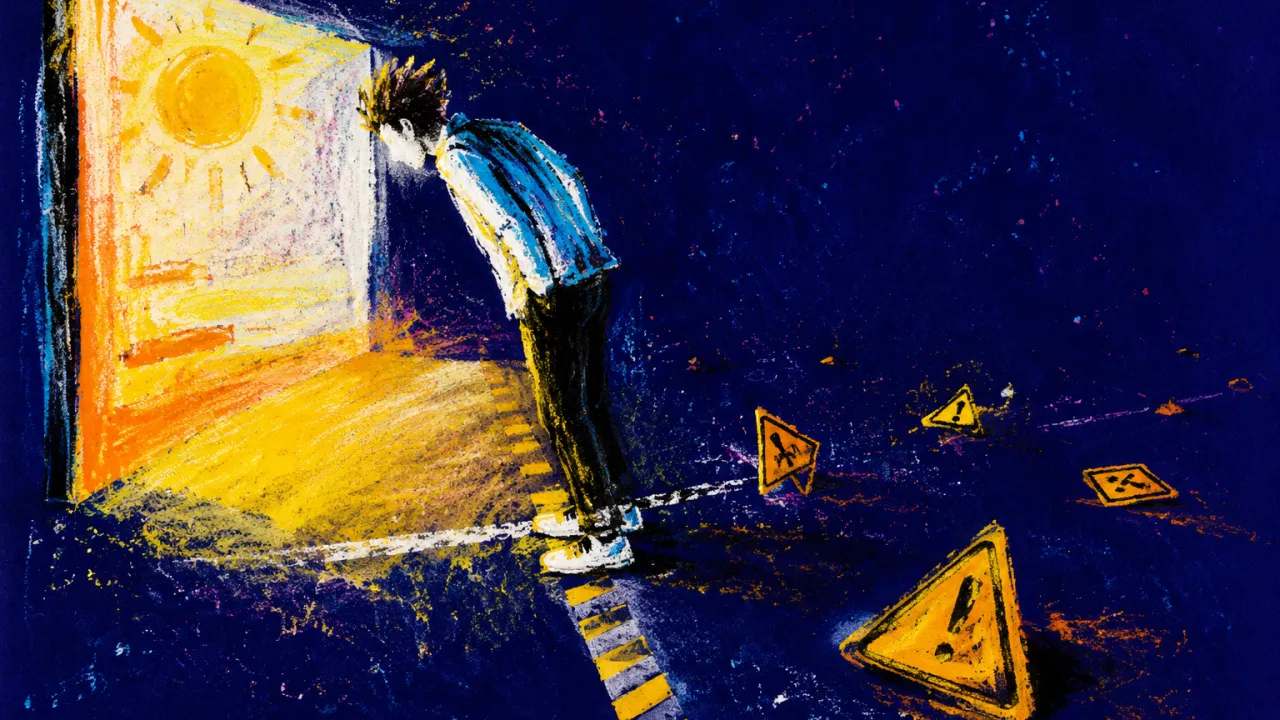
Risk Blind Spot — you step into a decision that already has momentum before you have had a quiet minute to look at the full shape of it. It might start as a job offer with a flattering title, a startup idea that everyone in the group chat keeps hyping up, a move to a new city, a lease you need to sign by Friday, a relationship label that arrives faster than the history behind it, or a project that looks too clean on the pitch deck to question out loud. The visible part is bright: the numbers that work, the person selling it with confidence, the friends saying it sounds exciting, the calendar invite already on your screen, the first rush of imagining a better version of your life. But the edge conditions sit in the background: the vague contract language, the missing backup plan, the commute no one has tested, the savings buffer that looks thinner when you open the banking app, the person whose “we’ll figure it out” keeps replacing a concrete answer. Around you, the pace of the situation keeps narrowing the frame; someone needs a yes, the window is “closing,” the opportunity sounds rare, and asking one more practical question starts to feel like you are ruining the mood. You notice your jaw tighten when the timeline is framed as “now or someone else gets it,” and you keep refreshing messages, comparing options, doing mental math in the notes app, trying to make the attractive version of the choice hold still long enough to inspect it. The drain comes from being surrounded by signals that all point forward while the terrain under the step remains only partly checked, much like The Fool with his gaze lifted toward the sky while the cliff edge stays close beneath his feet and the dog at his heels is the only thing in the frame still calling attention to the drop.

Why it's not you?

This is not you being difficult, negative, or incapable of making a move. A Risk Blind Spot forms when the setup makes the attractive part of an option easy to see while the costs, dependencies, and limits are kept vague, rushed, or socially inconvenient to ask about. The pressure belongs to the design of the situation: urgency, polished presentation, incomplete information, and other people’s momentum can all make caution look out of place.

Risk Blind Spot in Tarot Cards

A Risk Blind Spot forms when the offer, launch, move, or commitment makes the upside louder than the conditions that have to carry it. That small tightness in your jaw when the timeline is framed as “now or someone else gets it” is part of the body-level signal inside the scene. This is an environmental and structural dynamic: the room, the pitch, the deadline, and the people around the decision can all narrow what gets treated as relevant. The Tarot Cards below reflect the outline of that pressure, especially the gap between visible promise and the edge conditions still asking to be named.

The Fool Reversed
The precipice is not hidden; it is plainly under the traveler's next step, while the gaze and posture aim above the ground. The dog and the cliff both present data, but the scene shows attention being pulled away from operational risk. For personal growth, this maps to an environment where inspiration, challenge, or self-expansion makes practical constraints easy to minimize. You are not facing a lack of potential; the structure highlights the hazards that remain visible but unintegrated.
The Magician Upright
The Magician’s table looks impressively complete: every suit is visible, ordered, and ready. That polished surface creates confidence, but it also narrows attention toward what can be displayed and named. Risk blind spot emerges when a decision model looks more complete than it is. The visible tools can make a choice feel fully mapped while the unglamorous constraints sit below the table: timing, stamina, money, dependency, reputation, or the cost of reversing course. In a choice reading, this card helps separate real readiness from a convincing setup. You are invited to examine not only what is available, but what the tidy arrangement makes easier to ignore.
Reversed
The Magician's central stance and ordered table create a strong impression of control. In reversal, that clean layout can narrow attention around what is visible and make untested constraints outside the frame easier to miss. In timing questions, a risk blind spot often appears right before a decisive move. The surface looks organized, the next step looks obvious, and the confidence of the setup can hide dependencies that are not under your direct control. This context does not argue against action. It sharpens the audit: before the window is treated as open, the card asks what condition, person, cost, or delay has been left outside the visible work surface.
The High Priestess Reversed
The veil embroidered with fruit blocks the water behind the High Priestess, while the black and white pillars make the surface of the scene look clean and orderly. The visual promise is clarity, but the architecture insists that the deepest layer is not visible from the front. That is the anatomy of a Risk Blind Spot. The option may look balanced, ethical, attractive, or easy to compare, but an unseen dependency or hidden cost can still be shaping the outcome. The card is useful here because it does not treat uncertainty as a flaw in your judgment. It shows that the missing risk belongs to the structure of the situation, and that agency returns when the concealed layer is actively mapped before commitment.
The Emperor Reversed
The Emperor sits high enough to survey the world, yet the throne blocks the river and the territory in front of him is unseen. The image combines command with partial visibility, showing that elevation can still conceal the data that matters. For you, the risk is not obvious danger but the clean-looking option whose hidden costs sit behind the official picture. The card turns attention toward the blocked channel, the missing feedback, and the consequences that authority or confidence can accidentally overlook.
The Chariot Reversed
The chariot is visually impressive, but its most practical mechanics are easy to miss. The wheels blend into the ground, and the sphinxes are not connected by reins, so the image separates the display of command from the actual system that would create movement. You may be looking at an option that appears powerful, obvious, or already validated while its hidden costs remain under-examined. The reversed Chariot exposes the risk blind spot by asking where the steering link, traction, clearance, and follow-through are actually located. The outer symbols can be polished enough to distract from the operating details. This context points to decisions where the visible upside is loud, but the mechanism that will determine real consequences is quiet, indirect, or not yet tested.
The Hermit Reversed
The lantern is bright, but it is not wide. Around the Hermit, the night has no moon or stars, so the image contains both clarity and a large field of unexamined darkness. In a decision context, that contrast becomes a risk blind spot. You may have enough evidence to feel oriented, yet the card shows that the most important cost could sit outside the current radius of attention, especially where no second light source, second opinion, or external benchmark is available.
Justice Reversed
The sword is upright, sharp, and consequential, yet it visually blends into the gray pillar behind it. The danger is present in the image, but it does not dominate the scene the way the scales do. That is the shape of a risk blind spot in a decision. One cost, deadline, power dynamic, dependency, or long-term consequence may be technically visible but emotionally underweighted, so the option appears more balanced than it really is. Justice reversed asks the reading to bring the muted sword back into focus. The structure is not demanding fear; it is demanding that the hidden consequence receive the same evidentiary weight as the benefits already sitting on the scale.
The Tower Reversed
The tower rises on a mountain with no visible path, turning height into a substitute for safety. From that elevation, the structure appears dominant, but the card shows how a single exposed point can reorganize the entire risk map. You may be weighing an option whose upside is easy to see because it is tall, public, or impressive. The smoke and falling crown redirect the audit toward hidden fragility, unpriced costs, and the parts of the decision that were kept outside the original frame.
The Moon Reversed
The road is visible, but the light that reveals it is reflected and incomplete. Beyond the shoreline, the route bends through low hills and toward towers that cannot show what waits on the other side. That visual field matches a risk blind spot. You can see enough to build a confident argument for one option, while the real exposure sits outside the current evidence set: timing risk, reputational cost, dependency risk, or an assumption no one has tested. The card gives the uncertainty a location. Instead of treating risk as a general mood, it turns the question toward the uninspected stretch of the road and asks which part of the decision has been made visible only because the harder part is still in shadow.
Judgement Reversed
The coffins appear to rest on a surface that reads as both mud and water, with mountains closing the horizon behind them. The scene looks organized from above, but the ground underneath the decision is unstable and hard to classify. For a choice spread, this points to a risk blind spot: the main call may be loud, but the hidden terrain carries unpriced costs. You regain leverage by examining what the visible option leaves underwater, especially timing, dependency, and reversibility.
Knight of Cups Reversed
The knight's attention narrows around the cup while the horse continues toward the water. The scene is calm enough to look safe, but the next terrain is not fully specified, and the crossing still has to be managed. That is the shape of a risk blind spot: the most attractive part of the option becomes visually dominant, while the downstream constraints stay at the edge of the frame. The refined armor, clean sky, and graceful movement can make the decision feel smoother than its practical conditions actually are. For You, the card does not invalidate the option. It asks for the hidden cost audit: what is being overlooked because the offer feels elegant, emotionally right, or easier to imagine than the complications that follow.
Ace of Pentacles Reversed
The bright coin and tidy garden create a clean first impression, but the image also contains distance: the hand is above the scene, the interior of the estate is mostly unseen, and a barren hill sits far inside the property. Reversed, the polished surface can pull attention away from what is buried deeper in the option. That is the structure of a risk blind spot. The decision may look orderly because the obvious benefits are easy to name, while the maintenance costs, hidden constraints, or long-term friction remain less visible. The problem is not that the option is bad; the problem is that the visible part of it is doing too much of the persuading. The card asks you to inspect the neglected corner before committing to the estate. You regain agency by naming the risk that has been hidden by beauty, certainty, or practical appeal.
Three of Swords Reversed
The side blades enter at angles while the gray weather flattens the background. What matters is not only the obvious central wound, but the way the surrounding atmosphere makes side consequences harder to read. For a choice, this points to a risk blind spot: the option may look coherent from the front while an angled cost is already entering from the side. The card invites a colder audit of what is being minimized, hidden, or treated as background noise before the decision is made.
Seven of Swords Reversed
Bare hands grip several blades while the figure keeps moving, and the clustered sword tips sit close to his lifted knee. The card does not show danger as a distant possibility; it places the sharp edge directly inside the movement that appears clever. In personal growth, this maps to a strategy that looks adaptive but carries unexamined costs. A sudden routine overhaul, a hidden life pivot, a borrowed framework, or a high-control optimization plan may seem efficient while quietly increasing strain, instability, or exposure. The reversed Seven of Swords turns attention toward the risk built into the method itself. It shows that the blind spot is not the desire to change, but the unreviewed assumption that speed, secrecy, or tactical cleverness will protect the process from consequences.
Page of Swords Upright
The Page's face and sword do not point in the same direction. One part of the scene is armed and ready, while another part is scanning a different angle of the ridge, where the ground itself is rough enough to become a risk. This visual split captures a decision where one danger is highly visible and another is easy to miss. You may be defending against the obvious downside while the real exposure sits in timing, reversibility, social fallout, opportunity cost, or the hidden maintenance burden of the option. In decision work, the card functions like a second-angle check. It asks the choice to be examined from the side you are not naturally watching, so the final move is not built around the loudest risk while the quiet one remains unpriced.
King of Swords Reversed
The scene looks disciplined because one sword, one throne, and one frontal viewpoint dominate the composition. Yet the red warmth sits partly hidden under blue restraint, and the living landscape remains distant, suggesting that not every cost is being allowed into the official calculation. That is the structure of a risk blind spot in a major choice. You may be trusting the option that looks cleanest under one metric while quieter costs, timing effects, relationship consequences, or future constraints are kept outside the frame that is doing the judging.
Two of Wands Reversed
The sea lies calm beyond the castle, with no ship, road, or gate showing how the figure would actually cross into that distance. From the high wall, the option can look cleaner than the route required to reach it. For you, one side of the choice may be under-modeled because it is being viewed from too far away. The card reveals the blind spot in the missing bridge: the real risk is not only what could go wrong, but what has not yet been operationally tested.
Knight of Wands Reversed
The Knight of Wands looks fully committed: bright colors, raised wand, armor, plume, and a horse rising into motion. In reversal, that display of confidence can overpower the quieter facts of the scene, especially the exposed desert and the reduced contact between horse and ground. Risk Blind Spot appears when a personal growth move is energized by possibility but under-audited for capacity, timing, money, attention, or relational impact. The card's visual field is full of heat and forward signal, but it offers very little shelter or external checkpoint. This context does not shame boldness. It gives boldness a reality test. The card asks the structure around the move to become visible, so enthusiasm can be separated from the risks that have been hidden by speed, aesthetics, or the pressure to prove you are finally changing.

Risk Blind Spot in Tarot Card Reading Insights

When a Risk Blind Spot is in the room, people often bring the same mix of momentum, pressure, and half-visible constraints into readings. The focus shifts from the cards themselves to what tends to surface when others sit with a decision that looks exciting but not fully mapped. Tarot Reading Insights from related readings are gathered below.

Psychological contexts related to Risk Blind Spot