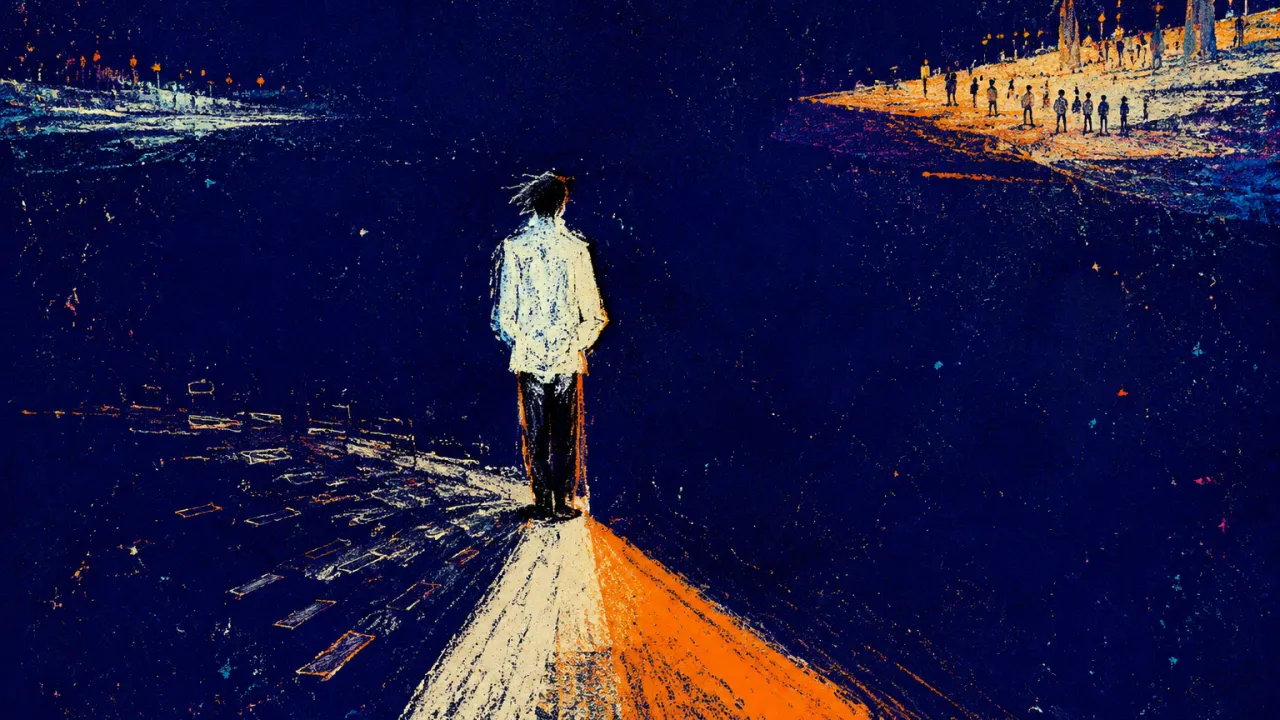
In Pathless Social Transition, the old group chat, campus routine, workplace orbit, or weekend scene no longer gives your week a clear social shape. The tight feeling shows up when an invitation feels less like a normal plan and more like stepping onto a thin edge with no route drawn past it. This is an environmental, structural, and dynamic shift in belonging: the map around you has changed before a new circle has formed. The Tarot Cards below reflect the outline of that in-between social terrain.
The Fool UprightThe Fool stands at a cliff with a small bundle and no visible road, suspended between open sky and distant mountains. That image fits a friendship phase where the old social route no longer gives you a stable map, but the next circle has not formed into a place you can rely on. You are not just losing contact with people; you are moving through a threshold where belonging has to be rebuilt without inherited rules. The cliff does not make the next step wrong, but it makes the absence of scaffolding impossible to ignore.
ReversedThe cliff edge becomes the whole stage: one more step is visible, but no road appears beyond it. The mountains make the wider world look large while the ground under the Fool narrows to a thin lip. This is the social version of being between circles, where the old network no longer provides coordinates and the new one has not become a place yet. You are not simply starting fresh; the structure around belonging has lost its map, so every invitation can feel like a jump rather than a step.
The Hermit ReversedThe snowy summit gives height but not a road. Under a moonless sky, the figure has a lantern and a staff, yet the surrounding terrain offers no obvious trail, landmark, or companion. That is the pressure of a pathless social transition. You may have outgrown one network or been moved out of it by life stage changes, and the card turns the blank space ahead into a map problem rather than a personal defect.
Wheel of Fortune ReversedThe wheel hangs in an open sky field with no floor, road, doorway, table, or shared human room beneath it. Figures occupy symbolic positions around the structure, but no ordinary social setting tells them where to enter, gather, or build continuity. That image captures a pathless social transition. After a move, graduation, breakup, job shift, or identity change, the old coordinates can lose function before a new community has formed, leaving movement without a clear social map. You are not simply between invitations. The card shows a larger transition where the problem is the missing pathway itself: the next circle has not yet become visible enough to organize your time, energy, and sense of place.
The Hanged Man UprightThe Hanged Man hangs between sky and earth with no road, floor, or crowd around him. The vertical trunk gives an axis, but not a direction; the scene contains him without offering a route back into ordinary movement. In your social world, this maps to the in-between stage after one circle no longer fits and the next one has not formed. The structure asks you to read the pause as a map-making phase, where belonging has to be rebuilt instead of chased through old routes.
The Moon ReversedThe road begins clearly at the shore, then bends through hills and disappears between towers under unstable light. The crayfish has left the water enough to be exposed, but not enough to be securely established on land. That layout captures a social transition where the old circle no longer holds you, and the next circle has not become real yet. You are not without movement; you are in a liminal stretch where the route has to be tested before it can become a social identity, a rhythm, or a place to belong.
The World ReversedThe whole scene floats without a road, floor, doorway, or horizon. The dancer has a completed frame, but the image offers no ordinary path from one social location to another, only a suspended threshold held in open blue space. That suspension mirrors the phase after an old circle stops fitting and before a new one becomes real. You are not simply alone; the structure shows a social map between containers, where the old cues no longer guide you and the next community has not yet formed a stable ground.
Seven of Cups ReversedMist replaces road, ground, and horizon, while seven options hover without showing how to reach them. The figure stands at a threshold with no map, no exit line, and no stable social coordinate. In friendship, that visual logic fits a transition where old connections still exist but no longer organize your life, while new circles have not become reliable yet. The card frames this as a real liminal stage, not a personal failure, and it helps you locate which ties have substance beyond nostalgia, convenience, or imagined potential.
Eight of Cups ReversedThe route away from the cups crosses water and rises toward mountains, but no finished destination is visible. The moon-covered light makes the next stage readable only in fragments, while the old structure remains clear behind the figure. This gives form to the social in-between: no longer at home in the old circle, not yet rooted in a new one. You may be moving through invitations, loose contacts, and half-open communities without a stable map. The card's value is not a promise of instant belonging; it locates the transition so the lack of a clear group stops looking like a personal failure and starts looking like a real threshold.
Queen of Cups ReversedThe small island, surrounding water, and visible shore create a clear transitional geography. Reversed, the image does not show simple solitude; it shows a person between social locations, with no obvious crossing into the next one. That is the shape of a pathless social transition. The old group, role, or version of belonging may no longer hold you, but the new ecosystem has not yet offered a stable route, rhythm, or invitation. The card makes the liminal stage visible. It shows why forcing yourself back into the old pattern may feel wrong, while waiting for connection without building a new bridge can leave you suspended.
Five of Pentacles ReversedThe figures keep walking through the blizzard, but the image gives them no clear road, threshold, or destination. The window marks a possible social center, yet it remains beside them rather than ahead of them. This is the social geography of a transition with no obvious map. You may have left one circle, outgrown another, moved cities, changed jobs, or watched a group dissolve, and now every possible connection feels like passing a lit window in bad weather. Five of Pentacles turns that drift into a readable stage. The problem is not only missing people; it is the absence of a clear social route from one form of belonging to the next.
Six of Swords ReversedThe far shore is visible but pale, and the boat has only just begun to leave the starting edge. In the reversed social frame, the crossing loses its clean sense of route: movement is happening, but the next place of belonging has not become concrete enough to organize around. That is the core of a pathless social transition. You may be outgrowing a circle, drifting after relocation, leaving a scene, or stepping back from old group dynamics, yet the next community has not appeared with enough shape to feel usable. The disturbed water around the oar gives the situation its friction. This is not simple solitude; it is a social threshold where the old shore no longer fits and the new one has not given you a stable coordinate.
Two of Wands ReversedThe coastline, bay, plains, and mountains are visible, yet the reversed scene offers no road, bridge, or bodily movement from the castle top into that terrain. The figure has perspective without a foothold, which turns the wide social map into a suspended threshold. For you, this describes the stage between social homes: the old circle no longer functions as a reliable base, while the next one has not become real contact, routine, or invitation. The card holds the discomfort of overview without entry, making the missing pathway the central fact.
Knight of Wands ReversedThe desert stretches between the rider and the distant pyramids without a marked road. The scene has direction, but not infrastructure; the body can move, yet the social coordinates are not already drawn. That is the pressure of moving between circles, outgrowing a scene, or trying to rebuild belonging after the old map stops working. The card holds the transitional space as real: you may have energy to move, but the route has to be discovered rather than inherited from the group around you.
No cards available for this filter.