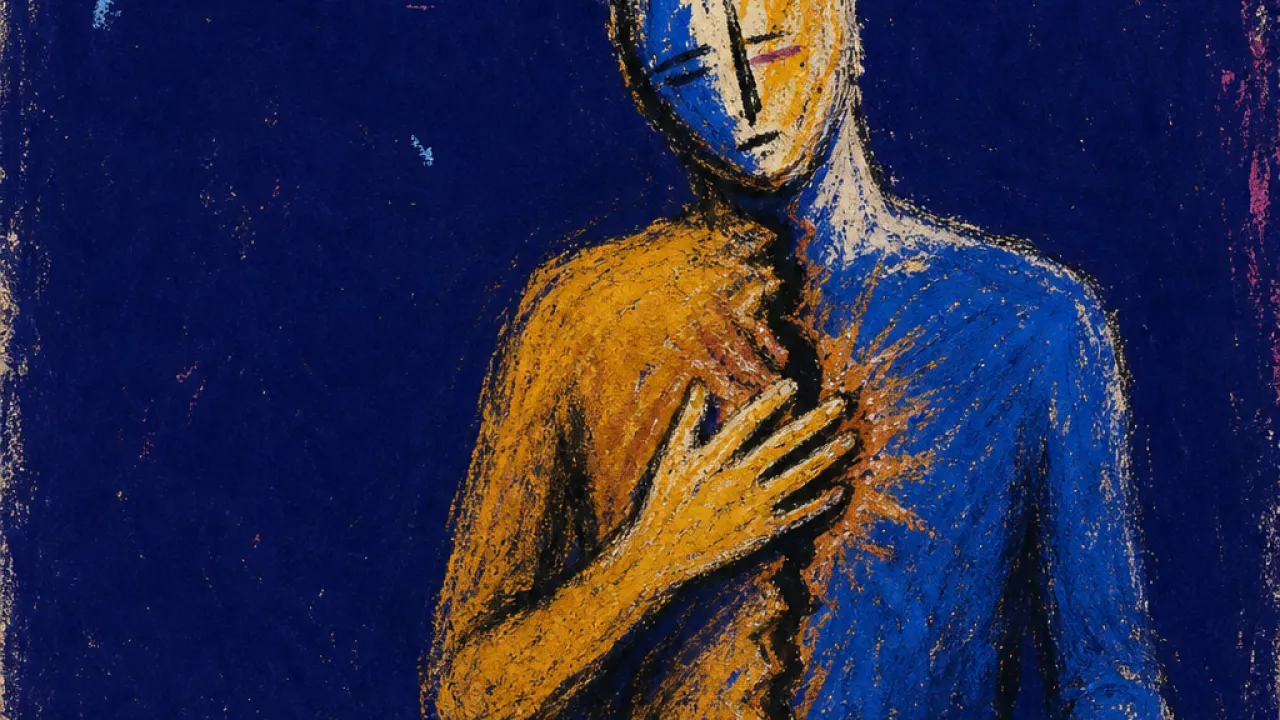
Boundary Diffusion is visible in the moment another person's mood enters your body before your own capacity has been checked. You may recognize it as the breath going shallow and heat gathering behind your eyes when a late message pulls you back in. Grounded in Jungian archetypal theory, the images below reflect the unconscious dynamics of that blurred edge; here are the Tarot Cards that make this pattern visible.
The Hanged Man ReversedThe figure’s body is not simply near the tree; it is organized by it. The rope, the vertical trunk, and the empty surrounding space make the external structure feel more defining than the body’s own direction. Boundary Diffusion appears when the line between personal responsibility and family emotional management becomes hard to locate. In this pattern, another person’s disappointment, anxiety, or expectation can feel like an internal command rather than an external pressure. The Hanged Man’s suspension shows how a family frame can become so familiar that it feels like identity. You may not be choosing every obligation freely; some of them may be inherited ropes that your nervous system has mistaken for belonging.
Death ReversedThe foreground compresses ruler, child, kneeling woman, and praying figure into one shared field beneath the horse. Distinct roles remain visible, but the advancing force makes their separateness feel fragile. Everyone is pulled into the same path, and the image leaves very little room for private psychological space. Boundary Diffusion works this way inside family systems when relatedness is treated as automatic access. A parent’s fear becomes your emergency, a relative’s expectation becomes your obligation, and a family mood becomes something your body starts managing before you have chosen to participate. The self does not vanish all at once; it becomes porous through repeated small invasions. In the reversed texture, Death does not simply clear an old structure; it shows the panic of a system that cannot tolerate differentiation. You may notice yourself becoming younger, more reactive, or less certain around family because the field itself pulls you back into old roles. The card reveals the spatial problem beneath the emotional one: there is not enough room between the family system and your separate self.
Temperance UprightThe angel's body bridges shore and pool, with one foot grounded and the other immersed. The boundary is visible, but the figure's posture turns that boundary into a living threshold rather than a hard wall. In a lifestyle system, that same bridging can become a coping pattern where every category of life starts leaking into the next. Work enters rest, emotional processing enters errands, health goals enter self-worth, and the day loses clean edges even when everything looks calm from the outside. Boundary Diffusion is not shown here as chaos; it is shown as over-blending. The card reveals how a beautiful desire for integration can quietly erase the separations that let a nervous system recover.
ReversedThe angel connects multiple realms at once: land, water, cups, reflection, body, path, and distant light. In its healthy form, this is integration; in its strained form, every boundary becomes permeable and every system starts blending into every other system. That is the psychological structure behind Boundary Diffusion in personal growth. You may absorb every framework, philosophy, productivity method, identity label, and healing model until your own signal becomes hard to hear inside the mixture. Temperance makes the distinction clear: integration requires a vessel. When the vessel becomes too porous, the pursuit of growth stops refining the self and starts dissolving self-trust.
The Devil UprightThe two human figures stand close to the altar and close to the Devil's field of influence, exposed and visibly altered by it. Their horns and tails suggest that the surrounding force has not stayed outside them; it has been incorporated into their bodies and self-presentation. Boundary Diffusion appears when the line between inner desire and external pressure becomes hard to locate. The chain makes restraint look like something imposed from outside, but the altered bodies show a deeper process: the environment has started to define the self from within. In personal growth, You may absorb the ambitions of mentors, influencers, peers, partners, or productivity culture until their path feels like your calling. The card reveals the cost of borrowed desire, where self-improvement becomes harder to trust because the self doing the improving has not been clearly separated from the noise around it.
ReversedThe chained figures are not visually separate from the Devil's nature; they carry horns and tails of their own. In a reversed psychological state, that resemblance blurs the boundary between external pressure and internal desire, between being influenced and wanting, between obligation and identification. Boundary Diffusion appears when the decision field becomes crowded with other people's needs, imagined reactions, expectations, or emotional consequences. The user cannot tell whether a path is chosen from genuine alignment or from absorbing someone else's fear, disappointment, urgency, or approval system. In choice tarot, this card helps locate where the self has become mixed with the field around it. The audit is not about cutting everyone out of the decision; it is about separating your signal from the emotional weather attached to each option. Once the boundary is visible, the choice can become yours again.
The Tower ReversedThe tower wall no longer contains what it was built to hold. Fire, smoke, crown, and bodies all cross the boundary at once, turning a sealed vertical structure into a scattered field of fragments. Reversed, this image describes an inner world where distinctions blur under pressure. You may struggle to tell whether a feeling belongs to the present, an old wound, someone else's judgment, or a role you learned to perform so long ago that it feels like selfhood. Boundary Diffusion fits because the collapse does not only destroy a wall; it scrambles the categories the wall used to maintain. The work is not to rebuild the same tower. It is to recover enough inner separation to know what is truly yours to process.
The Star ReversedThe woman's body bridges two territories at once: one knee planted on land, one foot resting on water, one stream entering the pool and another breaking across the ground. The borders are clear in the image, but the body is stationed exactly where they meet. When that liminal position strains, the inner sorting system can become too porous. You may struggle to know whether a sensation is intuition, memory, mood, projection, or an actual signal from the world. Boundary Diffusion is not sensitivity itself; it is sensitivity without enough internal edges. The Star connects this pattern to introspection because the same openness that makes deep self-reading possible can also blur the difference between inner weather and outer guidance.
The Moon UprightThe Moon places water, shore, path, animal instinct, and distant towers in one continuous field. The crayfish crosses from the pool onto land, while the reflected light makes perception feel soft-edged and unstable. The boundary between inner image and outer fact is deliberately porous. That porousness is the visual basis for Boundary Diffusion. In introspection, the psyche can absorb old emotional residue, other people's moods, imagined meanings, and present-tense signals into one undifferentiated inner atmosphere. The result is not simply sensitivity; it is difficulty locating where a feeling begins and what it actually belongs to. The card invites a more precise audit of ownership. You may be feeling something real, but the Moon asks whether it is current, inherited from a past dynamic, projected onto the present, or stirred up by the symbolic field itself. Clarity returns when the boundary is named before the feeling is obeyed.
ReversedThe shoreline is not a clean border; water, land, and the beginning of the path press into each other under dim lunar light. The crayfish is half in one world and half in another, exposed at the threshold before the route has become safe. Boundary Diffusion emerges when that threshold stops functioning as a boundary and becomes a leak. In a family system, another person's mood can enter your body as guilt, obligation, or panic before you have chosen a response. The Moon makes the mechanism visible through a blurred edge: You are not refusing connection; the map between self and family has become too porous.
The Sun ReversedThe child's body is completely uncovered, and the Sun's rays reach the entire scene with almost no private shadow. The wall exists, but the visual field is still saturated by light, making exposure feel total rather than chosen. That is the family-system logic of Boundary Diffusion. What should belong to your inner life, adult choices, or private emotional process becomes available for family interpretation, commentary, correction, or ownership. The pattern can feel like closeness because everyone seems involved, informed, and emotionally invested. The card's overexposure shows the hidden cost: without a protected inner zone, being loved can start to feel indistinguishable from being constantly visible.
Judgement ReversedThe ground in Judgement is unstable and waterlike, and the coffins seem to float between solid land and emotional depth. Every container is open at the same time, exposed to the same trumpet call, with little privacy between one awakening and another. Boundary Diffusion in friendship begins in that porous field. A friend's crisis becomes your emergency, their mood becomes your obligation, and the group's emotional weather enters your private space without consent. The card shows how openness without differentiated edges can turn connection into involuntary absorption.
The World ReversedThe laurel wreath is clear enough to protect, but in reversal it can become a ring that decides what counts as inside and outside. The dancer's body remains framed by a family-sized symbol of completion, while the surrounding figures hold the perimeter like witnesses to the approved whole. This visual pressure maps onto boundaries that look peaceful only because difference has been absorbed. The family system may call it closeness, care, or loyalty, but the psychological mechanism is a blurred line between connection and access. For you, Boundary Diffusion names the pattern where your separate life starts to feel negotiable to everyone else. The World reversed shows the trap clearly: the same circle that once meant belonging can become the structure that makes autonomy feel like betrayal.
Ace of Cups ReversedThe cup, droplets, streams, and pool form one continuous water system, with little visual separation between what is held, what overflows, and what receives the overflow. The image creates connection, but in the reversed texture that connection can dissolve the edge of the vessel itself. Boundary Diffusion fits when receptivity becomes over-identification. For self-development, You may absorb every framework, creator, coach, trend, and emotional atmosphere until the growth path no longer feels chosen; it feels inherited from whatever field touched you last.
Two of Cups ReversedThe cups meet across a narrow central space, and the staff rises exactly where one person's emotional offering could be mistaken for the other's. The scene is balanced, but its balance depends on a visible line that can become psychologically overcharged. Boundary Diffusion fits the reversed texture because the exchange can stop being mutual recognition and become emotional blending. You may be carrying moods, expectations, or imagined reactions as if they were native signals from your own inner world, which makes introspection feel crowded before it even begins.
Three of Cups ReversedThe figures stand close enough that the circle reads as one emotional unit before it reads as three separate bodies. Their distinct robes and identities remain visible, but the shared shape can pull attention toward cohesion more strongly than individual signal. Boundary Diffusion appears when connection becomes the container that decides what is true. In the reversed Three of Cups, the psyche may absorb group mood, remembered approval, or imagined reaction so quickly that private feeling becomes hard to separate from the emotional field around it. In introspective work, this matters because the voice that sounds like inner truth may actually be borrowed atmosphere. You can feel something intensely and still need to ask whether it began inside You, or whether the circle around You taught the mind to carry it as its own.
Six of Cups ReversedThe manor wall and the patrol draw a strong perimeter around the garden, making the children appear protected inside a shared emotional territory. In the reversed texture, that same enclosure stops feeling like safety and starts feeling like a field where every cup, memory, and gesture belongs to the household before it belongs to the individual. Boundary Diffusion emerges when closeness erases the line between affection and access. In a family setting, the old garden can make separate preferences feel like betrayal, because the system treats emotional nearness as permission to enter decisions, privacy, time, and self-definition. The Six of Cups anchors this pattern through its sweetness, not through obvious conflict. The danger is subtle: a beautiful shared past can make the boundary feel cold, even when the boundary is simply the adult self trying to stand outside the inherited courtyard long enough to think clearly.
Seven of Cups UprightThe cups hover in a shared cloud with no hard border between what belongs to the figure and what belongs to the visions. The castle, the face, the jewels, the wreath, the snake, and the shrouded self all appear in the same atmosphere, as if desire, identity, family, and expectation are being mixed before they can be sorted. That is the visual logic of a softened boundary. The outer images organize the figure's inner posture, so the self starts responding to projected demands before it has checked whether those demands are actually its own. In family dynamics, this pattern can make another person's mood feel like your responsibility and a private choice feel like a collective event. The card gives form to the moment when family expectations enter the psyche as if they were personal truth, making separation feel emotionally confusing rather than straightforward.
ReversedThe clouds blur the edge between the figure's grounded space and the floating images above. The covered self, the mask-like head, the snake, the dragon, and the reward symbols all occupy the same misty field, with no hard boundary separating desire, fear, and identity. That lack of separation maps onto group emotion entering your system too easily. In social ecosystems, other people's moods, expectations, and status signals can begin to feel like your own internal weather, making it hard to know where your preference ends and the room begins.
Ten of Cups ReversedThe family is visually gathered under one emotional sky: the couple is linked, the children hold hands, and every figure belongs to the same upward-facing field. The rainbow covers the whole scene, creating a shared atmosphere so complete that separate inner states are hard to locate. Boundary Diffusion forms when emotional belonging overrides self-differentiation. In introspective work, you may discover that certain feelings do not originate cleanly inside you; they arrive as inherited mood, copied responsibility, or a family-shaped expectation that has been mistaken for your own inner truth.
Page of Cups ReversedThe cup, the fish, and the sea all carry the same water logic, but their edges do not stay clean. A living thing from the wider emotional field appears inside the Page's personal vessel, while the waves behind him keep pulsing at his back. Boundary Diffusion follows that blurred container. In family systems, one person's mood, disappointment, or expectation can move inside you so quickly that it feels like your own emotion. The Page's image shows how a private cup becomes an extension of the sea when the edge between contact and absorption is not fully held.
Knight of Cups ReversedThe stream is a boundary, but the knight approaches it with the cup already extended. In reversal, the desire to keep the emotional offering intact can pull the body toward the crossing before the boundary has been evaluated. The visible threshold starts to lose authority under the pressure of connection. Boundary Diffusion appears when family warmth, guilt, and access begin to blur together. You may let relatives into private choices, emotional details, schedule decisions, or relationship territory because withholding access feels like rejecting the bond. The pattern turns closeness into permeability. The Knight of Cups ties this directly to the cup's power. The emotional offering is meaningful, but it can also become the reason the reins loosen. The card asks whether care is being carried across a boundary, or whether the boundary is being dissolved so the family system does not have to tolerate distance.
Queen of Cups ReversedThe throne rests on a small strip of land almost entirely surrounded by water, and the Queen's body is enclosed by cup, stone, shoreline, and sea. The scene is protected, but it is also extremely permeable; the emotional field presses close from every side. Reversed, that permeability becomes a problem for personal growth. You may absorb every framework, every mentor voice, every wellness trend, and every emotional cue before your own system has decided what belongs. The card shows a self-improvement process where the inner shoreline is too open, so the original signal gets diluted by everything that touches it.
King of Cups ReversedThe shell throne has an edge, but the ocean touches it from every side. In the reversed field, the container starts to feel porous; water is not inside the king's body, yet the whole scene is built from its pressure. Boundary Diffusion in family life feels like absorbing moods before words are spoken. A parent's disappointment, a sibling's tension, or a group chat message can enter your system as if it were your own emotional task. The card gives that invisible merge a physical shape: a self trying to sit upright while the surrounding sea keeps rewriting where the self ends.
Ace of Pentacles ReversedThe garden is fenced, but the fence is low and visually permeable. The archway opens a route inward, and the protected space still remains easy to imagine entering from the outside. In the reversed texture, that softness becomes psychological blurring. The family field treats access as natural because the boundary does not look forceful, so time, money, privacy, emotional energy, and life decisions can become shared property before consent is clearly given. Boundary Diffusion is the pattern of not knowing where the family ends and you begin. It often feels like love, duty, or normal closeness until the cost shows up as resentment, exhaustion, or the inability to make a clean personal choice.
Two of Pentacles ReversedThe infinity cord does not merely connect the pentacles; it wraps the two separate objects into a single moving system. In the reversed psychological texture, the cord becomes less like coordination and more like a binding that makes distance hard to feel. Boundary diffusion begins when family emotion, family need, and personal identity move through the same loop. You may register someone else's disappointment as your own task, or treat a parent's stress as evidence that your boundary is unsafe, because the internal map no longer clearly marks where their state ends and yours begins. The lifted foot intensifies the pattern because there is no fully grounded pause. The body keeps adjusting inside a shared circuit, which is how family pressure can feel immediate, intimate, and strangely difficult to locate as separate from your own will.
Three of Pentacles ReversedThe figures gather at the doorway, neither fully inside nor fully outside the building. In the reversed texture, that threshold can stop functioning as a clean boundary and become a shared zone where roles, access, and responsibility blur. Boundary Diffusion grows when the relationship has a blueprint, but nobody has clearly agreed to who authored it or what it requires. The structure looks cooperative from the outside, yet the emotional terms may be assumed rather than spoken. In friendship, this is the pattern behind always being available, absorbing a friend's crisis by default, or feeling guilty for needing space. The bond may be close, but without a working threshold, closeness turns into automatic access.
Five of Pentacles ReversedThe two figures move close together through the same hostile weather, while the warm interior remains separate behind glass. Their closeness is understandable, but it also takes shape inside exposure rather than inside a secure boundary. That is the reversed family logic of Boundary Diffusion. Another person's distress, disappointment, loneliness, or need can start to feel indistinguishable from your own internal state. The family system teaches the body to stay attached inside the storm, so separation feels cold, selfish, or unsafe even when it is simply differentiation. The Five of Pentacles grounds this pattern in space. The problem is not connection; the problem is connection without a protected self. When the only available warmth seems to come from staying fused with someone else's hardship, boundaries can feel like abandonment rather than an adult structure for staying intact.
Six of Pentacles ReversedThe kneeling figure's blue covering is torn open just enough to reveal red underneath, visually echoing the giver's red clothing. The image creates a strange overlap: the receiver is separate from the benefactor, yet marked by the same color inside the torn boundary. That overlap is the visual pressure point for Boundary Diffusion. In a family system, help can feel intimate and invasive at the same time, especially when money, guilt, access, and emotional loyalty are fused into one channel. You may struggle to tell whether accepting support means accepting control, or whether saying no means rejecting love. The card shows why that confusion sticks: the boundary is physically visible, but the emotional color has already leaked across it.
Eight of Pentacles ReversedThe card places private craft in an open setting, with the town still visible in the background. In the reversed field, that openness can stop feeling spacious and start feeling porous, as if the wider system can enter the workspace and define what the labor is for. Boundary Diffusion appears when family expectation crosses into the inner space where adult choice should form. You may feel a request as an obligation, a comparison as an identity verdict, or a parent's mood as an instruction. The boundary does not disappear dramatically; it becomes too permeable to filter what belongs to you. The Eight of Pentacles makes this visible through the relationship between worksite, town, and repeated coins. The same structure that supports skill can become a family template, where the role is stable but the self has too little room to decide what it is building.
Nine of Pentacles ReversedThe woman, vines, pentacles, bird, robe, house, and land are arranged as one continuous estate. The scene is beautiful, but its continuity can make it difficult to tell where the self ends and the owned, tended, inherited, or protected world begins. In family systems, that same continuity can blur emotional ownership. You may register another person's crisis, disappointment, reputation, or expectation as if it were already yours, before there is enough space to ask what actually belongs to you.
Ten of Pentacles ReversedThe arch pulls the household into one continuous field: elder, couple, child, animals, crest, property, and lineage all share the same enclosure. The child is visible but partly hidden behind the mother, present in the system without a fully separate outline. Boundary Diffusion works in exactly that blurred space. You may experience closeness as access, support as entitlement, and family concern as a reason your private choices become public property. The card's shared household becomes a psychological map of enmeshment when reversed. Connection remains important, but the audit point is whether the family bond still leaves enough room for a distinct adult self.
Page of Pentacles ReversedThe Page has space around him, but his attention does not fully inhabit it. The open field is available, while the body and gaze collapse toward the pentacle. The scene creates a subtle mismatch between external room and internal contraction. Boundary Diffusion appears when the wider field is no longer experienced as separate from the object being held. The pentacle gathers duty, value, and attention into one point, making it harder to tell whether the obligation belongs to the self or has been absorbed from the surrounding system. In family dynamics, You may call something responsibility while feeling a quieter pull of guilt, loyalty, comparison, or inherited pressure underneath it. The pattern blurs the line between choosing and complying, so autonomy feels present on paper but unstable in the body.
Queen of Pentacles ReversedThe Queen is surrounded by life, fabric, foliage, carving, and cultivated growth until her personal outline almost belongs to the whole scene. In reversal, the abundance that should support her can blur into an environment that claims her attention, body, and role. That visual merging maps directly onto boundary diffusion inside a family system. Needs arrive as if they are already yours, emotional pressure feels like a shared emergency, and saying no can feel like damaging the entire field. Boundary Diffusion does not mean you lack care. It means the family ecosystem has trained closeness to override separation, so your limits become hard to locate when guilt, resources, or inherited roles are activated.
King of Pentacles ReversedThe King's robe visually merges with the vines and greenery around the throne, while the wall and castle make the surrounding land feel like an extension of his body. The image blurs person, property, lineage, and domain into one continuous field. Reversed, that fusion becomes Boundary Diffusion. In a family system, your time, money, decisions, emotional availability, and future can start to feel like shared property. The problem is not closeness; it is the loss of a clean line between connection and entitlement. The card anchors this pattern through its abundance. Everything looks connected, fertile, and secure, which is exactly why the boundary can become hard to name. The psychological work begins when you can separate belonging from being absorbed into the family's expectations.
Two of Swords ReversedThe shoreline looks clear, but the woman has her back to the sea, so the emotional field is not being actively watched. In front of her, the swords reduce the usable space to a narrow defended zone, while the wider landscape remains unavailable. Boundary Diffusion appears when the family system gets closer than your inner boundary can track. Someone else's urgency, guilt, mood, or expectation starts to feel like your own signal, and the body responds before the self has separated. Reversed, the Two of Swords shows a boundary that looks guarded from the outside while the tide is already entering from behind.
Three of Swords UprightThe heart hangs without a body to shield it, move it, or separate it from the weather around it. Rain, cloud, blade, and organ all occupy the same emotional field, so the image gives vulnerability no clear edge. Boundary Diffusion works the same way in friendship when another person's crisis, disappointment, jealousy, or emotional intensity enters your system as if it were your own. You may call it empathy, but the pattern reveals a missing line between care and absorption. The Three of Swords makes the cost visible: without a boundary, every external pressure can reach the center. The card asks for clarity not because the bond is unimportant, but because a friendship cannot stay mutual when one heart is carrying the entire weather system.
Five of Swords ReversedThe fallen swords draw a hard line across the shore, yet the scene does not produce a clean boundary. Everyone faces away from everyone else, and the scattered blades send attention in multiple directions at once. That fractured layout shows a boundary system under pressure. The psyche tries to separate what belongs to whom, but the unresolved conflict keeps mixing blame, accountability, shame, and defense into the same field. The line is visible, but its meaning is unstable. Boundary Diffusion appears when introspection cannot clearly sort what is yours to own from what is emotional residue, projection, or inherited guilt. You may absorb too much responsibility, reject the piece that is yours, or keep merging your self-image with the conflict itself. The card makes the task concrete: the boundary is not just where the swords fall, but where the mind learns to separate accountability from self-attack.
Eight of Swords ReversedThe sword boundary is visible but not clean: blades, cloth, mud, and water all occupy the woman's personal field. One foot touches the unstable wet ground while the bindings take away the normal choice to reach, pull back, or reorient. Boundary Diffusion is carried by that mixed field. In friendship, You may absorb another person's crisis before deciding whether it belongs in your own emotional space, because closeness and obligation have started to feel physically intertwined. The card shows a boundary that exists in outline but cannot yet function as a lived limit.
Nine of Swords UprightThe bed should be a private boundary, but the swords cross into the figure’s head, throat, and heart. Even the quilt that covers the lower body does not create real separation; it contains her physically while the mental pressure enters the most intimate zones. Boundary Diffusion in friendship works in the same way. A friend’s crisis, jealousy, loneliness, or mood can pass straight into your nervous system until their emotional state feels like your responsibility to solve. The card does not frame care as the problem. It shows the moment where care loses its edge and becomes absorption, where your private inner space stops being a protected room and becomes an extension of someone else’s distress.
Ten of Swords UprightThe fallen body has no protective surface left. Ten blades have crossed the boundary of the back and spine, while the calm river and distant bank show that separation exists in the scene but has not been reached. That visual structure mirrors a friendship system where closeness stops being filtered. You may call it loyalty or being supportive, but the pattern reveals something more precise: access has replaced intimacy, and every friend's crisis is allowed to land inside your private space before your own limits can register.
ReversedThe swords do not remain outside the body; they cross the body's boundary and occupy the spine itself. The central line that should support standing, choosing, and moving has become the place where external force is installed. Boundary Diffusion in a family system is not simply having weak boundaries. It is the experience of family expectation becoming so internal that You cannot immediately tell whether a choice is yours or a voice that has been living in your backbone for years. The Ten of Swords makes that confusion physical: the outside has entered the structure that was supposed to hold You upright.
Three of Wands ReversedThe wands still mark a threshold, but the figure remains caught between the land behind him and the open water ahead. The cliff edge turns separation into suspension, and the planted supports start to feel like tethers. Boundary Diffusion in family dynamics works through that same blurred edge. The system makes your time, choices, privacy, or emotional bandwidth feel collectively available, so autonomy becomes something you have to justify instead of a basic inner perimeter.
Four of Wands ReversedThe garland hangs across the four wands like a soft threshold, open enough to look welcoming and connected enough to blur where the entry ends. Behind it, the house and gathering make belonging feel already decided before any individual boundary is spoken. This is how Boundary Diffusion operates in a family system. You may feel that being related automatically grants access to your time, mood, choices, or private information. The card's decorated shelter shows why this can be confusing, because the pressure arrives wrapped in warmth, so the loss of limits can look like closeness.
Five of Wands UprightThe figures stand close enough that their wands invade one another's space, yet none of them fully meets another person with a stable, grounded stance. The boundary is visible only because it keeps getting crossed. That is the visual logic of Boundary Diffusion inside friendship: private emotion, group expectation, and individual responsibility start occupying the same crowded field. One person's urgency becomes everyone's obligation before anyone has time to ask what actually belongs to whom. The card holds the tension between connection and over-access. You may value the friendship deeply, but the pattern makes closeness depend on constant permeability, until care begins to feel like being pulled into every raised wand at once.
ReversedThe Five of Wands compresses five separate bodies into one crowded field of overlapping gestures. Each person has a wand, a stance, and a direction, but the edges of those directions keep invading one another. Boundary Diffusion appears when the psyche cannot clearly separate what belongs to the self from what has been absorbed from external pressure, old criticism, social performance, or a reactive environment. The inner field becomes crowded with signals that all feel personal because none of them have been sorted. In introspection, this pattern can make You feel flooded by inherited voices, borrowed urgency, or emotions that do not seem to have a clean origin. The card points to the work of differentiation: not suppressing the noise, but identifying which wand is actually Yours to hold.
Six of Wands ReversedThe rider's victory is surrounded by other people's wands, other people's movement, and other people's recognition. His achievement is visually hard to separate from the crowd that receives it, mirrors it, and amplifies it. In reversal, the boundary between personal desire and group projection becomes unstable. Inside a family system, Boundary Diffusion shows up when your choices feel emotionally occupied by other people's pride, fear, reputation, or disappointment. You may struggle to know whether you want the path in front of you or whether you have absorbed the family's preferred image of who you should be. The self is still present, but it is surrounded by too many reflected expectations. This pattern belongs to the Six of Wands because the card's support field can become a projection field. The same crowd that celebrates the rider can also make it difficult to hear where the rider ends and the family's story begins.
Eight of Wands ReversedThe wands fill the open air and approach the land with no visible figure able to grant permission, set a pace, or refuse contact. The space is not chaotic, but it is being occupied by a force that arrives before any boundary can visibly respond. That is why the card can point to Boundary Diffusion in family dynamics. A parent’s urgency, a sibling’s distress, or a relative’s expectation enters the inner field so quickly that your body may register it as your own responsibility before your adult self has separated signal from demand. The pattern is not simple kindness. It is a boundary system losing definition under fast-moving emotional traffic, where another person’s state crosses the line and becomes your internal pressure to fix, soothe, explain, or comply.
Nine of Wands ReversedThe wands behind the figure look like a boundary, but they are not a sealed wall. A gap remains, and the figure stands in front of it with his own body and wand completing the line. The image is not just protection; it is protection that depends on personal exposure. Boundary Diffusion shows up when the family boundary cannot hold unless You physically, emotionally, or logistically reinforce it. A parent's disappointment, a sibling's crisis, or a long-standing family narrative may cross into your decisions so quickly that your own preference becomes hard to locate. The defense is active, but the line between care and obligation is not fully differentiated. The reversed Nine of Wands captures the strain of being both the person and the perimeter. The gap in the wall becomes a psychological opening where guilt, expectation, and old roles can enter. This card exposes the specific confusion at the center of family boundary work: trying to protect yourself while still feeling responsible for what crosses the line.
Ten of Wands UprightThe man is physically separate from the building ahead, yet the bundle presses so close to his body that the distance between self, task, and destination collapses. His arms do not simply hold the wands; they seal them into his personal space. Boundary Diffusion emerges from that collapsed spacing. The defense works by absorbing the system into the self: if everything is held close enough, nothing has to be sorted, refused, delegated, or reclassified. The immediate relief is control; the long-term cost is losing the ability to tell what is actually yours to carry. For lifestyle questions, this is the pattern behind a home, schedule, body, inbox, and social life all feeling like one undifferentiated burden. The card points to the missing boundary audit: not which wand is hardest, but which wands belong in your arms at all.
ReversedThe wands crowd the man's entire upper body, filling the space where his face, chest, and forward vision would be. He is not standing beside the responsibility; he is physically fused with it, moving as if the load and the self have become one object. That fusion is the visual core of blurred family boundaries. Other people's needs enter the same psychological space as your own, and the pressure to respond can arrive before you have had time to decide what actually belongs to you. Boundary Diffusion appears when separation feels threatening because the family system has trained closeness to mean absorption. You may still be moving, still functioning, still carrying, but the card reveals the central distortion: the burden has taken up the space where self-definition should be.
Knight of Wands ReversedThe horse rises into the frame with the wand lifted ahead of it, pressing energy outward before the landscape has offered any response. The rider's force arrives before the field has had a chance to answer. That is the relational mechanics of blurred friendship boundaries. You may experience closeness as access, urgency as permission, and emotional intensity as a reason another person should be available right now. The reversed pressure in this image is not about caring too much; it is about the other person's separateness getting overwritten by momentum. Boundary Diffusion appears when friendship warmth loses the gap that lets two people remain distinct.
No cards available for this filter.