Wanting Friends but Leaving After Class Turns Toward a Small Ask
Finding Clarity When You Leave Right After Class but Want Friends
I recognized the pattern before I drew a card. Maya was the second-year student on a big city campus who wanted class friends, but the second the professor said 'that's it for today,' her body started a clean exit like it was dodging social exposure.
She sat across from me with the strap of her tote still looped around her wrist, as if some part of her had not fully arrived. When she described 3:49 p.m. in a packed Toronto lecture hall, I could almost hear it: laptop lids clicking shut, winter coats rasping against plastic chairs, two classmates two rows over laughing as they swapped Instagram handles. Her phone was warm in her palm. Her throat tightened. Her shoulders folded in. She slid her notebook away before the final slide was closed and aimed for the aisle before the room became socially open.
'I always think I will say something after class,' she told me, looking down at the chipped black polish on one thumbnail, 'and then my body is already at the door. I don't want to look like I am waiting to be chosen.'
That was the ache in the room: wanting campus friends but leaving right after class to avoid the exposed awkwardness of initiating conversation. Her loneliness did not feel like a dramatic movie scene. It felt more like a blank notification screen refreshed again and again, warm from being held too tightly, offering nothing back.
I told her, 'I am not here to tell you to just be confident. That advice usually skips the exact second where your nervous system panics. We are going to look at the pattern with care, not judgment, and see if tarot can help us draw a map through the fog.'

Choosing the Compass: A Five-Card Shadow Spread
I asked Maya to place both feet on the floor and take one slower breath before I shuffled. I use that small pause as a psychological doorway, not as theater. It gives the mind a moment to stop sprinting ahead of the heart.
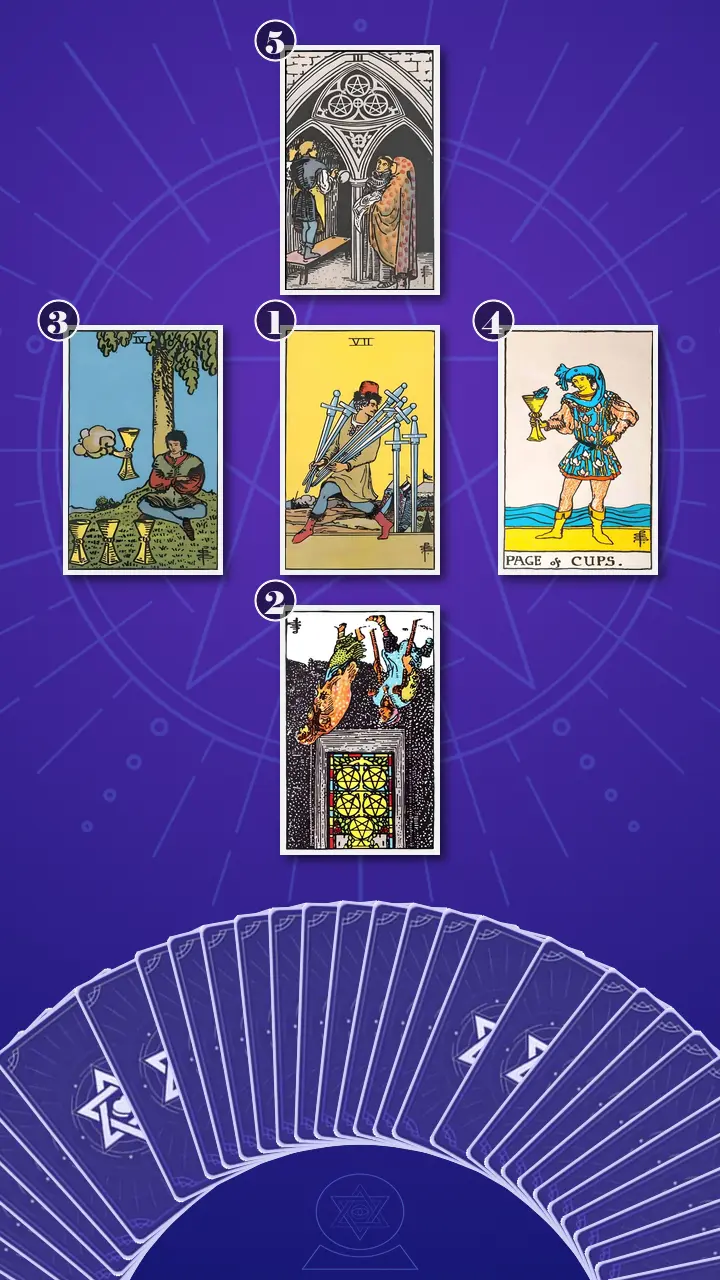
For this reading, I chose The Shadow Spread, a five-card Shadow Spread tarot reading designed for moments when the outer behavior and the inner desire seem to contradict each other. This is how tarot works in my practice: the cards do not issue a verdict. They offer symbolic structure, almost like a Jungian mirror, so we can see a hidden role, a fear, or a coping strategy without turning it into shame.
A larger spread would have added more context, but Maya's question was beautifully specific: Why do I leave right after class when I want friends? The Shadow Spread was precise enough to separate five layers: the visible behavior, the hidden fear, the protective posture, the disowned capacity, and the embodied next step.
I told her, 'The center card will show the class-end pattern itself. The card beneath it will name the fear under the fast exit. The card on the left will show what protects you, even if that protection is costing you. The card on the right will show what wants to come back online. The card above will turn this into something you can actually try after lecture.'
Reading the Map After the Last Laptop Click
Position 1: Seven of Swords and the Clean Exit
Now I turned over the card representing the observable class-end behavior: leaving quickly, looking busy, and avoiding the vulnerable social opening.
The Seven of Swords, upright.
I pointed to the figure on the card slipping away with swords in his arms, glancing back over his shoulder. 'This card is strategy,' I said. 'Not evil. Not fake. Strategy. It is the part of you that has learned how to leave before anything can hurt.'
In card meanings in context, the Seven of Swords is the private exit plan. In Maya's life, it looked exact: she zipped her tote before the lecture fully ended, unlocked her phone to look occupied, and slipped toward the aisle while still tracking the classmates she wanted to talk to from the corner of her eye. The strategy gave her instant relief, but it also removed her from the exact moment when casual familiarity could begin.
Energetically, this was Excess Air: the mind working overtime to manage every possible outcome before the body had to stand there and be seen. The quick exit was not random. It was a neat mental workaround for a messy emotional risk.
Maya gave a short, bitter laugh. 'That's me. That's too accurate, which is kind of brutal.'
I nodded. 'It can feel brutal when a card says the quiet part clearly. But I want you to hear the kindness in it too. Leaving first can feel like safety, but it also keeps the room from answering. This card is showing us a behavior, not sentencing your character.'
Position 2: Five of Pentacles Reversed and the Untested Doorway
Now I turned over the card representing the hidden fear beneath the visible pattern: that lingering and being ignored would confirm a lack of belonging.
The Five of Pentacles, reversed.
The image was almost too on the nose: two figures outside in the cold, passing beneath a glowing window. The reversal mattered. It suggested that warmth might be closer than it feels, but the outsider story is so loud that the door is treated as locked before anyone tries the handle.
In Maya's real classroom, this was the moment when she saw two classmates laughing about the assignment and instantly read the scene as proof that there was no space for her. She walked past before saying anything, even though the conversation was about the same class, the same deadline, and the same shared confusion she could have entered with one neutral question.
Energetically, this was blocked Earth. The need for social ground, for a place to stand among familiar faces, was present, but it had frozen into an assumption: they already have people. Don't stand here looking spare.
The window beside my table had caught the late afternoon light, and for a second the rectangle of gold on the wood looked like the stained glass in the card. I felt the environment join the reading, quietly underlining the symbol. A private memory came back to me too: arriving in a city where I understood the transit map before I had anyone to text. Across cultures, the outside feeling has a recognizable weather. You can be close to people and still feel as if you are watching life through glass.
Maya stopped rubbing her thumb over her phone case. Her breath thinned. 'I didn't know how to explain this,' she said, slower now, 'but yes. It is not even that they reject me. I decide they would.'
'That is the shadow belief,' I said. 'Where am I treating a possible doorway as a locked door? That is the question this card asks.'
Position 3: Four of Cups and the Phone as Crossed Arms
Now I turned over the card representing the protective posture that maintains the cycle: acting unavailable to reduce the immediate discomfort of wanting connection.
The Four of Cups, upright.
The figure on the card sits with arms crossed while a cup is offered from the side. I brought the image straight into Maya's world. She wanted someone to speak first, but her body language said she was already unavailable: eyes down, shoulders closed, phone open, backpack on. A classmate's casual question about the reading could have been the cup from the cloud, but Maya was too busy looking detached to receive it.
Energetically, this was blocked Water. Feeling was present, but it was held behind a posture of indifference. The phone had become the modern crossed arms, a little 'do not perceive me' sign. It reminded me of setting your Discord status to busy when what you actually want is for someone to check in. The signal protects you from awkwardness, but it also teaches people to move around you.
Maya winced, then laughed softly, embarrassed but not defensive. 'I hate that the phone thing is so obvious.'
'It is obvious to you now because we are looking at it,' I said. 'In the room, it probably reads as ordinary student behavior. That is why this is workable. We are not trying to rebuild your whole social life in one afternoon. We are changing one signal.'
When the Page of Cups Offered One Visible Cup
Before I turned over the fourth card, the room seemed to quiet itself. The radiator stopped ticking. The street noise outside fell back for one clean second. This was the card representing the disowned capacity needed for transformation: a small, sincere social signal that challenges the old exit pattern.
The Page of Cups, upright.
The Page holds a cup at chest height, and from that cup, a fish appears, strange and alive. I told Maya that this was not the energy of instant charisma. It was beginner energy, tender and slightly awkward, the part of her that could make a sincere offering before it sounded polished.
In her life, this was simple and specific: Maya stayed by her seat for one extra minute and said, 'I liked what you said about the reading,' before over-editing the sentence into silence. It was not a friendship proposal. It was one visible cup, a warm, low-stakes signal that let the room know she was reachable.
Energetically, the Page of Cups was balanced Water returning after blockage. The card did not demand that Maya become socially fearless. It asked for gentle social courage, emotional sincerity, and willingness to begin imperfectly.
This was where I used my Persona Fatigue Diagnosis. I told Maya, 'I am not looking for a new personality. I am looking at the energy drain of maintaining a social mask that does not match your actual longing.' Through Group Archetype Decoding, I named the role her nervous system had assigned her: The Unbothered One, the classmate who never waits, never needs anyone, never risks looking spare. The Page did not ask her to become extroverted. It asked her to let that mask loosen for ten seconds, just long enough for one honest signal to stay visible.
I slowed down here. Maya knew that 3:49 p.m. feeling: chairs scraping, people turning into pairs, the phone suddenly becoming a prop, her body choosing the door before her want to belong could show. She had been treating that want like evidence against her.
It is not that you do not want friends; it is that you have been hiding the want, and the Page's small cup asks you to offer one simple sign of warmth before you leave.
Maya did not soften immediately. First, her breath stopped at the top of her chest, and her thumb hovered over the black glass of her phone though no notification had appeared. Then her eyes lost focus, not blankly but as if she were replaying every lecture exit in a fast private montage: the zipped tote, the half-smile, the hallway. A small heat came into her face. 'But then that means I made myself impossible to approach,' she said, sharper than before. 'Like, was I just wrong the whole time?' I kept my voice low. 'Not wrong. Protected. Protection is allowed to retire when it starts charging too much rent.' The sharpness drained. Her shoulders dropped a fraction, then another. Her fingers opened around the tote strap. The first exhale shook slightly, less like triumph than the wobbly air after you set down a bag you have carried for blocks. I asked, 'Now, using this new perspective, think back to last week: was there one moment when this insight could have made you feel different?'
She named a tutorial where the person beside her had asked whether the reading was due Friday, and Maya had half-smiled while already opening Canvas. 'I could have just answered like a normal person,' she said.
'You could have answered as a person who was allowed to be reachable,' I said. 'That is the crossing here: from self-conscious urgency and strategic invisibility to cautious belonging through one small visible friendly signal. Not a personality upgrade. A direction change.'
Position 5: Three of Pentacles and the Shared-Task Bridge
Now I turned over the card representing the embodied next step: a low-stakes after-class experiment that could build familiarity without forcing instant intimacy.
The Three of Pentacles, upright.
Three figures gather around work in progress. No one is confessing loneliness. No one is auditioning for best friend status. They are looking at a shared task, making contact through something concrete.
In Maya's classroom, this looked like asking the person beside her whether they understood the assignment and offering to share a notes doc. The shared task did the first social lifting. They did not have to become close on the spot. They only had to cooperate around something already in front of them: a Canvas deadline, a confusing rubric, an exam date, a Google Doc, a reading everyone was pretending to have understood.
Energetically, this was balanced Earth. The reading had very little Fire, and I told Maya that mattered. This was not asking her to become louder, bolder, or more performative. The path to friendship started through repeated small cooperation. Belonging is not always something you wait to be handed. Sometimes it starts as one ordinary question about the assignment.
Maya's face changed in a practical way. Not glowing. Better than glowing: less braced. 'That sounds less like asking someone to hang out,' she said, 'and more like asking about the rubric.'
'Exactly,' I said. 'A classmate's polite answer is data, not a courtroom ruling on your worth. We are looking for real social data, not a verdict.'
From Escape Planning to Real Social Data
When I looked at all five cards together, the story was clear. The Seven of Swords showed the exit plan: Air turning the last minute of class into a private escape route. The Five of Pentacles reversed showed the hidden fear: being near warmth while believing it was not for her. The Four of Cups showed the mask: phone down, earbuds in, shoulders closed, longing hidden under detachment. The Page of Cups offered the remedy: one small, sincere signal before the old routine spoke for her. The Three of Pentacles made it practical: let shared class work become the bridge.
The cognitive blind spot was not that Maya lacked social skills. It was that she treated the feeling of exposure as proof that she did not belong. Her transformation direction was equally precise: shift from protecting against rejection by disappearing to testing connection through one low-stakes class-related comment before leaving.
I told her, 'The goal is not instant confidence. The goal is three minutes of not disappearing.' Then I gave her a plan small enough for the real hallway.
- The One Visible Cup.Before your next class, open Notes and write one opener under 12 words: 'Did you understand the assignment prompt?' or 'I liked your point about the reading.' After one lecture this week, stay by your seat for 60 seconds with both earbuds out and your phone screen down, then let one sentence be available before you reach the door.If speaking feels too intense, lower the difficulty: make eye contact, give a small smile, and do not unlock your phone until you reach the hallway.
- The Class-Related Bridge.Choose one shared task as the bridge: a Canvas deadline, a rubric, a reading, an exam format, or a Google Doc for notes. Ask one classmate, 'Are you starting the reading before Friday, or leaving it for the weekend?' or say, 'Want me to send you the doc?'Treat the exchange as participation, not a friendship audition. Shared work does not obligate you to become close, spend money, or keep talking if the other person is rushed or distracted.
- The Mask Detachment Protocol.Before class, name the role you usually perform: The Unbothered One, The Already Busy One, or The Person Who Never Waits. When class ends, silently separate the mask from your core self: 'My mask can leave later. I can stay visible for one minute.' Pack after the final sentence, not during it, and walk out at normal speed.Afterward, record one piece of social data on the TTC ride home: who responded, what was said, or how long you stayed. Do not write a judgment about your personality. Data only.

A Week Later: The Quiet Proof
Six days later, I received a message from Maya between appointments. She had stayed after tutorial for maybe ninety seconds, phone screen down, one earbud still in her pocket. She asked the person beside her whether the assignment needed outside sources. The answer was polite, then useful. The classmate added, 'I think someone made a notes doc. I can send it if you want.'
Maya did not report a cinematic breakthrough. She rode the TTC home still wondering if her voice had sounded weird. But she also wrote one line in Notes before the self-criticism could take over: polite answer, useful data, not a verdict. That was the quiet proof.
I thought about the Page's small cup and the Three of Pentacles' shared work. Tarot had not made friends for her. It had done something humbler and more valuable: it helped her see the moment where she still had a choice. The room could not include the version of her that had already disappeared, but it could begin to respond to the version who stayed visible for one ordinary question.
If the room loosens after class and your chest tries to choose between being seen wanting connection and getting out before that want can be ignored, I want you to remember Maya's one visible cup: noticing the urge to disappear already means the old routine is no longer driving alone.
If the next after-class minute became a tiny experiment instead of a verdict, what is one class-related sentence you might let stay visible before you leave?