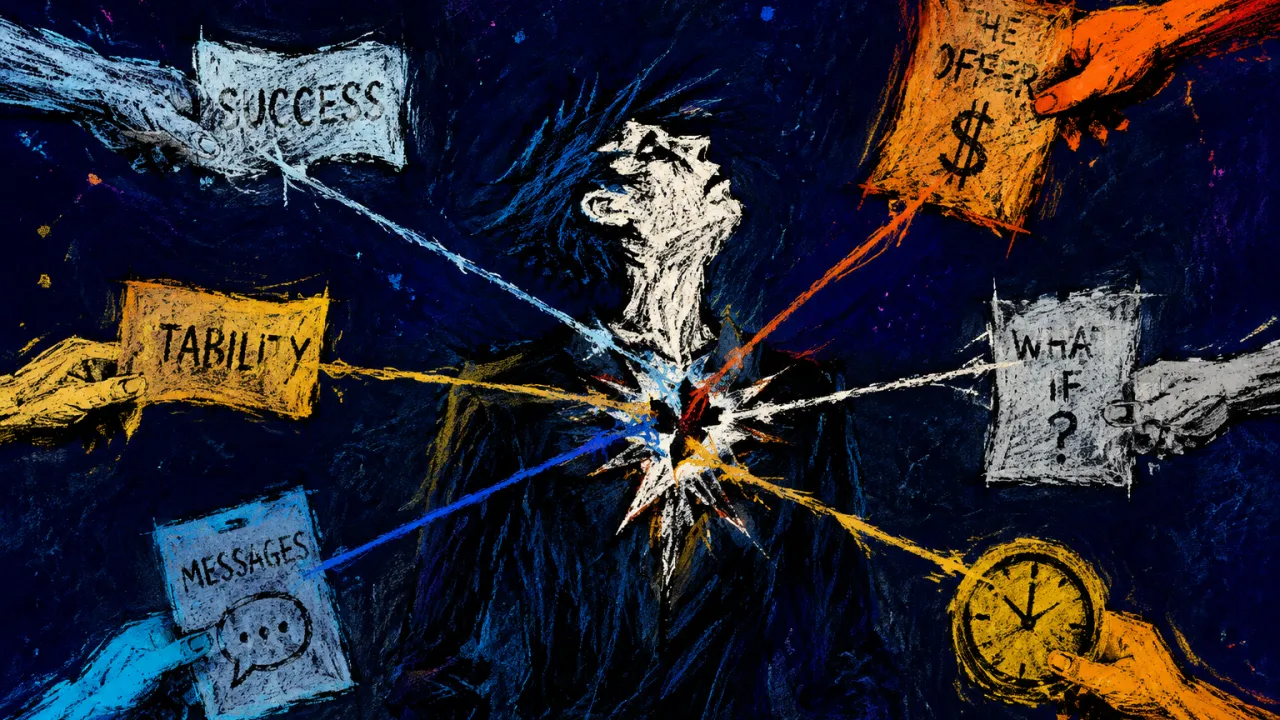
Values Alignment Crossroads describes a decision field where your next move is being measured by offers, people, timelines, and visible consequences, not by preference alone. The pressure shows up in the body as a fixed chest, a tight jaw, and the stillness of sitting between two possible roads while messages and deadlines keep arriving. This is an environmental, structural dynamic: the outer world is asking for one clean answer while several value systems are competing for the same future. The Tarot Cards below reflect the shape of that crossroads without telling you which path to take.
The Lovers UprightThe naked figures stand between the Tree of Life and the fruiting tree, with the angel above and the mountain rising behind them. Their hands are open, but the gaze lines split across the scene, so the card shows a choice field before it becomes an action. For personal growth, that field mirrors a moment when You cannot keep treating goals, habits, and identity as separate projects. The pressure is structural: the next step has to be aligned with what You actually value, or every method will pull in a different direction. The card links this context to the need for a values audit rather than another productivity push. It shows that movement becomes cleaner only when the outer path, the chosen standard, and the embodied desire can stand in the same frame.
The Chariot UprightThe black and white sphinxes sit before the chariot as opposing forces that must be held in one field. Their contrast is not decorative; it is the visible tension the driver has to integrate before the vehicle can move with authority. In personal growth, that becomes the stage where two real values both demand loyalty. You may be facing ambition and rest, independence and belonging, discipline and freedom, and the pressure is not to pick the loudest side but to build a direction strong enough to carry both.
Strength UprightThe woman's hands on the lion's jaw create a visible meeting point between raw force and deliberate restraint. The lion is not destroyed, denied, or allowed to take over; its power is held inside a structure that can receive it without becoming violent. That image fits a crossroads where two options both carry truth, but not the same kind of truth. One path may speak to appetite, momentum, chemistry, or ambition, while another asks for continuity, integrity, and a more sustainable shape of life. You are not being asked to choose the option that looks most controlled or the one that feels most alive in isolation. The card's structure makes the real audit sharper: which choice can hold your drive without requiring you to abandon your standards, and which choice only looks aligned because the louder force has been temporarily quieted?
The Hermit UprightThe six-pointed star inside the lantern holds opposing elements in one contained light. The bowed head, the raised lamp, and the grounded staff create a closed circuit between what is seen, what is valued, and what can actually be carried into action. When two choices both look reasonable, the card shifts the audit away from surface advantage. You are being shown a crossroads where the decisive question is which option remains coherent when measured against the values, costs, and responsibilities that will still matter after the immediate pressure passes.
Wheel of Fortune UprightThe wheel combines several symbol systems into one structure, with mirrored letters, fixed spokes, and a figure above it holding a sword. The image is not simply about movement; it is about whether different orders can fit inside the same turning frame. In love, this becomes the crossroads where attraction has to meet values. One person may want freedom while the other wants definition, or both may care deeply but organize life, conflict, money, sex, time, or future planning through different internal maps. You are being shown the compatibility question beneath the chemistry question. The card makes the hidden architecture visible: a relationship can keep moving for a while on feeling, but long-term direction depends on whether both people are building from principles that can actually share a wheel.
Justice UprightThe foot touching the hall step grounds the figure at a threshold, while the sword and scales make every option carry consequence. The composition is symmetrical, but it is not passive; it creates a decision point where opposing claims have to be weighed without distortion. In a personal growth context, that threshold becomes the moment when values stop being aesthetic language and start demanding tradeoffs. You are not simply choosing a goal; the scene reveals the external pressure of aligning time, discipline, ambition, rest, and integrity into one livable direction.
The Hanged Man UprightThe figure is held in a demanding posture, but the image does not collapse into punishment or panic. The red and blue clothing, yellow halo, and living wood make the suspension look costly and coherent at the same time, as if the body is paying a visible price to keep contact with a deeper organizing principle. A Values Alignment Crossroads appears when the practical option and the meaningful option do not carry the same cost. You may be comparing stability, approval, money, belonging, or freedom against a less efficient path that feels more accurate; the card makes the sacrifice visible so the decision can be judged by more than surface safety.
Death UprightThe fallen ruler, kneeling woman, watching child, and praying figure each meet the rider from a different social and symbolic position. The card is not only showing change; it is showing how change sorts what each position can still stand for when the old order is under pressure. The black flag with the white rose creates a stark field of contrast, stripping the scene down to what remains viable and what has become ceremonial. In a choice context, that visual contrast becomes a values audit: each option carries a visible benefit, but also a hidden demand on what you will normalize, tolerate, or protect. You may be trying to solve the decision as if it were only a risk calculation. The card shows why the choice feels heavier than that: it is asking which version of your life can still hold your values without turning them into decoration.
Temperance UprightThe angel holds two cups in active relation while one foot rests on land and the other touches water. Nothing in the image treats one side as wrong; the structure asks for a measured exchange between what is practical, what is emotionally true, and what can be carried without spillover. That visual balance maps onto a choice where both options can be defensible, yet each answers to a different value system. You are not only comparing pros and cons; you are auditing which version of stability, meaning, pace, and self-respect can be integrated into a life you can actually inhabit.
The Star UprightThe unarmored figure touches both water and earth while the star field hangs above as an orientation grid. Nothing in the scene is hidden behind armor, branding, or performance; the body is positioned where emotional pull and material ground have to be held at the same time. That visual structure matches a choice where both options may be defensible, yet only one can carry your actual values without splitting you into separate versions of yourself. The card links the decision to alignment rather than approval, asking the external choice to prove whether it can sustain both the felt truth and the practical ground.
The Sun UprightThe ordered rays above the child create a field where everything can be seen at once: the wall, the horse, the flag, the flowers, and the open space ahead. Nothing in the scene is hidden behind mist, shadow, or competing light sources, so the pressure of the image is not confusion but exposure. That structure maps cleanly onto a crossroads where the question is no longer whether the options exist. The real pressure sits in whether the visible option actually matches the life you can sustain, the role you want to inhabit, and the kind of freedom you are willing to protect. You are not being asked to choose the most impressive option on paper. The Sun's visual logic turns the decision into an alignment audit: which path keeps its clarity when every cost, desire, and public consequence is brought into the open.
Judgement UprightThe red cross on the white banner is an intersection point held directly beneath the trumpet. It is not decoration in the scene; it is the visible mark where different planes of obligation, embodiment, and direction meet. In a career setting, that symbol becomes a practical crossroads between external reward and internal professional standard. A promotion path, company mission, manager expectation, or industry track may still be viable on paper while no longer matching the kind of work you can stand behind. You are being shown a decision structure where the next career move needs more than momentum. The card asks which path can hold both material reality and professional integrity without forcing one to erase the other.
The World UprightThe four corner figures hold different powers in one stable frame, while the dancer remains balanced in the middle. Nothing in the image has to collapse into sameness for the whole scene to cohere. In a relationship, that visual structure points to values alignment as a real-world test, not a romantic slogan. You and the other person may love each other, but the relationship needs enough shared architecture around lifestyle, pace, intimacy, and long-term choices to hold both lives in one frame.
Ace of Cups UprightThe chalice is not built like an ordinary workplace tool; it is ceremonial, open, and centered around receiving something meaningful. The dove's token enters the cup and the water responds by moving into a living pool rather than staying trapped inside the vessel. In a career reading, that visual logic points to a values alignment crossroads. You are measuring whether a role, offer, or path can actually feed the part of work that needs meaning, care, and creative integrity, instead of only rewarding performance metrics. The lotus pool keeps the question grounded. Values are not decoration here; they are the environment that determines what can keep growing after the initial offer wears off.
Two of Cups UprightThe figures meet in the foreground, but the town in the distance gives the exchange a future-facing backdrop. The cups show present mutuality; the horizon asks whether that mutuality can travel beyond the moment. The caduceus stands between them as a balancing structure, holding two separate forces in one vertical line. In love, that structure points to values, timing, commitment style, communication norms, and the kind of life each person is actually building toward. You are not just looking at attraction; you are looking at a crossroads where compatibility has to become concrete. The card links to values alignment because the relationship can only stabilize if the private exchange and the longer path are pointing in directions both people can inhabit.
Four of Cups UprightThe three cups on the ground and the fourth cup from the cloud do not belong to the same visual system. One set is already part of the physical scene; the other enters from the side as an offer that may be meaningful but has not yet been tested against lived reality. That split maps directly onto decisions where multiple options can all sound correct while answering different needs. One choice may satisfy comfort, another recognition, another novelty, and another a quieter value that has not been given enough room. You are not only comparing outcomes; you are comparing the value systems each option would make you live inside. The card makes the crossroads visible by showing that an offer is not truly available until it can be connected to the user's actual inner and outer requirements.
Seven of Cups UprightThe cups do not show random prizes; they show different value systems competing for the same life. A castle, jewels, a wreath, a face, a snake, a dragon-like form, and the shrouded figure each ask for a different kind of allegiance, while the person below has not stepped into any one of them. That is why this card fits a values alignment crossroads in personal growth. You may be sorting through versions of success that look valid from the outside but demand different daily tradeoffs: recognition, security, image, creative risk, material comfort, or deeper self-contact. The scene turns a vague search for purpose into a visible negotiation between value systems. It does not declare which cup is correct; it shows that a growth strategy only becomes sustainable when the chosen path matches the values you are actually willing to live through.
Eight of Cups UprightThe gap in the ordered cups sits under an eclipsed moon, and the figure moves toward higher ground rather than back toward the neat arrangement. The visible structure is acceptable, but the missing piece changes the standard by which the decision has to be judged. A values alignment crossroads appears when both options can be defended on paper, yet only one can carry the part of life that is no longer negotiable. You gain agency by separating external proof of correctness from the quieter requirement that makes the choice sustainable.
Nine of Cups UprightThe red accents, blue garment, gray waistcoat, and gold cups create a layered decision surface: appetite, deeper value, caution, and public reward all appear in one body. The crossed arms protect the center, making the choice less about access to options and more about which signal deserves authority. For you, the crossroads may sit between what looks rewarding, what feels immediately desirable, and what still holds up when the social shine is removed. The image is clear and frontal, but clarity does not automatically decide the hierarchy of values. Values Alignment Crossroads turns the decision into an audit of the reward system itself. The card exposes the hidden driver behind each option so that the choice is not outsourced to status, comfort, or short-term appeal.
Ten of Cups UprightThe ten cups form a clean arc above a landscape where the river, home, garden, and people all appear to belong to the same order. Nothing in the scene is isolated; the path of feeling, place, and relationship moves through one visible structure. In career terms, that structure speaks to a crossroads where external opportunity and inner values must be tested against each other. A role may offer recognition, stability, or upward movement, but the deeper question is whether its culture, incentives, and future path actually line up with the life and identity you are trying to build. You are being shown the difference between a good-looking option and a coherent one. The card asks for an audit of alignment: what the workplace rewards, what it costs, and whether the path ahead can support more than short-term approval.
Knight of Cups UprightThe knight's gaze keeps returning to the cup even as the river opens ahead. The cup is the object that organizes the whole journey, while the threshold in front of the horse asks whether the next route can actually honor what is being carried. In personal growth, this becomes a crossroads between visible progress and value-aligned movement. You may have several possible paths, but the card narrows the question to which path lets the central cup remain intact rather than turning your growth into someone else's definition of success.
Queen of Cups UprightThe Queen's gaze does not scan the horizon; it rests on the closed cup she is responsible for holding. The shore, the water, and the distant land create a decision threshold where the visible route is not the only information in the room. This links to a crossroads where both options may look reasonable from the outside, but only one can carry the value you are trying not to flatten for convenience. You are being given a structure for separating public advantages from the private cost of choosing against your own standard.
King of Cups UprightThe King’s gaze rests on the cup while the scepter remains in his other hand, placing emotional value and practical authority in the same frame. His crown, cloak, and sea-colored robe repeat the same colors as the objects he holds, so the scene turns inner value into a visible public role. In a choice spread, this anchors the moment when both options can look correct on paper while asking for different versions of your life. The card helps name the hidden cost of choosing an option that fits the external checklist but asks you to betray the value the cup is making impossible to ignore.
Ace of Pentacles UprightThe card places the coin above a garden filled with both white lilies and red flowers, so the material offer is shown beside symbols of purity, appetite, and cultivated life. The road through the arch is not just a route toward gain; it is a threshold into a particular kind of life structure. That makes the card relevant when two options both look correct on paper but carry different value systems. One may offer security, one may offer growth, one may satisfy status expectations, and another may preserve a sense of inner fit. The question is not only which option gives more, but which option asks you to become someone you can actually live with. The visual field keeps the decision grounded. Values are not treated as vague ideals; they are tested against the coin, the garden, the boundary, and the road you would have to walk after saying yes.
Two of Pentacles UprightThe two pentacles sit at opposite ends of the same loop, and the figure keeps both moving through a controlled dance rather than a straight march. The image does not show one coin winning; it shows two materially real options demanding rhythm from the same body. That is the logic of a values crossroads: the choice is not simply which option looks better, but which value system can actually be carried without distorting your stance. You regain agency by naming the values each option asks you to fund with time, money, attention, and future flexibility.
Three of Pentacles UprightThe church façade is geometric, measured, and coherent, while the craftsperson works under a design that will outlast the moment of effort. The scene is not about a quick preference; it is about whether present labor belongs to a structure worth building into permanence. For a major choice, the card asks where the visible option connects to the life architecture behind it. You may be comparing two correct answers on the surface, while the deeper decision concerns which one can hold your standards, identity, and long-term investment without turning into a role you cannot inhabit.
Page of Pentacles UprightThe Page’s clothing blends with the earth while the pentacle commands his eyes. The image joins material evidence, grounded surroundings, and distant mountains into one question of direction rather than one isolated object. Values Alignment Crossroads emerges when the practical option is real but not the whole story. You may be looking at something sensible, measurable, and easy to explain, while another part of the terrain asks what kind of life that choice will keep reinforcing. The card does not split values from reality. It places values inside the practical field, showing that a decision becomes clearer when the material benefit and the future self it builds can be examined together.
Ace of Swords UprightThe sword has two edges, but the crown rests on one point. Olive and palm hang on either side of the same axis, so the image does not scatter attention across every possible value; it forces different ideals to meet around a single line. In a personal growth crossroads, the pressure is not simply choosing a better habit or a more impressive identity. You are being asked which principle actually gets to organize the next version of your life. The card turns the crossroads into a test of alignment: the blade cuts through borrowed standards so the governing value can be seen.
Two of Swords UprightTwo swords cross directly over the heart, equal in weight and separate in direction. Behind the seated figure, the shoreline opens into water, island, and distant coast, giving the scene more than one possible coordinate without making any path dominant. In personal growth, that visual tension becomes a crossroads of values rather than a simple choice between tactics. One route may offer discipline, visibility, or approval; another may protect coherence, privacy, or a slower form of mastery. Values Alignment Crossroads fits because the card makes the body carry the conflict before the environment resolves it. Your task is not to prove one option universally correct, but to identify which path is actually aligned with the person your growth strategy is supposed to serve.
Three of Swords UprightThree swords meeting inside the heart create a brutal kind of precision. The image does not scatter the wound across the surface; it draws every line toward one central point, turning vague discomfort about the future into a visible coordinate. That geometry mirrors a direction decision where different priorities no longer stay politely separate. Security, meaning, autonomy, status, and belonging may all appear to be different questions, but the card shows them converging on the same underlying test: what your future is being organized around. In this context, the card does not frame the crossroads as a simple preference problem. It reveals the moment when a path can no longer be chosen by momentum alone, because the structure of the choice has already reached the part of you that defines what a livable life is.
Five of Swords UprightThe swords point in different directions while every person in the scene faces away from the others. Even the shoreline offers a possible route beyond the conflict, but the ground immediately underfoot is divided by weapons, retreat, and unresolved consequence. This is how a values crossroads appears when the old route has been shaped by competition, proof, or the need to be right. You can continue along the path that produced the visible advantage, but the card makes the hidden price of that route physical: separation, defensive posture, and a future narrowed by the last argument. Five of Swords links this context to direction because it asks what kind of path requires you to keep carrying the swords. The meaningful question is not simply which option wins, but which option leaves you with a life structure you can actually inhabit.
Page of Swords UprightThe blade gives the scene a clean vertical line, but the Page has to hold that line while standing in wind, cloud, and uneven ground. Clarity is present, yet it has to be protected from weather, noise, and the instability of the ridge. That visual structure mirrors a long-range choice where the issue is not only which path looks successful. You are being placed in a field where goals, pressure, timing, and personal standards need to be separated before a direction can carry real weight.
Queen of Swords UprightThe upright sword, the formal throne, and the queen's forward-facing gaze create a scene of judgment before action. Nothing in the image is rushing; the blade is raised, the hand is extended, and the body holds a protected vantage point above the clouds. That visual structure fits a crossroads where the problem is not a lack of options, but a lack of clean criteria. You are being asked to separate what looks impressive, safe, or familiar from what actually matches the future you are trying to build. The card frames the decision as a values audit. It shows a moment where clarity comes from naming the standard first, then letting each option reveal whether it can meet that standard without forcing you to abandon your own authority.
King of Swords UprightClouds, birds, the butterfly mark, and the raised sword place the King inside a field of air symbols: thought, language, and changing perspective. His gaze fixes through the blade, not around it, as if the whole social field is being measured against a principle. That is the shape of a social circle whose values no longer feel casually compatible. You are not simply deciding who is fun to be around; you are testing whether the group's rules of honesty, fairness, status, and conflict still give you a place you can stand in.
Ace of Wands UprightThe wand rises as a single living axis, held with enough force to make it more than an object in the hand. It becomes a visible marker of mission, direction, and the kind of energy that wants to take form. When a decision contains two acceptable options, this image pulls attention away from surface logic alone. You may be comparing outcomes, approval, security, or reputation, but the card keeps returning to the question of which option actually carries usable life-force. Values Alignment Crossroads fits because the visual center is not divided among many tools. The hand, thumb, wand, hills, and castle line up around one living direction, exposing the difference between a choice that merely works on paper and a choice that can be inhabited.
Two of Wands UprightThe two wands frame the figure unevenly while the globe pulls his sight beyond the castle. One line of force stays attached to the known structure, and another reaches toward a wider field. That split turns personal growth into a values test rather than a simple preference problem. You are being shown the external shape of a crossroads: security, ambition, identity, and future scale all compete for the same next decision.
Five of Wands UprightDifferent clothes, angles, and stances divide the figures before any single winner is established. The image does not show one person clearly above the rest; it shows multiple valid positions pressing against the same limited field. In a relationship, that becomes a crossroads when chemistry is not the only question anymore. You may be seeing real differences in pace, lifestyle, commitment, conflict style, or future planning, and the card makes those differences concrete rather than letting them stay blurred under attraction.
Seven of Wands UprightThe young man’s wand is not floating in open possibility; it is braced with both hands against six other wands pressing upward from below. The image turns direction into a contested position, where a single line of purpose has to stay intact while outside demands test its strength from several angles. For a direction reading, that pressure maps onto the moment when future options stop feeling neutral. You are not simply choosing between paths; you are being asked to recognize which path still holds its shape when approval, comparison, and practical friction push against it. The high ground matters because it gives perspective, not comfort. You may be able to see further than the people challenging your route, but the card makes clear that long-range clarity becomes real only when it can survive contact with pressure.
Queen of Wands UprightThe Queen holds the wand and sunflower in separate hands while keeping her body centered on the throne. One object carries directed action; the other carries visible growth and warmth. The decision field is not empty or confused, but split between two real forms of value. That split mirrors a choice where both options can look valid from the outside, yet each asks for a different kind of commitment. You are not simply choosing between good and bad; you are auditing which option can sustain agency after the first wave of approval, excitement, or practical logic passes. The clear desert horizon gives the scene enough space to look ahead, but the living green is still held close to the body. The card turns the crossroads into a values test: the useful question is not which option looks more correct, but which one keeps your will, energy, and material reality in the same frame.
King of Wands UprightThe lion, lizard, crown, robe, and living wand do not sit randomly on the image; they form a coherent identity system around the king. Every visible symbol points to power, vitality, courage, and the ability to act from a defined center. That visual order fits a choice where both options can look valid on paper, but only one matches the force that can actually sustain you. You are not only choosing an outcome; you are testing which option belongs to the version of authority, energy, and life structure you can realistically inhabit.
No cards available for this filter.