The 8:47 p.m. Lock-Screen Tap
You see a missed call, put your phone face-up on the desk like it’s evidence, and suddenly you’re refreshing WhatsApp like it’s a live scoreboard.
Jordan sat across from me with the kind of posture you learn in a hybrid office job—shoulders squared, face composed—while her hands gave away the truth. Her thumb kept tracing the edge of her phone case as if the plastic could tell her what the silence meant.
She described Tuesday, 8:47 p.m., in her Zone 2 flat kitchen: the extractor fan humming, takeaway smelling aggressively of garlic and oil, her phone face-up on the table like a tiny witness stand. Tap. Tap again. Her thumb slightly sweaty. Chest tight. Jaw clamped. Type “Hey, all good?” delete it. Then draft two more versions, delete those too.
“It’s one missed call,” she said, almost laughing at herself. “But my brain treats it like… a relationship referendum.”
I nodded, because I’ve heard this exact pattern a thousand modern ways, and it always carries the same old ache. “You want clear connection,” I said, “but the second ambiguity shows up, your mind turns it into rejection—and then you try to think your way back to safety.”
Her breathing was fast and shallow, like she’d been jogging without moving. The anxiety wasn’t an abstract feeling; it sat in her body like a tight chest in a crowded carriage, a clenched jaw that refused to unclench, a restless urge to do something right now—anything—to stop the unknown from becoming an answer.
“We’re not here to decide what their missed call ‘means,’” I told her. “We’re here to find what it triggers in you—so you can stay on your own side long enough for clarity to arrive. Let’s draw a map through the fog.”

Choosing the Compass: The Four-Layer Insight Ladder
I asked Jordan to take one slow breath—nothing mystical, just a clean moment of focus—then I shuffled while she held the question in her mind: They missed one call—what old fear makes me overthink?
“Today I’m using a spread I designed called the Four-Layer Insight Ladder · Context Edition,” I said. I always tell my clients the same thing I told students in Cambridge: methods matter because they keep us honest.
For a missed-call spiral, prediction is the wrong tool. The external trigger is small; the internal reaction is huge. So the reading has to separate the symptom from the source: surface reaction → mental weather → old fear → subconscious story → key shift → grounded next step. It’s a compact six-card grid meant for deep inner work—more like an archaeological trench than a crystal ball.
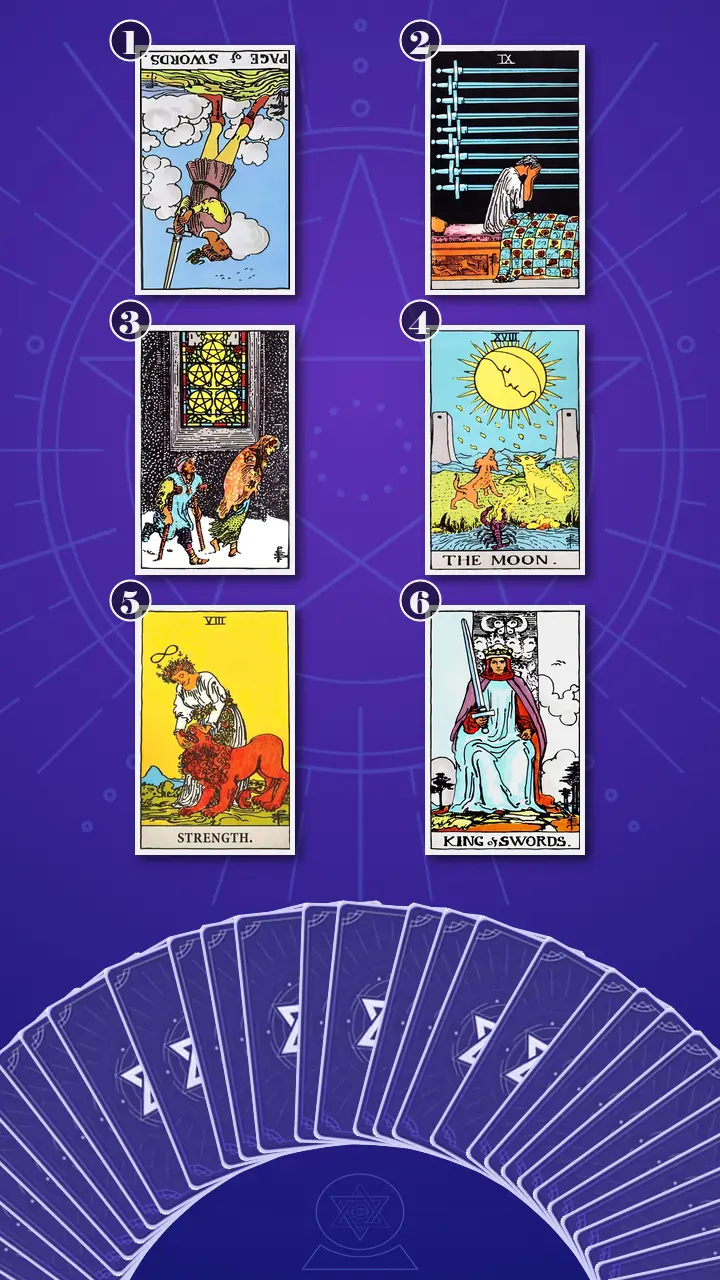
I previewed the structure for her (and, really, for anyone reading this who’s wondered how tarot works in real life): the first card shows the immediate “missed call ritual.” The middle cards reveal what ancient part of you is getting poked. And the final row is the exit: the inner shift and one practical move—clear communication or a boundary—that stabilizes you.
Reading the Map: From Surveillance to Fog
Position 1: Surface reaction — Page of Swords (reversed)
“Now we turn over the card that represents your surface reaction: the specific, observable way you respond right after the missed call.”
The Page of Swords, reversed.
I didn’t need to reach for anything esoteric. This card lives in Jordan’s daily micro-behaviours. “Right after the missed call,” I said, “you put your phone face-up like it’s evidence, keep one AirPod out ‘just in case,’ and start a silent investigation: WhatsApp thread open, timestamps checked, your last message reread for tone, then three drafts written and deleted because none of them sound perfectly chill.”
Reversed, the Page’s Air energy isn’t clarity—it’s hypervigilance. Too much scanning, too much forecasting. The Page becomes The Watcher: quick, sharp, and—under stress—stuck in surveillance mode.
In my mind I saw it the way my archaeological teams used to watch a storm front move in over a dig site: everyone staring at the horizon as if staring could change the weather. That’s what this does. It treats your phone like an airplane cockpit dashboard in turbulence—staring harder at the instruments doesn’t clear the sky.
I said it plainly, because she needed plain. “Check → interpret → rewrite → freeze. Control versus connection.”
Jordan let out a sharp exhale and nodded immediately, like she’d been caught mid-scroll. “It’s so embarrassing,” she muttered. “I’m literally doing a full Sherlock Holmes on a chat thread.”
“You’re not ‘too much,’” I told her. “You’re trying to feel safe in fog.”
Position 2: Mental weather — Nine of Swords (upright)
“Now we turn over the card that represents your mental weather: the thought-loop, images, and assumptions your mind generates in the uncertainty gap.”
Nine of Swords, upright.
“Later—usually when you’re tired and alone—the missed call turns into a whole midnight documentary,” I said. “You’re in bed with the screen glow on your face, stomach tight, replaying the last week of messages like you’re looking for the exact frame where things went wrong.”
This is Air energy in excess, but it’s not useful thinking. It’s the kind of cognition that punishes. The card often looks like insomnia, but what it really is: a late-night courtroom with no new evidence.
“Your mind becomes the prosecutor,” I said, “rerunning the same case: Exhibit A, the missed call. Exhibit B, that one emoji they didn’t send. Exhibit C, ‘last seen’ at 22:14. And the verdict is always somehow guilty—you guilty.”
Jordan went quiet in that uncomfortable way that means the truth has landed. Her eyes dropped to the table, then flicked back to the card, as if rereading it might make it less accurate. Finally she said, “Yeah. It’s like I can’t rest until I know. And I never know.”
Position 3: Old fear — Five of Pentacles (upright)
“Now we turn over the card that represents the old fear: the deeper emotional wound being poked—what you’re trying to protect yourself from.”
Five of Pentacles, upright.
Here the reading dropped from the mind into the body. “Underneath the overthinking is a colder, older feeling,” I said. “Being on the outside of warmth, watching other people get chosen more easily. The missed call doesn’t register as ‘busy’—it hits like ‘I’m forgettable.’”
This is Earth energy in scarcity: not enough safety, not enough belonging. When that old wound is active, it makes perfect sense that Air panics and tries to manufacture certainty.
Jordan’s mouth tightened. She gave a small, bitter laugh. “That’s… kind of brutal.” Then softer: “But yes. It’s like I’m outside looking in.”
As an archaeologist, I’ve learned that the deepest layers aren’t dramatic—they’re persistent. This fear isn’t about one person on one Tuesday. It’s a strata you’ve walked over for years.
Position 4: Subconscious story — The Moon (upright)
“Now we turn over the card that represents the subconscious story: the hidden narrative or projection that makes the fear feel like facts.”
The Moon, upright.
“This is the fog-layer,” I said. “The part where you can know you don’t have enough information—and still feel convinced you can sense the rejection.”
I drew an invisible line down the centre of the table, like a historian dividing a primary source from a rumour.
Fact track: They missed one call.
Fog track: They’re pulling away. You embarrassed yourself. You should have played it cooler. This is going to end like it ended before.
“A missed call is data, not a verdict,” I said, and I watched her shoulders shift—just a few millimetres—as if her body was considering standing down.
To make it practical, I gave her the Moon’s exercise in the most London way possible: “Imagine you’re on the Tube platform, typing, then deleting. Give me three neutral explanations—one practical, one benign, one boring.”
Jordan blinked, then tried. “Practical: they’re in a meeting. Benign: their phone died. Boring: they called by accident.”
That tiny loosening came—a quiet “oh… I’m telling myself a story” feeling—without any forced positivity. Just widened possibility.
When Strength Tamed the Lion in the Kitchen Light
Position 5 (Key Shift): Strength (upright)
I paused before turning the next card. The room felt suddenly still, the way a library goes quiet when someone reaches the end of a sentence that matters.
“Now we turn over the card that represents the key shift: the inner capacity that helps you tolerate ambiguity without abandoning yourself.”
Strength, upright.
Jordan’s default strategy has been to outthink her nervous system. Strength asks for something more courageous: to stay with the feeling without obeying it. “Instead of trying to outthink the panic,” I said, “you practice staying with it. You notice the jaw locked, the chest tight, the urge to send a second text—and you choose the gentle power move: soften, breathe, hold your dignity steady.”
As a professor, I can’t help but use time as a lens. One of my core tools is what I call Emotional Historiography: reading relationships through time, not through one dramatic moment. “Strength is asking you to judge this connection like a historian,” I told her, “not like a panicked journalist chasing a breaking headline. One missed call is not a whole era. You’re allowed to wait for pattern to emerge.”
I watched Jordan in the exact place the spread predicted: 8:47 p.m., overhead light too bright, phone face-up like a tiny stage—one missed call, and her body braced as if something bad already happened. She was trapped between ‘I need to be chill’ and ‘I need to feel safe.’
Stop trying to win control through overthinking, and start building quiet inner strength—the gentle lion-taming that keeps your dignity intact even when the phone stays silent.
There was a visible reaction chain—three steps, quick but unmistakable. First, a brief freeze: her breath caught, and her fingers stopped moving like someone had paused a video mid-frame. Second, the cognition seeped in: her gaze went slightly unfocused, as if an old memory replayed—the other times silence arrived with no explanation, the way she’d tried to “behave correctly” to prevent it. Third, the release: her shoulders dropped, and she exhaled a little shakily through her nose, like her body had been holding a door shut and could finally stop pushing.
“But if I stop doing that,” she said, and there was a flash of anger under the vulnerability, “doesn’t that mean I’ve been… wrong? Like I made this whole thing up?”
I kept my voice steady. “It means you were trying to survive in low light,” I said. “That’s not stupidity. That’s adaptation. Strength isn’t humiliation; it’s an upgrade.”
Then I offered the reset as a ten-minute excavation—layer by layer, artefact by artefact—so she could feel the difference, not just understand it:
(1) Write one sentence of fact: “They missed one call.” (2) Write one sentence of fear-story: “This means I’m not wanted.” (3) Put a hand on your chest, unclench your jaw, and take 6 slow breaths (longer exhale). (4) If you still want to text, send one bounded line (no edits after 60 seconds), then turn on Do Not Disturb for 45 minutes and do one offline task (shower, dishes, short walk). If you feel more activated while doing this, you can stop at any point—your only job is to come back to your body, not to ‘get it right.’
I leaned in slightly. “Now—with this new lens—think back to last week. Was there a moment when the urge hit, and if you’d done this, you would’ve felt even five percent more steady?”
Jordan swallowed. “Sunday night,” she said. “I rewrote a text for forty minutes. Forty.” Then, quieter: “I could’ve… just sent one normal line. And gone and taken a shower.”
That was the turning point: not from anxious to fearless, but from abandoning herself in ambiguity to staying kind and steady long enough for reality to show up.
Position 6: Grounded next step — King of Swords (upright)
“Now we turn over the card that represents the grounded next step: one clear communication or boundary move aligned with self-respect rather than panic.”
King of Swords, upright.
“This,” I said, tapping the card gently, “is Air restored. Not surveillance Air. Not courtroom Air. Clean Air.”
I gave her the modern-life translation exactly as her nervous system needed it: “One clean, respectful line that doesn’t hint, test, or audition for approval. Something like: ‘Hey—saw I missed your call. Free after 7 if you want to try again.’ Then you stop monitoring and let consistency over time be the data.”
Jordan’s eyes flicked up. You could see the impulse to screenshot the wording, to cling to something simple.
“Clean words beat perfect timing,” I added. “And here’s the part people miss: the boundary isn’t for them. It’s for the part of you that thinks you have to stay on-call to be chosen.”
From Fog to Facts: Actionable Advice You Can Actually Do
I drew the story back together for her, the way I’d reconstruct a site report: the sequence matters.
“Here’s what I see,” I said. “A missed call triggers the Page of Swords reversed—your immediate ‘digital surveillance’ ritual. That spirals into the Nine of Swords, where your mind runs a late-night trial with you as the defendant. Underneath, the Five of Pentacles is the real engine: an old fear of being outside warmth, being forgettable, being the one not chosen. The Moon then paints shadows onto silence and convinces your body those shadows are facts. Strength interrupts the jump—meeting the fear in your body with steadiness. And the King of Swords finishes it with clean, bounded communication.”
The cognitive blind spot was clear: Jordan believed overthinking was the price of not being hurt—like certainty could be earned through enough monitoring. The transformation direction was equally clear: regulate first, then choose one clear, time-bound action.
To make it concrete, I offered her a simple version of my Pictogram Dialogue strategy—because when you’re activated, long explanations become another maze. We reduce it to a few symbols on a sticky note: [FACT] [STORY] [BODY] [WORDS]. No essays. No negotiating with the fog.
- The Fog-to-Facts NoteOpen your Notes app and write two lines: [FACT] “They missed one call.” Then [STORY] “This means I’m not wanted.” Read both once, out loud, and stop there.If you feel the urge to add a third line, that’s the cue to pause—two lines only. You’re naming the pattern, not building a case.
- The 20-Minute Message WindowSet a 20-minute timer. You can draft one message, but when the timer ends you choose one version and send it—or choose not to send. No editing after 60 seconds once you’ve picked a line.Expect resistance like “but what if I miss something important.” You’re not banning your phone—you’re delaying compulsion. If 20 feels big, do the 5-minute version.
- Clean Words + 45 Minutes of QuietSend one King-of-Swords line: “Hey—saw I missed your call. Free after 7 if you want to try again.” Then turn on Do Not Disturb for 45 minutes and do one offline anchor task (shower, dishes, or a short walk to the corner shop).If you catch yourself rereading the thread, say once: “I’m in surveillance mode,” put the phone face-down for five minutes, and return to the task.

A Week Later: The Quiet Proof
Five days later, Jordan messaged me—not a paragraph, not a thesis, just a small report from the field. She’d missed another call from the same person. She did the two-line Notes split. She sent one clean text. She put her phone on Do Not Disturb and washed the dishes while the kettle boiled. “I still felt wobbly,” she wrote, “but I didn’t spiral.”
That’s what a Journey to Clarity usually looks like: not a dramatic transformation, but one moment where your dignity returns to your own hands.
We’ve all had that moment where a silent phone makes your chest go tight—not because you need a reply to survive, but because ambiguity pokes the old fear that being ignored means you don’t belong.
If you didn’t have to earn certainty by overthinking tonight, what’s one small way you could stay on your own side for the next 45 minutes?
This story is adapted from psychological research, written so that those in a similar struggle can see their own pattern in it — and find their next step clearly.These insights are not a substitute for professional psychological, medical, legal, or financial advice.
Learn more about our Journey to Clarity.
How did this insight land for you?
🫂 This Resonates Deeply
🌀 Living This Story
✨ Now I See Clearly
🌱 Seeing New Possibilities
🧰 Useful Framework
🔮 The Confirmation I Needed
💪 Feeling Empowered
🚀 Ready for My Next Step
Author Profile
 AI
AI“Having spent a lifetime at Cambridge and on archaeological digs, I’ve witnessed the rise and fall of countless civilizations. Please know that your current struggles are not a permanent fate, but merely a necessary fracture before rebuilding. I won't lecture you; instead, I invite you to sit with me in the ruins, using a patient, historical perspective to gently dust off the true, enduring value hidden beneath your temporary doubts.”
In this Love Tarot Reading :
Core Expertise
Service Features
Also specializes in :
Explore Related Patterns:
Anxious AttachmentJordan's missed-call reaction is not just about a phone notification; it is about how quickly a small gap in contact becomes a threat to being chosen. The phone stays face-up, one AirPod stays out, and the chat thread becomes something to monitor because the silence feels relational, not neutral. The deeper mechanism is an attachment alarm. You are not simply wanting a reply; you are trying to restore felt connection before the old fear of being forgettable can take over the room. That is why one missed call can feel like a relationship referendum even when the actual data is still thin. Anxious Attachment fits this story because the nervous system treats ambiguity as danger and pushes for immediate certainty through scanning, drafting, and staying emotionally on-call. The useful insight is not that your need for connection is wrong; it is that connection becomes harder to feel when fear turns every delay into proof of rejection.
CatastrophizingJordan names the escalation herself when she says one missed call feels like a relationship referendum. The actual event is small, but the mental forecast jumps from missed contact to pulling away, embarrassment, and an ending that repeats something painful from before. Catastrophizing is the mind's attempt to prepare for hurt by getting to the worst-case scenario first. In this story, it borrows emotional force from the older fear of being forgettable, so the imagined ending feels more convincing than the present facts. This pattern is not about being dramatic; it is about a protective system overestimating danger when connection feels uncertain. You start getting power back when you can identify the leap from data to disaster before it hardens into a verdict.
Certainty SeekingJordan's first move after the missed call is to chase certainty through thought. She refreshes WhatsApp, studies timestamps, rereads tone, and tries to make the unknown resolve before the other person has actually provided new information. Certainty Seeking works like a safety behavior: it promises relief if you can just find the right clue, the right wording, or the right interpretation. But the story shows the trap clearly: she cannot rest until she knows, and she never knows, because monitoring can multiply possibilities faster than it can confirm truth. This pattern matters because it reframes overthinking as an attempted self-protection strategy, not a character flaw. You are trying to earn safety through enough analysis, but the exit comes from tolerating a small amount of not-knowing long enough for real evidence to arrive.
Rejection SensitivityJordan hears one missed call as something colder than inconvenience. In the story, it does not land as 'they might be busy'; it hits like 'I'm forgettable,' with the old image of being outside warmth and watching other people get chosen more easily. That is the logic of Rejection Sensitivity: an ambiguous signal gets filtered through an older expectation of exclusion. The mind starts scanning for proof, the body tightens, and silence begins to feel like evidence before reality has had time to speak. This pattern answers the core question directly because the old fear underneath the overthinking is not just uncertainty; it is the fear that being missed means being unwanted. You regain clarity when you can name that fear as a trigger, not as a verdict.
Emotional ReasoningJordan knows, at one level, that one missed call is not enough information. But her tight chest, clenched jaw, shallow breathing, and urgent need to act make the feared rejection feel present before anything has actually been confirmed. Emotional Reasoning is the moment a feeling starts being treated like evidence. Because the body feels rejected, the mind begins to argue that rejection must be happening; then the phone, the timing, and the silence get recruited as supporting material. The pattern matters because the feeling is real, but its conclusion may not be. You do not have to dismiss the fear to regain clarity; you only have to stop letting body alarm become the final witness.
Assertive CommunicationJordan's grounded next step is not silence, chasing, or a perfectly engineered text. It is one clean line: saw the call, available after 7, try again if you want, followed by a clear stop to monitoring. Assertive Communication is the adaptive pattern because it protects connection and self-respect at the same time. The message does not hint, test, or audition for approval; it gives accurate information without handing the entire nervous system over to the reply. This matters because the old loop makes communication performative under pressure. You move out of the spiral when your words become bounded, direct, and proportionate to the facts.
Self-AbandonmentJordan's body reacts to the missed call with an urgent need to do something right now. The deeper pressure is not just to send a text; it is to leave her own steadiness behind and organize herself around the possibility of being chosen. Self-Abandonment appears in the story as staying emotionally on-call, monitoring for signals, and letting ambiguity pull her away from her own body, timing, and dignity. The other person's silence becomes the center, while her own regulation becomes secondary. The shift is subtle but important: she does not have to withdraw from connection to stay loyal to herself. She can send one clean line, step away from the phone, and let reality show up without sacrificing her inner ground.
Compulsive CheckingJordan's phone becomes the center of the room after the missed call. It stays face-up like evidence, WhatsApp becomes a live scoreboard, and each timestamp or thread reread looks like it might finally explain the silence. Compulsive Checking is the behavioral engine inside the spiral. The checking is meant to reduce uncertainty, but every refresh creates another opening for interpretation: why no reply, why that last seen, why that message tone, why this timing. The pattern is visible because the action repeats without delivering the safety it promises. You are not gathering meaningful new data; you are feeding a loop that turns a missed call into a surveillance ritual.
Control CopingJordan tries to outthink her nervous system as soon as ambiguity appears. Surveillance, interpretation, and message editing become the tools she reaches for because control feels like the fastest route back to safety. Control Coping is not simple control for its own sake; it is control as protection. In the story, the old fear of being forgettable makes uncertainty feel dangerous, so the mind attempts to manufacture safety through monitoring. The cost is that control starts competing with connection. You may feel temporarily busy, alert, and prepared, but the inner system remains braced because control cannot create the relational certainty it is trying to guarantee.
Emotional RegulationJordan's shift begins when she notices the locked jaw, tight chest, shallow breathing, and urge to send another text without immediately obeying the alarm. The story gives her a body-based pause before the phone becomes the whole battlefield. Emotional Regulation is the mechanism that lets her stay with ambiguity without collapsing into surveillance or self-blame. The fact-story split, slow breathing, Do Not Disturb, and one offline task all create enough space for the nervous system to come down before a choice is made. This pattern is not about becoming fearless. It is about building enough steadiness that fear no longer gets to be the only voice in the room.
Reality TestingJordan's clearest tool is the split between fact and story. The fact is that they missed one call; the story is that she is not wanted, they are pulling away, or this will end like it ended before. Reality Testing gives the mind a way to respect fear without letting fear rewrite the evidence. By naming neutral explanations and stopping at two lines, she widens the frame without forcing herself into false positivity. This is why the exercise works: it does not argue with the wound, but it does stop the wound from becoming the only narrator. You get a cleaner view of what is known, what is guessed, and what still needs time.
RuminationJordan's overthinking does not stop at the missed call. Later, in bed, she replays the last week of messages under the screen glow, searching for the exact frame where things went wrong even though no new evidence has appeared. Rumination turns reflection into repetition. The mind keeps rerunning the case, but the courtroom has no fresh data, so the loop produces guilt and threat rather than clarity. This pattern explains why thinking harder does not bring relief. You are not solving the situation anymore; you are rehearsing the fear until it feels increasingly familiar and therefore increasingly true.
Explore Related Struggles:
Monitoring-Safety FusionJordan puts the phone face-up like evidence, opens WhatsApp, checks timestamps, rereads the last message, then writes and deletes three versions of a simple text. The action is not random; it is the body trying to turn ambiguity into a dashboard it can control. The friction is that the monitoring is meant to create safety, but it keeps her locked to the same silence. You can feel the split between wanting clear connection and trying to earn it by staying on-call, alert, and perfectly worded. Monitoring-Safety Fusion fits because the story shows safety getting attached to surveillance. The more the phone is watched, the less space there is for reality to arrive on its own timeline, and the old fear keeps borrowing the screen as proof.
Chosen-Worth BindUnder the missed call, Jordan names a colder layer: it hits like "I'm forgettable," like standing outside warmth while other people are chosen more easily. A small contact gap becomes bigger than the call itself because it touches belonging, not scheduling. The bind is not simply wanting a reply; it is the way being chosen starts to feel like evidence of worth. You can be rational enough to know one missed call has neutral explanations and still feel your value being placed on trial by silence. Chosen-Worth Bind fits because the story keeps turning response into referendum. The old fear is that not being answered equals not being wanted, and clarity begins when that fear is seen as an old equation rather than a present-day fact.
Evidence DisconnectionThe reading separates the fact track from the fog track: the fact is that they missed one call; the fog says they are pulling away, you embarrassed yourself, and the ending is already repeating. Jordan can name the lack of information and still feel the rejection as if it has arrived. The friction lives in the gap between data and meaning. Your body reacts to the story built around the event, while the event itself remains small, unfinished, and open to several boring explanations. Evidence Disconnection fits because the story shows interpretation outrunning evidence. The useful shift is not forced positivity; it is learning to keep facts and fear-stories in separate lanes long enough for real information to appear.
Inner Tribunal LockLater, Jordan is in bed with the screen glow on her face, replaying the last week of messages and searching for the exact frame where things went wrong. The missed call, a missing emoji, and a timestamp become exhibits in a case with no new evidence. The lock forms when thinking stops gathering clarity and starts prosecuting the self. You are not just wondering what happened; you are forced into defending your own worth against a verdict the silence never actually delivered. Inner Tribunal Lock fits because the overthinking in the story has a courtroom structure. Every detail is reorganized into accusation, and the way out starts with recognizing that a mental trial is not the same thing as truth.
Explore Related Emotions:
Ambiguity DreadAt 8:47 p.m., one missed call leaves almost no reliable information, yet Jordan's mind starts filling the empty space with pulling away, embarrassment, and this is going to end like before. She can know there is not enough data and still feel the unknown hardening into an answer. You are not reacting to silence alone; you are reacting to the space where silence can become anything. Ambiguity Dread names the pressure of that open gap, where waiting feels unsafe because the mind wants a conclusion before reality has had time to arrive.
Certainty HungerJordan says she cannot rest until she knows, and then says she never knows. That is why the loop keeps restarting: check the timestamp, reread the tone, rewrite the message, delete it, and try again to force the unknown into something solid. You are reaching for certainty because uncertainty feels too physically loud to sit beside. Certainty Hunger names the ache for a clean answer, not because you lack intelligence, but because the body wants proof of safety before the other person has actually provided any new data.
Fear of Being ForgottenThe old layer in Jordan's reading is not dramatic; it is persistent. The missed call does not register as someone being busy, it hits like being outside warmth, watching other people get chosen more easily, and hearing the line that she is forgettable. You may overthink because the silence touches the fear that you disappear from someone's mind when you are not actively being held there. Fear of Being Forgotten captures the deeper ache beneath the phone checking: the worry that if contact drops for even a moment, your place in the connection drops with it.
Rejection ChillThe extractor fan is humming, the takeaway is cooling, and the phone sits on the table like a tiny witness stand. In that ordinary kitchen light, the missed call does not feel neutral; it cools the room and makes the connection feel suddenly less reachable. You are feeling the cold drop that happens when a gap in contact lands as possible rejection before the facts are in. Rejection Chill names that instant relational temperature shift, where silence brushes the old place that says being missed means being unwanted.
Verdict DreadJordan calls the missed call a relationship referendum, and later the bed becomes a late-night courtroom: screen glow on her face, stomach tight, last week of messages replayed for the exact frame where things went wrong. The mind gathers tiny exhibits and somehow makes her the defendant. You are not just waiting for a reply; you are waiting for a verdict about whether you are wanted, too much, or already losing the connection. Verdict Dread names the inner weather where ambiguity feels like judgment pending, and every small detail gets pulled into the case.
Hard-Won ComposureStrength does not ask Jordan to stop feeling the tight chest, locked jaw, or urge to send a second text. It asks her to stay with those sensations without obeying them, then move through one grounded sequence: fact, story, body, words. Five days later, the same person misses another call and Jordan still feels wobbly, but she does not spiral. Hard-Won Composure names that earned steadiness, the kind that exists while the body is still activated and becomes real through one bounded action at a time.
Quiet Self-RespectThe King of Swords moment gives Jordan one clean line: saw I missed your call, free after 7 if you want to try again. No hinting, no testing, no auditioning for approval, and then the phone goes on Do Not Disturb while she returns to an ordinary task. You make contact without handing over your dignity to the reply. Quiet Self-Respect names the calm edge that appears when communication stays clear and your inner space is not left open for the other person's timing to occupy completely.
Self-Audit AnxietyJordan rereads her last message for tone, writes three versions of Hey, all good, and deletes them because none sound perfectly chill. The focus slides away from the missed call and onto her own performance: wording, timing, tone, and whether she has exposed too much need. You are auditing yourself as if the right version of you could prevent distance from happening. Self-Audit Anxiety names that inward surveillance, where the mind inspects every sentence for evidence that you caused the silence or could still repair it by sounding more composed.
Standby Mode AnxietyJordan keeps one AirPod out just in case, leaves the phone face-up, and stays mentally available for the next signal. Even when she is not sending a message, part of her attention is still pledged to the possibility of being contacted. You are not simply waiting; you are keeping yourself on standby, as if being instantly reachable could protect your place in the connection. Standby Mode Anxiety names the wired, suspended feeling of living beside the phone because some part of you believes availability is the price of being chosen.
Hypervigilant AnxietyJordan puts the phone face-up like evidence, refreshes WhatsApp, checks timestamps, rereads tone, and keeps her body braced with a tight chest and clamped jaw. The missed call stops being one small event and becomes a live dashboard she feels she has to monitor. You are trying to create safety by scanning harder, but the scanning keeps the body on alert. Hypervigilant Anxiety names that keyed-up inner weather where every tiny signal feels like it might settle the whole connection, so the nervous system keeps watching even when there is no new information.
Explore Related Contexts:
Digital Snooping SpiralJordan keeps the WhatsApp thread open, checks timestamps, rereads the last message for tone, and writes then deletes three versions of 'Hey, all good?' The phone stops functioning as a communication tool and becomes an evidence board where every small digital trace gets recruited into the case. In Digital Snooping Spiral, the platform gives you just enough visibility to keep checking, but not enough context to settle anything. Last-seen times, drafts, and message history create an illusion of control while the actual exchange remains stalled. The exit is not pretending the urge is irrational; it is changing the rules of contact. One clean line, no repeated edits, and a block of time away from the thread turn the phone back into a tool instead of a courtroom.
Relationship Hypervigilance LoopJordan calls the missed call a 'relationship referendum,' then later describes replaying the week of messages in bed, searching for the exact frame where things went wrong. The external event is tiny, but the relationship field around it becomes loaded with possible rejection, approval, and loss of position. In that loop, every cue asks for inspection, including tone, emoji absence, last-seen status, and whether a second text would look too much. You end up working harder to monitor the connection than to participate in it, which keeps you close to the screen and far from stable evidence. The old fear may be real in your history, but the current situation still deserves present-tense data. Waiting for consistency over time lets you read the connection through behavior instead of letting one ambiguous signal take over the whole story.
Response Time PressureJordan sees one missed call at 8:47 p.m., places the phone face-up like evidence, and starts refreshing WhatsApp as if the timing itself can answer the relationship question. The missed call becomes less about the call and more about the social expectation that a meaningful person should be trackable, prompt, and legible through a screen. That pressure turns a small gap in communication into a demand for instant interpretation. You are not just waiting for a reply; you are being pulled into the modern response-time economy, where timestamps and silence can start to feel like social data even when they are thin evidence. The useful frame is that timing is a weak signal until it becomes a pattern. A bounded message and a deliberate pause protect your agency from a system that rewards constant checking but rarely gives real clarity faster.