Spiraling After the “k” Text at 8:46 p.m.
If you can run a whole meeting at work but a single “k” text makes you spiral like you’re back in middle school, welcome to emotional time travel.
Jordan sat down across from me like she’d been holding her breath since the notification hit. She’s 28, Toronto, corporate hybrid job—one of those people who can sound calm and polished on a client call and then absolutely unravel in the quiet afterwards.
She described it so clearly I could see it: 8:46 p.m. on a Tuesday in her condo, still in work clothes. The kitchen light is too bright—clinical, unforgiving. Her phone glows in her palm like a tiny spotlight. She opens iMessage and there it is: one lone “k.” The glass is warm against her thumb from how often she’s checked it.
“I scroll up,” she said, voice tight. “I reread my own text like it’s evidence. I draft three replies in Notes. I put my phone face-down like it’s radioactive. Then I pick it up two minutes later. It’s literally one letter and I’m acting like my whole personality got rejected.”
I watched her swallow hard, the way people do when their throat is trying to close around embarrassment. Shame has a very particular sound to it—like a song turning down to a whisper because you don’t want anyone to hear you caring.
What she wanted was simple: to be understood, to be taken seriously, to feel like she mattered in the conversation. What she feared was just as loud: that if she asked for more than “k,” she’d look needy and get dismissed.
“Let’s not treat this like you’re ‘overreacting,’” I told her gently. “Your body is having a real reaction. Our goal today is clarity—so you can respond from your adult self, not from the part of you that feels thirteen and exposed.”

Choosing the Compass: The Four-Layer Insight Ladder for Text Anxiety
I asked Jordan to take one slow inhale, then an even slower exhale—nothing mystical, just giving her nervous system a signal that we weren’t in an emergency. While she breathed, I shuffled.
“For this,” I said, “I’m going to use a spread I call the Four-Layer Insight Ladder · Context Edition.”
And for you reading along: this is a tarot spread for overthinking texts and tone—not because tarot can magically decode what someone ‘really meant,’ but because it can map the trigger-response loop that makes a dry reply feel like a verdict.
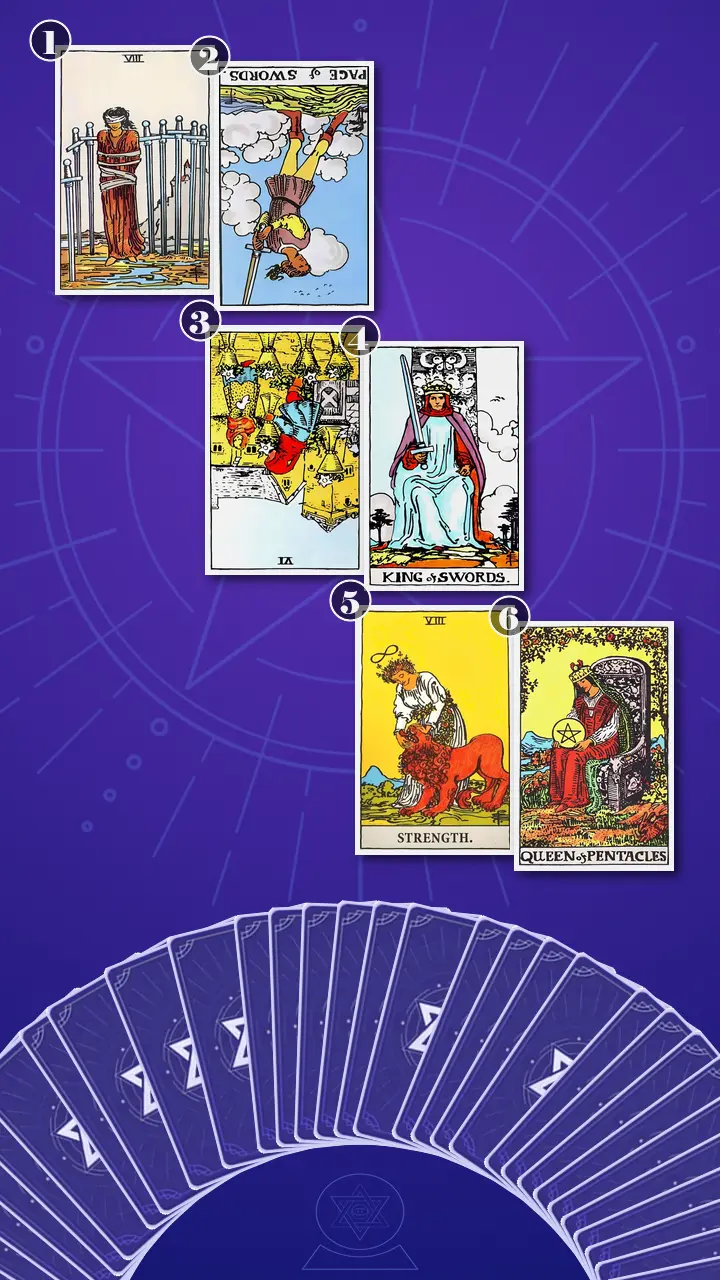
The Ladder is compact—six cards in a 2×3 grid—so we don’t get lost in a hundred possibilities. It’s built to move through: (1) your immediate autopilot, (2) the story you attach, (3) the older template underneath (why you feel 13 again), (4) a reality-check lens (facts vs guesswork), (5) the key inner shift, and (6) one grounded next step you can actually do this week.
“We’ll read it like walking down stairs,” I told Jordan. “From the phone screen back into your body and your life.”
Reading the Ladder: When a Chat Thread Turns Into a Courtroom
Position 1 — The immediate reaction pattern
“Now flipping over,” I said, “is the card that represents the immediate, observable reaction pattern after the ‘k’ text—what you do and how your mind clamps down.”
Eight of Swords, upright.
The image is blunt: a blindfold, a loose binding, and a circle of swords that looks like a fence—but not a locked one. I told her exactly what I saw in modern terms: the couch after a demanding hybrid workday, the phone glow, the hovering hands, every reply feeling like a trap. Too chill means you accept disrespect. Too direct means you’re “needy.” No reply means you’re “pathetic.”
“The actual bind isn’t the text,” I said. “It’s the belief that there’s no move that keeps your self-respect intact.”
Energetically, this is blockage: Air energy (thought) tightening into a corridor so narrow you forget you can step sideways. The Eight of Swords isn’t ‘no options.’ It’s ‘options feel unsafe because your mind is trying to prevent rejection at all costs.’
Jordan gave a small, bitter laugh—one sharp exhale that sounded like relief and offense at the same time. “That’s… so accurate it’s kind of rude,” she said. Then her jaw clenched again, like her face wanted to hold the line against being seen too clearly.
I nodded. “If you’re drafting in Notes, your nervous system thinks it’s in danger. Not because you’re dramatic—because you’re trying to protect dignity.”
Position 2 — The story you’re attaching to “k”
“Now flipping over,” I said, “is the card for the interpretation story you’re attaching to the message—the tone-reading, assumptions, and mental loop.”
Page of Swords, reversed.
Reversed, the Page’s sharp curiosity turns into over-vigilance. I described it the way Jordan lived it: becoming a human notification system. Refreshing iMessage. Checking if they’re active. Zooming in on punctuation like it’s a clue. Screenshotting the thread for group chat “message forensics” like everyone’s about to debate it like a case.
“This is you treating the text thread like a courtroom transcript,” I said. “Trying to win a case instead of having a relationship.”
Energetically, this is excess and distortion: too much mental scanning, not enough direct connection. It’s certainty-hunting—because certainty feels safer than asking. But it costs you trust in yourself.
Jordan winced and smiled at the same time, like she’d been caught doing something she hates that she can’t stop doing. “I literally checked their Instagram Story views,” she admitted. “Like… what am I doing with my life?”
“You’re trying to avoid embarrassment,” I said. “Your brain is serving you the same anxiety content like an algorithm feed: the more you click ‘what did they mean,’ the more it serves you tone-decoding and worst-case narratives.”
Position 3 — The root of “feeling 13 again”
“Now flipping over,” I said, “is the card for the deeper root beneath the present chat—the older relational template that’s getting activated.”
Six of Cups, reversed.
There’s a tenderness in this card even when it’s reversed. I told Jordan what it often means in situations like hers: it’s not that she’s reacting to one person’s one-letter reply. She’s reacting to a familiar pattern—being brushed off, made small, treated like her reaching out was inconvenient.
“This is emotional time travel,” I said. “Your adult life is happening, but a 13-year-old part of you is quietly steering.”
I described it as a split-screen, because that’s how it truly feels. On one side: adult Jordan on a Toronto couch, condo quiet-loud, phone in hand. On the other side: younger Jordan, cheeks hot, throat tight in that middle-school hallway way—trying to act chill while wanting someone to turn back and say, ‘No, I’m here. I heard you.’ Same body sensations, same shame about wanting care.
Jordan went still. Her hands stopped fidgeting for the first time since she walked in. Her eyes softened, not in a dramatic way—more like the muscles around them got tired of bracing.
“I hate that it’s true,” she whispered. “I feel embarrassed for caring. And then I get mad that I’m embarrassed.”
“That makes sense,” I said. “Six of Cups reversed often shows the swing: wanting warmth, then punishing yourself for wanting it.”
Position 4 — The reality-check lens (knowable vs unknowable)
“Now flipping over,” I said, “is the card for a reality-check lens: what’s knowable vs unknowable, and what a self-respecting adult conversation would require.”
King of Swords, upright.
Sometimes a card lands like a clean edit in a film. The King doesn’t guess. He doesn’t plead. He separates signal from noise.
“A one-letter text can sting,” I told her, “but it doesn’t get to set the price of your self-worth.” Then I added one of my favorite reality-check lines: “A one-letter text is not a referendum on your worth.”
I offered Jordan a literal “cut to facts” list, like a producer’s note when a segment is running long:
Knowable: they texted ‘k.’
Unknowable: their mood, their intent, whether they were distracted, whether they’re low-effort in general, whether they’re annoyed, whether they’re emotionally available.
“This King energy brings balance,” I said. “It returns choice. It turns mind-reading into a direct question.”
I gave her a one-sentence script, because King of Swords communication boundaries work best when they’re clean: “When you said ‘k,’ what did you mean by that?”
Jordan’s posture changed—subtle, but real. She sat up like her spine remembered it had a job. “That’s… so much simpler,” she said, and her voice sounded closer to her age.
“Clarity is not neediness,” I said. “It’s adult communication.”
Position 5 — The turning point (key inner shift before you reply)
“Now flipping over,” I said, and I let the moment slow down, “is the card that represents the key inner shift that breaks the spiral—the turning point energy.”
Strength, upright.
The room felt quieter, the way it does right before a song drops into its chorus—when you can sense the emotional center arriving. Strength isn’t about being unbothered. It’s about holding what you feel without letting it drive the wheel.
Setup: Jordan was stuck in that exact couch moment: phone buzzing, seeing “k,” throat tightening like a school hallway, and her brain running a full message autopsy—because if she could craft the perfect reply, maybe she could avoid being dismissed.
Stop letting a one-letter text decide your worth; choose gentle self-control instead, like Strength calmly holding the lion.
She froze first—breath caught high in her chest, fingers hovering as if she could still feel the invisible keyboard. Then her gaze unfocused, like she was replaying a dozen old scenes at once: the way she’d tried to be “cool,” the way she’d swallowed questions to avoid being “too much,” the way she’d punished herself for wanting warmth. Then the release came—small but unmistakable. Her shoulders dropped. Her jaw unclenched in a slow, tired way. Her eyes went glassy, not with drama, but with recognition.
“But if I’m gentle… I’m scared I’ll collapse,” she said, voice thin on the last word. “Like I’ll just… accept anything.”
“That’s the misconception Strength corrects,” I told her. “Strength is softness without collapse. It’s firmness without aggression. Don’t become colder or louder—become steadier.”
This was the bridge—the shift from shame-driven emotional time travel and compulsive text overanalysis to steadier self-worth and clear, boundaried communication. The lion is the spike of shame and panic. The calm hand is your adult self saying, ‘I can feel this and still choose my next move.’
Because I work with sound for a living, I added my own diagnostic lens—my Melodic Mirror. “When you spiral,” I asked, “what do you listen to? Not what you should listen to—what you actually put on.”
Jordan blinked, surprised. “Honestly? Like… sad-girl playlists. And then angry ones. Like I’m trying to pick an emotion and live there.”
“Exactly,” I said. “Your playlist is your nervous system speaking in rhythm and lyrics. Tonight, before you reply, we’re not going to debate your worth. We’re going to lower the emotional BPM first.”
I slid her a simple reset—ten minutes, phone face-down, one hand on chest, inhale for four, exhale for six. Then one line in Notes: “Fact: they texted ‘k.’ Story my brain made: ____.” Then choose one move: ask for clarity, pause until tomorrow, or disengage. “If your body gets more activated,” I added, “you’re allowed to stop and do something grounding. You’re not required to push through.”
Then I asked the question that turns insight into lived reality: “Now, with this new lens—can you think of a moment from last week when that one sentence would have changed how you felt?”
Jordan nodded slowly. “Friday,” she said. “I literally wrote a paragraph. Then deleted it. Then sent something sharp. I could’ve… paused. I could’ve asked one clean question. I didn’t have to audition for respect.”
Position 6 — Integration (a grounded next step this week)
“Now flipping over,” I said, “is the card for what you can do in the next week—a boundary, routine, or message style that supports secure communication.”
Queen of Pentacles, upright.
The Queen is the opposite of a night sacrificed to a chat bubble. She’s dinner. Water. Sleep. The steady choice to invest attention where it’s reciprocated.
“This is you making self-respect tangible,” I said. “Your evening doesn’t belong to a chat bubble.”
Energetically, it’s grounding: Earth after the Air spiral. Not a power play—an anchored life. The Queen doesn’t chase low-effort communication. She returns to her own stability and lets people show, through consistent behavior, whether they can meet her baseline.
From Insight to Action: A One-Sentence Text and a 10-Minute Reset
I leaned back and stitched the whole spread into one story Jordan could carry out of the room.
“Here’s the arc,” I said. “The Eight of Swords shows the trap: one letter makes you feel like there’s no safe move. The Page of Swords reversed shows how you try to escape—by turning into a detective, building a case, monitoring for certainty. The Six of Cups reversed explains why it hits so hard: it’s not just today, it’s an older ‘dismissal’ template waking up. The King of Swords cuts through it with facts vs stories. Strength regulates the shame spike so you can choose—without going cold or exploding. And the Queen of Pentacles turns it into a lifestyle boundary: you protect your time, your attention, your night.”
“Your cognitive blind spot,” I added, “is that you keep treating clarity like something you have to earn by being perfectly chill. But the transformation direction is the opposite: ground your self-worth first, then ask for what you need directly. That’s how you stop mind-reading texts and start communicating like an adult.”
Then I gave her the smallest possible next steps—practical, low-drama, doable even when you’re activated.
- The 10-Minute Phone Face-Down ResetTonight (or next time you get a dry reply), put your phone face-down and set a 10-minute timer. One hand on your chest; inhale for 4, exhale for 6, repeat five times. Write one line in Notes: “Fact: ____. Story: ____.”If 10 minutes feels impossible, do the “2-minute version.” The goal is turning the volume down 10%, not deleting the feeling.
- The King of Swords One-Sentence Clarity AskSend one clarifying question (not a speech): “When you said ‘k,’ what did you mean by that?” Then stop. No apology tour. No second message to soften it.If you feel tempted to add a paragraph, that’s your cue to pause—clarity works best when it’s clean.
- The Queen of Pentacles “Phone Is Not the Night” RoutineThree nights this week: dinner → shower → 10-minute walk/stretch → then check messages once. If a thread starts to spike you, mute it for 12 hours.Make it stupidly small on purpose. You’re training your attention to come back to your life, not to the chat bubble.
And because my work always comes back to sound, I added one more tool from my practice—my Emotional BPM strategy. “Before you text,” I said, “put on one song that slows your body down. Not your ‘breakup anthem.’ Not the rage track. Something steady, around a walking tempo. Let your breath sync to it. Then decide.”

A Week Later: Ownership, Not Certainty
A week later, Jordan texted me—short, almost casual, like she didn’t want to jinx it: “Got a dry reply. Did the 10 minutes. Sent the one sentence. Didn’t add a paragraph. I felt like an adult.”
She told me she’d eaten dinner before checking her phone. She’d muted the chat overnight when it started to spike her. In the morning, she still had that flicker of “what if I messed it up?”—but she noticed it, exhaled, and didn’t sprint back into the thread like it was a fire.
That’s what a real Journey to Clarity looks like. Not perfect confidence. Not psychic certainty about what “k” means. Just steadier self-trust—enough to choose your next move without abandoning yourself.
When a single “k” makes your throat go tight and your brain start bargaining for dignity, it’s not because you’re dramatic—it’s because you want to be taken seriously and you’re terrified that asking for that will get you dismissed.
If you didn’t have to prove you’re “chill” tonight, what would one small, adult-you move toward clarity or self-respect actually look like—one sentence or one pause?
This story is adapted from psychological research, written so that those in a similar struggle can see their own pattern in it — and find their next step clearly.These insights are not a substitute for professional psychological, medical, legal, or financial advice.
Learn more about our Journey to Clarity.
How did this insight land for you?
🫂 This Resonates Deeply
🌀 Living This Story
✨ Now I See Clearly
🌱 Seeing New Possibilities
🧰 Useful Framework
🔮 The Confirmation I Needed
💪 Feeling Empowered
🚀 Ready for My Next Step
Author Profile
 AI
AI“Through ten years of sound energy research, I’ve found that when we struggle, it's usually just our internal rhythm falling out of sync under pressure. I know firsthand the frustrating helplessness of wanting to move forward but feeling paralyzed. Without overwhelming theories, I want to be the soothing background track that helps you recalibrate, turning your heavy burdens back into a light, effortless, and harmonious melody.”
In this Love Tarot Reading :
Core Expertise
- Communication Dissonance Audit: Diagnosing arguments not by the words spoken, but by the fundamental mismatch in emotional tempo and frequency.
- Reactive De-escalation Mapping: Identifying the specific 'high notes' of defensive anger that shatter the emotional safety of the connection.
Service Features
- The Syncopation Pause: A 3-second acoustic grounding technique to interrupt an escalating argument, lowering the emotional BPM before permanent damage is done.
Also specializes in :
Explore Related Patterns:
Anxiety SpiralJordan's scrolling, rereading, drafting, flipping the phone face-down, and picking it up again shows a full trigger-response loop built around one sparse message. The "k" is small, but her nervous system treats it like a social threat, so the mind starts moving fast to regain control. That is the core shape of an Anxiety Spiral: activation creates urgency, urgency creates more checking and interpretation, and each new mental pass makes the threat feel more real. You are not simply "thinking too much" here; the story shows a protective system trying to prevent rejection by scanning harder. The useful audit is that the spiral is not proof that the text contains a hidden verdict. It is evidence that ambiguity has hit an older shame point, and the next move has to begin with regulation before interpretation can become reliable again.
Assertive CommunicationJordan's practical next step is one clean clarifying question: "When you said 'k,' what did you mean by that?" The instruction not to add a paragraph, apologize, or soften the ask shows the boundary of the pattern: direct does not have to become dramatic. Assertive Communication fits because the goal is not to win, plead, decode, or perform indifference. It is to state the need for clarity in a way that respects both people while keeping Jordan connected to her own dignity. The deeper shift is that asking is no longer framed as neediness. You can want to be taken seriously and still communicate with restraint, which is very different from swallowing the question or turning it into a defensive speech.
Certainty SeekingJordan refreshes, monitors activity, checks Story views, and keeps returning to the thread because certainty feels safer than asking. The behavior is not random; it is an attempt to remove ambiguity before she risks direct communication. Certainty Seeking fits because the mind is trying to turn incomplete social data into a final answer. The problem is that digital micro-signals rarely provide the kind of certainty the nervous system wants, so every clue creates another opening for doubt. The story's reality-check lens is the antidote: knowable is "they texted k," while their intent, mood, distraction level, and emotional availability are not knowable yet. You regain power by admitting the limit of the data instead of forcing the thread to confess something it cannot prove.
Compulsive CheckingJordan's warm phone, repeated iMessage checks, Story-view monitoring, and two-minute return after putting the phone face-down show a checking ritual rather than a one-off reaction. The behavior is trying to make uncertainty tolerable by finding one more clue. Compulsive Checking fits because the relief it promises never holds. Each return to the thread gives the brain a new object to analyze, which restarts the loop and makes the lack of certainty feel even more unbearable. You can see the pattern clearly because the check is not neutral information gathering. It becomes a temporary self-worth audit, where the phone is treated as the place that can finally confirm whether you matter, whether you are too much, or whether you are safe to speak.
Emotional RegressionJordan can sound calm and polished on a client call, yet a dry reply at 8:46 p.m. pulls her into hot cheeks, a tight throat, and the feeling of being back in a middle-school hallway. The story presents this as a split-screen: adult life is happening, but an earlier relational template has been activated. Emotional Regression fits because the present trigger temporarily recruits an older state of self. The reaction is not childish; it is younger material coming online under stress, especially around dismissal, embarrassment, and the fear of wanting care too visibly. The point of naming the pattern is to return choice. When you can tell the difference between adult-you reading a text and younger-you bracing for humiliation, the next move can come from regulation and self-respect instead of from the part that feels exposed and desperate for reassurance.
Emotional RegulationJordan is given a concrete reset before she replies: phone face-down, slower breathing, one hand on her chest, and a facts-versus-story line in Notes. The sequence matters because the story does not ask her to solve the relationship while her body is still treating the text like an emergency. Emotional Regulation fits because the central shift is from being driven by the spike to being able to hold the spike. She can feel hurt, exposed, or embarrassed without letting those sensations write the next message for her. This is the upright version of the same trigger-response system: the emotion is still real, but it is no longer in charge of the steering wheel. You create enough internal space to choose between asking, pausing, or disengaging instead of reacting from panic or shame.
Mind ReadingJordan's mind turns one letter into a full theory about the other person's mood, intent, annoyance, and emotional availability. The story is explicit that these things are unknowable from the text itself, yet they become the center of the reaction. Mind Reading is the mechanism underneath that courtroom feeling. Instead of asking a clean question, the brain tries to infer the whole relationship from tone, timing, punctuation, and online behavior because direct clarity feels socially risky. The cost is that you start responding to a projected meaning rather than to the actual message. The adult move in the story is not to shame the sensitivity, but to separate fact from guesswork and let a direct question replace the invisible trial happening in your head.
Reality TestingJordan's King of Swords moment draws a clean line between what happened and what her mind added. The fact is that they texted "k"; the guesses about mood, intent, annoyance, distraction, and availability are not yet evidence. Reality Testing fits because it turns the thread from a courtroom into an audit. Instead of letting emotional reasoning treat a body reaction as proof, Jordan can check the data, name the unknowns, and ask one direct question. This pattern gives you a way to respect your sensitivity without surrendering to it. The feeling gets acknowledged, but the conclusion has to earn its place through facts, context, or clear communication.
Rejection SensitivityJordan says it feels like her whole personality got rejected, even though the observable event is only a one-letter reply. That gap matters: the intensity is not coming from the text alone, but from the meaning her system attaches to being met with so little. Rejection Sensitivity fits because the story keeps returning to the fear of being dismissed, brushed off, made small, or seen as needy for wanting more. The "k" becomes a signal that her reaching out might be inconvenient, and the body reacts before the adult mind can reality-check it. This pattern does not mean the need for care is unreasonable. It means the threat detector is calibrated around dismissal, so ambiguous communication gets processed as personal rejection unless you slow down and test what is actually knowable.
Self-SilencingJordan's fear is very specific: if she asks for more than "k," she might look needy and get dismissed. That fear makes her swallow questions, perform chillness, and edit herself before the other person has even answered a real ask. Self-Silencing fits because the core behavior is not simply pausing; it is muting a legitimate need for clarity to protect against shame. The defense is understandable, but it leaves the other person unasked and leaves Jordan alone with a thread full of guesses. The repair is not becoming louder or colder. It is allowing one clean sentence to exist without the apology tour, the paragraph, or the self-erasure that tries to make a basic need more acceptable.
Shame BindingJordan does not only feel hurt by the dry reply; she feels embarrassed for caring, then angry that she is embarrassed. That second layer turns a normal need for warmth into something she feels she has to hide, edit, or punish. Shame Binding fits because the desire to be understood gets tied to self-judgment. She wants clarity, but the moment she wants it, the shame story says she is being needy, too much, or not chill enough to deserve a direct answer. This is why the story's shift is so important: clarity is not something you earn through emotional performance. The pattern loosens when you can let the need exist without making it a character flaw, then choose a grounded response from that less-punitive place.
Explore Related Struggles:
Clarity-Exposure SplitJordan already has the clean adult sentence available: "When you said 'k,' what did you mean by that?" The difficulty is that clarity would expose the very thing she is trying to hide: that the reply mattered, that she wanted more care in the exchange, and that being brushed off would land somewhere tender. You can see the split between the simple action and the emotional cost attached to it. Asking a direct question would reduce guesswork, but it also risks revealing need. Staying in analysis protects you from that exposure, yet it leaves the other person's intent unknowable and lets the story keep expanding in your head. Clarity-Exposure Split is the core of the "what now" question. The next move is not about finding the perfect tone; it is about deciding whether you can let a direct ask be an act of self-respect rather than proof that you are too much.
Dignity-Belonging SplitJordan keeps moving between the phone and the pause: three drafted replies, the screen turned face-down, then the phone back in her hand two minutes later. The action looks small, but the bind is precise. One dry reply turns the next move into a test of whether she can stay connected without surrendering self-respect. You can feel the split in the options she names for herself. If you stay casual, it feels like accepting low-effort treatment. If you ask directly, it risks being labeled needy. If you say nothing, the silence starts to feel like proof that you did not stand up for yourself. The struggle is not the letter "k" itself; it is the way the thread makes dignity and belonging feel mutually exclusive. Dignity-Belonging Split fits because Jordan's real question is not only what to text next. It is how to keep wanting connection without auditioning for respect, and how to protect self-respect without turning the whole exchange into a defensive performance.
Low-Maintenance Worth LockJordan describes wanting a basic signal of being understood, then immediately measures that want against the fear of looking needy. The dry reply hurts, but the deeper pressure comes from the rule underneath it: if you need less, ask less, and stay chill enough, maybe you will not be dismissed. You end up shrinking the request before it ever leaves your mouth. Wanting warmth becomes something to manage, disguise, or punish yourself for, even when the need itself is ordinary and relational. The performance of being low-maintenance starts to stand in for worth. Low-Maintenance Worth Lock fits because Jordan is not trying to demand control over another person. She is trying to decide whether her need for responsiveness is allowed to exist without being edited into something smaller, cooler, and easier to ignore.
Monitoring-Safety FusionJordan scrolls up, rereads her own text like evidence, checks activity cues, and even looks at Instagram Story views. The chat stops being a conversation and becomes a surveillance field, where every timestamp, punctuation mark, and silence is recruited into a case about what the other person really meant. You are not simply overthinking in that moment; you are trying to manufacture safety out of data. Monitoring feels useful because it promises certainty without the vulnerability of asking. But the more evidence you collect, the less contact you have with the actual relationship in front of you, and the more the phone becomes the authority on what you are allowed to feel. Monitoring-Safety Fusion names that locked structure. The search for clues becomes a temporary shield against embarrassment, but it also keeps the nervous system attached to the thread as if clarity can only arrive through more checking.
Read Receipt Worth LockJordan says one letter makes her act like her whole personality got rejected. That sentence captures the scale shift: the message is tiny, but the meaning system it activates is enormous. A dry reply becomes a verdict machine. You can still know, logically, that a text is just a text and feel your body treat it like proof of where you stand. The thread starts deciding whether you matter, whether you are respected, and whether your reaching out was a mistake. Self-worth gets tied to a notification state that was never built to hold it. Read Receipt Worth Lock fits because the injury is not simply waiting for a reply. It is the way digital ambiguity gets promoted into identity evidence, making one low-effort message feel powerful enough to measure your value.
Wound-Compass FusionJordan is sitting in a Toronto condo with a phone in her hand, but the body memory she names belongs to a middle-school hallway: hot cheeks, tight throat, trying to act chill while wanting someone to turn back and say they heard her. The present scene and the older scene run at the same time. You are not reacting only to the current message when that happens. The old dismissal template starts acting like a compass, pointing every ambiguous signal toward the same conclusion: reaching out makes you inconvenient, wanting care makes you exposed, and a dry response means you have been made small again. Wound-Compass Fusion names the way an old relational imprint can steer present-day interpretation before adult judgment gets a clear vote. The task is not to erase the younger reaction, but to notice when it has taken the wheel so your next move can come from the present.
Explore Related Emotions:
Inner Child AcheThe split-screen image is exact: adult Jordan in a Toronto condo with a phone in hand, and younger Jordan in a middle-school hallway with hot cheeks and a tight throat. The present exchange wakes a younger template where reaching out once meant risking being brushed off or made small. Inner Child Ache names the age-slip inside the body while keeping the focus on the felt experience. You are seeing an older need for someone to turn back and say, "I heard you," surface inside an adult texting moment, which is why the feeling arrives with such disproportionate force.
Invalidation AcheJordan wants to be understood, taken seriously, and made to feel like she matters in the conversation. The pain point is not only that the reply is short; it is that the shortness echoes being brushed off, treated as inconvenient, or made smaller for reaching out. Invalidation Ache fits because the sting lives in the gap between wanting contact and receiving a signal that feels dismissive. You are watching a need for basic recognition turn fragile, then guarded, because asking for more seems to risk another dismissal.
Low-Maintenance ShameJordan fears that asking for more than "k" will make her look needy, so she tries to be perfectly chill before she lets herself ask for clarity. She deletes paragraphs, edits her tone, and treats emotional need like something that must be made convenient for the other person. Low-Maintenance Shame names the pressure to stay easy, brief, and undemanding even when something hurts. You can see how the performance of being low-drama becomes its own trap: the more she tries not to need anything, the more the need leaks out through spiraling.
Quiet Self-RespectThe one-sentence clarity ask gives Jordan a way to request meaning without auditioning for respect. Putting the phone face-down, muting the chat overnight, eating dinner first, and checking once turn self-respect into actual evening structure. Quiet Self-Respect fits because the story's repair is not a dramatic speech or a power move. You are seeing dignity return through small boundaries: one question, no apology tour, no second message to soften it, and a night that no longer belongs entirely to a chat bubble.
Regulated CourageStrength arrives at the moment when Jordan is still activated: phone buzzing, throat tight, fingers hovering, the perfect reply fantasy still running. The shift is not to become unbothered; it is to feel the spike and stop letting it drive the next move. Regulated Courage fits the choice to lower the emotional BPM, write fact versus story, and send one clean question instead of a paragraph. You are seeing courage as steadiness under heat, where self-control is gentle enough not to collapse and firm enough not to chase.
Shame SpiralJordan's throat tightens around the admission that she cares, and her face braces when the reading names it too clearly. She wants warmth, then turns on herself for wanting it, saying she feels embarrassed for caring and then mad that she is embarrassed. Shame Spiral is the emotional weather of caring becoming something she feels she has to hide. You can see the spiral build from a dry reply to self-monitoring, from self-monitoring to embarrassment, and from embarrassment to punishment for having a need at all.
Verdict DreadJordan names the fear plainly when she says one letter has her acting like her whole personality got rejected. The bind tightens because every option seems to convict her somehow: too chill accepts disrespect, too direct risks being needy, and no reply makes her feel pathetic. Verdict Dread captures the inner courtroom created around the "k." You are not just seeing discomfort with ambiguity; you are seeing a one-letter reply become a referendum on whether she matters, whether she is too much, and whether she can ask for clarity without losing self-respect.
Cautious Self-TrustA week later, Jordan gets another dry reply, does the ten minutes, sends one sentence, and does not add the paragraph. In the morning, the flicker of "what if I messed it up?" is still there, but she notices it and does not sprint back into the thread like it is a fire. Cautious Self-Trust fits because her steadiness is real but not absolute. You are seeing a fragile adult confidence taking shape: enough trust to pause, ask cleanly, and stay with herself even while uncertainty keeps making noise in the background.
Message DreadThe phone glows in Jordan's palm at 8:46 p.m., and one lone "k" turns a quiet condo evening into a high-stakes place where every move feels exposed. She scrolls up, rereads her own text, drafts three replies, puts the phone face-down, and picks it up again two minutes later. Message Dread fits because the message is not being processed as a small piece of information; it is being felt as a social signal that could shrink her, dismiss her, or make her look foolish for caring. You are watching the body treat a dry reply like a threat to dignity, which is why the reaction feels bigger than the screen.
Certainty HungerRefreshing iMessage, checking whether they are active, and looking at Instagram Story views give Jordan tiny hits of data without giving her any real answer. Each check promises relief and then sends her back into the same loop, because the missing piece is not more data but a tolerable level of not knowing. Certainty Hunger fits the part of the story where certainty feels safer than vulnerability. You are seeing the craving for a clean explanation become stronger than the relationship itself, which is why the direct question feels both simple and strangely hard.
Evidence AnxietyJordan rereads her own text like evidence, drafts in Notes, checks status, and turns punctuation into clues. The thread stops being a conversation and starts behaving like a case file, with screenshots and group-chat analysis standing in for direct contact. Evidence Anxiety names the pressure to prove what happened before she lets herself feel what happened. You can see the mind trying to make the situation measurable because asking directly feels too exposed, and that evidence chase keeps her suspended inside the question instead of returning her to choice.
Explore Related Contexts:
Digital Intimacy Boundary ConfusionJordan opens iMessage at 8:46 p.m. in her condo and sees one lone 'k'; the message is tiny, but the social meaning around it is overbuilt. The thread offers almost no context, while the platform keeps the exchange present through the glowing phone, repeated checking, active-status clues, and Story-view breadcrumbs. That makes the outer stage less about a single letter and more about digital intimacy with no shared rules. You are trying to decide whether the reply is casual, dismissive, distracted, or emotionally unavailable while the medium gives you just enough signal to keep interpreting and not enough signal to actually know. The pressure point is the boundary confusion: the chat thread starts acting like a relationship checkpoint, a social scoreboard, and an evening schedule all at once. The useful move is not to decode the whole person through the message, but to separate what the platform can show from what only a direct question can clarify.
Low-Maintenance Communication PressureJordan says the fear out loud: if she asks for more than 'k,' she might look needy and get dismissed. That line reveals the social pressure underneath the message, where wanting basic clarity becomes something she feels she has to hide behind being chill. This is not just about composing the perfect reply. You are navigating a communication culture where low-maintenance behavior can become the price of staying liked, desired, or unmocked. The old middle-school feeling returns because the social position is familiar: wanting someone to take you seriously while trying not to show how much it matters. The pressure loosens when you stop auditioning for respect through perfect coolness. A direct, measured ask does not make you excessive; it tests whether the exchange can handle ordinary clarity without requiring you to shrink your needs into silence.
Mixed Signal LimboJordan is handed one knowable fact: they texted 'k.' The rest of the exchange is a blank space she tries to fill with tone, timing, distraction, mood, availability, and the possibility that the other person simply does not want to meet her at the level she is reaching for. That is Mixed Signal Limbo because the message does not provide enough information to move forward cleanly, yet it carries enough relational weight to keep you waiting for meaning. The later dry reply confirms that this is not just a single awkward syllable; it is a communication pattern thin enough to keep interpretation open and unsatisfying. In this stage, the trap is treating uncertainty as a puzzle you can solve alone. The steadier route is to name the signal gap directly, then let the other person's response become usable data about whether the connection can support clearer communication.
Direct Communication TrialJordan is given one sentence to send: 'When you said k, what did you mean by that?' The script matters because it replaces the courtroom version of the chat thread with a clean request for information. This is a Direct Communication Trial because the story moves from private interpretation to observable action. You are not trying to win the whole relationship in one text, and you are not padding the ask with an apology tour; you are testing whether a simple question can be met with a usable answer. The follow-up a week later shows the trial becoming real. Jordan gets another dry reply, does the 10-minute reset, sends the one sentence, and does not add a paragraph, which turns clarity from an idea into a repeatable communication move.
Relationship Boundary NegotiationJordan's next moves are deliberately bounded: ask for clarity, pause until tomorrow, or disengage. She is also told not to send the second message that softens the first one, because that extra paragraph would hand the thread more authority than it has earned. That is Relationship Boundary Negotiation in practical form. You are deciding what access this communication pattern gets to your night, your attention, and your self-respect, especially when the other side is offering low-context replies and leaving you to do the interpretive labor. Dinner before checking, muting the chat overnight, and letting people show consistency through behavior turn the boundary into something visible. The focus shifts from chasing a better signal to protecting the conditions under which you can communicate clearly.
Secure Attachment RehearsalOne week later, Jordan gets another dry reply, does the 10 minutes, sends the one sentence, and does not add a paragraph. Her own summary is small but concrete: 'I felt like an adult.' Secure Attachment Rehearsal fits because the story is not claiming perfect confidence or guaranteed reassurance. It shows you practicing a steadier way to stay in contact with yourself while still reaching toward another person: ask clearly, wait for real information, and stop performing indifference as protection. The rehearsal is external because it happens inside an actual thread, with actual timing, wording, and boundaries. Each repetition builds evidence that adult communication can be calm without collapsing, firm without escalating, and connected without chasing.
Digital Snooping SpiralJordan refreshes iMessage, checks whether they are active, and then admits she checked Instagram Story views. The phone is no longer just carrying the message; it becomes a dashboard of weak signals she can keep inspecting for proof. That creates a Digital Snooping Spiral because the platform offers endless fragments without requiring the other person to communicate clearly. Active status, Story views, punctuation, and reply timing look like evidence, but they rarely answer the actual relational question you need answered. The way out is not better surveillance. You regain leverage by treating those clues as low-quality data and moving the question back into direct communication or a deliberate pause, where your attention is not being spent on signals that cannot confirm what they pretend to reveal.