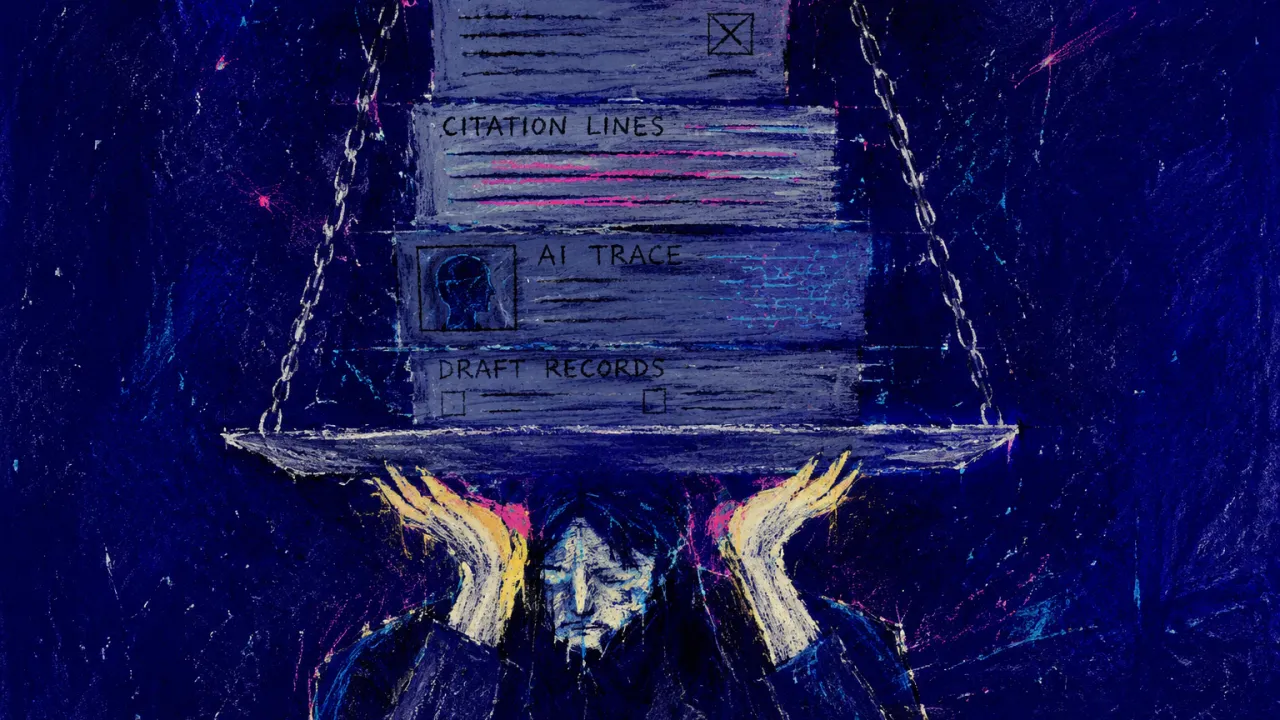
Academic Integrity Scrutiny is not only about what you submitted; it is the point where your work process is placed under inspection. The stomach drop when a neutral email or draft comment appears comes from being asked to account for sources, tools, timestamps, and collaboration all at once. That makes it an environmental, structural dynamic: the institution, the policy language, and the evidence trail are all shaping the room around you. The Tarot Cards below reflect that outline of weighing, exposure, rule, and record.
Justice UprightThe upright sword in Justice's right hand is visible, controlled, and not yet in motion. The scale in the other hand receives more visual emphasis, making the process of weighing evidence more prominent than punishment itself. That is the exact pressure of academic integrity scrutiny: the work is not only judged by content, but by process, sourcing, citation, originality, and disclosure. Essays, lab reports, code, research notes, and AI-assisted drafts can all feel like they are being weighed before the institution decides whether the method counts as legitimate. Justice does not reduce this to guilt or innocence as a personal identity. It maps the external compliance structure around the work so you can separate ethical responsibility from vague fear, and see where the rule, the evidence, and the institution's standard actually meet.
Death ReversedThe black-armored rider enters as a rule-bearing authority, and the figures in the foreground are exposed before it without a private buffer. The banner is not a conversation; it is a visible standard under which every body in the scene is suddenly positioned. In study life, this can mirror academic integrity scrutiny: citation questions, AI policy ambiguity, collaboration boundaries, authorship uncertainty, or a review process that examines how work was produced rather than only what the final submission says. The card fits because the pressure is formal and external. You regain clarity by seeing the scrutiny as a rule environment with boundaries, evidence, and procedures, instead of letting it become a vague shadow over your entire academic identity.
The Devil ReversedThe exposed figures stand beneath a central gaze with collars at their necks and imposed symbols on their bodies. The scene presents scrutiny before dialogue: the body is already marked, watched, and positioned inside a rule structure. In school, that becomes the moment when an essay, citation choice, AI trace, or collaboration pattern is interpreted through suspicion. You may still have an explanation, but the external stage has shifted from learning to being evaluated under a controlling frame.
The Tower ReversedThe lightning exposes the tower in a single, public strike, while sparks scatter from both sides and the occupants are visible in open air. Nothing in the image stays privately contained once the structure has been hit. In academic life, that is the shape of integrity scrutiny: a flagged essay, citation concern, AI policy review, or exam conduct issue that turns a work process into an institutional event. The intensity comes from exposure, not from certainty about what the review will find. The card keeps the focus on structure. It asks what evidence is visible, what policy frame is being applied, where the process became unclear, and how to regain agency without collapsing your whole academic identity into the scrutiny itself.
Judgement ReversedThe trumpet, flag, and exposed bodies create a scene of public standard-setting, with the figures below visible inside open containers. The review mechanism is cold and formal: it makes what was stored, hidden, or private available to inspection. In academic life, this matches citation checks, AI policy questions, collaboration boundary reviews, or requests to explain how a draft was produced. The pressure is not only about whether the work is correct; it is about whether the process behind the work can withstand institutional visibility. You regain agency by making the workflow legible rather than letting the review define the whole story. The card's structure points to documentation, context, and process as the places where clarity can return.
Ace of Swords ReversedThe double-edged sword is a tool of clarity, but it is also an instrument that can cut both ways. With the crown pinned to its point and the whole act exposed in open sky, the image turns truth, citation, and proof into a visible institutional test. In academic life, that becomes the scrutiny around originality, source use, collaboration boundaries, or AI assistance. You are not facing a vague moral cloud; the card locates the pressure in a system where intellectual work must be traceable, defensible, and clean enough to survive inspection.
Three of Swords ReversedThe three hilts and three tips create a six-point field around the pierced heart, like multiple watching angles fixed on one center. In academic integrity scrutiny, the student is not only answering a question about work; the submission, process, intention, and record can all feel exposed at once. The swords are formal instruments, which matters. This is not random social judgment but institutional review: citation rules, AI policy, plagiarism software, authorship standards, or departmental procedure pressing into the same vulnerable point. The card clarifies why the experience can feel larger than the specific assignment. You are inside a rule system that has become visible mainly through suspicion, and the first act of agency is seeing the difference between the facts of the case and the pressure field surrounding them.
Five of Swords ReversedThe swords remain visible after the fight, scattered across the ground like evidence that cannot be quietly removed. The foreground figure still holds the tools, but the separated figures and bleak open shore make the aftermath socially exposed. In academic life, that exposed field resembles the period after a contested submission, AI-assisted draft, shared file, citation problem, or group assignment dispute. The issue is not limited to whether something was done wrong; the structure itself has become suspicious, with documents, timelines, comments, and ownership trails now carrying extra weight. The reversed texture of this card locks attention onto scrutiny rather than victory. You are not simply dealing with a task anymore; you are dealing with an academic environment where trust has thinned and every tool used to produce the work may be read as part of the case history.
Seven of Swords ReversedThe backward glance is not just caution; it is the visual tension of a person carrying evidence through a watched space. The swords are still visible, the camp is still close, and the two blades left upright create a checkpoint that the figure has not fully cleared. In academic life, that configuration becomes the moment when a submission, citation trail, exam answer, AI-assisted draft, or shared document begins to look difficult to account for. The issue is not only whether the work is right; it is whether the process can survive being examined. This card gives the situation a clean external shape. You are not looking at a vague fear of being judged, but at a rule-bound environment where visibility, evidence, and explanation have become the pressure points.
Knight of Swords ReversedThe hard armor and raised sword create a field of sharp rules, visible surfaces, and defensive readiness. In the reversed texture, the polished equipment no longer reads as simple preparedness; it becomes exposure to judgment under a narrow code. That is the academic experience of integrity scrutiny, especially around sources, collaboration boundaries, citation choices, or tool use. The environment makes every move feel inspectable, while the student has to protect their work without always receiving clear institutional guidance. You are not just dealing with a rulebook. The card shows how an evaluative system can turn learning tools into risk surfaces, and how agency returns when the boundaries of authorship, evidence, and process are made explicit instead of guessed under pressure.
King of Swords UprightThe upright sword in the King's hand is not decorative; it is a rule made visible. His plain blue robes and stone throne strip the scene down to principle, evidence and a decision that can be enforced. In academic life, that visual field becomes the moment when originality, citation practice, AI use or authorship is placed under institutional review. The pressure comes from being asked to prove the clean line between your work, your sources and the system's rules. The card does not turn this into a moral panic. It shows the structure of scrutiny: a formal standard, an exposed student record and the need to make your process legible before authority draws its conclusion.
No cards available for this filter.