The Saturday That Felt Like a Final Warning
When Maya sat down with me, I recognized the look immediately. If a free Saturday feels less like time off and more like your last shot to prove you are not falling behind at adult life, I know that look. I hear some version of that question in readings about weekend redemption pressure all the time.
She described 10:15 a.m. in her small Toronto apartment kitchen so clearly I could almost hear it myself: the coffee going lukewarm beside her laptop, Google Calendar and Notes both open, a grocery cart tab and a banking app waiting, the laundry basket still parked by the bedroom door. The fridge hummed. A streetcar rattled past outside. Her phone felt warm in her hand from checking and rechecking the plan. Her jaw kept locking as she rewrote the order of tasks for the third time.
"I do not need a break," she told me. "I need to catch up. If I waste today, the whole week is going to start wrong." There it was in one breath: getting on track versus wasting the one free Saturday and somehow falling even further behind. The urgency in her body sounded to me like she had swallowed a smoke alarm. Everything in her was blinking red before the day had even properly begun.
I nodded and let that truth land without trying to pretty it up. Then I told her what I have learned after many long seasons with people who think pressure will save them: a free day is support, not a final exam. "We are not here to judge your Saturday," I said. "We are here to draw a map of the pressure, so you can stop mistaking it for your personality and start finding clarity inside it."

Choosing the Ladder Instead of a Crystal Ball
I asked Maya to place both feet on the floor and take three slower breaths before we touched the deck. Not as theatre, and not as some mystical test. Just as a way to let her nervous system arrive in the same room as her question. Then I shuffled slowly and asked her to hold one thought only: Why does one free Saturday feel like my last chance to get on track?
For her reading, I chose the Four-Layer Insight Ladder · Context Edition. This is how tarot works best for me with Saturday reset anxiety and weekend productivity guilt: not as fortune-telling, but as card meanings in context. Her question was not really asking for a prediction. It was asking why an ordinary day off had become so psychologically overcharged. So I wanted the smallest spread that could trace the full chain clearly: symptom, fear, reframe, and grounded action.
I told her what each rung would show. The first card would name the visible Saturday pattern she keeps living out. The second would reveal the deeper fear and scarcity logic underneath it. The third—our turning point—would show the core shift needed for transformation. And the fourth would ground the whole reading in one lived experiment, a small repeatable practice that could make a free day usable again.
Reading the Weight in the Room
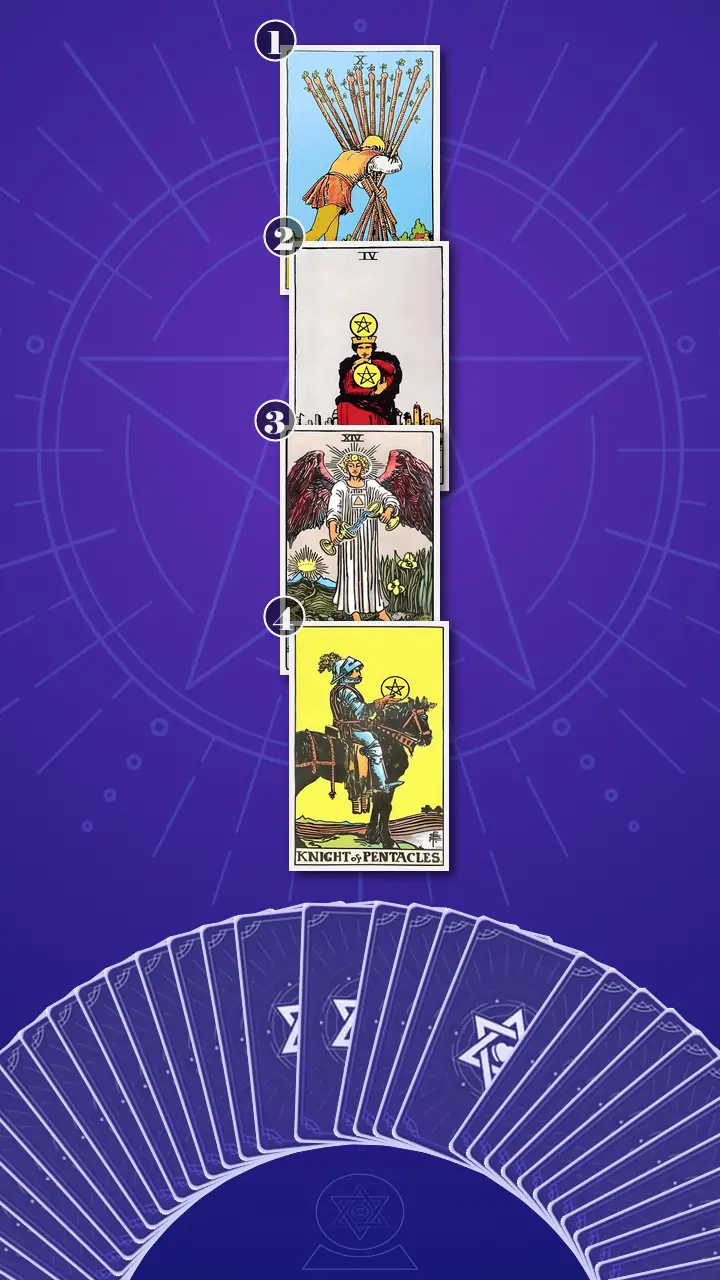
Position 1: The Bundle That Blocked the Horizon
I turned the card representing the visible Saturday symptom: Ten of Wands, upright.
I told Maya this was almost painfully literal. It looked exactly like her trying to use one free Saturday to carry chores, life admin, self-improvement, and emotional recovery all at once. Laundry, groceries, inbox cleanup, budgeting, exercise, texting people back, maybe even becoming a calmer and more evolved person before dinner. In the Rider-Waite image, the bundle of wands blocks the figure's line of sight. In modern life, that becomes too many tabs, too many categories, too many mini-deadlines in one day until the next real move disappears behind the plan.
Energetically, I read it as excess fire under compression. There is energy here, but it is so overloaded that it stops being useful. It bends the back instead of moving the feet. I told her, gently but directly, "Planning can feel like control while quietly stealing the energy to begin." The day starts to resemble 27 browser tabs eating all your battery while you keep deciding what to click first.
Her reaction came in three small waves. First her fingers froze around her mug. Then her eyes narrowed in that quick inward wince people make when a card catches them too cleanly. Finally she gave a short, dry laugh and said, "That is so accurate it feels a little rude." I smiled. "Good," I said. "Then the card is looking at the right Saturday."
Position 2: The Day Clutched Like Low Battery
I turned the card representing the deeper control-based fear and scarcity logic beneath the pattern: Four of Pentacles, upright.
I told her this card showed why rest feels stressful when chores are undone. In her life, it looked like clutching her free hours the way people protect the last 12 percent of their phone battery. She tightens the plan, postpones food, delays showering, keeps lunch on hold, and treats thirty minutes of sitting down as if that would be reckless spending. The day becomes proof that life is still under control, so every minute feels too precious to use imperfectly.
Here the energy was defensive earth—solid, closed, guarded, and stuck. The figure on the card holds one pentacle to the chest and pins the others underfoot. I told Maya that when time is gripped this tightly, flexibility disappears first. And once flexibility goes, starting becomes harder, not easier. This was the moment I named another lens I use, one I call Social Clock Decoupling. I said, "The second you measure your Saturday against productivity reels, soft-weekend posts, or what twenty-eight is supposed to look like, your day stops belonging to you. It becomes an exam you think everyone else already passed."
She stared down at the card and pressed her lips together. I asked, "If you did 'waste' this Saturday, what exactly would your mind say that meant about you by Sunday night?" She answered without hesitation. "That I cannot manage basic adult life." There was the root. Not laziness. Not lack of ambition. Fear that one imperfect day could expose a deeper loss of control.
When Temperance Poured Between Two Cups
Position 3: The Antidote in Plain Sight
When I reached for the third card, the room went noticeably quieter. Even the traffic outside my window seemed to flatten into the distance. I turned the card representing the central reframe needed for transformation: Temperance, upright. I have lived enough winters to know the feeling that came over me then. Not drama. Relief.
Whenever Temperance appears in a reading like this, I use my Seasonal Energy Diagnostics lens. I look for the place where someone is trying to force a spring harvest during a winter dormancy phase. Maya was not failing at being an adult. She was trying to squeeze bloom, harvest, repair, and future planning out of one tired morning. No field responds well to that. Neither does a nervous system.
I named the moment she knew too well: cold coffee, six tabs open, laundry still untouched, and her whole body acting like noon is already too late to recover the week. That is the weather this card interrupts.
Saturday is not a verdict you have to survive; like Temperance pouring between cups, let one manageable task and one act of care coexist, and trust balance to rebuild momentum.
Her first reaction was not relief. It was resistance. Her breath paused. Her fingers stopped tapping against the mug. Then her gaze drifted slightly past me, as if she were replaying that bright kitchen-counter scene with the unopened mail, the banking alert, and the lunch she felt she had not earned yet. Only after that came the release: a long, shaky exhale that seemed to come from somewhere behind the ribs. I watched her jaw loosen by degrees. Her shoulders lowered, and with that softening came the strange little dizziness that often follows clarity—the body letting go of an emergency while the mind is still catching up.
"But if I make it smaller," she said, and there was a flash of anger in it, "doesn't that mean I am admitting I cannot handle normal life?"
"No," I told her. "It means you are finally working with your real energy instead of against it. You do not need a rescue Saturday. You need a Saturday you can repeat." I let that sit for a moment. Then I asked, "Now, with this new angle, think back to last weekend. Was there a moment this would have changed how you felt?"
She nodded once, slowly. "Lunch," she said. "If I had just eaten, paid the hydro bill, and moved the laundry, I probably would have felt human again. I kept acting like eating meant I was quitting."
That was the hinge of the whole reading. Not from chaos to perfection. From deadline panic and guilt-driven overplanning toward the first believable inch of steadier self-respect through moderation and follow-through.
Position 4: The Still Horse and the Human Pace
I turned the card representing the grounded next step, the lived experiment that could replace binge-repair with self-trust: Knight of Pentacles, upright.
I love this card because it is gloriously unimpressed by drama. I told Maya it looked like a phone note with three anchors instead of a full reset manifesto. One realistic practical task. One maintenance task. One restorative thing. Not a cinematic comeback. More like boring autopay for life maintenance: not glamorous, just reliable.
Energetically, this was grounded earth in balance. The horse is still. The knight is focused. Nothing is rushing, which is exactly why something gets done. I told her, "Completion builds trust faster than intensity." In other words: carry one meaningful thing well instead of carrying your whole life badly.
This time she did not laugh. She just gave me the kind of nod people give when their body has decided before their brain has fully drafted its opinion. "Boring is fine," she said. "Honestly, boring sounds amazing."
A Saturday You Can Repeat
Once all four cards were on the table, the story was clean. First came the Ten of Wands: an overloaded day, stacked so high with chores, admin, self-repair, and ideal-self goals that perspective vanished. Then the Four of Pentacles: the deeper fear that one wasted day means life is slipping, so time gets gripped so tightly it stops being usable. Temperance interrupted that whole loop by replacing redemption pressure with measured exchange—effort and care in the same day, not competing for permission. And the Knight of Pentacles brought it down to earth: fewer commitments, slower pacing, ordinary follow-through.
I told Maya the blind spot was not a lack of discipline. It was the belief that more pressure would create more control, when in fact the pressure itself was what made Saturday unusable. Her transformation direction was simple, but not easy: stop using one day to prove she is finally fixed, and start using one day to practice a limited rhythm she can return to. A support-not-exam Saturday. A completion-first weekend. Something human.
Then I gave her the practical part, because insight matters most when it can walk out the door with you. I reminded her of something I say often in readings like this: rest is not the prize at the end of perfect admin.
- Build a Saturday 1+1+1 note. In your phone, make a note called 'Saturday 1+1+1' with exactly three items: one practical task like paying the hydro bill, one maintenance task like one load of laundry, and one restorative thing like a 20-minute walk with no podcast. If your mind says three things are not enough, keep the cap anyway. That protest is the pattern, not a command.
- Use a 15-minute visible start. Before you open planning apps, do one physical task that changes the room: start the laundry, clear the sink, or sort the mail into three piles. Set a timer and stay with only that task until it ends. Choose the task with the clearest physical starting point, not the one with the biggest symbolic meaning. Traction first, optimization later.
- Try my Winter Dormancy Ritual for one week. For the next seven days, do nothing about the blocked goal of 'getting fully back on track.' No redesigning your Notion life-admin system. No heroic Saturday makeover plan. No productivity videos for inspiration. Let the rescue fantasy go dormant and protect only the smaller rhythm. Guilt may flare up immediately. Treat that flare as weather, not instruction. The ritual is not laziness; it is how you stop trying to force spring out of frozen ground.
Maya looked at the list for a long moment and then said, very quietly, "That feels possible." For me, that is always the real threshold. Not whether advice sounds impressive. Whether it sounds doable in the actual apartment, with the actual laundry basket, and the actual version of you who woke up tired.

A Week Later, the Quiet Proof
A week later, Maya sent me a message just after mid-afternoon. She had paid the hydro bill, run one load of laundry, eaten before 2 p.m., and taken a short walk without a podcast. The apartment was not transformed. Her life was not suddenly color-coded into peace. But she told me she had finished her three anchors by 2:40, then sat alone in a coffee shop for forty minutes feeling oddly tender about the extra space instead of guilty for it.
She added one more line: the old thought had still shown up the next morning—What if I am still behind?—but this time it sounded less like a judge and more like weather. I smiled when I read that. That is the kind of clarity I trust. Not certainty. Ownership.
And if I can leave you with the heart of this journey, it is this: when a quiet Saturday makes your chest tighten instead of soften, the day has usually stopped feeling like time and started feeling like evidence.
So when your next free day arrives, what would your own cup-to-cup rhythm be—one practical task, one maintenance act, and one kind thing that proves you can return without punishing yourself?
This story is adapted from psychological research, written so that those in a similar struggle can see their own pattern in it — and find their next step clearly.These insights are not a substitute for professional psychological, medical, legal, or financial advice.
Learn more about our Journey to Clarity.
How did this insight land for you?
🫂 This Resonates Deeply
🌀 Living This Story
✨ Now I See Clearly
🌱 Seeing New Possibilities
🧰 Useful Framework
🔮 The Confirmation I Needed
💪 Feeling Empowered
🚀 Ready for My Next Step
Author Profile
 AI
AI“As the seventh generation of a Highland healing family, I see modern anxieties as a simple, temporary disconnection from nature's rhythm. I bring 67 years of lived seasons not to instruct you, but to hold space for you. Using tarot as a mirror, I want to gently guide you out of the chaos, helping you breathe deeply and rediscover the organic, steady heartbeat of your own life.”
In this Timing Tarot Reading :
Core Expertise
- Seasonal Energy Diagnostics: Diagnosing your deep exhaustion as a misalignment with natural seasons—trying to force a spring harvest during a winter dormancy phase.
- Social Clock Decoupling: Detaching your core self-worth from artificial timelines like peer pressure or societal milestones.
Service Features
- The Winter Dormancy Ritual: A grounded challenge to consciously do 'nothing' regarding a blocked goal for one week, eradicating guilt and rebuilding organic energy.
Also specializes in :
Explore Related Patterns:
Compulsive Self-ImprovementMaya tries to make one Saturday carry laundry, groceries, budgeting, exercise, inbox cleanup, emotional recovery, and the hope of becoming a calmer, more evolved person before dinner. The overload is not random ambition; it turns self-improvement into a pressure ritual. Compulsive Self-Improvement shows up when the self becomes a permanent renovation project and every free hour feels morally assigned to repair. You can see the cost in the way basic care gets delayed: food, showering, and rest are treated as interruptions until enough progress has been made. The psychological loop is harsh because it makes ordinary maintenance feel insufficient. You are not only trying to do tasks; you are trying to prove you are becoming the version of yourself who would never fall behind. The story loosens when Maya accepts a repeatable Saturday instead of a rescue Saturday, replacing self-optimization with sustainable self-trust.
Productivity as SafetyMaya's cold coffee, open apps, grocery tab, banking screen, and rewritten task order show a Saturday being turned into a control system before it has even started. The pressure is not simply about chores; the plan is trying to regulate the fear that one unproductive day could prove she is falling behind at adult life. That is the core mechanism of Productivity as Safety: doing more, planning harder, and tightening the schedule become ways to feel temporarily secure. You can see the defense in how the day is treated like evidence, not time. If Saturday goes well, life feels manageable; if it goes badly, the whole week seems threatened. The trap is that pressure starts pretending to be discipline while draining the energy needed for actual follow-through. The story's turning point comes when Maya stops asking one day to rescue her identity and starts building a smaller rhythm she can repeat. Clarity arrives when productivity is no longer used as proof that you are safe.
Explore Related Struggles:
Catch-Up ParalysisYou open the day with a cold coffee, the calendar, Notes, a grocery cart tab, a banking app, and a laundry basket still parked by the bedroom door. The Saturday is already being assigned the job of catching up before it has even started, so the first move feels heavier than the tasks themselves. That is why the plan keeps expanding while the actual start keeps shrinking. When one free day has to erase the feeling of being behind, every minute starts carrying proof-value, and the body slows down under the weight of trying to make up for time all at once.
System Reset OverloadOne free Saturday is being drafted to handle chores, life admin, self-improvement, and emotional recovery at the same time. By the third rewrite of the task order, the day has become a reset project instead of a usable block of time. A small morning cannot hold every kind of repair at once, and the story only opens when the goal gets smaller than the fantasy of fixing everything in one pass. You do not need a heroic Saturday makeover plan; you need a rhythm the day can survive.
Rest-Permission SplitYou keep postponing food, delaying the shower, and treating thirty minutes of sitting down like a reckless expense. Even lunch starts to feel like quitting, which means the body is being asked to wait for permission that never arrives. The story makes the rule plain: a free day is support, not a final exam. But when care has to prove itself by getting the list under control first, rest is never allowed to arrive on time.
Social Clock EntrapmentThe same Saturday stops feeling private once it gets measured against productivity reels, soft-weekend posts, and what a 28-year-old is supposed to look like. The day is no longer just a day off; it becomes a comparison surface. That borrowed timeline is what turns a normal morning into a verdict. You are not only trying to use your time, you are trying to prove you are not behind on the life script you think everyone else has already mastered.
Explore Related Emotions:
Life Admin ShameLaundry, groceries, inbox cleanup, budgeting, exercise, and texts all crowd into Maya's one free Saturday. When asked what wasting the day would mean, she answers immediately: she cannot manage basic adult life. That answer turns practical maintenance into personal exposure. You are not just facing errands; you are facing the fear that ordinary admin has revealed a hidden inadequacy. Life Admin Shame names the heat that rises when small undone tasks start speaking in the language of self-worth.
Productivity AnxietyMaya keeps Google Calendar, Notes, a grocery cart tab, and a banking app open while the laundry waits by the bedroom door. Her phone is warm from checking the plan again, and her jaw keeps locking before the first real task has begun. The body is trying to outrun the fear that a free day can be wasted beyond repair. You can feel the Saturday turning into a performance metric, where planning promises control but keeps raising the cost of starting. Productivity Anxiety fits because the threat is not one task; it is the sense that every hour must prove you are still on track.
Productivity GuiltMaya delays lunch, postpones showering, and treats thirty minutes of sitting down as if it would be reckless spending. Even eating becomes suspicious, as if care for the body might count as quitting the mission. The guilt forms when productivity becomes the gatekeeper for permission. You are not simply trying to get things done; you are trying to earn the right to exist without an open tab proving your usefulness. Productivity Guilt names the sting of needing output before you can let the day hold you.
Rest GuiltMaya remembers that if she had just eaten, paid the hydro bill, and moved the laundry, she probably would have felt human again. Instead, she kept acting like eating meant she was quitting. Rest Guilt appears when care has to prove it deserves a place in the schedule. You can be hungry, tired, and clearly overloaded, yet still feel that a pause must be justified by prior output. The ache here is not laziness; it is the internal rule that softness only becomes legal after perfect admin.
Scarcity AnxietyMaya clutches her free hours like the last twelve percent of a phone battery. She postpones food, delays showering, and treats sitting down as a risky use of the only resource that might save the week. Scarcity Anxiety is the feeling of having time but not being able to inhabit it. You grip the day so tightly that flexibility disappears, and the supposed free space starts acting like a locked account with penalties for every imperfect withdrawal.
Timeline PanicMaya's question sharpens when the Saturday gets compared to productivity reels, soft-weekend posts, and what twenty-eight is supposed to look like. The day stops being a day and becomes a checkpoint on an invisible timeline. Timeline Panic shows up when the pressure is not only about laundry or bills, but about the imagined pace of adulthood. You start measuring a private kitchen morning against a public script, and suddenly one unfinished Saturday feels like proof that everyone else already passed a test you are still trying to decode.
Verdict DreadMaya's Saturday is not just full; it is put on trial before it has even started. The cold coffee, open apps, waiting laundry, and locked jaw all gather around one private verdict: if the day goes badly, it will say something damning about whether she can handle adult life. That is why the pressure feels so absolute. You are not reacting to a normal to-do list as much as to the feeling that the day has become evidence, and evidence has no softness built into it. Verdict Dread names the internal weather of being watched by your own standards, where one imperfect Saturday feels capable of sentencing the whole self.
Grounded Self-TrustMaya replaces the full reset manifesto with three anchors: one practical task, one maintenance task, and one restorative thing. By mid-afternoon, the proof is quiet and physical: the bill is paid, the laundry has run, food has happened, and the walk is done. Grounded Self-Trust comes from evidence you can live inside, not from intensity. You do not need the old thought to disappear; in the story, it still returns the next morning. What changes is its authority, because a repeatable rhythm has given Maya something steadier than panic to stand on.
Guilt-Free RestA week later, Maya has paid the hydro bill, run one load of laundry, eaten before 2 p.m., and taken a short walk without a podcast. The apartment is not transformed, but she sits alone in a coffee shop for forty minutes feeling tender about the extra space instead of guilty. Guilt-Free Rest is not a fantasy of doing nothing forever. It is the small, grounded sense that rest can stand beside completion without needing to apologize. You still have a real life with real maintenance, but the free space no longer has to be defended like a mistake.
Optimization FatigueMaya rewrites the task order for the third time while the coffee cools and the tabs stay open. The planning looks active, but it quietly drains the energy that would have gone into beginning. Optimization Fatigue names the tiredness that comes from trying to design the perfect route through an already overcharged day. You keep refining the map because precision feels safer than movement, but each revision makes the first step feel heavier.
Scope Creep AnxietyMaya tries to load chores, life admin, self-improvement, emotional recovery, exercise, budgeting, and replies into the same Saturday. The plan keeps getting wider until the actual next move disappears behind the categories. Scope Creep Anxiety is what happens when a day becomes too symbolically large to enter. You are not avoiding effort; the container has been overfilled. The body can do one next thing, but the mind has turned that one next thing into a full-life repair project.
Explore Related Contexts:
Adulting Performance PressureMaya says she does not need a break; she needs to catch up, because wasting the day would make the whole week start wrong. Later, when asked what a wasted Saturday would mean, she answers that it would prove she cannot manage basic adult life. That is the exact structure of Adulting Performance Pressure. The pressure is not coming from the laundry basket alone. It comes from the way ordinary adult maintenance has been converted into a competence test, where bills, food, cleaning, exercise, messages, and emotional repair all become evidence of whether you are keeping up. You are dealing with an external scorecard disguised as a private Saturday. The story shows how adulthood can start to feel like a silent evaluation period, where one imperfect free day is treated as a verdict on your whole capacity to function.
Catch-Up ParalysisMaya has Calendar and Notes open, a grocery cart tab waiting, a banking app ready, and the laundry basket still by the bedroom door while she rewrites the task order for the third time. The tools are available, the day is open, and the tasks are concrete, but the first real move keeps disappearing behind the plan. Catch-Up Paralysis names the external jam created when too many overdue categories compete for priority at the same time. You are not blocked because there is nothing to do. You are blocked because every task has been made responsible for restoring the whole week, so choosing one feels like abandoning the others. The story makes this paralysis visible in the way planning consumes the energy that action needs. The Saturday has become a backlog funnel, and the more carefully Maya tries to sequence it, the less usable the morning becomes.
Panic ProductivityMaya says she does not need a break; she needs to catch up, and if she wastes today the whole week is going to start wrong. The morning is ordinary, but the operating mode is emergency: warm phone, locked jaw, repeated planning, and a sense that noon would already be too late. Panic Productivity names the external productivity script that tells you pressure will create control. Under that script, planning feels responsible, urgency feels virtuous, and rest looks like a dangerous leak in the system. The story shows why that script fails. You can push harder at the plan while losing the very traction needed to begin, because the day has been organized around alarm rather than sequence. The result is not disciplined momentum; it is a Saturday run by threat signals before the first task is even done.
Social Clock PressureThe reading names productivity reels, soft-weekend posts, and what twenty-eight is supposed to look like as part of the pressure around Maya's Saturday. Her day stops being measured by what is actually possible in her apartment and starts being measured against a timeline she believes other people are already passing. Social Clock Pressure fits because the fear is not only about laundry or lunch. It is about the idea that there is a correct pace for adult life and that a single messy weekend can expose you as late to it. You are dealing with a comparison structure that turns private time into public evidence. Once Saturday is measured against an imagined age schedule, every imperfect hour can feel like proof that you are behind, even when the actual situation is just a crowded day of maintenance.
Weekend Reset PressureMaya is standing in a small Toronto kitchen with Calendar, Notes, a grocery cart, a banking app, and laundry all waiting at once. The free Saturday is not functioning as open time; it has been turned into a compressed reset window where chores, money admin, self-improvement, and recovery all demand proof before the day has even started. That pressure becomes structural when the weekend is expected to repair the whole week and confirm that adulthood is still under control. You are not simply deciding what to do first. You are facing a cultural script that treats one free day as the place where the overdue life, the ideal routine, and the calmer future self are supposed to be produced on command. Weekend Reset Pressure fits because the story's central problem is not laziness or a lack of ideas. The external stage is a Saturday overloaded with redemption logic, where usable time gets converted into evidence and every ordinary maintenance task starts carrying the weight of a final warning.
Life Admin Deadline Pile-UpThe hydro bill, banking app, grocery cart, laundry, inbox cleanup, budgeting, exercise, and texts are all trying to occupy the same free Saturday. None of these tasks is dramatic on its own, but together they create a visible pile-up of maintenance demands. Life Admin Deadline Pile-Up fits because the story is built around the compression of home, money, food, communication, and self-maintenance into one narrow window. You are not facing one hard task. You are facing a queue of small obligations that all become louder because they have been deferred into the same block of time. The pressure intensifies because these tasks are tied to basic functioning. When the pile-up sits in the middle of the weekend, Saturday stops feeling like free time and starts feeling like the only remaining checkpoint for keeping ordinary life from spilling over.
Zero-Sum Self-Improvement CultureMaya's Saturday is asked to hold chores, life admin, exercise, messages, emotional recovery, and the possibility of becoming calmer and more evolved before dinner. Even eating lunch starts to feel like quitting, because care has been placed on the opposite side of productivity. Zero-Sum Self-Improvement Culture fits because the story shows improvement being organized as a contest against basic maintenance. You are pushed to treat food, rest, and a slower pace as costs, even though those are the conditions that make follow-through possible. The external pressure here is a culture of total optimization. It does not simply ask you to do the laundry or pay the bill; it asks you to transform the self while doing it, then treats any human need as a deduction from the score.