Three Voice Notes After Figma, Then One Honest Twenty-Minute Limit

The 10:48 p.m. Voice-Note Spiral
If a friend sends can I vent? just as you close Figma after a deadline-heavy day, and you delete I cannot do this tonight before putting in your headphones, you already know the loop Maya brought into our session. She was 27, a junior product designer in Toronto, and she began by holding her phone close to the camera. Three voice-note waveforms filled the screen.
She walked me through the previous Tuesday. At 10:48 p.m., she had been setting her alarm for an early hybrid-work morning when those voice notes appeared. Her lunch for the next day remained unpacked on the kitchen counter. The refrigerator hummed, the counter light buzzed, and one earbud grew warm against her ear as she listened. She knew she was at capacity, drafted the limit, deleted it, then answered as if her exhaustion were evidence that the other person's need mattered more.
“I know I can say no,” she told me, pressing her thumb into the edge of her phone case. “I just cannot make myself press send. I keep thinking this is what a good friend does. But by the time she feels better, I have nothing left.”
Her guilt-tinged anxiety was not floating around as an abstract worry. It worked like a seat belt locking across her chest the instant her friend's name appeared. Her jaw clenched while she drafted a limit. Her shoulders stayed lifted while she monitored every pause and change in tone. Once the conversation ended, the belt released, but it left resentment, fatigue, and the lonely sense that she had disappeared from another evening of her own life.
The contradiction was clear. Maya wanted to preserve a friendship with real history, but she feared that any limit on emotional access would cause rejection or loss. Constant availability brought a few minutes of relief because the connection remained intact. That relief then taught her nervous system the wrong lesson: perhaps the friendship survived only because she never stopped carrying it.
“You are not choosing between caring and not caring,” I told her. “You are noticing whether care has become unlimited access. I am not going to predict whether this friendship stays or ends. I want to help you see the pattern clearly enough that your next response belongs to you.”
I thought of the unfinished films I have watched take shape in my own art practice. A painful scene can remain in the cut long after it has revealed everything it came to reveal, simply because nobody has dared to write the transition. I told Maya that our Journey to Clarity would not erase the friendship's past or cast either person as a villain. I would help her study the scene, identify the role she had been repeating, and gently put the pen back in her hand.

Choosing a Map for Friendship Boundaries
I asked Maya to place both feet on the floor and take one ordinary breath before I shuffled. There was nothing supernatural about the pause. It was a practical transition from reacting to the latest notification toward concentrating on one question: “Why do I keep accepting emotional dumping to preserve this friendship?”
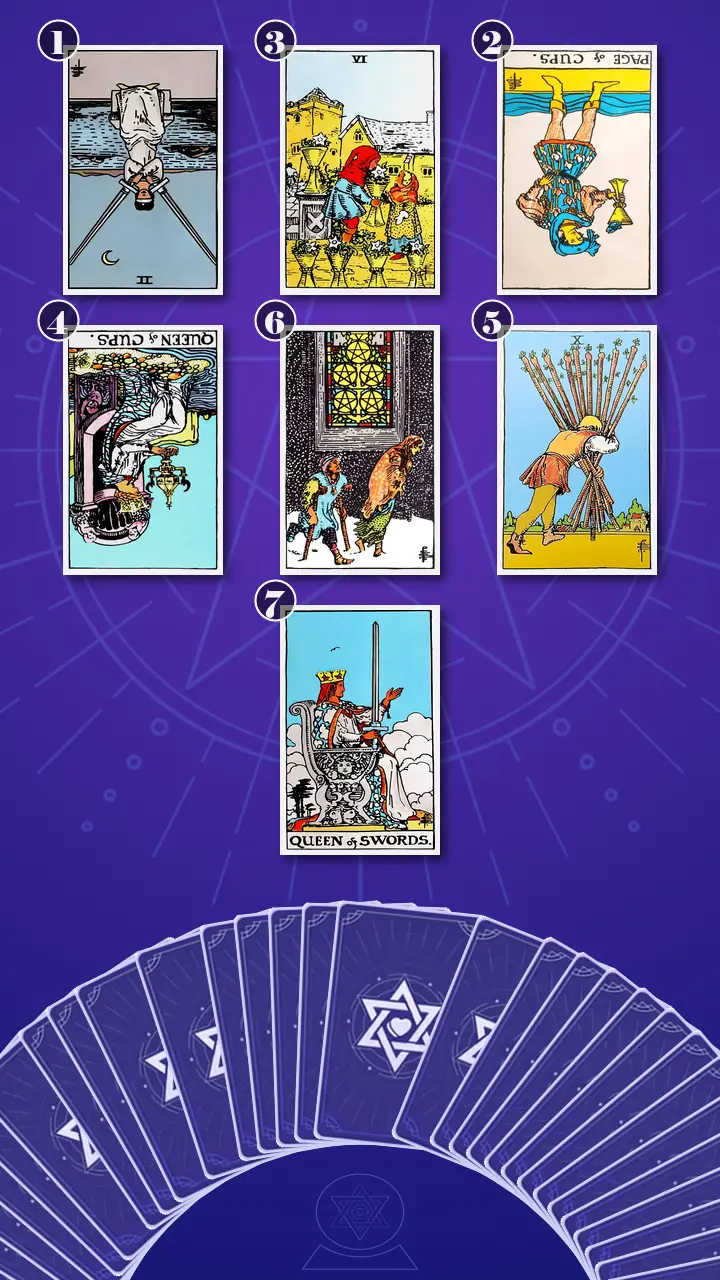
I chose the Relationship Spread · Context Edition, a seven-card relationship tarot spread designed for friendship boundaries and emotional reciprocity. For anyone wondering how tarot works in a situation like this, I use the cards as a structured cognitive map. Their symbols externalize roles, fears, and behavioral loops that otherwise remain tangled inside one stream of thought. They do not read a friend's hidden motives, issue a diagnosis, or replace observable facts.
This spread was more precise than a broad Celtic Cross because every position served the relationship question. The first two cards would compare Maya's unspoken stance with the communication pattern she could actually observe. The third would show the shared foundation she was protecting. The mirrored fourth and fifth positions would reveal what each side brought into the exchange without assigning moral blame. The sixth would expose the central obstacle, and the seventh would offer a self-directed way forward.
I arranged the cards in three tiers, like two riverbanks narrowing toward a bridge. Positions four and five faced each other across the table and converged on position six, where the emotional burden met Maya's fear of exclusion. The final card rested alone beneath them. I explained that this was a map of choices and dynamics, not a forecast of fate. Maya would remain the person deciding what to say, what to offer, and what evidence mattered.
Reading the Messages Stuck in Draft Mode
Position 1: Two of Swords Reversed and the Unsent Limit
The first card I turned occupied the position that revealed Maya's present stance: she recognized that the emotional load was unsustainable, yet repeatedly withheld a clear boundary. The card was the Two of Swords, reversed.
I pointed to the blindfold and the two swords crossed protectively over the figure's chest. Upright, the image can hold a tense but temporary stalemate. Reversed, that truce has started to collapse. This was Maya in draft mode. The long voice note was visible, she knew she was exhausted, and she kept rewriting I cannot talk tonight as if every version were a Figma component trapped in endless review. Every possible sentence seemed to cast a vote on the entire friendship.
The card showed blocked Air: Maya had perception, but it was not becoming usable language. Her private decision kept destabilizing under too much analysis, so her behavior defaulted to an automatic yes. I also named the overcorrection risk. Escaping the tension by suddenly ghosting or sending a sweeping ultimatum would still let overload make the decision. The smaller move was to identify one capacity fact before answering.
Maya gave a short laugh, but there was no amusement in it. “That is so accurate it feels a little brutal.” Her fingers tightened around her mug, then loosened.
“Then let us be precise without becoming cruel,” I said. “The card is not accusing you of weakness. It is showing the exact point where what you know gets edited out. When the next message arrives, what fact about your energy do you already know before fear starts revising it?”
“Usually that I have twenty minutes at most,” she said. “Sometimes I have nothing. I just never let that count.”
Position 2: Page of Cups Reversed and the Unexpected Emotional Payload
The next card represented the counterpart only as Maya experienced the observable communication pattern. I was careful not to turn this position into speculation about another person's private intentions. The card was the Page of Cups, reversed.
The fish unexpectedly rising from the Page's cup became the tiny voice-note preview that concealed far more emotional intensity than it promised. Maya would open a casual hey, are you around? after work and discover several detailed messages before anyone had agreed on timing, support mode, or a stopping point. Vulnerability could be sincere and still arrive without enough containment for the person receiving it.
Here, Water was not evil or unwelcome; it was uncontained. There was an excess of emotional material and a deficiency of shared structure. Maya had been treating receipt as responsibility, as though opening the message meant becoming the only available processor for everything inside it.
“You can receive someone's feelings without agreeing to carry all of them,” I told her. “A consent check is more than the phrase can I vent? if the entire story arrives before you have answered. It also includes how much time is available, what kind of support is wanted, and whether both people can stop.”
Maya looked away from the card and rubbed the hinge of her jaw. “She does ask sometimes. But the voice notes are already there when she asks. Saying no feels like returning a package after I have opened it.”
I nodded. “That is useful information about the exchange, not proof of malicious intent. Your task is not to decide whether her feelings are valid. Your task is to decide whether you are available to engage with them now.”
Position 3: Six of Cups and the Friendship Maya Was Protecting
The third card represented the shared history, affection, and meaning Maya was trying to preserve. I turned over the Six of Cups, upright.
The child offering a flower-filled cup did not expose a false memory. It confirmed real tenderness. Maya told me about university exams, breakups, cheap takeout eaten on residence floors, and the year this friend had answered Maya's own late-night calls. She had recently sat in a cafe near Queen Street West, scrolling through those old messages while the espresso machine hissed behind her. Every generous memory made the current imbalance harder to question.
The upright card held a balanced current of affection, but nostalgia could become excessive when past reciprocity granted the present arrangement permanent exemption from review. Saved messages and old photos showed what the friendship had meant. They could not, by themselves, answer what the friendship currently allowed.
“If you name what is happening now, do you believe you are betraying what happened then?” I asked.
Maya's eyes filled before she blinked the moisture away. She nodded once. “It feels like I am rewriting the good years as fake.”
“You do not have to do that,” I said. “A past act of care can remain true. A present limit can also be true. Respecting the history does not require freezing the friendship in its old form.”
When Care Lost Its Container
Position 4: Queen of Cups Reversed at the Water's Edge
The fourth card showed what Maya contributed to the dynamic: empathy, emotional labour, and the suppression of her own capacity limits. It was the Queen of Cups, reversed.
I drew her attention to the Queen's ornate, lidded cup and the water surrounding the throne. Maya recognized the modern version immediately. She would hold her phone with both hands, listen for the moment her friend sounded calmer, and keep asking follow-up questions while tomorrow's design review waited on a dark laptop. The call might begin with ten available minutes and pass an hour because relief had become the only acceptable stopping signal.
Reversed Water showed both excess and blockage. Maya's sensitivity had not disappeared; it had lost a reliable edge. She was running another person's feelings through her own nervous system as if she were the friendship's permanently staffed support desk. Her own fatigue, missed plans, and wish to speak became background tabs she never reopened.
“Are you offering compassion,” I asked, “or are you trying to secure the bond by becoming indispensable?”
Maya inhaled quickly. Her eyes narrowed, not in disagreement, but in the sting of recognition. “I wait until she sounds better because then I know I did my job.”
“That is the part I want you to notice,” I said. “Friendship is not a job where another person's emotional state signs off your shift. You are allowed to choose a stopping time before either person feels fully resolved.”
Position 5: Ten of Wands and the Call That Kept Expanding
The fifth card represented the emotional weight Maya observed entering the exchange, without defining her friend's character or claiming intent. I turned the Ten of Wands, upright.
The figure bent beneath the bundled staves looked like Maya after a short check-in became an hour-long call. By the end, she was carrying the original story, every follow-up detail, several possible solutions, and responsibility for whether her friend would be okay. The destination beyond the bundle was the rest of Maya's evening: food, sleep, her own plans, and more reciprocal friendships. The load blocked all of it from view.
Upright Fire had reached excess. Energy that could have supported deliberate action had become accumulated labour. The card did not say that the friend was inherently burdensome. It showed that the amount being carried had exceeded the current conversation's sustainable capacity, and that Maya had accepted sole responsibility for transporting it.
I used the image that had been present from the beginning. “It is as if you hold your friend's entire backpack through every conversation. You are not only afraid that putting it down will disappoint her. You are afraid that the moment your hands are empty, there will be no reason to keep you beside her.”
Maya stared at the ten wands. Her shoulders moved downward on a long breath, then rose again. “That is exactly it,” she said. “And I hate that I feel resentful, because she is genuinely struggling.”
“Resentment is not proof that you do not care,” I replied. “Sometimes it is the body reporting that consent has been replaced by obligation. A friendship is not preserved by deleting your voice.”
Outside the Lit Window
Position 6: Five of Pentacles and the Rejection Maya Had Already Imagined
The sixth card exposed the central challenge beneath the unequal exchange. I turned the Five of Pentacles, upright.
Two figures moved through snow beneath an illuminated stained-glass window. Outside Maya's actual window, Toronto snow had started to catch in the streetlight, and for a moment the weather seemed to enter the reading with us. I asked her to imagine sending I cannot talk tonight. The card made her anticipated outcome visible: she saw herself outside the warmth of the friendship before the friend had made any decision at all.
Earth had contracted into scarcity. Maya treated access to her attention like a membership fee she had to keep paying to remain inside the bond. A delayed or cooler reply created a drop in her stomach, and fear immediately supplied a full ending: the friend would stop trusting her, stop reaching out, and eventually leave.
I watched a three-part reaction move through her. First, her breath paused and her hand froze halfway to her face. Then her gaze slipped beyond the screen as though she were replaying every short okay she had ever tried to decode. Finally, she lowered her hand, released a quiet sound from deep in her chest, and let her shoulders settle against the chair.
“If I put the backpack down,” she said, “I might find out there was only a place for me because I carried it.”
“That is the real fear,” I said. “But this card is a psychological image of anticipated exclusion, not a prediction that a boundary will end the friendship. A limit is information about your capacity, not a verdict on the relationship.”
I asked Maya to place her phone face down for two minutes. On paper, I had her separate a feared response into two columns. The fact might be: She replied, okay, tomorrow works. The forecast might be: She will never trust me again. Even a cooler reply would still need to be observed before it was interpreted.
“Let the response become information; do not let fear write it in advance,” I said.
Maya looked at the lit window in the card, then at her phone's dark screen. “I do not know what the response means yet,” she said slowly. That sentence was small, but I could feel the old pattern loosen around it.
When the Queen of Swords Returned the Pen
Position 7: Clear Speech With an Open Hand
The room became quiet enough for me to hear a heating pipe click and stop. I turned the final card, the position offering a self-directed way forward through capacity statements, compassionate boundaries, and observation of reciprocity. The card was the Queen of Swords, upright, the spread's antidote.
I pointed to the Queen's vertical sword and her extended open hand. Her Air was balanced and usable. The sword represented the sentence that separated one truth from another: I care about you and I have twenty minutes could coexist. The open hand preserved relationship without promising unlimited access. This was not coldness. It was discerning compassion.
The modern scene was almost identical to the opening, except Maya no longer deleted herself from it. She could look at the capacity fact and send: I care about you, and I have twenty minutes tonight. After that I need to sleep. She did not need perfect wording, a long apology, or a guarantee that her friend would feel no disappointment.
As an artist, I often notice when someone's life is being filmed entirely from a supporting character's camera angle. I call this diagnostic lens Sidekick Syndrome. In Maya's friendship script, she had become the therapist, the dependable one, the character who appeared whenever the emotional plot needed stabilizing but rarely received room for a storyline of her own. That role could develop without conspiracy or conscious malice. Every immediate reply rehearsed it, and every withheld personal update kept it in the final cut.
The Queen of Swords was not asking Maya to recast her friend as the villain. She was asking Maya to resign from one restrictive character. Unlike the familiar Little Mermaid story, preserving connection did not require giving up her voice. The sword edited the role; the open hand left the possibility of honest friendship intact.
I returned us to the setup the spread had exposed. At 10:48 p.m. in her Toronto kitchen, Maya had deleted I need to sleep, listened to three voice notes, and left tomorrow's lunch unpacked. She was trying to protect the friendship, but the only protection she could imagine required her to become unavailable to herself.
I let the spread ask its sharper question. The real question is not whether Maya cares enough to answer every disclosure. It is whether the friendship can include an honest account of what she can offer. One proportionate limit does not predict the relationship; it gives the relationship a chance to respond to reality instead of to her fear.
Preserving a friendship does not require surrendering your voice; name what you can genuinely offer, and let the Queen's upright sword separate care from self-erasure.
For one beat, Maya did not move. Her breath stopped high in her chest, and her fingers hovered above the phone as if the old deletion were happening again. Then her eyes lost focus. I watched her replay something beyond the screen: her jaw tightened, her mouth opened, and no words came. Her shoulders dropped only a fraction before she pulled them up again.
“But does that mean I have been doing friendship wrong this whole time?” she said, sharper than before. The anger seemed to surprise her. I saw it give way to wet eyes and a shaky exhale.
“No,” I said. “It means a strategy that once protected closeness now costs you too much. I am not putting your care on trial. I am giving it a container.”
Her fist slowly opened on the table. Relief arrived, but so did the blank, unsteady look of someone realizing that clarity creates responsibility. Maya could no longer pretend she had no choice. She took one deeper breath, rubbed her jaw, and whispered, “I can keep my voice.”
I asked her, “Now, using this new perspective, think back to last week. Was there a moment when this insight might have let you feel something different?”
“Tuesday,” she said. “I could have offered twenty minutes. Or I could have said tomorrow. Her crisis did not automatically create capacity in me.”
I then gave the insight a short physical rehearsal. I asked Maya to open a blank note and write three lines: what I feel in my body, what I actually have capacity for, and what I can offer without resentment. She drafted one sentence with a time limit, knowing she could choose whether or when to send it. I made clear that if the exercise increased her distress, she could close the note and return to something grounding. No one was entitled to immediate access while she decided.
I named the crossing we had reached: this was a movement from guilt-driven emotional overavailability to discerning compassion and capacity-based friendship boundaries. It was not instant confidence. It was the first discomfort of letting a truthful sentence exist without immediately softening it.
For me, this is how tarot works at its most useful. The Queen did not grant Maya power she lacked or guarantee a particular response. The card made her own discernment visible. The voice, the choice, and the next action were already hers.
The Role Resignation Act
I gathered the seven cards into one coherent storyline. Blocked Air in the reversed Two of Swords kept Maya's knowledge in draft mode. Uncontained Water arrived through the reversed Page of Cups. The Six of Cups showed why genuine history made the pattern difficult to question. The reversed Queen of Cups absorbed what the Ten of Wands made too heavy to carry. Both pressures converged on the Five of Pentacles, where Maya expected a limit to cast her outside the friendship. The Queen of Swords restored mature Air by turning private perception into clear relational language.
The cognitive blind spot was not simply that Maya lacked a boundary script. TherapyTok and late-night searches had already given her dozens. She was treating perfect wording as a technology for controlling another person's feelings. She believed that if she could make the sentence warm enough, no disappointment would occur. When no wording could provide that guarantee, she deleted the boundary and called the deletion kindness.
The transformation direction was capacity-first care: check what is genuinely available, communicate one proportionate limit, and observe whether consent, reciprocity, and respect can exist alongside warmth. Maya did not need to decide the entire future of the friendship before sending one accurate sentence.
When I suggested a fifteen-minute pause, Maya pushed back. “But when the notification is sitting there, fifteen minutes feels impossible. I will spend all fifteen imagining that she is getting more upset.”
“Then start with two,” I said. “A useful practice has to survive contact with your actual nervous system. We are building a choice point, not testing your discipline.”
I adapted my Role Resignation Act into three small experiments. The Act is a conversational pivot that lets someone decline an assigned character without staging a dramatic exit from the whole relationship. Maya could stop playing the permanently available therapist while remaining a caring friend who chose what she could honestly offer.
- Run the three-line capacity check. When the next heavy voice note arrives, wait two to fifteen minutes before replying. In a phone note, write what your body is doing, how much time and energy you actually have, and what you can offer without resentment. A valid answer can be twenty minutes, tomorrow afternoon, or not today. Start with the two-minute version if waiting feels exposed. The goal is an accurate capacity fact, not a perfectly calm body or a perfectly pleased friend.
- Perform the Role Resignation Act. At the beginning of the next call or voice-note exchange, say: I care about you, and I have twenty minutes tonight. Do you want me to listen, help you think through options, or just check in? Set a timer for the time you named. When it ends, use one prepared closing line: I need to stop here for tonight, but I am glad you told me. Do not add a second listening window to prove that the first limit was kind. If the conversation becomes coercive, unsafe, or overwhelming, Maya can end it sooner and decide later whether to continue.
- Use the Belonging Reality Check. After one small limit, write the friend's exact response word for word. Beneath it, separate facts from forecasts. Then spend twenty minutes on dinner, sleep preparation, a design task, or another relationship before checking the chat again. Pause the repair impulse. One cool reply is information about one interaction, not a final verdict on belonging. Look for patterns of consent, respect, and reciprocity over time.
I reminded Maya that these were experiments, not moral obligations. Her friend might respond warmly, awkwardly, or with disappointment. None of those reactions would automatically tell the whole story. What mattered was that Maya no longer had to repair an imagined rejection before the friendship had been given any chance to respond to reality.

A Week Later, Twenty Honest Minutes
Five days later, I received a screenshot from Maya. A new voice note had arrived at 9:37 p.m. She had placed her phone face down, written tight chest, low energy, twenty minutes available, and sent: I care about you. I have twenty minutes tonight, or I can listen tomorrow afternoon.
The reply was brief: Okay, tomorrow works. There was no heart emoji and no extra reassurance. Maya's first draft of the meaning was: She is angry, and I have damaged everything. Then she used the reality check. Fact: tomorrow worked. Forecast: the friendship was ending. She did not send an apology.
The next afternoon, Maya asked whether her friend wanted listening or brainstorming. She listened for twenty minutes, ended when the timer sounded, and did not reopen the call. The friendship was not suddenly solved, and Maya still had questions about reciprocity. What changed was that she had participated without abandoning herself.
That night she slept through, but her first thought in the morning was, “What if I got this wrong?” She smiled at the old forecast, made coffee, and waited until after breakfast to check the chat.
I did not read that as the cards producing a magical outcome. Maya had done the meaningful work: she noticed her body, named her capacity, kept her voice, and allowed another person to respond. Her clarity was not certainty about the friendship's future. It was a grounded sense that she could meet that future without paying for belonging through automatic self-sacrifice.
When a friend's name lights up your phone and your chest tightens, part of you may still reach for the headphones while another part wonders whether saying I cannot do this tonight will leave you outside the friendship altogether. Simply noticing those two impulses means the old scene is no longer playing without your awareness. The Relationship Spread gave Maya a map, but she remained the person holding the pen.
If you could keep the Queen's open hand while loosening the automatic yes, what would an honest twenty minutes look like in your next conversation?