Sunday Reset Mental Load: Making One Need and One Task Visible

The Sunday Reset That Became an Invisible Second Shift
If you share a Toronto apartment with a partner and quietly reset the calendar, laundry, groceries, and recycling while they watch TV, this may be what relationship mental load looks like before anyone calls it a problem.
I met Alex, a 28-year-old product operations coordinator, over video at 8:47 on a Sunday evening. Her work laptop was closed, but the unpaid second shift had already started. Through the kitchen doorway, I could see the blue-white glow of the television in the next room. The washing machine hummed under our voices, and the fridge light spilled across the floor as she checked whether they had milk.
Alex opened a shared Notes app and added groceries, recycling, two loads of laundry, and three upcoming appointments. The phone looked warm in her hand. Her shoulders had climbed toward her ears, and her jaw moved once as if she were chewing a sentence she did not want to say.
“If I do it myself, at least we won't have to argue about it,” she told me. “I know it is invisible, but I still wish someone would notice. Then I feel guilty for wanting that.”
Her central question was direct: “Why do I keep taking on unseen work at home to protect our bond?”
I heard the contradiction beneath it. Alex wanted closeness, but she was maintaining that closeness by absorbing every task that might expose a difference in effort. Asking for shared responsibility felt like stepping onto thin ice; finishing the chore gave her a few minutes of solid ground. The fear of disconnection had become a smoke detector wired to every empty carton, quiet mood, and unfinished pan. Even when there was no fire, her body was already sounding the alarm.
“You are not asking for too much just because the work was easy to miss,” I said. “You call it keeping the peace, but your body experiences it as another shift. I don't want the cards to decide what your relationship means. I want us to use them to separate the task, the fear attached to it, and the choice that is still yours. Let's draw a map through this fog.”
Before I reached for the deck, I asked one more question: “When you make the apartment calm, what are you hoping the labor will prevent?”
Alex looked toward the television glow. “Distance,” she said. “Or finding out that I'm difficult when I need something.”

Choosing a Map for the Work No One Sees
I invited Alex to put both feet on the floor and take one slow breath without trying to improve it. I shuffled while she held the question in mind. I treat this small ritual as a transition for attention, not as a supernatural test: it gives the nervous system a moment to stop sprinting ahead of the conversation.
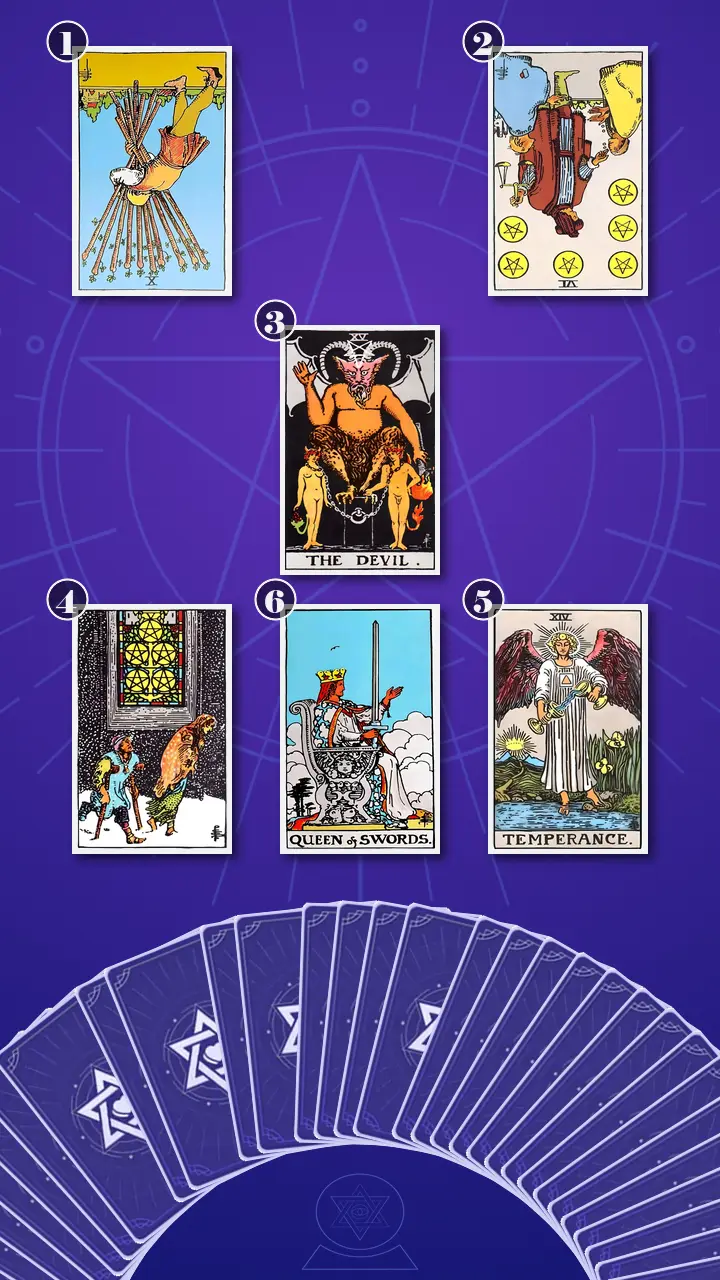
I chose the Relationship Spread · Context Edition, a six-card relationship tarot spread designed here to examine invisible domestic labor, reciprocity, belonging fears, and boundaries. This is how tarot works best for me: not as a prediction machine, but as a structured way to place different parts of a problem where we can inspect them without collapsing them into one emotional verdict.
I chose this spread because “Who did the chores?” was not the whole question. I needed one position for the role Alex automatically assumed, another for what she believed her partner expected, and a central position for the pattern they were living inside. The lower positions would distinguish the fear beneath that pattern from the resource available to change it. The final card would identify a next step Alex could take without pretending to control her partner's response.
I arranged the cards in a compact cross. The first two held the perceived sides of the relationship. The third sat between them as the shared dynamic. Beneath that, fear and resource faced each other. The final card rested below the center, turning insight into a self-directed experiment. The layout would let us explore card meanings in context while keeping observation separate from assumption.
“Nothing here will tell us whether your partner is secretly good, bad, committed, or checked out,” I said. “The cards can show us the contract you may be following. You will decide which terms still belong in your life.”
Reading the Burden Behind “I've Got It”
Position 1: The Role That Carries the Whole Project Board
I turned over the card representing Alex's current role in the relationship: the way she quietly took over household and emotional work before asking for it to be shared.
It was the Ten of Wands, reversed.
I pointed to the figure bent under ten separate wands, face hidden and view of the road blocked. In Alex's daily life, those wands were the grocery order placed between work calls, the laundry plan, recycling day, the shared appointments, the birthday reminder, and the emotional temperature of the apartment. It was like running the household on a private project board where every ticket had already been assigned to her before anyone else could see the backlog.
“The reversal shows an excess of responsibility collapsing into blockage,” I explained. “Your effort is not deficient. Your ability to see beyond the effort is being obstructed. By completing a task before it becomes visible, you hide both the work and the person doing it.”
I did not read the card as an instruction to stop caring or let urgent needs fail. I read it as a question about one recurring, low-stakes responsibility that could be named and handed over completely. Setting down one wand would give Alex more information than imagining what might happen if she dropped all ten.
She gave a short laugh, but there was no amusement in it. “That's so accurate it's kind of brutal.” Her fingers tightened around her mug, then released. “At work, being proactive is literally why people trust me. I come home and keep doing it because I don't know where the job ends.”
The washing machine clicked into silence. In the sudden gap, I asked, “When did reliability stop being something you offer and become the admission price for rest?”
Alex looked down at the card. “Probably when rest started feeling like waiting for something to go wrong.”
Position 2: The Exchange Nobody Actually Negotiated
I turned over the card representing what Alex perceived or assumed her partner's stance to be, especially the expectation she felt to prevent needs and unfinished work from becoming disruptive.
It was the Six of Pentacles, reversed.
The traditional image shows one figure distributing coins while holding scales. Reversed, I saw an exchange whose terms had become unclear. In Alex's apartment, this looked like wiping the counters, booking a dentist appointment, paying for a shared item, and waiting for a thank-you that never came. She contributed time, planning, errands, and emotional check-ins before either person had agreed on what shared support meant.
“This is an excess of giving combined with a deficiency of explicit agreement,” I said. “The scales are not proof that your partner is intentionally exploiting you. They show the private measurement happening after you give: Did they notice? Did it count? Will they offer something back without being asked?”
Alex rubbed the side of her phone with her thumb. She admitted that she often said, “It's fine, I'll do it,” while hoping her partner would interrupt and volunteer. When that did not happen, she treated the silence as an answer even though the real request had never entered the room.
“So I am quietly keeping score,” she said.
“Yes, but the scorekeeping is downstream of something tender,” I replied. “You want reciprocity without having to risk asking for it. The card is not shaming that wish. It is showing why the current method cannot reliably meet it.”
I placed the reversed Ten and reversed Six side by side. “A calm home is not the same thing as a mutual relationship.”
Position 3: The Auto-Renewing Contract
I turned over the card representing the shared relational pattern maintaining the cycle: the belief that carrying more would prevent distance and preserve closeness.
It was The Devil, upright.
I watched Alex's eyebrows rise, so I clarified before the image could gather unnecessary fear. “This card does not mean your relationship is doomed, toxic, or controlled by some outside force. I read it as attachment: a rule with such a strong grip that a familiar choice has started to feel compulsory.”
I showed her the chains around the two figures. They appeared binding, but they were loose enough to examine and potentially remove. The Devil's energy was in excess here: not too much evil, but too much authority granted to one private rule.
In visible terms, Alex washed the late-night pan, ordered dinner, or initiated an emotional check-in when her partner seemed quiet. Secretly, each action was trying to guarantee something no chore could guarantee: no argument, no distance, no discovery that her needs might be inconvenient.
“Nobody had to say this out loud for my body to obey it,” Alex said after I reflected the pattern back to her. “If I carry this, we stay close.”
Her breath paused. Her gaze moved past the screen as though she were watching Wednesday night replay beside the sink: hot water, buzzing overhead light, detergent drying around her fingers. Then she drew her arms inward, not dramatically, but with the compact movement of someone recognizing an old rule in her own handwriting.
“When usefulness becomes your proof of belonging, every chore starts carrying emotional weight,” I said. “The pan is no longer just a pan. It becomes a referendum on whether the evening is safe.”
I asked her to separate two columns. In the first: what happened. The pan was left in the sink; her partner said they were tired. In the second: what her alarm system predicted. If she asked them to finish it, the mood would sour and the relationship would weaken.
That distinction mattered. A fact could require coordination. A prediction required more information. The loose chain was the moment between noticing the pan and obeying the forecast.
Position 4: Outside the Lit Window
I turned over the card representing the fear beneath the overfunctioning: that asking for reciprocity could threaten Alex's belonging or reveal that she was difficult to love.
It was the Five of Pentacles, upright.
I drew her attention to the two figures moving through snow beneath a warm stained-glass window. The card gave form to a fear, not a forecast. Its energy showed belonging experienced as deficient and the threat of exclusion felt in excess.
I asked Alex about the last request she had deleted. She told me about scrolling through Instagram Stories on the TTC after work. Spotless kitchens, couples laughing over wine, matching “Sunday reset” routines. She had already ordered groceries for home. By the time the train brakes squealed into her stop, she had drafted, “Could you handle the groceries next week?” and erased it.
“I was physically going home,” she said, “but I felt like I was standing outside it. If I asked and they got annoyed, I thought I would prove I wasn't easy to live with.”
Her palm flattened against her chest. Her eyes lost focus for a second, then returned to the illuminated window on the card. I told her that wanting access to support was not the same as demanding guaranteed agreement. The warmth in the image did not promise a particular response; it reminded us that support could only become real when a need was allowed to approach the door.
“You have been protecting yourself from hearing no,” I said gently, “but the protection also prevents you from hearing an informed yes, a negotiation, or even a clarifying question.”
When Temperance Made Room Between the Cups
Position 5: One Feeling, One Task, One Agreement
I turned over the card representing the relationship's available resource: a way to balance emotional care with visible, negotiated responsibility instead of silently absorbing more work.
It was Temperance, upright.
The angel pours steadily between two cups, with one foot on land and one in water. I read the card as balanced energy: feeling and practical reality remaining in the same conversation. Alex did not have to choose between swallowing the need and turning groceries into a verdict on the entire relationship.
“Temperance could sound like this,” I said. “‘I feel alone when the weekly planning defaults to me, and I need us to decide who owns groceries and appointments.’ The feeling is present, the task is concrete, and the agreement can be observed.”
The two cups reminded me of a principle I call Rest Phase Legitimacy. After years of studying cycles, I have learned not to treat every low tide as evidence of failure. An orbit contains phases when motion looks less dramatic from where we stand; that does not make the phase useless. Alex, however, had been treating every tired evening as a demand for additional output. If her partner had less energy, she compensated. If she had less energy, she criticized herself and kept compensating.
“Rest cannot belong to only one person,” I told her. “And your low-energy phase is not a relationship emergency. Sometimes the responsible action is to let the recycling wait until the person who owns it can respond.”
Alex inhaled slowly. Her shoulders lowered by a fraction, and her hand opened on the table. “So I don't have to choose between saying nothing and making this the whole issue.”
“Exactly. Temperance offers adjustment, not forced harmony. One task. One feeling. One agreement. Then both of you get reality instead of a private simulation of every possible argument.”
When the Queen of Swords Put the Request Into Words
Position 6: The Boundary With an Open Hand
I turned over the final card, representing Alex's self-directed next step: naming one specific need, setting one clear boundary, and allowing her partner's response to become information rather than a predetermined verdict on belonging.
The room seemed to narrow around the card. It was the Queen of Swords, upright, the key card and antidote of the reading.
I could see Alex caught in the old Sunday logic: the laundry was turning, the recycling was waiting, and completing everything herself still looked faster than tolerating a conversation. Her mind demanded a perfectly safe request before she was allowed to make any request at all.
I pointed first to the Queen's visible face and steady gaze, then to the sword held upright and the open left hand. The reading had begun with a figure whose face was hidden behind a burden. It ended with a figure who could see the field, name what was true, and remain open without surrendering discernment.
In modern terms, the sword was not an ultimatum. It was the clean sentence Alex kept replacing with a paragraph of apology: “I can help with this today, but I cannot own it by default.” The open hand prevented clarity from becoming punishment. The request gave her partner information; the response would give Alex information.
I then brought in my Micro-Cycle Energy Mapping, because clear language still needs humane timing. I asked Alex to notice when her natural weekly energy was steady enough for a ten-minute conversation. Not at 11:26 p.m. with detergent on her hands. Not during the hollow part of the TTC comparison spiral. The Queen did not require constant confrontation. She asked Alex to stop confusing an exhausted low tide with the final truth about her relationship.
“Picture the moment before you send, ‘Could you own the groceries this week?’” I said. “Your first thought may be, ‘I want to say this plainly, but I am already preparing to apologize.’ The Queen asks you to remove the apology for existing, not the kindness from your voice.”
You do not have to keep the household running to prove the bond is safe; raise the Queen's sword of clarity, name one need, and let honest information replace silent proof.
For a beat, Alex did not move. Her breath stopped halfway in, and the thumb resting against her mug stayed suspended. Then her eyes shifted from the card to the shared Notes app still open on her phone. I watched recognition move through her in stages: the groceries ordered from the TTC, the pan washed at 11:26, the Sunday calendar reset. Her pupils widened. The skin around her mouth tightened, and her eyes turned bright.
“But doesn't that mean I got all of this wrong?” she asked, more sharply than before. Anger arrived first; then her voice shook. “Like I trained them not to see me?” Her shoulders dropped, but the release left her briefly unsteady, as if setting down the bundle had revealed how tired her arms were.
I thought of the orbital charts I have drawn over the years: a course correction does not declare the whole journey a mistake. “No,” I said. “You used a strategy that created short-term calm. Now you can see its cost. That is information, not an indictment. With this new perspective, think back to last week: was there a moment when this insight could have changed how you felt?”
Alex returned to the grocery order she had placed on the train. “I could have said I noticed we were out of food and asked them to place the order,” she said. “I didn't need to turn it into proof that I care more.”
Her fist loosened completely. A long breath left her chest, followed by a smaller, almost disbelieving laugh. The new clarity brought relief, but it also returned responsibility to her: she could no longer wait for mind-reading to settle a question she had never voiced.
I named the shift plainly. This was movement from fear-driven overfunctioning and silent resentment toward visible needs, direct communication, and negotiated mutuality. It was not certainty about the relationship. It was the first act of trusting herself enough to gather real evidence.
The Visible Handoff: Turning Clarity Into a Shared Task
I gathered the spread into one causal story. The reversed Ten of Wands showed Alex hiding behind competent overwork. The reversed Six of Pentacles showed an exchange measured privately because it had never been negotiated openly. The Devil revealed the auto-renewing contract linking usefulness with safety, while the Five of Pentacles exposed the fear underneath it: a visible need might leave her outside the warmth of belonging. Temperance offered regulation and shared adjustment. The Queen of Swords gave that balance a sentence.
The pattern reminded me of a bridge repaired by one person at night. Alex patched every crack before daylight, then used the bridge's smooth appearance as proof that no maintenance conversation was necessary. Her blind spot was not a failure to understand chores. It was treating the discomfort of naming a need as evidence that the bond itself was already unsafe. By rescuing every outcome, she also removed her partner's opportunity to respond and then interpreted the absence of response as meaningful.
The direction forward was smaller than “fix the relationship.” Alex needed to make one responsibility visible, negotiate ownership, and observe what happened without using either discomfort or cooperation as an instant verdict on belonging.
I gave her two experiments:
- The One-Task Visible Handoff On Sunday, set a 10-minute timer and list recurring household work in the shared Notes app: groceries, laundry, recycling, cleaning, appointments, and social planning. Circle one non-urgent task and say, “I have been carrying this automatically. Could you own it from noticing through finishing for the next two weeks?” Leave the task visible instead of silently completing it, and record what actually happens. Choose something meaningful but not safety-critical. Tight shoulders and the urge to rescue are sensations, not instructions. Shared ownership should be negotiated, and Alex remains free to revise the experiment.
- The Lunar Routine Sync For one week, spend one minute each evening marking the day's energy as low, steady, or high. Before taking over an unassigned task, pause for 30 seconds and label it urgent, chosen, assumed, or fear-driven. Schedule the 10-minute household conversation during a steady-energy window; on a low-energy night, write the request privately and allow rest to count as part of the plan. This is energy mapping, not another perfect tracker to maintain. Missed days do not need catching up. If direct communication feels unsafe, stop the experiment and prioritize trusted support and personal safety.
“The bond cannot be protected by making your needs disappear,” I told her. “Name one need, hand over one whole task, and let the response be information rather than a verdict.”
This was actionable advice, not a hidden test for her partner to pass. Alex was not required to withhold help, manufacture consequences, or become emotionally cold. She could choose care freely while refusing to use care as silent proof of her right to belong.

A Week Later: The Quiet Proof of Mutuality
Six days later, I received a message from Alex. She had opened the shared note, named the invisible planning work, and asked her partner to own groceries from noticing what was missing through placing and putting away the order for two weeks.
The conversation was not cinematic. Her partner looked surprised and asked why she had not said something sooner. Alex felt the old reflex rise and nearly answered, “It's fine.” Instead, she repeated the request without adding a case for why she deserved it. They negotiated the budget and delivery day. The groceries became one person's visible responsibility rather than Alex's private relationship insurance.
That night, Alex slept all the way through. In the morning her first thought was, “What if I made this bigger than it needed to be?” Then she noticed the thought, smiled once, and left the grocery list where both of them could see it.
I did not consider the reading successful because the cards produced a favourable outcome. The cards had not sent the request, held the boundary, or tolerated the pause. Alex had. The six-card Relationship Spread simply helped her see that finding clarity did not mean knowing the future; it meant no longer abandoning her own reality while trying to secure it.
When you keep the apartment calm by swallowing the request, your shoulders may relax for a minute, but the part of you longing to belong without performing can still feel alone in the room. Letting one need remain visible is already a way of returning to yourself.
If you stopped repairing one plank of the bridge in secret this week, what small form of shared care would you be curious to name, clearly and without rescuing the answer?