The 8:41 p.m. Kitchen and the Adulting Shame Spiral
I knew, before I turned a single card, that if you’re a junior creative in Toronto doing the Slack-to-banking-app-to-Uber-Eats triangle after work, and a rent reminder can tank your whole nervous system, this would feel uncomfortably familiar. That was the exact pattern sitting across from me when Jordan, a 27-year-old junior content strategist, lowered herself into the chair and said she felt ridiculous for needing help with what she called ‘normal life stuff.’
She described 8:41 p.m. on a Sunday in her apartment kitchen so clearly that I could practically hear the fridge hum myself. The air had that sweet-sour stale takeout smell. Three plastic containers were stacked beside the sink like small accusations. Her phone lit up with the muted group chat still chattering away, and then the rent reminder loaded. She told me her shoulders climbed, her stomach dropped, and her chest went tight so fast it felt like her body had mistaken a notification for an emergency.
Then she said, softly, ‘I just need one clean weekend and then I’ll be normal again.’
I have learned to pay close attention when someone uses the word normal like that. What Jordan wanted was simple enough: she wanted to stop the spiral and regain stability. What she feared was far more loaded. She was afraid that if she looked directly at the late rent, the takeout bags, and the unanswered messages, the whole pile would say something final about her worth. Shame had done what shame does best: it had turned separate tasks into one giant red badge, as if her entire apartment had become the same unread notification in different forms.
I told her, as gently and plainly as I could, ‘I’m not here to decide what this says about your character. I’m here to separate the pile.’ Then I added, ‘Let’s use a Horseshoe tarot spread and make a map of where this started, what keeps it alive, and what kind of repair can actually hold.’

Choosing the Map: A Horseshoe Spread for Late Rent, Clutter, and Avoiding Messages
I asked Jordan to take two slow breaths while I shuffled. Not for mystique. Not because the cards demand ceremony. Simply because the nervous system needs a beat between bracing and seeing. Tarot works best, in my experience, when it is used as a structured way to notice patterns clearly enough that choice becomes possible again.
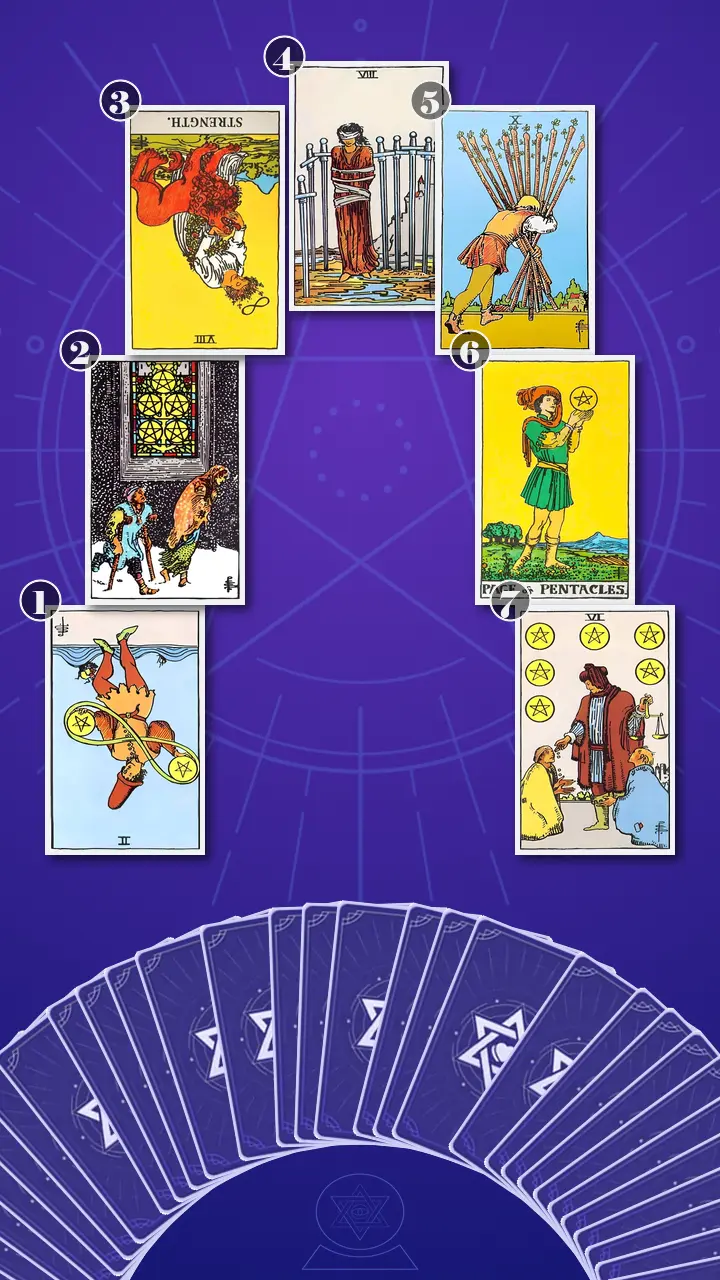
I chose the Horseshoe Spread because her question contained two separate needs at once: Where did this adulting shame spiral actually begin, and what is maintaining it now? The Horseshoe is excellent for that. It traces a clean arc from origin point to present symptoms, then down into the hidden driver, the core blockage, the outside pressure, the best available advice, and the near-term direction that opens if that advice is practiced. No excess complexity. Just a root-to-repair chain.
I told her I would be watching four points especially closely: the first wobble in her everyday rhythm, the central trap that keeps backlog turning into paralysis, the card of practical advice, and the final card showing whether support could re-enter the story. She nodded once, still guarded, but more focused now than when she had arrived.
Reading the Arc: Where the Wobble Began
Position 1: The Juggle That Stopped Being Flexible
I turned the card for the earliest place the everyday rhythm began to wobble. It was the Two of Pentacles, reversed.
In real life, this card looked exactly like the subway ride home she had already described to me: phone warm in her hand, fluorescent light buzzing overhead, Slack open, then the bank app, then Uber Eats, then her calendar, then the messages she still meant to answer. Motion everywhere, completion nowhere. The energy of the reversed Two here was not laziness. It was unstable excess. Too many coins in the air, not enough ground under either foot.
I told her the spiral often begins this way: not with one grand collapse, but with repeated tab-switching that slowly erodes trust in your own follow-through. Her mouth twitched into a brief, bitter laugh. ‘That’s… annoyingly accurate,’ she said. The laugh had that particular edge people use when something is so true it feels almost rude.
Position 2: Outside the Warm Room
The next card was for the current symptom cluster, the visible shape the spiral is taking now. Five of Pentacles, upright.
This was late rent, takeout containers, and the muted group chat all landing in the same emotional register. The card showed what her week already felt like from the inside: temporary strain mistaken for personal exile. The lit window in the card became, in her life, the active chat, the ease of other people making brunch plans, the sense that everyone else had somehow remained inside the warm room while she had slipped out into the cold. Silence can feel protective right up until it starts feeling like exile.
I told her, ‘This card does not say you’ve lost your place. It says you’ve started reading a rough stretch as if it revoked your right to warmth, help, and ordinary re-entry.’ Her gaze dropped to the table. She rubbed the cuff of her sleeve between two fingers and went very quiet.
Position 3: When the Inner Spotter Turned Harsh
I turned the card for the hidden inner driver, the part not being said out loud. Strength, reversed.
This is one of those cards people misunderstand. Upright, Strength is not brute force. It is steady regulation. It is the part of the self that can meet fear without turning cruel. Reversed here, that regulating voice had thinned out and curdled. A five-minute admin task became a thirty-minute prosecution. The task was small; the meaning attached to it was huge. Instead of a calm internal spotter saying, ‘Easy, one step at a time,’ she had an angry manager in her head saying, ‘Normal adults just handle this.’
I said, ‘Late is not the same thing as incapable.’ The moment I said it, her jaw loosened. Not dramatically. Just enough to notice. Then came one of those longer exhales that tell me a card has named the engine under the behavior. ‘I genuinely thought I was just being dramatic,’ she admitted.
Position 4: Eight of Swords and Why Small Tasks Feel Impossible
The fourth card sat at the top center of the horseshoe, the visual peak and the core self-reinforcing blockage. Eight of Swords, upright.
This is the card that answered the question so many people search in the middle of a shame loop: why do small tasks feel impossible when I’m stressed? Because the task stops feeling like a task. It starts feeling like a test. In Jordan’s case, this was the phone in hand, the draft unsent, the cursor blinking, the bank app unopened because no next move felt big enough to count. Her mind had fused repair with redemption. If she could not erase all of it, she felt she should not start any of it.
I pointed to the loose bindings in the image and said, ‘This is what makes the spiral so convincing. You are not imagining the freeze. It is real in the body. But the trap is narrower than it feels. A backlog is not a character reference.’
She froze for a beat, eyes fixed on the card, then gave a tiny nod that barely moved her chin. ‘This is the exact loop,’ she said. There it was: first the brief physical stillness, then the recognition crossing her face, then the drop in her voice when the truth of it landed.
Position 5: The Weight Is Real
The fifth card showed the outside pressures amplifying everything from the environment around her. Ten of Wands, upright.
I was glad to see it, honestly, because this card corrects a common cruelty people commit against themselves. Sometimes the pressure is real. Work deadlines, high rent, digital admin, commuting fatigue, apartment upkeep, and friendship maintenance had all landed in the same nervous system without enough recovery space between them. The energy here was overload, not weakness. The bundle was so dense it blocked the figure’s line of sight; in Jordan’s life, that meant each responsibility had blurred into one heavy mass.
I told her, ‘Part of why this feels like a life admin shame loop is that your life actually has been crowded. Competent on Slack and unraveling in personal admin is not a moral defect. It’s a modern split-screen problem.’ She gave me a look that said she had never felt more seen by a sentence.
When the Page of Pentacles Held One Coin
Position 6: Page of Pentacles Advice for Overwhelm and Shame
When I turned the sixth card, the atmosphere changed. It often does when the antidote finally appears. The late afternoon light on my table caught the gold of the pentacle, and for a moment the room felt less cluttered by her story and more precise inside it.
This position offered the most useful reorientation, the smallest workable shift that could reopen movement. The card was the Page of Pentacles, upright.
This is where my archaeological training always comes forward. I use something I call Historical Case Matching: I compare a person’s life choice to a civilization at a crossroads. Societies do not recover from strain because they deliver a stirring speech and become impressive overnight. The ones that endure restore one load-bearing system at a time: a water channel cleared, a gate ledger corrected, a storage room counted properly again. The Page belongs to that family of turning points. It asks a long-term value question: what one concrete act, repeated, protects the future better than tonight’s avoidance?
At 8:41 p.m. on Sunday, the fridge hum is loud, the takeout smell has gone stale, and the bank app is still unopened. The hardest part is not the mess itself. It is how quickly the mind turns three separate tasks into one verdict about the self. The spiral gets cruel when a backlog stops being a list and starts acting like a personality test. Dignity returns the moment one task becomes just one task again.
Stop treating the pile as proof you failed; hold one coin, do one task, and let steadiness grow from what the Page of Pentacles can actually carry.
Jordan went still in three waves. First her breathing caught, brief and shallow, as if she had missed a stair. Then her eyes drifted past the card and unfocused, the unmistakable look of someone replaying a recent scene; I would have wagered she was back at that Thursday lunch break, rent email open, jaw locked, telling herself it was already too loaded to touch. Then the feeling arrived, and it wasn’t relief at first. It was anger. ‘But that’s so small,’ she said, sharper now. ‘So what, I’ve been wrecked for weeks by something I could’ve done in ten minutes?’ I shook my head. ‘No. You were not defeated by a ten-minute task. You were paying interest on shame.’ That changed her posture. Her shoulders lowered. One hand opened flat on the table. She let out a shaky laugh and rubbed at the corner of one eye. When I asked, ‘Using this lens, was there a moment last week when this would have changed how you felt?’ she answered immediately: ‘Thursday. If I’d just logged in and written the number down, I think I would’ve stayed with it.’ That was the crossing: not a miracle, but the first real move from shame-driven avoidance toward practical self-trust.
Position 7: Exchange Over Exile
The final card showed the near-term direction if she practiced the Page’s advice. Six of Pentacles, upright.
I love this ending for readings like this because it is not about becoming polished. It is about allowing exchange to return. The same story that began with Five of Pentacles, feeling shut out of the warm room, ended with visible scales and an open hand. In practical terms, that meant a realistic payment conversation instead of private panic, one honest message instead of a perfectly drafted apology, maybe even letting someone sit with her while she did the admin. Support did not need to be earned by first becoming immaculate.
I told her, ‘This is not a fixed prediction. It’s a direction. If you practice the Page, life starts moving from secrecy to reciprocity.’ Her whole face softened at that. Not with triumph. With something better: permission.
From Comeback Fantasy to One Repeatable Repair
When I looked at the full horseshoe, the story was remarkably clean. First came the wobble: too much juggling, not enough completion. Then came the visible strain: late rent, takeout buildup, social silence. Beneath that sat the shame engine, where every tiny task got inflated into a referendum on worth. At the center, Eight of Swords fused the whole backlog into one trap. Around it, Ten of Wands confirmed that the load pressing on her was real. Then the spread deliberately stepped down the escalation ladder: not more force, not a harsher reset, but apprenticeship, one coin, one act, and finally exchange returning.
I told Jordan that her cognitive blind spot was not disorganization. It was treating every neglected task as evidence of failure, and treating support as something she had to earn after perfection. Using my Time Stratigraphy Method, I separated the loud layer from the lasting one. The loud layer said, ‘Fix everything now so nobody sees the mess.’ The lasting layer was simpler: protect housing, reduce visual pressure at home, and reopen one human link. That was the transformation direction in plain English. You do not need a comeback weekend. You need one repeatable repair.
She glanced back at the Page and said, ‘But I don’t actually have some serene spare hour after work. By the time I get home, I’m done.’ I nodded. ‘Then we do not plan for your fantasy self,’ I said. ‘I use a Voyage Log Technique for this. Ancient navigators did not plot routes based on ideal weather. They logged the wind they actually had. So we build for the week you truly live, not the week guilt keeps promising.’ Then I added the line I wanted her to remember: ‘Make the task smaller before you make yourself smaller.’
- The 15-Minute Stability SlotBook one 15-minute rent or admin block this week at a real time and place your life can carry, such as Wednesday at 7:15 p.m. at the kitchen table with a glass of water, or Thursday at 12:25 p.m. at your desk if evenings are dead. Before opening any app, write one sentence on paper: ‘This session is only for finding the exact amount due, making one transfer, or drafting one payment question.’ When the timer ends, stop on purpose.If the balance makes your chest spike, the minimum version is just logging in and writing down the number. Small still counts.
- The One-Surface ResetTonight, choose one visible patch of home only: one counter, one sink section, or the floor beside the bed. Throw out takeout bags and containers first and nothing more is required. Pair it with one song, one podcast segment, or an eight-minute timer so the task has an end point.Do not let this become a full apartment rescue mission. The goal is not a glow-up weekend. It is proving movement is possible without punishment.
- The Honest Re-Entry TextSend one low-drama message this week, either to the group chat or to the safest single friend first: ‘Hey, I went quiet because I got overwhelmed. No neat reason, just reappearing. Hope you’re okay.’ One sentence is enough. No polished explanation required.If sending feels too exposed, draft it in Notes and wait ten minutes. The smallest version is one line or even a heart reaction that reopens the door.

A Week Later: Ownership, Not Certainty
Six days later, Jordan sent me a screenshot of a calendar block titled One Coin. Under it she wrote, ‘Opened the rent portal, wrote the number down, made one transfer, cleared the counter, texted Maya. She replied in two minutes like nothing weird had happened.’ There was no cinematic before-and-after. That was precisely why I trusted it.
She also told me she slept properly after setting a payment plan, though her first thought at 7 a.m. was still, what if I slide again? This time she smiled, put the kettle on, and turned on the kitchen light anyway.
That is what a real Journey to Clarity usually looks like to me. The Horseshoe tarot spread did not magically rescue her from rent, clutter, or modern life. It traced the origin, blockage, and repair path of an adulting shame spiral clearly enough that her own agency could come back online. Once the pile stopped functioning as a verdict, she could move from frozen avoidance toward practical self-trust and reciprocal support.
And if you’re in that place tonight, where rent alerts, takeout bags, and unanswered messages all start feeling like evidence against you, so even a tiny notification makes your chest brace as if you’re about to be found out, then let me leave you with the only question that really matters: if one small repair were allowed to count tonight, which one coin would you be willing to hold first so your world feels even 2% less closed?
This story is adapted from psychological research, written so that those in a similar struggle can see their own pattern in it — and find their next step clearly.These insights are not a substitute for professional psychological, medical, legal, or financial advice.
Learn more about our Journey to Clarity.
How did this insight land for you?
🫂 This Resonates Deeply
🌀 Living This Story
✨ Now I See Clearly
🌱 Seeing New Possibilities
🧰 Useful Framework
🔮 The Confirmation I Needed
💪 Feeling Empowered
🚀 Ready for My Next Step
Author Profile
 AI
AI“Having spent a lifetime at Cambridge and on archaeological digs, I’ve witnessed the rise and fall of countless civilizations. Please know that your current struggles are not a permanent fate, but merely a necessary fracture before rebuilding. I won't lecture you; instead, I invite you to sit with me in the ruins, using a patient, historical perspective to gently dust off the true, enduring value hidden beneath your temporary doubts.”
In this Choice Tarot Reading :
Core Expertise
- Historical Crossroad Matching: Contextualizing your dilemma by comparing it to macro-historical turning points, providing an objective bird's-eye view.
- Enduring Value Assessment: Evaluating competing options based on what will survive the test of time versus what is merely a short-term impulse.
Service Features
- The Time Stratigraphy Exercise: A mental time-travel protocol evaluating your current dilemma strictly from the perspective of your 10-year future self, instantly dissolving trivial anxieties.
Also specializes in :
Explore Related Patterns:
Action ParalysisJordan's after-work loop moves from Slack to the banking app to Uber Eats to calendar to messages, but the movement does not create completion. The rent portal stays unopened, the draft stays unsent, and the takeout containers remain beside the sink, so her nervous system is spending energy without converting any of it into closure. That is the mechanism of Action Paralysis: pressure does not produce one clean decision, it produces a frozen field of competing micro-demands. You are not looking at laziness in this story; you are looking at a defensive freeze response where every possible next step feels either too small to matter or too exposed to risk. The spiral starts when the backlog stops being a sequence and becomes a blocked operating system. Once the mind fuses rent, home mess, and messages into one threat cluster, even a ten-minute task feels like entering the whole verdict at once. The useful move is not a heroic reset, but separating the pile until one action becomes psychologically safe enough to complete.
Black-and-White ThinkingJordan's rent, takeout containers, and muted group chat become one giant red badge instead of three separate repair points. The backlog stops being a list and starts acting like a personality test, which collapses practical choices into an all-or-nothing verdict. That is Black-and-White Thinking in a high-pressure life-admin spiral. The cognitive distortion says either everything gets fixed and you are normal again, or one small step is pointless because it cannot redeem the whole mess. This makes partial repair feel emotionally invalid even when it would be practically effective. You can see the distortion break when the advice becomes one coin, one task, one repeatable repair. The point is not to deny the weight of the load; the story is clear that the pressure is real. The shift is learning to stop treating incomplete repair as failed repair.
Conditional Self-WorthJordan looks at late rent, takeout bags, and unanswered messages and fears they will say something final about her worth. The apartment does not just look messy to her; it starts to read like evidence that she is not a real adult, not stable enough, not normal enough. Conditional Self-Worth is the cognitive schema underneath that shift. The mind ties basic self-respect to visible competence, so ordinary backlog becomes a referendum on whether you deserve ease, help, or re-entry. In this state, support feels like something you can access only after you have made yourself presentable. The story's repair matters because it breaks that contract. Jordan does not become worthy by clearing everything; she regains agency by making one transfer, clearing one counter, and texting Maya while still imperfect. The pattern softens when worth is no longer held hostage by flawless functioning.
Fresh Start FantasyJordan says she needs one clean weekend and then she will be normal again. That sentence turns repair into a comeback fantasy: a single ideal block of time where rent, clutter, messages, and self-respect all get restored together. Fresh Start Fantasy is not simple optimism; it is a defense against the discomfort of small, imperfect continuity. The fantasy self has a serene spare hour, a clean apartment, and enough emotional energy to fix everything in one sweep. The actual self gets home depleted, sees the pile, and freezes because the imagined reset is too big to begin. The story's antidote is deliberately unglamorous: a 15-minute stability slot, one surface, one re-entry text. You can feel the mechanism shift when Jordan stops planning for the week guilt keeps promising and starts building for the week she truly lives. Stability returns through repeatability, not through a dramatic reset.
Shame-Driven DelayThe rent reminder does not stay a rent reminder for Jordan. Her shoulders climb, her stomach drops, and a routine notification becomes an emergency signal because the task is carrying shame far beyond its practical size. Shame-Driven Delay shows up when the mind attaches identity-level meaning to ordinary repair. A five-minute admin task becomes a thirty-minute prosecution; opening the banking app starts to feel like standing trial for being a failed adult. The delay is not simply avoidance of the task, but avoidance of the self-judgment the task now seems to unlock. You can see the loop in the line about needing one clean weekend before she can be normal again. Shame says repair only counts if it restores the whole self-image at once, which makes starting feel dangerous. The pattern loosens when one task is allowed to be just one task, not a character reference.
Emotional CutoffJordan's group chat is muted while the unread messages keep chattering on the screen. At first, silence works as protection because it lowers exposure, but the same silence starts to feel like being outside the warm room while everyone else is still inside. Emotional Cutoff appears when withdrawal becomes the main way to manage shame and overwhelm. Instead of sending an imperfect message or letting a friend see the unfinished state, the system chooses distance. The defense reduces immediate pressure, but it also removes the reciprocity that could make the pile feel less private and less total. The repair is not a polished confession; it is one honest re-entry text. That matters because the pattern does not require becoming socially flawless before reconnecting. It asks whether support can return while the task is still ordinary, unfinished, and human.
Explore Related Struggles:
Catch-Up ParalysisJordan's phone is already in her hand, the rent portal is one tap away, and the message draft exists before it is sent. The problem is not that there is no possible move. The problem is that every possible move feels too small beside the size of the pile. Catch-Up Paralysis appears when repair is imagined as a full comeback weekend instead of one repeatable action. You wait for the version of yourself who can clean the whole apartment, settle the whole rent problem, explain the whole silence, and return fully normal. While that version is being awaited, the ten-minute action that could reduce the pressure gets stranded. The struggle is not laziness or a lack of care. It is the bind of needing the first step to redeem the entire backlog before you allow it to count. Jordan's shift begins when one coin becomes enough: writing down the amount, clearing one surface, sending one honest line.
Identity Verdict LockLate rent, takeout containers, and unanswered messages do not stay separate in Jordan's kitchen. They collapse into one accusation, so the bank app is no longer just a place to check a number and the clutter is no longer just clutter. Each object starts carrying the same verdict: maybe she is not handling adulthood correctly. That is the lock. You are not only facing tasks; you are facing what the tasks seem to say about you when they are overdue, visible, or unanswered. A five-minute admin step becomes a trial of character, and the body braces because opening the app feels like opening the case against yourself. Identity Verdict Lock names the point where repair gets blocked because the pile has been given too much symbolic power. Once the rent amount, the counter, and the message thread become evidence of worth, ordinary action has to fight through a false courtroom before it can even begin.
Support Access SplitThe group chat keeps moving while Jordan stays quiet, and that silence gives her a little cover at first. No one has to see the late rent, the takeout containers, or the unfinished explanation. Then the same cover starts closing around her, and the active chat becomes the warm room she feels she has slipped outside of. Support Access Split is the divide between needing connection and believing connection has to be earned after the mess is cleaned up. You may have people within reach, but the unfinished state of your life makes the doorway feel conditional. The help exists, yet it feels unavailable until you become easier to witness. Jordan's repair path is so specific because it restores exchange before perfection. A realistic payment conversation, one honest text, or letting someone sit nearby during admin breaks the split by proving that support does not require an immaculate re-entry.
Mental Bandwidth DepletionThe spiral starts in a crowded split-screen life: Slack after work, the banking app, Uber Eats, the calendar, the messages still waiting, the apartment asking for care, the rent reminder arriving on top of it all. Jordan is not holding one problem; she is holding too many live tabs inside the same tired body. Mental Bandwidth Depletion names the pressure point where the system has no clean recovery margin left. You can still look functional in one channel while another channel quietly breaks down, because attention is being spent on switching, bracing, remembering, avoiding, and catching up before any task is actually completed. That depletion matters because it keeps the pile from being read accurately. Rent, food, home, work, and friendship become one blurred mass, so the next practical action disappears inside the total weight. Separating the pile is the first act of power because it gives your attention one object to carry instead of asking it to carry the whole week at once.
Performative StabilityJordan can still appear competent in the work channel while her personal admin is quietly slipping at home. Slack can be handled, but the rent portal, the kitchen counter, and the group chat begin telling a different story after hours. The split is sharp because both versions are real. Performative Stability forms when looking okay becomes another load to carry. You keep trying to restore the appearance of being normal before anyone sees the backlog, which makes the backlog harder to touch. The performance does not solve the instability; it hides it long enough for the pressure to thicken. The story loosens when Jordan stops planning for a fantasy self with a clean weekend and begins building for the week she actually lives. Stability returns as something practiced in small visible acts, not something performed after the whole mess has been erased.
Explore Related Emotions:
Cautious Self-TrustSix days later, Jordan has a calendar block titled One Coin, opens the rent portal, writes the number down, makes one transfer, clears the counter, and texts Maya. The change is deliberately ordinary, which is exactly why it can hold. Cautious Self-Trust fits because the story does not end with certainty. Her first thought is still, what if I slide again, but she puts the kettle on and turns on the kitchen light anyway. Trust here is not a mood; it is the felt evidence that one small action can be completed without self-punishment. This emotion matters because it gives agency a believable scale. Jordan does not need to become a different person overnight; she needs enough proof, gathered in small repetitions, that she can meet the next concrete task without turning herself into the problem.
Grounded AgencyTwo slow breaths create a beat between bracing and seeing, and the pile is separated into protect housing, reduce visual pressure at home, and reopen one human link. The story becomes workable when it stops being one giant red badge and becomes a map with handles. Grounded Agency names the feeling of getting choice back through concrete structure. Jordan is not asked to become serene, impressive, or perfectly organized; she is asked to build for the week she truly lives and make the task smaller before she makes herself smaller. That is the practical emotional shift at the center of the reading. Agency returns through a real time, a real place, one bounded action, and a clear endpoint. The body can stop treating every notification as an emergency when the next move has a shape it can actually carry.
Life Admin ShameThree takeout containers sit beside the sink like small accusations, the rent reminder loads, and the muted group chat keeps moving without her. None of these details is dramatic on its own, but together they become a private courtroom where ordinary unfinished tasks start testifying against her character. You can feel Life Admin Shame in the way Jordan calls the problem normal life stuff while her body reacts as if the notification has exposed something much larger. The rent portal, the clutter, and the unanswered messages stop being separate repair points and merge into one humiliating image of adulthood she thinks she is failing. The emotional logic is precise: when admin becomes evidence of worth, avoidance starts to look like protection. Naming this feeling separates the task from the verdict, which is what lets one payment question, one cleared surface, or one honest text become a real act of repair instead of a confession of failure.
Performance FreezeThe phone is already in her hand, the cursor is already blinking, and the bank app is right there, yet no next move feels big enough to count. Jordan is physically close to action, but the task has swollen into a performance she does not know how to pass. Performance Freeze names the moment when a small repair stops being practical and starts feeling like a test of competence. A five-minute admin task becomes a thirty-minute prosecution because the mind demands proof that the whole self is still acceptable before it allows the first step. You can see the trap in the line between repair and redemption. If the action has to erase everything, then every action feels inadequate; once one task is allowed to be only one task, movement can return without requiring a perfect comeback.
Scattered OverwhelmSlack, the bank app, Uber Eats, the calendar, and the messages keep rotating through her hand after work. There is constant motion in the story, but very little completion, so the body never gets the clean signal that anything has actually landed. Scattered Overwhelm is the weather of too many small systems asking for attention from the same tired person. Jordan is not facing one single monster task; she is living inside a split screen where work competence, rent pressure, food decisions, home upkeep, and friendship maintenance all compete for the same narrow band of capacity. That is why the repair path has to shrink the field. The 15-minute slot and the one-surface reset are not cosmetic tricks; they give the nervous rush a boundary, so one object can become visible without the whole pile speaking at once.
Shame ReliefWhen she hears that late is not the same thing as incapable, Jordan’s jaw loosens. Later, her shoulders lower and one hand opens flat on the table, as if her body has been given permission to stop defending against the pile. Shame Relief is not a sudden happy ending. It is the quieter release that comes when a backlog stops functioning as a verdict. The tasks are still there, but they no longer have total authority to describe who she is. That relief matters because it creates room for repair without humiliation. Once the story separates lateness from incapability, Jordan can engage the rent portal, the counter, and the text thread as concrete realities rather than evidence against her entire self.
Start-Line ParalysisJordan says she just needs one clean weekend and then she will be normal again. The fantasy sounds hopeful on the surface, but it also keeps the first real action waiting for a version of her life that is not actually arriving after work. Start-Line Paralysis captures that stalled threshold. The bank app stays unopened and the message remains unsent because the beginning feels too small unless it can deliver a total reset. When the mind demands a comeback, a ten-minute repair can feel almost insulting. The story’s turning point comes when the standard changes from rescue to repeatability. One coin, one transfer, one cleared counter, one text: these are not grand enough to satisfy the fantasy self, but they are exactly the size that lets the real self begin.
Verdict DreadHer shoulders climb, her stomach drops, and her chest tightens the moment the rent reminder appears. The body is not only registering a bill; it is bracing for a verdict, as if the screen might confirm the harshest story she already fears about herself. Verdict Dread fits because Jordan is not simply worried about being late. She is afraid that if she looks directly at the rent, the takeout bags, and the unanswered messages, the whole pile will say something final about her worth. That is why the bank app feels loaded before it is even opened. This feeling keeps the spiral alive by making every repair attempt feel like a character trial. The clearer move is not to win the trial all at once, but to refuse the premise: a backlog can be handled without being allowed to define the person holding it.
Reciprocal WarmthJordan texts Maya, and Maya replies in two minutes like nothing weird had happened. After all the private pressure around silence, that simple response changes the temperature of the story. Reciprocal Warmth appears when support returns as an exchange rather than a reward for being immaculate. The honest re-entry text does not require a polished explanation, and the reply does not demand a performance of having everything together. This feeling is important because it contradicts the exile logic without shaming the silence that came before it. You can re-enter through one human link, not because the mess has vanished, but because connection is allowed to exist while repair is still in progress.
Social Exclusion DreadThe group chat is muted, but it is still alive. Brunch plans, casual updates, and other people’s ease keep glowing at the edge of the story while Jordan stays quiet in her kitchen. Social Exclusion Dread emerges because silence first gives her cover, then starts to feel like banishment. The chat becomes the warm room she can see from outside, and each unanswered message makes re-entry feel more exposed than the last. This is not about needing a perfect apology. The emotional pressure comes from believing absence has changed her place in the room. One honest re-entry text matters because it tests a different possibility: that connection may still be available before she feels fully cleaned up.
Explore Related Contexts:
Adulting Performance PressureJordan calls rent, dishes, and unread messages 'normal life stuff' and then immediately treats needing help with them as evidence that something is wrong with her adulthood. The key scene is not only the late rent reminder; it is the way a kitchen counter, a group chat, and a banking app all become public-facing proof in her private scorecard. Adulting Performance Pressure names that external cultural script: basic maintenance has to look effortless, and falling behind starts to feel like failing a visible adulthood test. In Jordan's story, that script is intensified by city rent, junior-work expectations, and the social feed of other people apparently managing brunch plans, clean weekends, and quick replies without friction. You can see where the spiral starts because the tasks stop being tasks and become a performance review of whether she is 'normal.' The repair path is not to become a flawless adult by Sunday night; it is to remove the audience from the task. A rent portal, a takeout bag, and one text can be handled as practical objects again once they are no longer forced to carry her entire legitimacy.
Life Admin BacklogJordan is standing in her apartment kitchen with late rent, stale takeout containers, and unanswered messages all arriving in the same mental pile. The story keeps returning to the same external pattern: separate pieces of maintenance lose their edges, and the banking app, home mess, calendar, and chat thread begin to function like one overloaded dashboard. That is the structure of Life Admin Backlog. The pressure is not just that one task is overdue; it is that too many small obligations now compete for the same depleted after-work window, so starting one item feels inadequate against the size of the whole pile. You are not looking at a character flaw in this frame. You are looking at an external maintenance system that has exceeded the amount of clean time, recovery space, and practical sequencing available. The useful audit point is that the backlog becomes movable only when the pile is separated again. Rent, one visible surface, and one reply are different repair tracks, not one verdict. Once each track becomes small enough to enter, agency returns through sequence rather than through a fantasy of fixing everything at once.
Financial Adulting PressureJordan's rent reminder lands at 8:41 p.m. in the same kitchen where the takeout bags and unanswered messages are already visible. The banking app is not just another tab in the loop; it is the place where an adult obligation has to be faced in numbers, timing, and consequences. Financial Adulting Pressure fits because the story frames money through rent logistics rather than abstract anxiety. Jordan has to open the portal, identify the amount, make one transfer, and later set a payment plan. Those are concrete financial responsibilities attached to housing stability, and they become harder to approach when they are mixed with shame about being behind. The pressure here remains everyday rather than catastrophic, which is exactly why it is so recognizable. You are dealing with the strain of becoming the person who can look directly at a bill, ask a practical payment question, and keep housing admin separate from self-judgment. The turning point is not perfect financial control; it is replacing private panic with one visible, trackable money action.
Support Access BarrierJordan reads late rent, takeout buildup, and unanswered messages as if they have pushed her outside the warm room. The story shows support nearby in several practical forms: a payment conversation, one honest message, a friend who can receive her return, and even the possibility of someone sitting with her while she does the admin. Support Access Barrier names the external blockage between available help and usable help. Jordan is not shown as completely alone; she is shown treating help as something she can approach only after she has cleaned up the evidence. That creates a closed loop where the moment she most needs ordinary support is also the moment she feels least permitted to use it. The repair is to lower the entry requirement for connection. You do not have to become immaculate before asking a question, sending a text, or letting another person witness one unfinished task. The barrier weakens when support is allowed to arrive during the repair, not only after the repair has already been completed.
Cost-of-Living PressureJordan is a 27-year-old junior content strategist in Toronto, and the story names high rent as part of the outside weight pressing on her week. The late reminder matters because it arrives inside a city-worker routine already crowded by deadlines, commuting fatigue, digital admin, food delivery, and limited recovery time. Cost-of-Living Pressure is the wider stage around her spiral. The story does not present rent as an isolated mistake; it shows housing cost sitting close enough to the edge of daily functioning that one reminder can collapse the distinction between practical strain and personal failure. A junior salary, urban rent, and after-work exhaustion leave less room for ordinary delay. Seeing that structure matters because it restores proportion. You still need a concrete payment action, but the audit is more accurate when the pressure is placed back into the material environment that produced it. The rent reminder is not floating in a vacuum; it belongs to a Toronto life where the margin for being tired, late, or disorganized is thin.
Work Life Boundary CreepJordan's after-work loop starts with Slack and then slides into the bank app, Uber Eats, calendar checks, and unanswered messages. Even the subway ride home is not a clean transition out of work; it is another screen-based corridor where professional communication, money admin, food logistics, and social obligations compete for attention. Work Life Boundary Creep names the environment created when the work channel remains part of the evening's control panel. The issue is not simply that she checks Slack. It is that Slack sits beside rent, dinner, friendship maintenance, and home upkeep as if all of them belong to one continuous shift with no recovery border. That blurred border helps explain why the spiral starts before the rent reminder fully loads. You are watching an after-hours system with no protected landing zone. The practical repair is not only a better to-do list; it is rebuilding a boundary where work pings, financial admin, and domestic care no longer arrive as one merged demand.