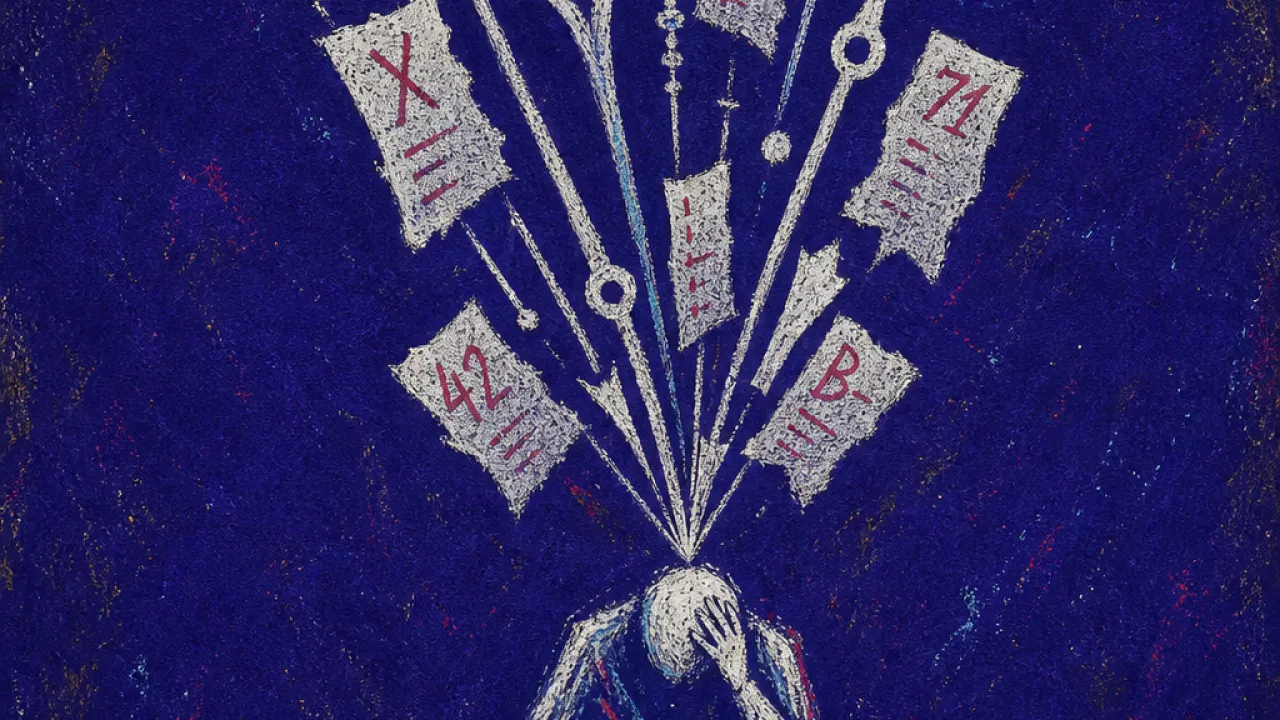
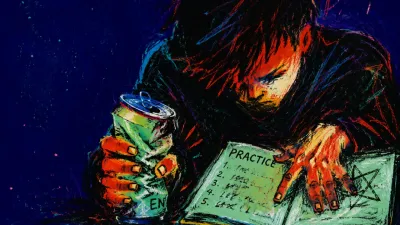
High-Stakes Exam Pressure is the moment a test stops feeling like one task and starts carrying grades, access, and next steps at once. The raised shoulders and tight stomach you notice while revising are signals from a room, clock, and score system built to concentrate consequence. This is an environmental and structural dynamic, not a private failure of focus. The Tarot Cards below mirror the shape of that timed assessment field.
The Emperor ReversedArmor under red robes, a stern gaze, and raised feet ready to rise turn the seated ruler into a figure of contained enforcement. The throne is stable, but the body is prepared for action, and the red sky presses heat into the whole scene. That pressure matches an exam structure where one timed performance is treated as proof of competence, eligibility, or future academic standing. You are facing more than a test; you are facing a compressed judgment ritual, and the useful clarity comes from seeing how the system concentrates power into a single room, date, or score.
The Chariot UprightThe armored driver stands in a motionless chariot with a command wand raised, fully dressed for a public test of control. The sphinxes wait in front of him, the city and its walls sit behind him, and the whole scene compresses preparation, rank, pressure, and performance into one visible platform. In an academic setting, this becomes the moment when knowledge has to move on command. You may have studied, built notes, and rehearsed the material, but the exam turns learning into a timed arena where focus, recall, and self-command are inspected under formal pressure. The Chariot links this context to the gap between preparation and execution. It does not frame the pressure as a lack of intelligence; it shows a system where the body has to steer competing forces while being visibly measured by the institution.
Strength ReversedThe lion's mouth is the most pressurized point in the image, held at the edge between release and restraint. Its claws disturb the ground, while the woman's body has to stay composed directly in front of that force. Exam pressure creates the same narrow channel. A whole semester of knowledge, timing, grading, and self-evaluation can be compressed into one timed opening, where the task is not simply to know the material but to keep the performance system from taking over the body. The card connects this context to contained intensity. You are not looking at a lack of ability; you are looking at a structure where stored academic force has to pass through a very small gate under public measurement.
The Hermit ReversedThe reversed Hermit holds one concentrated light on a high, exposed ridge. The scene compresses attention into a single point, while the narrowed ground makes the cost of misstepping feel immediate and visible. That is the structure of a high-stakes academic assessment: one exam, defense, interview, oral presentation, or final submission becomes the place where months of learning seem to be judged at once. The pressure is intensified by the sense that process disappears and only performance remains. The card does not reduce this to ordinary nerves. It shows an external evaluation setup where the student is placed on a peak, watched through the narrow beam of one outcome, and forced to carry too much academic meaning in a single moment.
Wheel of Fortune ReversedThe wheel gathers many directions into one hub while the corner figures keep reading from fixed positions. Around the rim, ascent and descent are attached to a single moving mechanism, so one turn appears to reorganize the entire scene. That visual pressure maps cleanly onto high-stakes exam pressure. You are not only facing a test; You are facing an academic structure where one timed performance can seem to carry grades, admissions, scholarships, placement, and self-definition at once, making the exam feel larger than the material itself.
Justice UprightSeated between the two pillars with the scales balanced in one hand and the sword held upright in the other, Justice turns assessment into a visible public structure. The scene is not a loose learning space; it is a hall where evidence, timing, and consequence are arranged around a single standard. In an academic setting, that visual logic maps cleanly onto finals, entrance exams, graded presentations, and defenses where one performance is treated as proof of competence. You are not just working through material; you are moving through a formal weighing system that can affect scholarships, progression, or program standing. The card's value is to separate the real stakes from the story that the exam measures your whole worth. Once the scales are named as an external assessment mechanism, you can see which part belongs to the institution and which part can be reclaimed as study strategy, pacing, and self-definition.
The Devil UprightThe black cube functions like a single controlling point: the ring, chains, bodies, and raised figure all organize around it. The background gives no wider campus, classroom, or road, so the whole scene compresses into one chamber of consequence. That is the architecture of a high-stakes exam when one score starts to stand in for competence, access, approval, and next steps. You are not facing a normal test environment; you are facing a system where one assessment has been loaded with too much structural power.
The Tower ReversedThe tower is already built at an impossible height when the lightning hits the crown, and the people inside are thrown out before any orderly descent can happen. That is the visual shape of an exam system where too much meaning is stacked onto one result. The pressure is not just that the test matters. It is that the whole learning structure has become vertical and brittle: one final, one standardized score, one timed performance, one moment where a semester of work is forced through a narrow opening. You are not being asked to treat the pressure as proof of weakness. The card makes the structure visible, so the question becomes which supports are real enough to carry you after the assessment shock: feedback, pacing, retrieval practice, accommodations in the ordinary academic sense, or a less fragile definition of progress.
Judgement UprightThe central trumpet gathers the whole landscape into one signal, while the figures below stand exposed in a contained arena. The mountains, open coffins, and ordered call create a pressure chamber where many separate histories are asked to answer at once. That structure maps directly onto finals, qualifying exams, entrance tests, and oral defenses. The assessment is not merely another task; it becomes the point where memory, performance, timing, and institutional ranking are forced into a single event. You regain agency by seeing the exam as a compressed system rather than a measure of total worth. The pressure is real, but its shape can be mapped: what is being tested, what is being staged, and what kind of readiness is actually being demanded.
King of Cups ReversedThe throne floats in open water with no visible land, dock, or exit point, while the King’s body remains composed at the center. The surrounding waves create pressure without giving the figure an obvious place to discharge it. Under exam conditions, that becomes the experience of having to perform clarity while the environment intensifies around a single outcome. You may know the material in fragments, yet the testing setup compresses memory, timing, evaluation, and self-presentation into one exposed seat. The card does not reduce the pressure to nerves. It shows an assessment structure where the demand to remain calm becomes part of the burden, and where the real leverage begins with seeing how the exam setting itself organizes the pressure.
Ace of Swords ReversedThe sword holds the crown on its point, concentrating recognition onto one narrow blade. Against the empty sky and barren ground, the scene reduces a wide field of learning into a single exposed performance line. That is the structure of an exam season where one paper, timed test, or score can feel like it is carrying the whole academic story. You are not being shown a lack of ability; the image maps the external compression that turns knowledge into a sharp gatekeeping event.
Three of Swords UprightThe red heart is held at the exact center while three sharp blades meet at the same vital point. A high-stakes exam works the same way when one timed assessment appears to carry grades, future options, self-presentation, and institutional judgment all at once. The swords are not chaotic; they are clean, straight, and formally placed. That precision matches the exam room, the score sheet, the qualifying test, or the final paper deadline: a rule-bound structure that can still land with real force. The gray rain around the heart gives the scene its pressure chamber. You are facing an external assessment system that has narrowed many parts of academic life into one visible result, and the card helps separate the actual test from the wider meaning that has been loaded onto it.
Four of Swords ReversedThree swords hanging above the knight's head, throat, and chest turn the wall into an overhead field of evaluation. The body is still, but the threat is not distant; it is positioned exactly where recall, speech, and proof of competence would have to pass. In exam season, that configuration becomes the pressure of a test that begins affecting output before the paper is even in front of you. You may be facing a system where the assessment structure is so dominant that revision, memory, and written response freeze around the demand to perform.
Eight of Swords ReversedThe bound figure remains upright while exposed sword points define the edges of her available space. The body is not collapsing, but it is being made to hold still under a rigid arrangement of consequences. Exam pressure works in a similar way when a single assessment appears to compress weeks of learning, identity, scholarship access, program progression, or future options into one narrow performance window. The swords become measures, timers, grade bands, and comparison points surrounding the student before the exam even begins. The card makes visible how pressure can shrink a study field until preparation feels like containment. It asks what part of the academic structure has turned learning into a fixed threat display, and where a more usable line of movement can be restored.
Nine of Swords UprightNine swords fixed in a tight horizontal stack above the bed create the look of an exam schedule turned into a ceiling. The lower blades cross the head, throat, and heart line, so evaluation is not floating in the abstract; it is drawn through the body’s thinking, voice, and confidence. In academic life, that visual pressure maps cleanly onto an assessment environment where one result appears to carry too much weight. You may technically be facing a paper, a final, a viva, or an entrance exam, but the structure around the test has made it feel like a total verdict on competence. The card does not frame the pressure as a personal flaw. It shows a high-stakes academic system pressing inward until sleep, preparation, and self-trust occupy the same narrow space.
Ten of Swords ReversedTen swords driven straight down into one body create the image of pressure concentrated into a single point of failure. The card does not show a gradual learning curve; it shows an assessment structure landing all at once, with the head, spine, and body line pinned under identical blades. In an academic setting, that visual logic maps cleanly onto the exam or viva that seems to carry every consequence at once. The student is not just answering questions; the whole system has been organized so one performance moment appears to decide competence, future access, and self-positioning inside the institution. The dark sky and exposed ground intensify the feeling that there is nowhere to hide from evaluation. You are being shown a structure where the pressure is real, but also where the pressure has become over-concentrated, making clarity depend on separating the test from your entire academic identity.
Page of Swords ReversedA young figure stands exposed on a windy ridge with the sword raised and the body braced for sudden challenge. The scene carries the physical logic of timed assessment: alertness must become performance before the ground has any softness to offer. High-stakes exams work the same way when one test compresses weeks of learning, grade consequences, scholarship requirements, or progression rules into a narrow window. You may have studied, but the structure demands retrieval under exposure rather than understanding in a stable environment. The card names the pressure as more than nervousness. It reveals an assessment container where the body, the rules, and the clock all turn knowledge into a public test of readiness.
Knight of Swords UprightThe armored rider leaning into the gallop with his sword raised turns the whole card into a picture of timed intellectual force. Horse, reins, wind, blade, and body all move in one direction, with no visual space wasted on hesitation or secondary routes. That visual structure matches the pressure of an exam setting where the external system rewards speed, accuracy, and visible command under a fixed time limit. The sword is not just thought; it is thought forced to perform immediately in public conditions. You are not looking at a calm learning environment here. You are looking at a testing field where the route is clear, the standard is sharp, and the body is required to convert knowledge into output before the wind changes.
Eight of Wands UprightThe eight wands descend in a single focused direction, with no figure in the scene to slow, negotiate, or soften their arrival. Their alignment creates the visual grammar of a timed event: everything is moving toward one point. For You, an exam can turn a whole learning process into a single compressed checkpoint. The card captures the external structure of that pressure, where preparation, evaluation, and self-measurement all seem to converge at once, making clarity about pace and target more important than raw intensity.
Nine of Wands UprightThe bandaged figure gripping one wand in front of a fence of eight turns preparation into a visible defense system. Every wand is grounded, but only one is in his hands, so the body becomes the last active point between prior effort and the next test. In an academic setting, that maps cleanly onto a high-stakes exam season where weeks of study sit behind you like a wall, yet the final performance still has to pass through recall, time limits, and scoring rules. The pressure is not simply that an exam exists; it is that one narrow event is being asked to validate a much longer stretch of work. The card names the structural problem without reducing it to personal weakness. You are standing at the point where preparation, evaluation, and self-protection meet, and clarity comes from seeing which part of the pressure belongs to the exam system rather than to your worth.
Ten of Wands UprightThe ten rods form a complete set, and the carrier's bowed posture makes that completeness heavy rather than satisfying. Nothing in the image is casual; the whole bundle has to reach the endpoint intact. A high-stakes exam compresses a term's worth of learning into the same kind of closed delivery structure. Concepts, grades, scholarships, program requirements, and future options can become fused into one performance checkpoint, even when the actual exam is only one academic event. You can read the card as pressure created by compression. It helps distinguish the real exam in front of you from the larger bundle of meaning that has been strapped onto it by the academic system.
Knight of Wands UprightThe armored rider poised above the rearing horse concentrates speed, discipline, and visibility into one compressed instant. The desert remains wide, but the body is gathered as if one immediate performance could decide the next stretch of ground. An exam or final can take on that same charged shape when a score starts to feel like a gate into future options. You are dealing with more than content recall; the structure around the test has loaded identity, access, and academic standing into a single checkpoint.
No cards available for this filter.