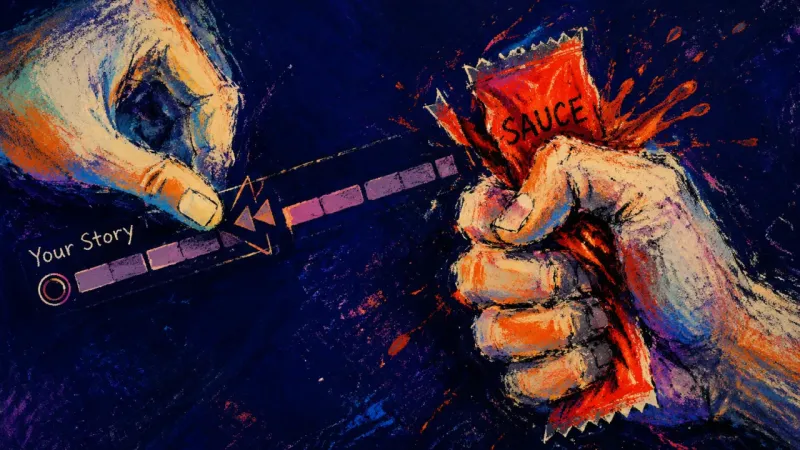
The 8:47 PM Streetcar and the Friend-Group FOMO Spiral
If you're a mid-20s city person who can go from normal commute to full friend-group FOMO in under thirty seconds because one Instagram Story hit at the wrong time, this is probably your exact spiral.
When Jordan sat across from me, she put her phone face down on my table the way people do with an object they half need and half resent. She was twenty-five, a junior marketing coordinator in Toronto, online all day for work and then still somehow ambushed by other people's togetherness on the ride home. Outside my window, the evening was wet and silver. Inside, the room held a soft bergamot note and the papery hush of shuffled cards.
She told me about a Tuesday at 8:47 p.m., riding the 504 streetcar with takeout on her lap. The fluorescent light buzzed overhead. Her phone felt warm in her hand. Soy sauce was leaking faintly through the paper bag while she tapped through a dinner Story, zoomed in on tags, and started matching faces to missed texts before she'd even reached her stop. Then came the body hit first: the stomach drop, the chest tightening, the restless thumb going back for one more look. After that came the private conclusion. If they wanted me there, they would've texted me.
When she said, 'I know it sounds small, but it never feels small to me,' I shook my head. It didn't sound small. It sounded like a trapdoor opening under her ribs while twenty browser tabs auto-played in her mind at once. Rejection panic often looks like overthinking from the outside, but from the inside it feels more like your whole nervous system trying to solve a social crime before the evidence disappears.
I told her gently, 'We don't need to shame the spiral to understand it. Let's make a map of it. That's how we get to clarity.'
Choosing the Compass: A Tarot Spread for Feeling Left Out by Friends
I asked Jordan to take one slow breath and hold the question in its real form, not the polished one. Not Am I being silly? Not What's wrong with me? Just: Why do I spiral when I see my friend group hanging out without me? Then I shuffled slowly, not as a performance of mystery, but as a way of helping her mind step out of scroll-speed and into attention.
For this reading, I chose the Relationship Spread · Context Edition, a five-card friendship tarot spread I use when the pain lives in the relationship field but the real work is not guessing absent people's motives. This is how tarot works best for a moment like this: it does not read their private group chat like a surveillance tool. It reads the pattern, the trigger, the wound underneath it, and the next move that gives power back to the person sitting in front of me.
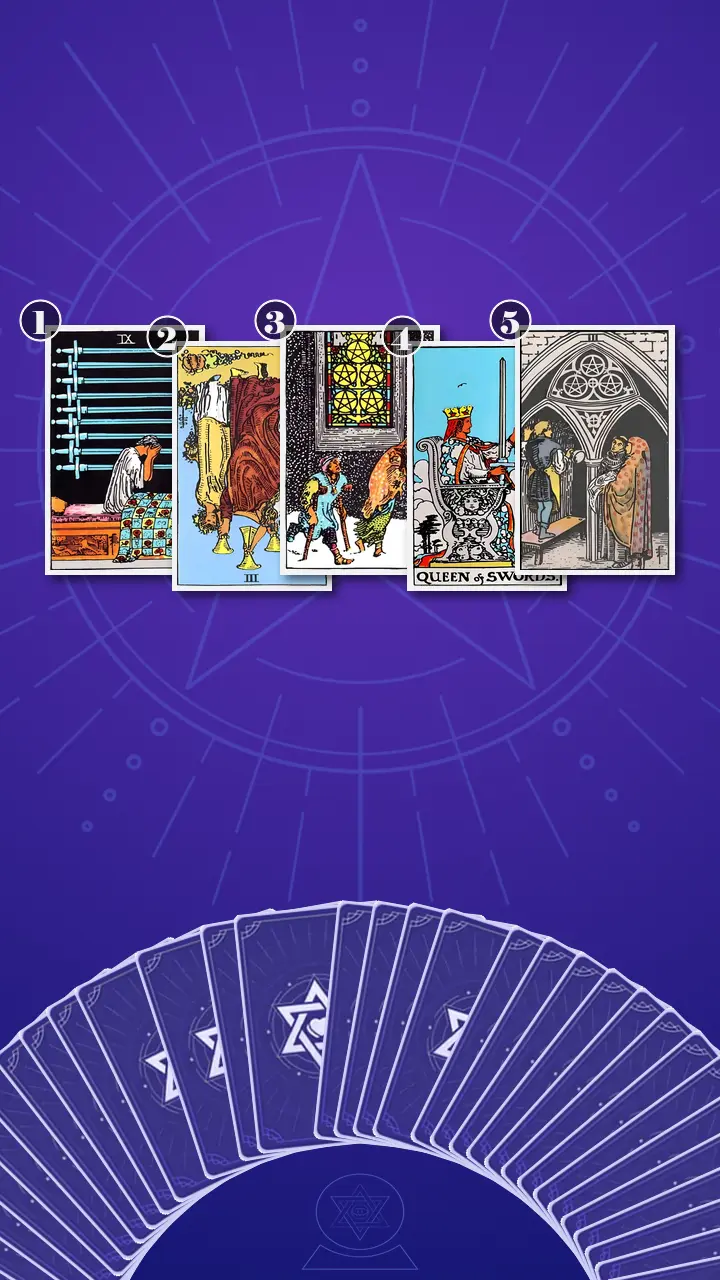
I told her why this spread fit so well. Five cards were enough to hold the whole chain without overcomplicating it: first, the immediate spiral response; second, the visible social cue that lights the fuse; third, the deeper belonging wound that gives that cue its charge; fourth, the corrective lens that interrupts catastrophic mind-reading; and fifth, the grounded next step that rebuilds connection through reciprocity instead of surveillance. In other words, we were not asking the cards to prove whether she was secretly unwanted. We were asking them to show us how one post became a verdict in her head, and how to stop treating social media like proof.
Reading the Map from Trigger to Wound
The Night Her Mind Became a Courtroom
I turned over the first card and said, 'This is the position that shows the immediate spiral response you described: checking posts, replaying details, and turning a social cue into an internal emergency.'
Nine of Swords, upright.
It was exact. This card is the moment close to midnight when the original Story lasted five seconds, but the internal emergency lasts three hours. In real life, it looked like Jordan lying in bed reopening tags, checking who was there, rereading her last few messages, and mentally reconstructing the night until the phone was hot in her hand and sleep was gone. The figure on the card sits up under a row of swords; to me, those swords were the stacked assumptions on her mental wall, lined up like evidence in a private trial.
This was excess Air: too much thought, too fast, with no grounding under it. The mind tries to get control by analyzing harder, but the analysis itself becomes the thing that keeps the alarm alive. It reminded me of a Severance-like split between what happened and the story the brain writes afterward, only her body had to live in both timelines at once.
Jordan gave a short laugh with a bitter edge. 'Okay,' she said, 'that's so accurate it's almost rude.' Her fingers went to the edge of her sleeve and twisted there. I smiled and told her, 'Good. Now we've named the loop before it gets to pretend it's insight.'
The Story That Looked Like a Closed Door
I turned the second card. 'This position represents the external social scene that triggers the spiral: the visible hangout, the group image, the exclusion cue that sets the whole reaction in motion.'
Three of Cups, reversed.
In its modern form, this card is brutally familiar: a cheerful group post becomes a social scoreboard. Jordan sees who got tagged first, who is standing closest, whose joke made the caption, who got the arm-around-the-shoulder photo, and she reads the image like a ranking of closeness instead of one unfinished snapshot of the night. Who got there first? Who knew about this? Was this planned in another chat? That is the reversed Three of Cups in digital-age friendship anxiety.
This is distorted Water. The emotion of connection is present, but it has tipped into comparison. Group joy gets read as a closed circle. Belonging can't be measured from the outside of a Story, but when this card shows up reversed, the nervous system keeps trying anyway, like reading one party photo as a seating chart of who matters most.
I watched Jordan's jaw set for a second and then release. She looked down at the card and nodded once, small and unwilling. 'I do the seating-chart thing,' she admitted. 'Every time.' That was the wince of recognition I was waiting for; not shame, just pattern naming.
The Lit Window in the Snow
I turned over the center card and said, 'This position reveals the deeper belonging wound and the meaning you attach to being left out. This is the part that makes a missed hangout hit like much more than a missed hangout.'
Five of Pentacles, upright.
Here was the real ache. In lived terms, this card is what happens when one missed plan lands in your body like you are outside a warm building looking in. Before anyone confirms anything, the omission has already become identity-level meaning: not I missed this, but I am the kind of person who gets left behind. The stained-glass light on the card and the figures in the cold mapped perfectly onto what Jordan had described on those Sunday afternoons in gray apartment light, kettle hissing in the kitchen, brunch photos appearing from a café twenty minutes away.
This is scarcity in Earth form: not unstable because it is dramatic, but unstable because it feels solid, factual, embodied. The spiral starts when pain turns into proof. That is why reassurance alone rarely works here. The hurt is not staying on the level of event. It stops being about tonight and starts feeling like evidence about who gets kept.
Jordan wrapped both hands around her mug, though the tea had already cooled. Her shoulders lifted a fraction, then dropped. 'Yes,' she said quietly. 'That's the part. It becomes about me slowly not mattering.' In that moment, the room felt smaller, as if even the rain against the glass had leaned closer. I asked her where she had first learned to read temporary distance as permanent rejection, and the silence that followed answered almost as much as words did.
When the Queen of Swords Changed the Air
A Tagged Photo Is Not a Verdict
When I turned over the fourth card, the whole reading shifted. I could feel it in my own body first, the way I do when a formula finally separates into clean notes after too much muddiness. 'This,' I told her, 'is the position that points to the key cognitive and relational shift: the lens that interrupts mind-reading, restores self-respect, and changes what happens next.'
Queen of Swords, upright.
In real life, this is the moment Jordan stops using detective work as self-protection. She writes down what she actually knows. She names what she is assuming. She chooses one direct interpretation or one honest reach-out instead of feeding a hundred imagined versions of the same hurt. The upright sword is the clean cut between feeling and storyline. The Queen's gaze says: we do not need to become cold to become clear.
Because I am a perfumer, I have a very specific way of reading moments like this. I call it Aura Permeability Diagnosis. Some environments are like overly aggressive scents in a room; if your boundaries are too porous, one note takes over everything. Jordan's problem was not that she felt too much. It was that one visible social note, one photo, one tagged Story, was flooding the whole inner atmosphere until her own reality had no clean air left in it. The Queen of Swords does not shame sensitivity. She ventilates it. She clears the room so truth can be smelled again.
I asked her to picture the ride home: dinner cooling in her lap, phone warm in her hand, one Story turning into a full private case file before she had even reached her stop.
The Sentence That Split Hurt from Story
A tagged photo is not a verdict; let the Queen's sword cut through the story you invented so you can choose one honest, grounded reach-out over ten imagined rejections.
The pain is real. The conclusion is unverified. A missing invite can sting without becoming proof that you do not belong.
Jordan went still in three clear beats. First, her breath caught and her thumb froze above the black screen of her phone, as if her body had reached the exact second it normally reopens Instagram. Then her eyes lost focus, not in dissociation but in replay; I could almost see her revisiting some recent Story, some group chat wake-up, some sentence she'd written and deleted. Then came the emotional release, but it wasn't clean relief at first. It was resistance. 'But if that's true,' she said, a flash of anger crossing her face before her voice thinned at the edges, 'then have I been doing this to myself?'
I answered her carefully. 'You've been trying to get certainty from incomplete information. That's not the same as making it up. It means your hurt has been real, but you've been asking panic to do the job of discernment.'
I let the words settle. Then I asked, 'Now, with this new perspective, think about last week. Was there a moment when this would have changed the night for you?'
She exhaled so deeply her shoulders finally dropped away from her ears. There was almost a slight dizziness in it, the kind that comes when a body sets down something heavy it has been carrying for too long. 'Yes,' she said. 'I would've stopped before rereading the chat. I would've written what I actually knew. I probably would've texted one person instead of disappearing.'
That was the crossing point of the whole reading: not from hurt to numbness, but from rejection panic and detective-mode checking to self-respect, discernment, and steadier belonging. The Queen was not teaching her to be unbothered. She was teaching her to be accurate.
Building Belonging Instead of Monitoring It
I turned over the final card. 'This position offers the next grounded way to rebuild connection through action, reciprocity, and reality-based participation rather than surveillance.'
Three of Pentacles, upright.
I loved the precision of this ending. Earlier, the reversed Three of Cups showed belonging as something witnessed and compared. Now this Three showed belonging as something built. In modern terms, it looked like Jordan making one low-pressure plan, showing up, following through, and paying attention to who collaborates with her in real life. A Wednesday coffee. A post-work walk. An actual calendar invite instead of grading herself from the hallway.
This is balanced Earth: constructive, observable, reciprocal. It does not promise inclusion in every spontaneous plan, because no card should flatter us with impossible guarantees. It offers something better: a way to participate that gives clearer information than doomscrolling ever will. Friendship is more like a shared Google Doc than a feed you monitor from the outside. The question shifts from Was I chosen tonight? to How is belonging actually built here?
Jordan's mouth softened at that. Not a huge smile. Just the first sign of room. 'That feels less humiliating than what I usually do,' she said. I nodded. 'Exactly. Because collaboration is quieter than comparison, but it's also much more honest.'
Facts Before Fallout
When I laid the whole spread back to Jordan, the story was clean. A visible social cue hit her nervous system fast and hard, and the Nine of Swords turned that hit into a courtroom. The reversed Three of Cups made one image feel like a social ranking. The Five of Pentacles gave that image its deepest charge by translating one missed moment into an old fear of being outside the warmth. Then the Queen of Swords interrupted the entire chain, separating hurt from interpretation. Finally, the Three of Pentacles showed where real repair lives: not in getting invited to everything, but in building connection through direct contact, reciprocity, and visible effort.
I told her the blind spot was this: she had been treating social visibility as proof of her worth and silence as protection. But silence was letting the spiral speak on her behalf. The transformation direction was simpler, and braver: move from treating social media as a verdict to treating it as incomplete information, then name a need directly or create one real point of contact. You do not have to investigate your way into feeling secure.
- The 20-Minute Air GapThe next time a post stings, put your phone face down and set a twenty-minute timer before reopening Instagram. Before the timer starts, use my Scent Bubble Protocol: picture a clear ring of air around your body, press your thumb to your wrist, inhale once, and say, 'I can feel this without letting it fill the room.'If twenty minutes feels impossible, start with five. If you're too activated, mute Stories for the night instead of forcing yourself to act chill.
- Facts, Story, Next Respectful StepOpen your Notes app on the streetcar, in the office bathroom, or before bed. Make three headings: 'Facts,' 'Story,' and 'Next respectful step.' Write three bullets under Facts, three under Story, and one tiny action under the final heading, even if that action is simply 'Do nothing until tomorrow.'Stop after the facts if your body is still flooded. This is about reality-checking the narrative, not suppressing the feeling.
- One Clean SentenceText one trusted friend individually instead of performing okayness in the group chat. Try: 'Hey, I'd love to be looped in next time if there's room,' or make one concrete plan instead: 'Want to grab coffee Wednesday after work?' Send the clear version, not the third draft designed to sound perfectly unbothered.Choose the safest, most responsive person first. No evidence dossier, no passive-aggressive testing, and no second follow-up that same night.
A Week Later, the Screen Felt Smaller
Six days later, Jordan sent me a screenshot. One text bubble read: 'Want to grab coffee Wednesday after work?' The reply underneath said yes, with a real time and a real café. Below that, she added, 'I almost did the whole tag-checking thing on Sunday, but I did Facts vs Story instead and didn't disappear.'
She slept through the night after sending it, then woke with one old thought: What if I'm still wrong? This time, she smiled at the thought, let it pass, and opened Notes before Instagram.
That is what a Journey to Clarity often looks like in real life. Not a magical ending. Not permanent certainty. Just the moment when a person stops letting one image write the whole script. The Relationship Spread · Context Edition did not decide Jordan's worth for her. It helped her return to it.
There is a very specific ache in seeing people you love under warm light and feeling your body decide, before the facts arrive, that you must already be on your way out. If that ache is familiar, please know this: the moment you separate hurt from proof, you are already no longer standing at the very start of the spiral.
If you treated the post as incomplete information instead of a verdict, what small, honest move would feel most like self-respect this week?
This story is adapted from psychological research, written so that those in a similar struggle can see their own pattern in it — and find their next step clearly.These insights are not a substitute for professional psychological, medical, legal, or financial advice.
Learn more about our Journey to Clarity.
How did this insight land for you?
🫂 This Resonates Deeply
🌀 Living This Story
✨ Now I See Clearly
🌱 Seeing New Possibilities
🧰 Useful Framework
🔮 The Confirmation I Needed
💪 Feeling Empowered
🚀 Ready for My Next Step
Author Profile
 AI
AI“As a perfumer for fifteen years, I’ve learned to perceive human boundaries through the delicate metaphor of scent. Relationships need the right amount of space to breathe, and I've seen too many kind souls exhaust themselves trying to please everyone. I’m here with warmth and understanding—not to teach you to be guarded, but to help you gently clear the air and rediscover the comforting, safe boundaries that are rightfully yours.”
In this Social Tarot Reading :
Core Expertise
- Aura Permeability Diagnosis: Using scent as a metaphor to identify environments where your personal boundaries are too porous, allowing toxic group vibes to permeate.
- Sensory Overload Management: Diagnosing the physical and emotional exhaustion caused by absorbing the chaotic energy of crowds.
Service Features
- The Scent Bubble Protocol: A visualization and somatic anchoring technique to establish an impenetrable energetic perimeter before entering draining social ecosystems.
Also specializes in :
Explore Related Patterns:
Certainty SeekingJordan keeps looking for more data inside the Story: tags, captions, proximity, timing, missed texts, possible side chats. The checking feels rational because the mind is trying to answer one urgent question with enough detail to stop the ache. That is Certainty Seeking because the defense is trying to convert social ambiguity into a clear yes-or-no verdict. You are not wrong for wanting clarity, but the platform cannot give the kind of relational certainty You are asking from it. The more the mind hunts for proof, the more uncertainty it manufactures.
Comparison TrapJordan does not just see friends having dinner. She sees who is tagged first, who stands closest, whose joke made the caption, and who seems to occupy the warm center of the group. That is the Comparison Trap because visible togetherness becomes a scoreboard for invisible belonging. You start measuring Your place from outside the room, using an unfinished snapshot as if it were a ranking system. The trap is that comparison feels like information while quietly converting connection into status.
Exclusion SpiralThe dinner Story on the 504 streetcar does not stay as a five-second image. Jordan checks tags, matches faces to missed texts, rereads messages, and turns the visible hangout into a private case file before she reaches emotional ground. That chain is Exclusion Spiral because the cue moves through several layers at once. A public image becomes a ranking, the ranking becomes a rejection verdict, and the verdict becomes a story about whether You still belong. The spiral keeps its power because it feels like social detection, but it is actually incomplete information being processed through panic.
Mind ReadingJordan sees the Story, zooms in on tags, matches faces to missed texts, and starts answering questions nobody has actually answered for her. Was this planned in another chat? Did they not want her there? Did the silence mean exclusion? That is Mind Reading because the mind fills the gap between visible behavior and invisible motive with a rejection-based explanation. You may be trying to protect yourself from being blindsided, but the defense starts treating guessed intent as confirmed fact. The result is a private courtroom built from partial evidence.
Rejection SensitivityThe stomach drop, chest tightening, and restless thumb arrive before Jordan has direct information about why she was not there. The conclusion follows fast: if they wanted me there, they would've texted me. That is Rejection Sensitivity in a friendship context. The nervous system treats a missing invite as early evidence of being unwanted, so You are not just reacting to a plan You missed; You are bracing against the possibility that belonging is being quietly withdrawn. The hurt is real, but the speed of the verdict is the pattern.
CatastrophizingThe original Story lasts a few seconds, but Jordan's internal emergency can last for hours. By bedtime, the missed dinner is no longer just one plan; it has become evidence that she is slowly not mattering. That is Catastrophizing because the mind leaps from a limited social cue to a much larger threat narrative. You are not simply noticing an awkward omission. You are watching the brain turn one uncertain moment into a prediction about permanent exclusion, which keeps the alarm alive long after the post is gone.
Conditional Self-WorthThe missed hangout does not stay on the level of scheduling. For Jordan, it shifts into the deeper sentence: I am the kind of person who gets left behind. That is Conditional Self-Worth because social visibility starts acting like a measurement of value. You are not only asking whether You were included this time; You are asking whether Your place is secure enough to count. When worth depends on being visibly chosen, every unseen plan can feel like a verdict.
Emotional ReasoningJordan's body reacts first: stomach drop, chest tightening, the urge to look again. Because the sensation is so strong, the conclusion that she has been excluded starts to feel solid before it has been checked. That is Emotional Reasoning because the intensity of the feeling is being used as evidence for the story. You can honor the pain without letting it become proof. The key distinction is not whether the hurt is valid; it is whether the hurt has enough facts to write the whole explanation.
Reality TestingThe shift begins when Jordan writes down what she actually knows and names what she is assuming. Later, she uses Facts vs Story instead of doing the full tag-checking loop. That is Reality Testing in its useful form. You are not forcing yourself to be unbothered or pretending the sting is fake. You are separating evidence from interpretation so the mind can stop treating a tagged photo like a final verdict. This restores discernment without denying sensitivity.
Compulsive CheckingThe phone stays warm in Jordan's hand because the body wants one more look. On the streetcar and later in bed, she reopens tags, checks who was there, rereads messages, and reconstructs the night until sleep is gone. That is Compulsive Checking because the behavior briefly promises relief while feeding the loop it is meant to calm. You check to reduce uncertainty, but each pass creates another detail to interpret. The action becomes a coping ritual, not a path to clarity.
Self-SilencingJordan recognizes that she might have texted one person instead of disappearing. The story names the cost clearly: silence was letting the spiral speak on her behalf. That is Self-Silencing because withdrawal becomes a protective move when direct contact feels too exposed. You go quiet to avoid looking needy, but the silence leaves the mind alone with its most frightening interpretation. The pattern protects dignity in the short term while blocking the reality check that could soften the spiral.
Explore Related Struggles:
Access-Belonging FusionJordan sees people she loves under warm light and immediately feels herself positioned outside the scene. The Story is public enough to be visible, but not relationally open enough to answer the question that matters: whether she is still included, wanted, and held in the group. Access-Belonging Fusion forms when access to the visible layer of friendship starts standing in for belonging itself. You begin measuring closeness through tags, captions, proximity in photos, and whether you were looped in, because those are the available signals on the screen. The pain lands so hard because access looks measurable while belonging is harder to verify from the outside. In Jordan's story, one missing invite stops being a missed event and starts feeling like proof that the circle has closed. The path back is not more surveillance of the doorway, but more direct participation in the relationship itself.
Connection-Defense FusionJordan keeps returning to the post even after her body has already registered the hit: stomach drop, chest tightness, thumb going back for one more look. The same moment that makes her want reassurance also pushes her toward a private defensive loop where checking replaces contact and silence starts doing the talking. That is the structure of Connection-Defense Fusion. You want to feel connected to the group, but the cue that activates the need for connection also activates the strategy that pulls you away from it. The phone becomes a bridge and a barricade at the same time. The spiral makes sense because it is trying to protect you from being humiliated by wanting too much. But in this story, protection starts costing Jordan the very belonging she wants to stabilize. The clearer move is not to shame the need, but to separate the hurt from the defense long enough to choose one real point of contact.
Evidence DisconnectionA five-second Story turns into a full private case file before Jordan even reaches her stop. She zooms in on tags, matches faces to missed texts, studies who is standing closest, and treats the caption like it contains a hidden ranking of who matters most. Evidence Disconnection names the break between what the evidence can actually prove and what the spiral demands from it. You are not reacting to nothing; you are reacting to a real cue. The trap is that the cue is incomplete, while the mind tries to force it into a complete social verdict. That gap is where the spiral gains power. When a tagged photo gets treated as proof, every detail starts looking meaningful because the system is trying to solve belonging with the wrong kind of data. The core work is to restore the line between fact and storyline without pretending the sting was imaginary.
Monitoring-Safety FusionJordan puts her phone face down like an object she half needs and half resents, then gets pulled back toward the same screen when a Story stings. The device holds the trigger and the promised relief, so the hand keeps returning even when each return makes the room feel smaller. Monitoring-Safety Fusion describes that locked system: watching becomes the thing that is supposed to protect you, while the act of watching keeps the threat alive. You are trying to get secure by tracking the social field, but the field keeps changing faster than it can reassure you. The spiral intensifies because social visibility starts carrying too much authority. A post becomes evidence, silence becomes armor, and checking becomes the substitute for contact. The opening comes when safety is no longer outsourced to the feed and can begin to move back into discernment, directness, and self-respect.
Outsider Identity LockOne missed plan lands in Jordan's body as something much larger than a scheduling gap. Before anyone confirms what happened, the meaning shifts from I missed this to I am the kind of person who gets left behind. Outsider Identity Lock is the moment a temporary distance hardens into a self-definition. You are no longer only asking whether you were included tonight; you are carrying the heavier suspicion that exclusion might be your place in the group. That is why reassurance alone can feel thin. The hurt has moved from event-level to identity-level, so every new post can seem to confirm an older story. The way out begins when the missed moment is allowed to stay a missed moment long enough for you to gather real information before it becomes a verdict about who you are.
Rumination EntrapmentJordan lies in bed reopening tags, checking who was there, rereading her last messages, and mentally reconstructing the night until the phone is hot in her hand and sleep is gone. The original post only lasted seconds, but the internal trial keeps running for hours. Rumination Entrapment is what happens when analysis stops being a route to clarity and becomes the enclosure itself. You keep returning to the same fragments because each pass promises a little more certainty, but the loop mostly produces more material for the alarm to process. In this story, the mind is not lazy or irrational; it is overworking with incomplete evidence. The cost is that the feed becomes the room, the night becomes a case file, and rest becomes impossible until the loop is interrupted by a cleaner distinction between facts, story, and one grounded next step.
Identity Verdict LockJordan reads the group image like a seating chart of who matters most. The missing invite, the tags, the caption, and the physical closeness in the photo all get pulled into a single implied judgment about her place. Identity Verdict Lock is the pressure point where a social cue stops being information and starts acting like a ruling. You are not simply wondering what happened; you are bracing for the image to decide what you are worth to the group. The story shows how quickly that ruling can form when pain and proof collapse into each other. A photo cannot actually measure belonging, but once it is treated like a verdict, every detail starts testifying. Clarity returns when the image is demoted back into partial evidence rather than allowed to define the self.
Explore Related Emotions:
Conditional Belonging FearThe missed hangout lands in Jordan's body as more than a missed hangout. In the apartment light on Sunday, with brunch photos appearing from a café twenty minutes away, the thought shifts from 'I missed this' to 'I am the kind of person who gets left behind.' Conditional Belonging Fear names the deeper rule underneath the spiral: belonging feels real only when it is visibly confirmed. You are not just reacting to one plan; you are measuring whether your place still exists through invites, tags, response speed, and how close people appear to one another in the frame. This feeling makes every gap in information feel loaded. Silence stops being neutral space and becomes a test, because the inner question is not whether one event happened without you, but whether connection has to be constantly re-earned to stay valid.
Evidence AnxietyJordan reopens tags, checks who was there, rereads her last messages, and mentally reconstructs the night until the phone is hot in her hand. The visible cue does not stay visible; it turns into a case file that has to be solved before sleep can return. Evidence Anxiety names the pressure to make incomplete social information behave like proof. You are not simply wondering what happened; you are trying to force certainty out of timing, captions, proximity, and silence, because the unknown feels too unstable to leave alone. The loop keeps running because every new detail creates another possible interpretation instead of closing the question. The mind looks busy and logical from the outside, but inside it feels like standing in a private courtroom where the evidence keeps changing shape.
Friendship Screenshot AnxietyJordan is on the 504 streetcar with takeout on her lap, her phone warm in her hand, zooming into tags before she has even reached her stop. The Story is only a few seconds long, but her body treats it like a live relational signal: stomach dropping, chest tightening, thumb returning for one more look. Friendship Screenshot Anxiety fits because the image stops being a casual post and becomes a compressed social weather report. You are not only seeing people together; you are watching your mind scan the frame for where you stand, while the missing text starts to feel louder than anything anyone actually said. The emotional pressure comes from how much evidence the screen seems to offer while still leaving the real situation incomplete. The more you inspect the photo, the more the gap between what is visible and what is knowable fills with heat, urgency, and the need to check one more detail.
Social Exclusion DreadJordan sees people she loves under warm light while she is alone with a leaking takeout bag, a buzzing streetcar light, and a phone that keeps pulling her back. The image feels like a lit room she can see but cannot enter. Social Exclusion Dread fits because the fear is spatial as much as relational. You are not only worried about missing a plan; you are feeling yourself pushed outside the circle, watching closeness happen behind glass while your mind tries to decide whether you are already on your way out. The dread sharpens when temporary distance starts looking permanent. One social scene becomes a map of who belongs where, and the body reacts as if the door is closing before anyone has explained what actually happened.
Verdict DreadJordan's private conclusion arrives quickly: if they wanted me there, they would've texted me. A five-second Story becomes much larger than the event itself, and the missing invite starts to sound like a ruling on her place in the group. Verdict Dread fits because the pain comes from the post feeling final before the facts are complete. You are not only hurt by being left out of one plan; you are bracing against the possibility that the image has already decided something about your worth, your relevance, or your future in the friendship circle. That is why reassurance alone does not fully settle it. The inner system is not asking only, 'Was I invited?' It is asking, 'Has a decision already been made about me?' and that question gives the spiral its courtroom intensity.
Belonging ShameJordan says, 'I know it sounds small, but it never feels small to me,' and later asks whether she has been doing this to herself. Those moments show the private second layer of the spiral: the hurt itself, and then the embarrassment of needing so much reassurance around it. Belonging Shame fits because the missed invite becomes self-referential. You are not only wondering whether the group forgot you; you are wondering whether your reaction proves something exposed, needy, or less secure about you. That shame can make disappearing feel safer than reaching out. Silence protects you from the risk of asking clearly, but it also leaves the spiral alone with the microphone, turning an unmet need for contact into a private verdict against the self.
Quiet Self-RespectSix days later, Jordan sends one clean text: 'Want to grab coffee Wednesday after work?' The reply gives her a real time and a real café, and she adds that she almost did the tag-checking thing on Sunday but chose Facts vs Story instead and did not disappear. Quiet Self-Respect fits because the repair is direct without becoming dramatic. You are not demanding certainty from the whole group or pretending the hurt never happened; you are choosing one grounded move that protects your dignity and gives reality a chance to answer. This emotional shift is quiet because it does not need a performance of being unbothered. It lives in the smaller decision to stop surveilling belonging from the hallway and create one honest point of contact you can actually stand behind.
Clarity ReliefJordan's breath changes when she imagines stopping before rereading the chat, writing what she actually knows, and texting one person instead of disappearing. The phone is still part of the scene, but it no longer gets to set the entire pace of the night. Clarity Relief fits because the release comes from separating hurt from storyline. You do not have to deny the sting of the post; you get room by naming the difference between what happened, what you are assuming, and what respectful action is still available. The relief is not flashy or total. It is the body setting down one heavy layer of interpretation and discovering that incomplete information can stay incomplete for a moment without taking over the whole room.
Rejection ChillThe stomach drop and chest tightening arrive before Jordan has a full story. Her thumb is already going back for one more look while the streetcar light buzzes overhead and the takeout bag leaks faintly in her lap. Rejection Chill names that first body-level drop in temperature. You have not confirmed exclusion yet, but the system has already registered the post as a relational cold front, and the body starts preparing for the possibility of being unwanted. Because it happens before the analysis, this feeling can make the later thoughts seem more believable. The mind builds reasons around a body that has already flinched, which is why the spiral can feel immediate, physical, and hard to talk yourself out of.
Explore Related Contexts:
Soft ExclusionYou are on the 504 streetcar with takeout in your lap, and the hinge point is not a confrontation but a missing invite chain. The Story is already live, the missed texts are already visible, and the omission is concrete enough to stop feeling like a guess. That makes the social problem external and immediate rather than vague. The friend group then becomes a visible room you can look into from the outside. You have just enough information to know you were not included, but not enough context to resolve why, so the absence starts to read like a social fact.