Finding Clarity in the 11:43 p.m. Birthday Audit
When Taylor sat down across from me, I recognized the pattern immediately: if one casual question about turning 29 can turn a normal Tuesday night into six tabs on career pivots, rent math, and whether you should move, that is not drama. It is birthday milestone panic under a social clock.
She was twenty-nine, living in Toronto, working a hybrid content strategy job that looked stable from the outside and unfinished from the inside. By the week before her birthday, her life would start to feel less like a life and more like a dashboard. At 11:43 p.m. she would be upright in bed with LinkedIn open beside a salary calculator, a Notes list called 29 reset, and a half-serious article about moving cities. The fridge hummed in the dark kitchen. The screen light went hard and blue against her face. Her phone ran hot in her palm from flipping between Instagram Stories and budgeting tabs.
“I know this is dramatic,” she said, trying to smile and not quite landing it, “but I need a plan before my birthday.”
What I heard underneath that sentence was the real contradiction: she wanted to feel in control of her future, and she was afraid that another birthday would prove she was falling behind. Her panic had the texture of trying to reroute your whole life in Google Maps while the app kept shouting new directions. Tight chest. Shallow breath. Jaw locked so long it almost became posture. Panic-planning feels like control because it is louder than uncertainty.
I leaned in a little and kept my voice gentle. “You are not here because you are failing,” I told her. “You are here because the date turns the volume up on a fear. Let’s make a map for it. We are not here to prove your life tonight. We are here to find clarity.”
Choosing the Compass: The Situation-Obstacle-Advice-Outcome Spread
I asked Taylor to put both feet on the floor and take one slow breath before she touched the deck. Then I shuffled. I always treat that opening moment as a practical threshold, not a mystical performance. It helps the mind stop sprinting long enough to notice what it is actually reacting to.
I told her I was using a Situation-Obstacle-Advice-Outcome spread. When people ask me how tarot works for a birthday anxiety spiral, this is one of the cleanest layouts I know. It is compact enough to hold the full pattern without feeding it. We get the visible symptom, the hidden blocker, the restoring energy, and the grounded next step. Tarot card meanings only become useful when they are read in context, and this spread gives context without adding more noise to an already overloaded system.
The first card would show the midnight life audit itself. The second would reveal the deeper verdict underneath it. The third card, the hinge of the entire reading, would show what could restore alignment. The fourth would bring everything back down to earth, into an actual calendar, an actual budget, an actual week.
Reading the Map of the Birthday Anxiety Spiral
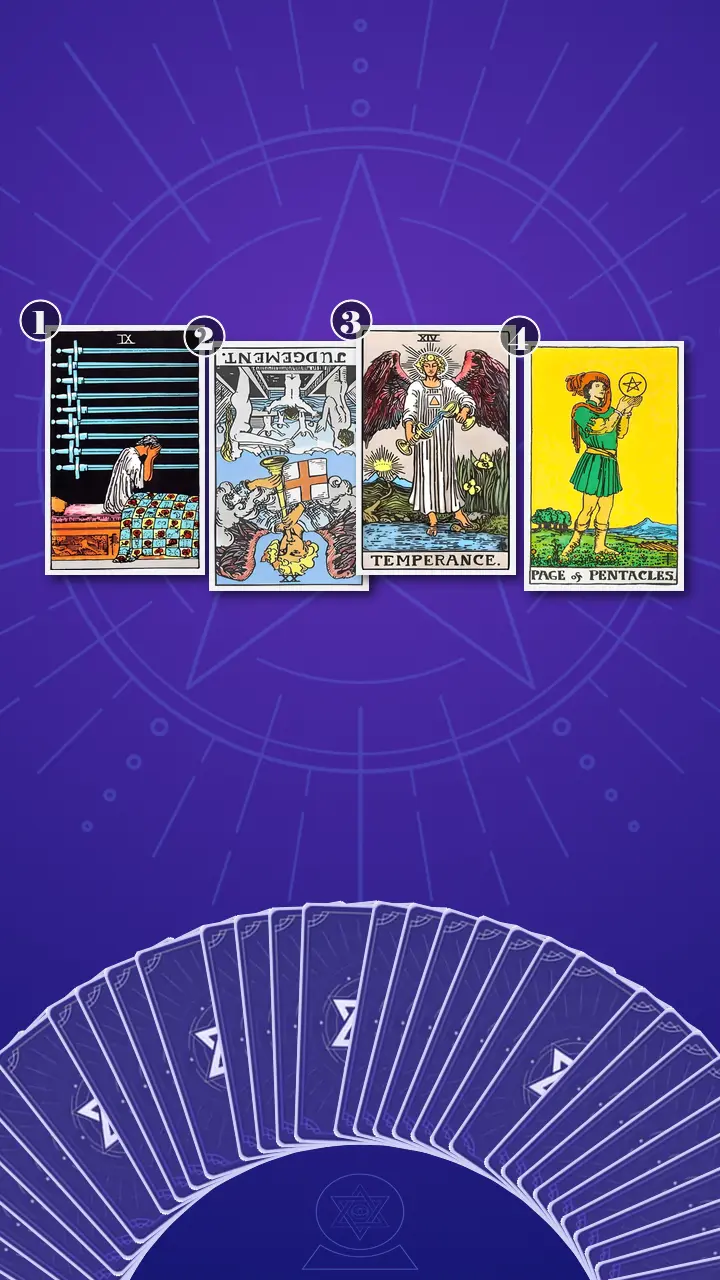
Position 1: Nine of Swords and the Midnight War Room
The first card I turned over was the one showing the birthday-week symptom cluster: late-night panic-planning, comparison, and mental overwhelm. It was the Nine of Swords, upright.
I told Taylor that this card is what happens when the body is in bed but the mind is in a war room. In real life, it looks exactly like the week before your birthday when Chrome is open to LinkedIn, a savings calculator, and articles about moving cities, while your Notes app fills with urgent life fixes. Nothing external has changed enough to justify the level of alarm. The date has simply become symbolic, and suddenly the whole future feels like something that must be solved before sleep.
Upright, the Nine of Swords is excess. Too much air. Too much thought. Too much projection. I pointed to the figure sitting straight up beneath the swords and said, “This is the moment your nervous system starts acting like the future is on fire, even though you are physically safe in your own apartment.”
She let out a short laugh with a bitter edge to it. “That is so accurate it is almost rude.”
I smiled. “Good. That means we are not guessing.” Her fingers eased off the paper cup by a fraction. Then came a slow exhale. Naming the spiral without shaming it is often the first moment a person starts to come back into the room.
Position 2: Judgement Reversed and the Courtroom in Her Head
The second card I turned over represented the deeper blocker beneath the panic: the fear that age will expose a lack of control or worth. It was Judgement, reversed.
I told her this card answered the question beneath the question. Why do birthdays hit harder than random Thursdays? Because what begins as reflection turns into prosecution. In real life, this looks like old photos, old journals, classmates’ job titles, engagement posts, salary comparisons, and the quiet feeling of being graded by timelines you never agreed to. The birthday stops being a checkpoint and becomes a sentencing hearing where you have to prove you used time correctly. It is like a personal Spotify Wrapped narrated by your harshest inner critic.
Reversed, Judgement is blocked renewal. The fire is still there, but instead of rising into clarity, it folds inward and becomes self-sentencing. Instead of hearing a call toward honest change, you hear an internal alarm saying your life is late. “A birthday can be a checkpoint without becoming a verdict,” I said, and let the sentence settle between us.
Her reaction came in three quiet beats. First, stillness: even her breath seemed to stop for a second. Then recognition: her eyes lost focus, as if she were replaying every birthday text and every LinkedIn promotion post she had ever entered into evidence. Then release: her shoulders dropped the smallest amount, and she said, very quietly, “I do turn birthdays into a performance review.”
That was the real blockage. Not a lack of ambition. Not a lack of options. An inner tribunal. The card was not issuing a sentence. It was exposing the courtroom so she could stop mistaking it for truth.
When Temperance Slowed the Whole Room
Position 3: Temperance, the Two-Cup Check-In, and Better Timing
When I reached for the third card, the atmosphere changed. The traffic noise outside seemed to thin out. Even the lamp light felt steadier. This was the hinge card, the one identifying the shift that could replace deadline thinking with paced integration. It was Temperance, upright.
I gave her the first layer plainly. Temperance is not dramatic reinvention. It is one notebook, one timer, two honest questions, and a pace slow enough for feeling and planning to share the same room. I told her I think of it as a two-cup check-in: one cup holds what you feel, the other holds what is practical, and the point is not to let either one flood the table. It is the opposite of staying up all night trying to manufacture a new identity.
Seeing that patient movement between the cups, I had a flash from my old Wall Street life. On the trading desk, the most expensive moves were rarely the slow ones. They were the under-resourced ones made just to relieve discomfort. So I used the framework I rely on when people are on the edge of forcing a pivot: my Resource Readiness Assessment. “Temperance is asking a very unglamorous but powerful question,” I told her. “Do your internal resources — your sleep, your attention, your money, your emotional bandwidth — actually match the speed of the decision you are trying to force? Because if they do not, that is not clarity. That is bad strike timing. On the desk, we called that strike timing calibration: knowing the difference between a true moment to act and an impulse to act because waiting feels unbearable.”
When it is 11:43 p.m., your Notes app is full, your tabs are multiplying, and your chest is tight because the birthday suddenly feels bigger than the actual day, it is easy to think the answer is a more intense plan.
Your age is not a fire alarm; let Temperance's two cups teach you to replace frantic life audits with measured mixing and one workable next step.
She did not soften immediately. First came resistance. Her jaw tensed again, and a quick spark of frustration crossed her face. “But if I stop pushing,” she said, “won’t I just drift?”
I kept my voice steady. “No. Drifting is unconscious. This is deliberate pacing. Panic is a fire alarm, not a project manager.”
Then the reaction moved through her in layers. Her hands, which had been locked together so tightly the knuckles had gone pale, loosened one finger at a time. Her gaze dropped from me to the card and then somewhere beyond it, into the memory of a recent Sunday when she had built a beautiful birthday reset in Notion and abandoned it by Monday. The skin around her eyes flushed pink. She took one breath, then a deeper one, and with that second inhale her upper body seemed to remember the chair could hold it. Relief was there, yes, but not the clean movie version. There was also a flicker of vulnerability, the slight dizziness that comes when you set down a burden you have been using as structure. If urgency was not going to run the meeting anymore, then she would have to hear something quieter. I asked her, “Now, with this lens, think about last week. Was there a moment when slowing down would have told you more than opening another tab?” She gave a smaller, truer laugh. “Sunday. Coffee shop. I did not need a new life plan. I needed to admit I felt behind.”
That was the shift in plain language: not from failure to success, but from panic-driven self-verdicts to steadier self-trust around age and timing. The future gets clearer when it stops being cross-examined.
Position 4: Page of Pentacles and the One-Pentacle Month
The final card I turned over represented the grounded next step, the way this reading could end in practice rather than another abstract life overhaul. It was the Page of Pentacles, upright.
I told Taylor this card is what happens after the panic settles. The future stops looking like one giant verdict and starts looking like one small experiment: one savings transfer, one informational coffee, one course module, one recurring Sunday check-in. The page is not trying to appear fully figured out. The page is willing to learn.
Upright, this is balanced earth. Steady. Trackable. Teachable. Not ten imagined futures, one tended thing. “One grounded step tells the truth faster than ten emergency plans,” I said. “This card wants one tab called next step, and it wants the rest closed.”
She nodded without the earlier flinch. “That I can actually do.” And there it was: less performance, more contact with reality.
The Checkpoint, Not Verdict Method
When I laid the spread back out in a line, the story was clean. The Nine of Swords showed the symptom: birthday-week overthinking that turns an ordinary night into a private emergency. Judgement reversed showed the hidden mechanism: she was not just planning, she was trying to outrun a verdict about her worth. Temperance showed the reorientation: slower pace, better regulation, clearer signal. The Page of Pentacles showed the embodiment: one experiment she could actually tend. The elemental flow was almost textbook in the best way — air overload, blocked fire, careful mixing, then earth. The whole reading moved from courtroom to workshop.
The blind spot was subtle but expensive. Taylor had been treating intensity as evidence of seriousness. If the plan felt punishing enough, strict enough, or exhausting enough, part of her assumed it must be real. But intensity is not the same thing as truth. That is how panic borrows the costume of direction. The transformation here was simpler and stronger: move from using age as a deadline for worth to using it as information for one realistic next step.
She looked at me and made a face. “Twenty minutes feels almost insultingly small.”
“Exactly,” I said. “Small is the medicine. I want boring enough to be repeatable.”
I gave her a practical framework I call the Strategic Holding Pattern. On a trading desk, the waiting period is not wasted if you use it to reduce friction and prepare resources. Around birthdays, it can work the same way. Instead of letting the countdown hijack your nervous system, you turn the waiting period into a high-ROI reset that protects your attention.
- Single-Tab Birthday ReviewThis week, sit at a table — not in bed — with one blank page, your phone on Do Not Disturb, and a timer for 8 to 20 minutes. Answer only two prompts: ‘What actually grew this year?’ and ‘What is one area I want to nourish next?’If 20 minutes feels like too much, do 8. When the timer ends, stop. No LinkedIn, no salary calculators, no old-photo deep dive.
- The Strategic Holding PatternFrom the day before to the day after your birthday, log out of LinkedIn and move Instagram off your home screen. Keep a small note titled Not for Tonight for giant topics like moving cities, quitting your job, redesigning your whole routine, comparing net worth, or deciding your five-year identity.This boundary is temporary, not avoidant. If full logout is unrealistic, mute the accounts or apps that trigger the most scorekeeping.
- One-Pentacle MonthChoose one one-month experiment that fits your real life: one savings auto-transfer every Friday, one coffee chat with someone in content strategy, or one course lesson every Sunday. Put the first tiny step on your calendar within the next seven days.Track completion, not meaning. Ask ‘Did I do the step?’ not ‘Did this instantly prove who I am?’
I reminded her that none of this was designed to fix her life in a weekend. It was designed to stop the birthday anxiety spiral from hijacking her long enough for something honest to surface.

A Week Later, the Tabs Were Fewer
Six days later, Taylor sent me a photo of a single sheet of paper on her kitchen table. There was a tea ring in one corner, two columns in black pen, and a calendar alert beneath it that read Maya coffee next Thursday. Her message said, “Woke up with the usual what if I’m behind thought. But I did not open six tabs. I made tea and kept the one appointment.”
That is the kind of proof I trust. Not a dramatic reinvention. Not a birthday reset routine built for a fictional version of yourself. Just the quiet evidence that a person has started to belong to her own timing again.
This is what I value most about a Situation-Obstacle-Advice-Outcome spread for birthday milestone anxiety: it does not hand your power to the cards. It gives your pattern a shape, lowers the noise, and helps you choose your next step on purpose.
When the birthday gets close and your chest tightens, the panic is rarely just about the number — it is the ache of wanting your life to feel legible before the clock can judge it.
If that ache is familiar, remember this: noticing the courtroom is already the beginning of leaving it. If you let this birthday be information instead of a verdict, what is the one pentacle — the one small thing — you already know you want to tend next?
This story is adapted from psychological research, written so that those in a similar struggle can see their own pattern in it — and find their next step clearly.These insights are not a substitute for professional psychological, medical, legal, or financial advice.
Learn more about our Journey to Clarity.
How did this insight land for you?
🫂 This Resonates Deeply
🌀 Living This Story
✨ Now I See Clearly
🌱 Seeing New Possibilities
🧰 Useful Framework
🔮 The Confirmation I Needed
💪 Feeling Empowered
🚀 Ready for My Next Step
Author Profile
 AI
AI“I spent years in the intense, high-stakes world of Wall Street. I know exactly how isolating and heavy the weight of uncertainty can feel in the dead of night. I use strategic, commercial logic not to be cold, but to protect you from unnecessary friction. Think of me as a fellow traveler who has walked the same rocky path—offering sharp but deeply supportive wisdom to help you clear the fog and confidently win your narrative back.”
In this Timing Tarot Reading :
Core Expertise
- Resource Readiness Assessment: Objectively evaluating if your internal assets match external market timing before a major pivot or launch.
- Strike Timing Calibration: Calculating the optimal node for decisive action versus strategic holding based on ROI.
Service Features
- The Strategic Holding Pattern: A tactical micro-plan for the 'waiting period', turning anxious stagnation into high-ROI resource preparation.
Also specializes in :
Explore Related Patterns:
Social Clock ComplianceTaylor's birthday week does not stay private; it fills with LinkedIn promotions, engagement posts, salary comparisons, old photos, and the feeling of being graded by timelines she never agreed to. The panic plan is not just about turning 29. It is the moment a social clock gets internalized as an audit, so every peer milestone starts to look like evidence about whether you are late. That pattern is Social Clock Compliance because the nervous system treats age-based expectations as if they were objective deadlines. You are not simply planning a career move or a budget; you are trying to reduce the shame of being off-schedule. Once the borrowed timeline becomes the judge, planning stops being information gathering and turns into a frantic attempt to prove your life is acceptable by a certain date.
Control CopingTaylor's control ritual is concrete: LinkedIn beside a salary calculator, budgeting tabs, a Notes list called 29 reset, and a half-serious moving-city article open in the dark. The body is signaling alarm, but the behavior tries to translate that alarm into metrics, scenarios, and options. That is Control Coping because planning becomes a way to quiet uncertainty rather than a way to choose. You are using the dashboard feeling to avoid the raw sentence underneath it, which is that you feel behind and want the future to become legible right now. The problem is not planning itself; it is planning being forced to do the emotional job of safety.
Self-Judgment LoopTaylor names the pattern when she says she turns birthdays into a performance review. The story keeps returning to courtroom language because reflection has stopped being curiosity and become prosecution: old journals, job titles, engagement posts, and salary numbers are entered into evidence. That loop works by converting neutral self-review into a verdict about worth. You are not only asking what changed this year; you are cross-examining whether you used time correctly. The more harshly you judge, the more urgent the planning becomes, and the more urgent the planning becomes, the more it seems to confirm that something is wrong.
Timing PerfectionismTaylor keeps returning to one rule: she needs a plan before her birthday. At 11:43 p.m., the date turns a normal apartment into a deadline machine, and the future feels like something that must be solved before sleep. That is Timing Perfectionism in a birthday-specific form. You start treating the timing of clarity as proof of maturity, so any unfinished question feels like a personal defect. The mind keeps pushing for the perfect decision at the perfect age, even when the body is already showing that the timing of the planning session is wrong.
Urgency BiasTaylor's sentence, 'I need a plan before my birthday,' compresses a whole life question into an artificial deadline. Nothing external has changed enough to require a midnight decision, yet the date makes waiting feel unbearable and turns the future into something that has to be solved tonight. That is Urgency Bias because emotional pressure starts masquerading as evidence that action is required immediately. You are not responding to a true emergency; you are responding to the discomfort of uncertainty. The bias pushes you toward bigger, faster decisions precisely when your sleep, attention, money, and bandwidth are least available for clear thinking.
Comparison TrapTaylor's phone keeps moving between Instagram Stories, LinkedIn, salary comparisons, and budgeting tabs. The story makes the source of pressure visible: other people's public milestones become the background against which her own birthday is evaluated. That is Comparison Trap because attention narrows around visible outcomes while the hidden context of other people's lives disappears. You end up comparing your private uncertainty to their polished signals, then treating the discomfort as a planning problem. The result is not better information; it is a distorted scoreboard that makes your own timing feel suspicious.
Timing DiscernmentTaylor's shift begins when the reading separates a true moment to act from an impulse to act because waiting feels unbearable. The practical change is small and observable: one sheet of paper, tea, one coffee appointment, and fewer tabs six days later. That is Timing Discernment because the pattern moves from emergency timing to calibrated timing. You are still allowed to care about your future, but you stop treating every birthday thought as a command. The skill is learning when a step is ready to be taken and when the wiser move is to protect attention until the signal is clear.
Explore Related Struggles:
Identity Verdict LockYou do not just reflect on the year; you put yourself on trial. Old photos, old journals, classmates' job titles, engagement posts, and salary comparisons all enter as evidence for a verdict about whether you used time correctly. That is why the birthday feels heavier than the number itself. The hidden pressure is not ambition, but the fear that the date will pronounce a sentence on your worth, so every late-night plan is really a bid for temporary relief from the inner court. The story makes that courtroom visible so you can stop mistaking it for truth.
Life Audit ExhaustionYou can see the loop in the way a birthday week turns into a dashboard of tabs, notes, calculators, and moving-city articles. The reset you build is already asking for another reset, so the process keeps circling the same pressure instead of landing on a stable decision. That is what makes it exhausting. You are asking a planning ritual to deliver a durable answer about your life, and it can only give temporary relief before the same question returns. The story shows that the drain comes from repeating the audit, not from one isolated choice.
Social Clock EntrapmentYou can watch a casual question about turning 29 turn a normal Tuesday into six tabs on career pivots, rent math, and whether to move cities. By the week before the birthday, the date itself starts running the room: LinkedIn, budgeting tabs, and a Notes list called 29 reset gather around the same private deadline. What keeps this structure alive is not just age, but the way the calendar starts behaving like a social yardstick. The birthday stops being a day and becomes a countdown that tells you to measure yourself against an invisible schedule, so the pressure comes back even when nothing urgent has changed. The panic is the moment the clock starts feeling like a judge.
Explore Related Emotions:
Directionless UrgencyCareer pivots, rent math, moving cities, routine redesigns, and five-year identity questions all collapse into the same night. The image of rerouting your whole life in Google Maps while the app keeps shouting new directions captures the exact pressure pattern. Directionless Urgency fits because the energy is intense but not yet organized. You want to move because waiting feels unbearable, but the field of possible action is too wide to become a real step. The panic-plan tries to convert motion into certainty, even when the motion has no grounded route yet.
Hollow ControlPanic-planning feels like control because it is louder than uncertainty. The strict plan, the punishing reset, and the exhausting intensity all start to seem serious simply because they are hard to ignore. Hollow Control fits because the planning gives the sensation of command without restoring real agency. You are not being grounded by the plan; you are being temporarily protected from the quietness of not knowing. Once urgency stops running the meeting, a more honest form of control can appear: one bounded review, one workable next step, and the choice to stop treating intensity as truth.
Not-Enough PanicThe sentence I need a plan before my birthday carries more weight than a normal planning impulse. Under it sits the fear that another year arriving might prove you are behind, unfinished, or not enough yet. Not-Enough Panic fits because the alarm is aimed at worth, not logistics alone. The plan becomes a shield against the thought that your current life cannot stand as it is. Even six days later, when the usual what if I'm behind thought returns, the emotional pattern shows itself as a recurring pressure to prove adequacy before time can question it.
Self-Audit AnxietyLinkedIn, a salary calculator, budgeting tabs, a 29 reset list, and a moving-city article are all open while you are supposed to be sleeping. The bed becomes an audit desk, and ordinary life starts to look like a dashboard that needs immediate correction. Self-Audit Anxiety fits because the planning is built around inspection, not nourishment. You are scanning every domain for proof that you are on track, but the more you measure, the less human the life feels. The birthday intensifies the audit because it gives the inner reviewer a timestamp.
Timeline PanicAt 11:43 p.m., you are upright in bed with LinkedIn open beside a salary calculator, a 29 reset note, and a moving-city article. A birthday that should mark a date starts behaving like a countdown, pulling career, rent, location, and identity into one compressed mental deadline. Timeline Panic fits because the fear is not only about getting older. The number turns time into an evaluator, and every tab becomes an attempt to get ahead of being judged by the clock. Panic-planning becomes the body's way of trying to outrun the feeling that your life has to become legible before the birthday arrives.
Verdict DreadOld photos, classmates' job titles, engagement posts, salary comparisons, and birthday texts all get pulled into evidence. The birthday stops functioning as a checkpoint and starts resembling a hearing where you have to prove you used time correctly. Verdict Dread names the pressure underneath the planning. You are not simply choosing goals; you are bracing against an inner tribunal that turns age into a measure of worth. The fear spikes because the plan is being asked to do impossible work: protect you from a verdict that was never supposed to be real authority over your life.
Comparison FatigueInstagram Stories sit beside budgeting tabs, and classmates' titles, engagement posts, salary comparisons, old photos, and old journals all crowd the birthday review. The phone runs hot because the comparison field never really closes. Comparison Fatigue fits because the exhaustion comes from measuring your private timing against other people's visible milestones. You are not only looking at their updates; you are letting those updates write the grading rubric for your own life. The birthday hits harder because it gathers all those comparisons into one annual scorecard.
Cautious MomentumThe future is reduced to one savings transfer, one informational coffee, one course module, or one recurring Sunday check-in. Instead of ten imagined futures, there is one small experiment that can be tended in an actual week. Cautious Momentum fits because the movement is deliberately modest. You are not trying to prove who you are in one birthday weekend; you are giving the future a repeatable entry point. The momentum matters precisely because it is boring enough to survive the next wave of urgency.
Clarity ReliefHer fingers ease off the paper cup, her shoulders drop slightly, and a slow exhale arrives after the spiral is named without shame. The room changes once the pattern has a shape and no longer has to be solved through more tabs. Clarity Relief fits because the relief is not a dramatic reinvention. It comes from seeing the difference between a real next step and a whole-life emergency. You can still care about the future, but the care becomes easier to hold once feeling and practicality are allowed to share the same room.
Grounded Self-TrustSix days later, the proof is a single sheet of paper on the kitchen table, a tea ring in one corner, and a calendar alert for Maya coffee next Thursday. The usual what if I'm behind thought appears, but you do not reopen the six-tab audit. Grounded Self-Trust fits because trust is rebuilt through contact with reality, not through a perfect life plan. You keep one appointment, make tea, and let one small commitment count. The emotional shift is subtle but important: your timing starts to belong to you again because you can act without cross-examining your whole life first.
Pattern Recognition CalmNaming the spiral without shaming it is the first moment the room becomes easier to inhabit. The courtroom image exposes how the birthday had been mistaken for an authority that could grade the whole life. Pattern Recognition Calm fits because calm arrives through accurate seeing, not forced positivity. Once the audit, the courtroom, and the social clock are visible as patterns, you have more room to choose. The birthday can still matter, but it no longer gets to disguise itself as the only judge in the room.
Explore Related Contexts:
Social Clock PressureAt 11:43 p.m., one casual question about turning 29 can turn a normal Tuesday night into six tabs on career pivots, rent math, and whether you should move. That is the point where the birthday stops acting like a date and starts functioning as a social clock. The story keeps returning to the same pressure: another birthday might prove you are falling behind, so the night becomes a scorekeeping ritual instead of an ordinary evening. You are not reacting to the number itself, you are reacting to the way the number invites comparison and makes the next step feel publicly measurable.
Career Identity AuditLinkedIn is open beside a salary calculator and a Notes list called 29 reset, so the night reads like a review of whether your current role still fits. The hybrid content strategy job looks stable from the outside, but the birthday week turns it into a question of fit, trajectory, and whether the work still matches the life you are trying to build. That is why the thinking keeps circling back to career pivots and moving cities instead of landing on one clean answer. The birthday does not invent the audit, it just strips away enough noise that the mismatch becomes harder to ignore.
External Scorecard PressureThe story keeps moving your attention between LinkedIn, salary math, Instagram Stories, and budgeting tabs, which is a very specific comparison loop. Public job titles, income benchmarks, and feed-level life updates keep walking into the same late-night room. By the time old photos, old journals, classmates' job titles, engagement posts, and salary comparisons are part of the frame, the birthday stops feeling private. It becomes a place where your own timeline is constantly being measured against other visible timelines.
Quarter-Life CrisisYou are twenty-nine in Toronto, working a hybrid content strategy job that looks stable from the outside and unfinished from the inside. That combination puts the story in a quarter-life crisis zone, where the current setup still functions but no longer feels like the final shape. The half-serious moving-cities article, the career pivots, and the way life gets reduced to a dashboard all point to a transition that has not settled yet. The birthday does not create that uncertainty; it simply makes the unfinished middle impossible to ignore.