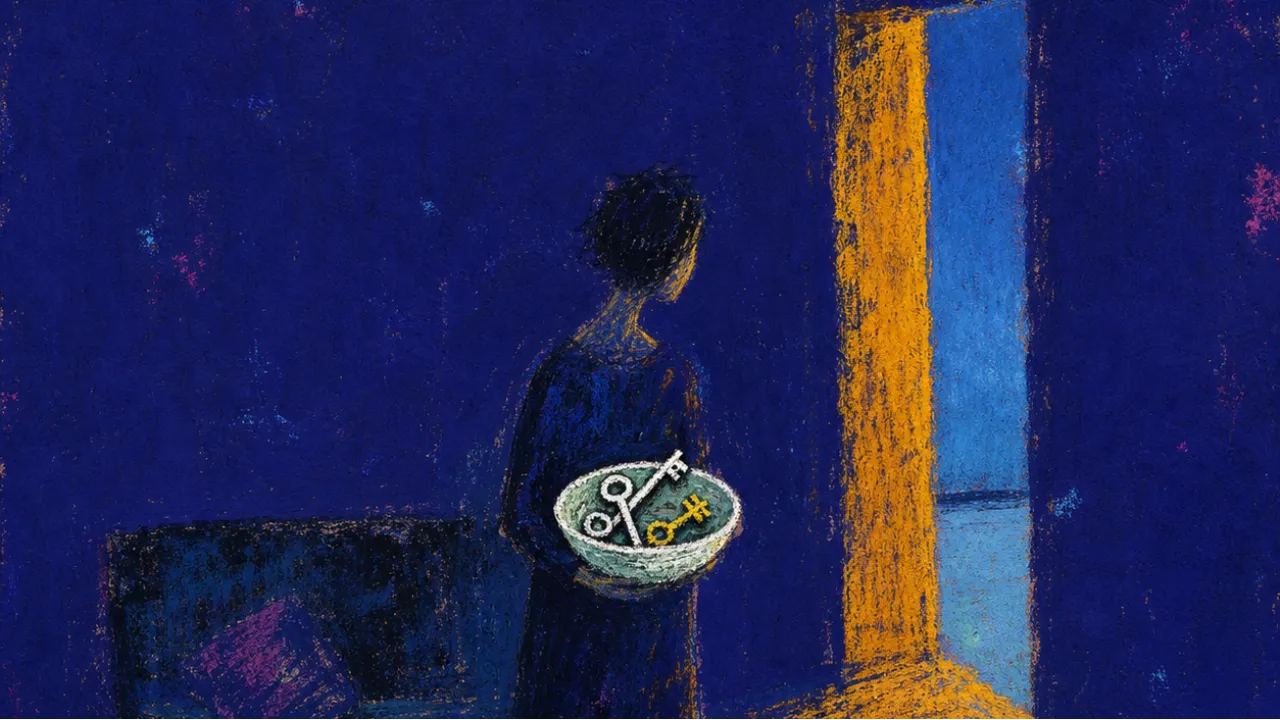
When easy starts to feel correct and unfamiliar starts to feel unsafe, Comfort Zone Attachment is shaping the room before a decision even has language. You might recognize it in the dull heaviness under your sternum after you type that you will stay in. From a Jungian archetypal theory lens, this pattern can be understood as the psyche holding the known self inside a protected image. The Tarot Cards below reflect the unconscious dynamics of that enclosure and the threshold it keeps postponing.
Six of Cups UprightThe children in the Six of Cups do not stand at a doorway, road, or cliff edge; they remain inside a contained courtyard where every cup is already filled. The home behind them and the guarded atmosphere make the garden feel complete, self-sufficient, and emotionally low-risk. Comfort Zone Attachment grows from that same enclosed geometry. The psyche is not refusing growth because it lacks desire; it is trying to preserve the conditions under which the self once felt safe, competent, and uncomplicated. In personal growth, this can look like optimizing the familiar instead of entering the unknown. You may build routines, collect insights, and refine old strengths, while the real threshold remains untouched because the old garden still feels more regulating than the open field beyond it.
ReversedThe manor walls, patrol, and calm courtyard create a safe perimeter around the children. The scene is warm and protected, but it also keeps the figures inside a familiar world where nothing sharp, uncertain, or unfinished can enter too quickly. Comfort Zone Attachment grows from that protected field when academic pressure makes familiar material feel like the only place you can still think. You may keep returning to easy chapters, old notes, or tasks that create a feeling of progress while the harder conceptual jump remains outside the wall. The Six of Cups makes the defense visible through softness rather than force. The comfort is real, but the pattern starts costing you when safety becomes the condition for studying instead of the base from which study can expand.
Eight of Cups ReversedThe cups are orderly, familiar, and close to the viewer, while the higher path is dark and uncertain. When this scene is read as a stalled mechanism, that visual stability becomes a psychological anchor: the known structure feels safer than the unresolved pull of the mountain path. Comfort Zone Attachment forms when the mind keeps choosing a stagnant container because it is legible. You may call it patience, realism, or timing, but the card's swampy emotional field shows how safety can become a quiet agreement to stop expanding.
Nine of Cups UprightThe seated figure rests in front of nine cups with his arms crossed over the center of his body, as if the proof of fulfillment behind him has become a reason to stop moving. The posture is not frantic or collapsed; it is composed, satisfied, and quietly closed. That is the exact psychology of Comfort Zone Attachment in a growth context. You may not be avoiding progress because you feel weak. The system may be defending a version of you that finally feels safe, competent, and complete. The card shows satisfaction turning into a boundary. The cups are full, but the body is not reaching, sharing, or stepping into the next developmental threshold, which mirrors the moment when personal growth gets paused by the comfort of already having enough evidence that you are doing fine.
ReversedThe figure's body stays settled in the pleasure of what is already held. The cups behind him keep reflecting sufficiency, and the enclosed stage makes the present comfort feel more real than the next demand. In academic life, that becomes attachment to familiar proof of competence. You may reread what you already understand, choose safe topics, polish old notes, or stay close to subjects where the self already feels impressive. The pattern is not a lack of ambition. It is a protective loop that keeps the nervous system inside a known zone of capability, even when growth requires the temporary humiliation of not being fluent yet.
Ten of Cups ReversedThe house and garden create a safe emotional base, and the family stands in a field where nothing appears threatening. The scene is open, but it is also complete enough that leaving its emotional climate would require breaking the spell of settledness. Comfort Zone Attachment forms when the psyche starts treating familiar safety as the same thing as alignment. The container that once allowed regulation begins to protect the self from the threshold where new capacity would actually be tested. You may describe the familiar as peace, readiness, or self-care, and sometimes it is. The audit is whether the container is restoring you for movement or quietly training you to avoid the discomfort that growth now requires.
Queen of Cups ReversedThe Queen's throne is beautiful, protective, and much larger than her body, while the land beneath it is only a narrow sandbar surrounded by water. In the reversed texture, the very structure that offers safety can start to occupy too much of the available space, leaving little room for movement or revision. Comfort Zone Attachment appears when the psyche keeps choosing the familiar container because it reliably lowers emotional risk. In lifestyle terms, You may stay with the same room setup, same evening pattern, same comfort rituals, same low-demand choices, or same private pace even after your life has outgrown them. The card does not frame comfort as weakness. It shows comfort as a container that once made sense but now needs an audit. When the throne becomes bigger than the living space around it, the routine may still feel safe while quietly blocking the next version of your daily architecture from forming.
Ace of Pentacles ReversedThe garden is lush, enclosed, and visually safer than the pale mountain beyond it. The archway is open, but the scene preserves the comfort of the cultivated enclosure before the harder climb begins. Comfort Zone Attachment emerges when the protected field becomes more compelling than the path that would expand it. The psyche can frame safety as stability while quietly avoiding the stretch that would turn potential into maturity. For personal growth, this pattern shows up as staying loyal to the version of you that already knows how to function. The card's garden is not wrong; it becomes limiting only when it replaces the mountain as the place where development must continue.
Four of Pentacles UprightThe figure's body is arranged like a small fortress: arms closed around the chest, feet planted on the coins, crown held steady by immobility. The square seat gives him a base, but that base only remains secure as long as he does not disrupt the arrangement. This is a precise image of safety becoming overidentified with sameness. The posture is stable, but the stability has a price: no reach, no experiment, no relational exchange, no threshold crossing. In personal growth, the comfort zone can operate exactly this way, not as ease but as a defended perimeter around the current self. Comfort Zone Attachment keeps the familiar identity in place even when it has become too small. You may genuinely want growth, but the card shows why movement feels expensive: stepping into the next version of your life requires loosening the very structure that has been providing psychological safety.
Nine of Pentacles ReversedThe falcon is built for flight, but here it is hooded, gloved, and held in a beautiful garden. The body still contains power, instinct, and reach, yet the scene keeps that force inside a controlled perimeter where nothing has to risk the open air. That is the reversed mechanism behind Comfort Zone Attachment. The psyche can turn refinement, safety, and self-care into a subtle defense against exposure. In personal growth, this looks like staying inside the version of life that already proves you are competent while avoiding the next challenge that would make you feel unskilled again. You may not be stuck because you lack potential. The card shows potential that has been domesticated too well, where the system protects comfort so efficiently that evolution starts to feel like a threat.
Ten of Pentacles UprightThe stone arch, protected courtyard, loyal dogs, distant wall, and stable family grouping create a world where safety is not abstract. Every element has a place, and the field feels contained enough that nothing has to be improvised in the open. Comfort Zone Attachment grows from that same containment when safety becomes the reason movement keeps getting postponed. For personal growth, You may have enough structure to take the next step, but the nervous system reads the familiar container as identity itself, making expansion feel like leaving protection rather than using it.
ReversedThe estate is protected by stone, arch, wall, family order, and accumulated signs of security. Visually, the same architecture that offers shelter can also make the horizon harder to see; the eye keeps returning to what is already built, already named, already safe. Comfort Zone Attachment emerges when protection becomes the main organizing principle for direction. You may know a life is too small, but the secure container still feels more believable than the unknown. The card links this pattern to the moment when stability stops being support and starts functioning as a psychological lock on the next authentic movement.
Page of Pentacles ReversedThe Page stands in an open field, yet his posture keeps him gathered around one familiar object. The mountains and wider path are visible, but the body does not move toward them; attention stays close to the known pentacle. Comfort Zone Attachment forms when the nervous system treats familiar competence as safety. In career terms, the skill you already know, the junior role you can perform well, or the predictable lane of work becomes easier to hold than the broader terrain of authority. You may call it being practical, but the card reveals a more precise structure: the field is open, and the body is contained. The pattern is not laziness; it is a defense against the exposure that comes when growth requires leaving the proof you already know how to display.
Knight of Pentacles ReversedThe armored rider sits inside a layered protective system: helmet, breastplate, gloves, saddle, reins, and a powerful horse beneath him. Around that protected center, the field is open but undeveloped, asking for contact with terrain that is less controlled than the mounted position. Psychologically, the container can become more compelling than the journey. You may want growth while still organizing your choices around environments where competence, predictability, and self-image remain protected. Comfort Zone Attachment is not shown here as laziness; it is shown as overprotection. The card makes the familiar zone look sturdy, functional, and reasonable, which is exactly why leaving it can feel like losing the structure that has been holding you together.
Queen of Pentacles ReversedThe carved throne, soft greenery, and rose canopy create a highly protected container around the Queen. In reversal, that container can feel less like support and more like a gravity field, with the body held in place by comfort, familiarity, and environmental softness. Psychologically, the scene shows safety becoming sticky. For you, personal growth may be blocked not by the absence of desire, but by an overlearned attachment to the version of yourself that knows how to survive inside familiar conditions.
King of Pentacles ReversedThe same throne that supports the King can also become too heavy to leave; black marble, wall, castle, robe, and vines form layered enclosure around a seated body. The pentacle and scepter occupy both hands, so the figure appears secure but unavailable to movement. In this orientation, protection starts consuming mobility. You may be using what already works as a defense against the uncertainty of the next level, turning safety into action paralysis because growth would require stepping outside the domain that proves you are competent.
Two of Wands UprightThe castle is not only a sign of achievement; it is the structure that keeps the figure physically safe while he studies the world beyond it. One wand is fixed to the wall, another is held in the hand, and the body remains positioned at the boundary between possession and departure. Comfort Zone Attachment grows from that precise threshold. The known identity has become weight-bearing, so leaving it can feel less like adventure and more like losing the psychological container that proves competence, safety, and control. In personal growth, this pattern often hides inside sensible language about timing, readiness, or realism. The card shows that the current structure may genuinely protect you, while also showing how protection can become the reason a larger self remains unentered.
ReversedThe castle gives the figure height, safety, and status, but it also keeps his feet inside the known structure. The fixed wand on the wall turns stability into an anchor, while the sea and distant land remain visible but unentered. Comfort Zone Attachment forms when the familiar friendship circle becomes easier to inhabit than the honest truth of change. The bond may feel cramped, uneven, or outdated, yet the shared rituals and history still provide a sense of identity that makes movement feel risky. Reversed, the card shows the cost of mistaking the old container for emotional safety. You may be able to see that a friendship needs renegotiation, but the known role still feels less threatening than stepping into a new relational arrangement.
Four of Wands UprightThe four wands stand as an unheld square, making a shelter before the distant castle while garlands soften the threshold. Nothing in the scene has to be forced; the structure is already upright, already decorated, and already socially readable as safe. That is why Comfort Zone Attachment fits this card in a choice reading. The pattern treats existing safety as if it were the same thing as strategic truth. You may be drawn toward the option that feels housed and low-risk, but the card also makes visible the difference between a secure base and a decision that has stopped being alive.
ReversedThe four wands create a stable foreground shelter, but the castle still waits beyond the river. When reversed, the psyche can confuse the safety of the threshold with the fullness of the destination. Comfort Zone Attachment forms when stability becomes over-identified with safety. The existing structure has genuinely supported you, but the same support can start absorbing the energy that would otherwise move toward the next bridge. In personal growth, this pattern often looks like staying loyal to a version of yourself that once protected you. The Four of Wands shows why the attachment is not irrational: the canopy is real, warm, and earned, but it was built as a threshold, not a permanent ceiling.
No cards available for this filter.