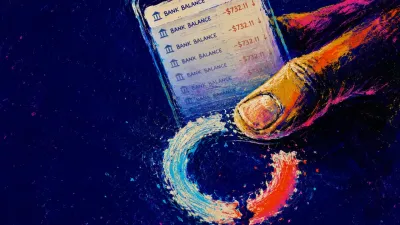
Emptying the Cart Until One Bounded Choice Became Possible
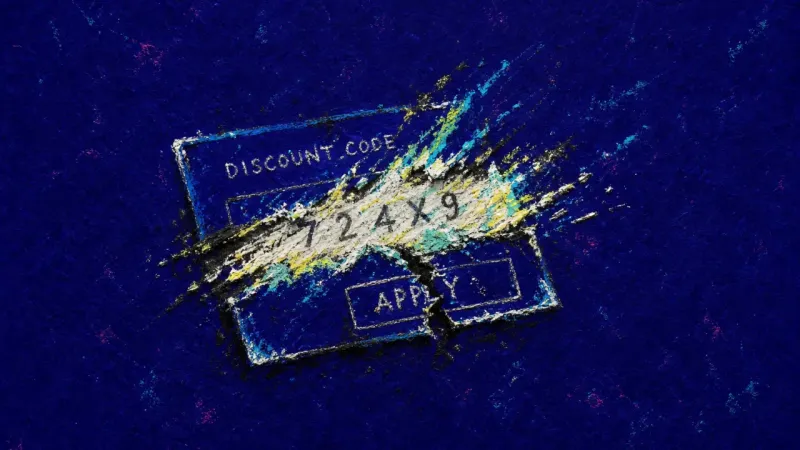
Finding Clarity in the 11:47 p.m. Cart
You can build campaigns, decode trends, and know exactly how brands create desire, then still freeze at 11:47 p.m. when tax and shipping turn a normal cart into a personal finance exam.
That was how Maya arrived in my reading room: not with a dramatic crisis, but with the quieter modern ache of an abandoned cart. She was 29, a junior marketing coordinator in Toronto, sharing an apartment, paying rent on time, buying groceries, saving a little, doing the responsible things. And still, one practical item at checkout could make her body behave as if danger had entered the room.
She told me about the night before. Laptop balanced on her duvet. Banking app open on her phone. A promo-code page refreshing in another tab. The room smelled faintly of laundry detergent and cold takeout, the laptop fan hummed, and the final total glowed too brightly against the dark blue ceiling. Her hand hovered over the checkout button, then moved to delete the one item she actually needed.
“I can afford it on paper,” she said, pressing her thumb against the side of her mug, “but my body acts like I’m about to do something dangerous.”
I watched her shoulders lift as she said it, as if the sentence itself had weight. Financial anxiety often arrives like that: not as a neat thought, but as a tight stomach, shallow breath, a hand paused over a button while every future bill seems to crowd around the card reader. In Maya’s case, the pain was painfully specific. She wanted one practical, self-supporting step, but feared that spending now would prove she was unsafe, careless, or out of control.
“I’m not here to tell you to buy the thing,” I said. “And I’m certainly not here to tell you to deny yourself forever. Let us sit with the pattern carefully. We are not hunting for a verdict. We are looking for clarity.”
Choosing the Compass: The Four-Layer Insight Ladder
I asked Maya to take one slow breath and name the question without defending it. She said, “What scarcity story makes me empty the cart, and what is one step I can take?” I shuffled while holding that wording steady. Not as a mystical performance, but as a way of narrowing the mind’s noise into one clean line of inquiry.
For this reading, I chose the Four-Layer Insight Ladder · Context Edition, a compact tarot spread for checkout hesitation and scarcity mindset. A Celtic Cross would have mapped too much terrain for a question that asked for one step. This layout is more like a careful excavation trench: visible behavior, hidden root, key transformation, grounded action.
I explained the structure before turning the cards. The first position would show the surface pattern: the checkout hesitation, the cart deletion, the contracted money response. The second would uncover the root story underneath it: the fear that safety depends on perfect control. The third would identify the internal shift needed to loosen the all-or-nothing grip. The fourth would translate that shift into one bounded, values-based next step.
In my years among ruins, I learned that a collapsed wall is never just a collapsed wall. It has weather, pressure, repair attempts, older foundations beneath it. A repeated behavior works similarly. Emptying an online cart may look small from the outside, but inside it can hold an entire buried architecture of fear.
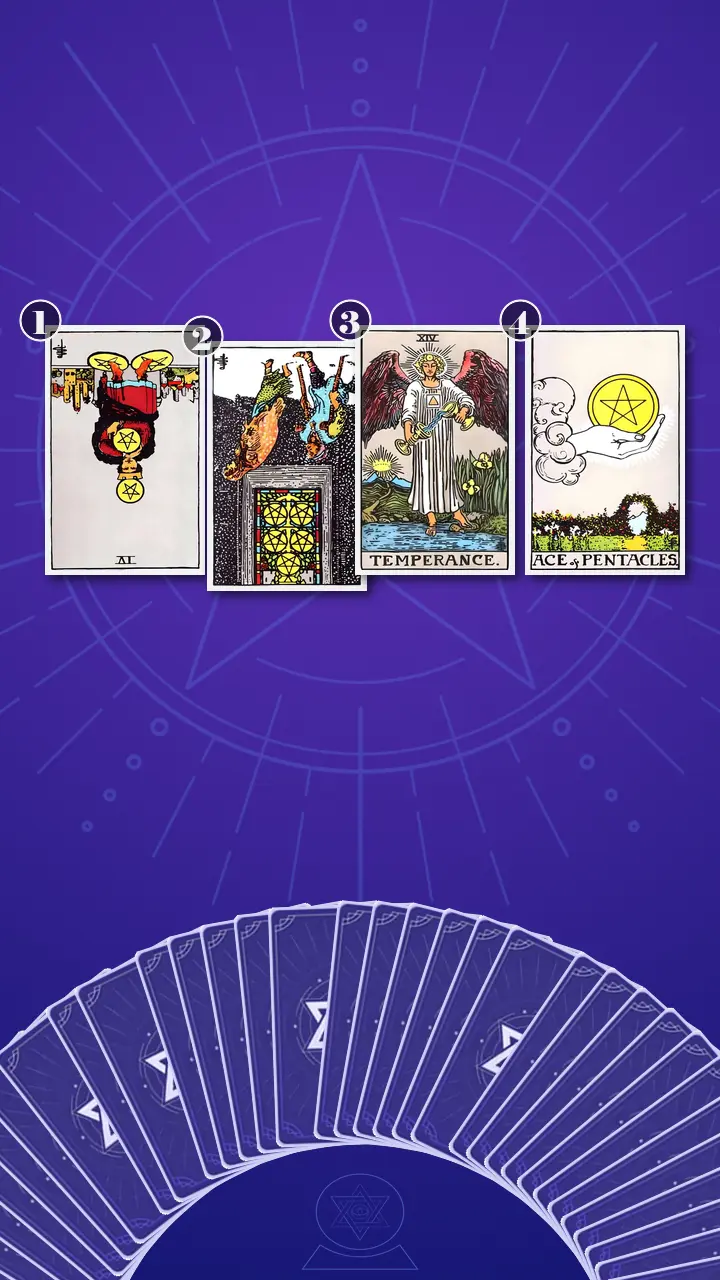
Reading the Map: From Frozen Earth to a Usable Seed
Position 1: The Grip That Looks Like Control
“Now I am turning over the card that represents the diagnosis-level presenting problem: the observable checkout hesitation, cart deletion, and contracted money response.”
It was Four of Pentacles, reversed.
On the card, the figure clutches a coin to the chest while pinning two beneath the feet. Reversed, the image felt less like wise saving and more like cramped protection. I told Maya, “This is the moment when the checkout total becomes less like a number and more like a threat assessment.”
I named the scene directly because the card asked for it. At checkout, she sees the final total, refreshes the banking app, rereads the shipping fee, checks one more discount code, and deletes the practical item because keeping the money untouched gives a short burst of control. The reversal shows that the grip is no longer protecting her day; it is pinning her in place.
“The energy here is Earth in excess,” I said. “Security has become so over-controlled that movement itself feels unsafe. The question is not whether you value stability. You clearly do. The question is whether total stillness is being mistaken for safety.”
Maya gave a small laugh, bitter enough to catch in the air. “That’s too accurate. A little rude, honestly.”
I smiled gently. “The card is not accusing you. It is showing the mechanism. Deleting the cart gives relief, but it does not meet the practical need. It is like keeping every tab open in Chrome because closing one feels like losing control of the whole project.”
Her fingers moved to the rim of the mug and stopped there. I saw the first recognition land: not shame, not yet relief, just the stomach-drop of being seen without being judged.
Position 2: The Snow Outside the Window
“Now I am turning over the card that represents the psychological mechanism beneath the behavior: the scarcity story, underlying fear, and belief that safety depends on perfect control.”
It was Five of Pentacles, reversed.
The two figures in the snow stood outside the lit church window. Reversed, the card did not deny hardship; it suggested the possibility of turning toward warmth, support, and current resources that fear had edited out.
I said, “This is where the cart stops being about one item. It becomes a mental movie of future deprivation: being short on rent, embarrassed, alone with the consequences. But the reversal asks us to compare that movie with the actual facts open in the other tab.”
Maya looked down at the table. The room had gone quiet except for the faint tick of the radiator. Outside my window, a bus sighed at the curb, that tired city sound of brakes and wet pavement. It suited the card: a small coldness, a light still visible nearby.
“The energy here is not simply lack,” I continued. “It is a blockage around receiving support. Your fear says, ‘If I choose wrong, I will be the only one stuck with the consequences.’ But your current life may include more support than the fear admits: a planned rent payment, groceries covered, a return window, a budget category, a friend who can sanity-check without taking over.”
She inhaled and did not speak at first. Her hand hovered, then tightened around the mug, then loosened. That three-part reaction told me the card had reached the buried layer: first the body freezing, then the eyes going distant as memory replayed, then a slow exhale that made the shoulders drop a fraction.
“I think I act like one wrong purchase puts me outside the window,” she said. “Like everyone else gets to be warm, and I’m the one who messed up.”
As an archaeologist, I have learned to respect what surfaces. A shard in the dust is rarely the whole story; it is an artifact from an older room. I introduced my Cognitive Stratigraphy here: the checkout panic was the surface artifact, but beneath it lay an older belief-layer, one where being careful meant never needing anything, never asking, never misjudging. We did not need to smash that layer. We needed to date it, name it, and stop letting it govern every present-day purchase.
When Temperance Poured Between Two Cups
Position 3: The Middle Path That Changes the Question
“Now I am turning over the card that identifies the key transformation needed to loosen the core contradiction between practical self-support and fear of financial danger.”
The room seemed to settle before I named it. The third card was Temperance, upright.
I placed my hand lightly beside the card. The angel poured water between two cups, one foot on land and one in water. “This is the bridge,” I said. “One cup holds future care. The other holds present need. Temperance does not ask you to choose which cup deserves to exist. It teaches you to pour between them.”
Maya had been trapped in the thought, “I must make the correct decision, or I will prove something bad about myself.” The card softened that courtroom. It offered a process instead: one item, one cap, one review, one action. Not reckless spending. Not total denial. A proportionate checkout decision.
It is not responsibility if it only teaches you to freeze; real responsibility is the Temperance path of pouring caution and desire into one proportionate choice.
I let the sentence sit. It needed silence around it.
Maya’s face changed in layers. First, she went still, her breath caught halfway as if the body had not yet decided whether this was permission or a threat. Then her eyes lost focus, not drifting away from the reading but replaying something: the laptop light, the cart total, the banking app refresh, the old script that said wanting anything had to be defended beyond doubt. Finally, the tension at her jaw loosened. Her hand opened on the table, palm facing up for a second before she noticed and tucked it back around the mug. Her voice came out lower than before.
“But if that’s true,” she said, with a flash of frustration, “doesn’t it mean I’ve been making myself miserable for no reason?”
I did not rush to comfort her out of that. “It means the strategy protected something once,” I said. “Ruins are not failures just because they are ruins. They show what endured, what cracked, and what is ready to be rebuilt differently. Your caution is not the enemy. It is simply asking for restoration.”
This was my Ruins Restoration Thinking at work: not treating Maya’s fragmented money-self as broken, but as a structure in transition. Some walls had held too long. Some needed openings. Temperance was the restoration plan, not a demolition order.
Then I asked the question the card required. “Now, with this new view, think back to last night. Was there one moment when this insight could have made the decision feel different?”
She closed her eyes. “When shipping appeared,” she said. “That’s when the whole thing became suspicious. I could have asked whether the total still fit my number instead of treating the fee like proof I was being stupid.”
That was the crossing: from scarcity-driven checkout paralysis to proportionate self-trust with money. Not a grand transformation. A first step. Her budget still got a vote. Her actual life got one too.
Position 4: The Seed That Does Not Need to Prove a Whole Life
“Now I am turning over the card that translates the transformation into one bounded, values-based next step that supports self-trust without bypassing real financial limits.”
It was Ace of Pentacles, upright.
The hand on the card offered one pentacle over a garden path. Not a mansion. Not a lifestyle rebrand. One seed.
I told Maya, “This card is beautifully practical. It asks for one small checkout experiment: one useful item, within a preset limit, with a clear boundary. The energy here is balanced Earth. Money is no longer frozen under the feet or clutched to the chest. It becomes something you can hold lightly, plant carefully, and observe.”
The modern version was clear. Maya could choose one practical item, complete the checkout or consciously pass on it, and treat the result as information. The inner line became: “This is data, not a verdict.”
She nodded slowly. Not the dramatic nod of someone whose whole life had been solved, but the steadier nod of someone who could see a next move. “One item,” she said. “Not the whole notes app list. Just one.”
“Exactly,” I said. “One bounded choice is different from losing control.”
The Temperance Checkout Method: One Bounded Choice
When I looked at the four cards together, the story was coherent. The Four of Pentacles reversed showed Maya’s visible pattern: gripping control so tightly that checkout became paralysis. The Five of Pentacles reversed revealed the deeper scarcity story: one wrong small purchase could cast her outside safety and support. Temperance restored proportion, allowing future care and present need to sit at the same table. The Ace of Pentacles grounded the insight into one material seed.
The blind spot was not that Maya lacked discipline. It was that she had started treating deprivation as the only proof of responsibility. The transformation direction was equally clear: shift from asking whether the cart is perfectly justifiable to choosing one bounded, values-based next step that her budget can actually hold.
I gave her three actions, small enough to be used in real life rather than admired as advice.
- Set the spending boundary before checkout.Before opening the cart this week, write one maximum spend number in your notes app, including tax and shipping. Use a number that is genuinely safe for your current budget, whether that is $25, $40, or another limit that fits your real accounts.Keep the boundary visible. Do not adjust it mid-spiral just to make the decision impossible again.
- Use the three-criteria checkout filter.Choose one cart item and test it against only three criteria: budget fit, real usefulness, and return policy. If it passes, decide within 24 hours. If it fails, remove that item only instead of emptying the entire cart.The mind may ask for ten more rules. Temperance asks for proportion, so stop at three.
- Try the Trigger Excavation Exercise.When your body reacts strongly to the final total, pause for five minutes and write two short columns: Current Facts and Future Fear. Under Current Facts, list rent status, grocery plan, savings commitment, return window, or budget category. Under Future Fear, list the imagined consequence your mind jumps to.This separates the present purchase from the older epoch of fear. If your body feels flooded, close the tab and stop. The practice is noticing proportion, not forcing a purchase.
I also asked her to place one line beneath the item name before buying or deleting it: “This purchase is an experiment, not a verdict.” It was a plain sentence, but plain sentences often make the best tools. They leave less room for the mind to turn a shopping cart into a courtroom.

A Week Later: The Quiet Proof
A week later, Maya sent me a message. She had chosen one practical item under her preset limit, checked the return policy, and bought it on a Saturday morning with coffee beside her and daylight in the room. She said the first thought after checkout was still, “What if I regret it?” Then she laughed, because this time the thought did not take the steering wheel.
She did not describe fireworks. She described using the item on Monday and noticing that one small daily annoyance had disappeared. That was enough. Tarot had not made the decision for her. It had helped her see the architecture of the decision, the old layer beneath the trigger, and the one doorway she could actually walk through.
For me, that is the heart of a Journey to Clarity. Not certainty. Not impulse. Not a perfect money personality. Just the return of scale: one cart, one item, one boundary, one honest step.
When one checkout total can make your stomach tighten like every future bill has crowded into the room, it is not just about the cart; it is the ache of wanting care while trying to prove you are safe. If you allowed this decision to be one small experiment instead of a verdict on your whole money story, what would your next honest step be?