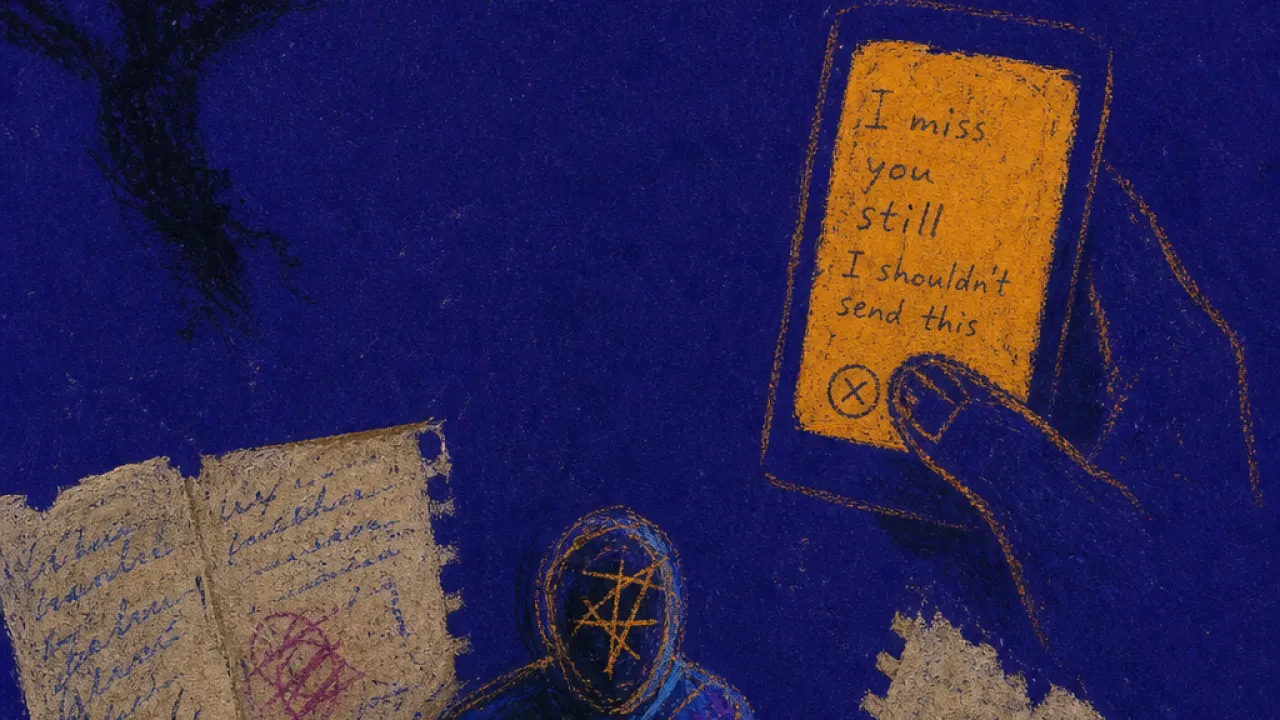
When reflection becomes the room you keep returning to, the issue is not a lack of depth; it is the loss of a bridge back to contact and movement. You can feel it in the thumb hovering over an unsent message, the throat tightening while the outside world waits. From an existential angle, the structural framework is about an inner room becoming more usable than the life beyond it. The Tarot Cards below make that outline visible.
Four of Cups ReversedThe reversed Four of Cups turns inner retreat into a sealed environment. The tree, shade, crossed limbs, closed eyes, grounded cups, and cloud-borne cup all remain in view, but the figure's private inner space dominates the whole field. In personal growth, Inner World Entrapment appears when self-reflection stops returning to life. Journaling, processing, mindset work, or meaning-seeking may keep generating internal material, while the ordinary world of feedback, risk, practice, and relationship becomes harder to re-enter. The card holds the cost of an inner world that has become too complete. It does not reject introspection; it shows the point where introspection loses its bridge back to embodiment, and growth becomes a room you keep thinking inside instead of a life you move through.
Five of Cups ReversedThe black cloak wraps the figure into a nearly sealed silhouette, and the bowed head turns the open landscape into a private tunnel of attention. River, bridge, castle, and remaining cups exist around the body, but the embodied field has shrunk to the immediate ground. For personal growth, that narrowing mirrors the way introspection can become a closed room instead of a path. Inner World Entrapment is the structure where your inner narrative becomes so complete that outside evidence, feedback, and possibility can no longer enter with enough force to change the map.
Six of Cups ReversedThe courtyard looks open because the sky is clear and the colors are warm, yet the scene still functions as a sealed memory chamber. The figures do not travel through the space; they preserve a perfect internal moment inside it.\n\nReversed, that visual structure becomes Inner World Entrapment in personal growth. Reflection, meaning-making, and self-analysis may feel rich and necessary, but the inner landscape starts replacing the external test where growth would become visible.\n\nThe card does not dismiss introspection. It shows the moment when introspection becomes a private estate: emotionally coherent, beautifully arranged, and increasingly difficult to leave with your body, schedule, habits, and choices.
Seven of Cups ReversedThe cups do not merely appear in the clouds; they become the whole map in front of the figure. With no road, table, horizon line, or grounded object to compare them against, the floating images begin to function as the scene's reality system. You can keep moving deeper into symbols and still lose contact with the part of life that would help you test them. In this reversed structure, introspection turns from a doorway into a chamber, because every answer leads back to another image inside the same mist. The struggle is an inner world that has become too complete. The card gives form to the point where reflection stops clearing psychic space and starts enclosing it.
Page of Cups ReversedThe eye, fish, and cup form a closed loop, while the broad water behind the Page becomes background. Here, that loop stops behaving like a message window and becomes the room itself: the smaller vessel absorbs the whole field of attention. In personal growth, inner work can become a place where every feeling, symbol, and insight is examined until the outer life loses scale. You are not lacking depth; the card locates the point where depth loses circulation and begins to trap the self inside its own reflective chamber.
Knight of Cups ReversedThe scene offers openness, distance, water, and a gentle road forward, yet the rider remains absorbed in the object he carries. The landscape can become less like a route and more like an inner atmosphere that keeps extending around the same cup. Inner World Entrapment emerges when introspection no longer returns you to contact, choice, or movement. The psyche keeps generating symbols, meanings, and refined feelings, but the crossing stays ahead rather than becoming an embodied step. The reversed card gives this struggle a boundary. It shows an inner world that is rich enough to feel alive and enclosed enough to become a holding pattern. You are not lacking depth; the depth has started to replace exit.
Queen of Cups UprightThe throne is planted on a small island, surrounded by water and backed by a wall that cuts off the distant view. The Queen's gaze does not search the horizon; it stays with the private object in her hands. That sealed, beautiful interiority can hold real depth, but in personal growth it can also become a room with no exit. You may keep finding richer meanings, cleaner language, and more nuanced self-understanding while the outer life stays almost untouched. The card's structure locates the struggle in the protected inner world itself: the same sanctuary that preserves your sensitivity can start replacing lived change.
ReversedWater surrounds the throne like an open field that cannot be crossed from the seated position. The Queen has sky, sea, and a distant wall in view, yet her body stays anchored to the island and her attention returns to the closed cup. That space turns inwardness into geography. You can have a rich inner life and still feel trapped by it when every route out leads back to the same private chamber of thought, memory, and interpretation. For introspective work, the card marks the moment when retreat stops restoring you. The inner world remains meaningful, but it becomes too total, too enclosed, and too structurally central to let the rest of life re-enter.
King of Cups ReversedThe throne floats in the middle of the sea with no visible shore, while the king's attention can stay absorbed in the cup he holds. Around him, the waves, dolphin, and ship suggest movement, but the central body remains seated inside its own field of water. In a personal growth context, that structure becomes the trap of endless inner processing. You may keep examining feelings, motivations, wounds, and potential, yet every route still returns to the same internal seat instead of opening into practice, risk, or contact. The card does not frame introspection as useless. It shows the moment when reflection loses its exit channel, and the inner world becomes so complete that it starts replacing lived movement.
Ace of Pentacles ReversedThe garden is lush and protected by a low hedge, yet most of its interior is hidden from view. The archway offers entry, but the scene's main action remains outside the lived space of the garden. You can feel this when introspection becomes a beautifully maintained enclosure. The inner world may look ordered and safe, but the same protection can quietly narrow contact with the messier experience of actually living, choosing, and being seen.
Four of Pentacles ReversedThe town sits in the background as an open field of life, while the foreground is reduced to a stone seat, four pentacles, and a body that cannot safely shift position. The scene contains space, but the figure’s usable world has collapsed into a guarded interior. In the reversed state, that compression becomes an inner architecture. You may be surrounded by thoughts, memories, and self-protective meanings, yet still feel unable to move within them; the card shows the mind becoming a room with visible windows and no trusted door.
Five of Pentacles ReversedThe snowfield looks open, yet the only visible route is a narrow exposed passage along a wall with no shown entrance. In the reversed texture, the environment has been normalized so completely that cold, movement, and lack of shelter become the coordinates of the inner landscape. This gives your introspection a precise boundary: the problem is not too much depth, but a private world organized around a path that never becomes a room. You can see the light, but the inner architecture has not yet revealed a door.
Nine of Pentacles ReversedThe estate behind the woman is open, but her immediate space is dense with vines, coins, robe, bird, and the slow path of the snail near her feet. The garden is spacious to look at and narrow to move through. In a reversed inner-world reading, this becomes a soft enclosure: safety, beauty, and self-command organize every available path. You may have built a private mental garden that protects you from chaos, while the same system quietly limits movement, risk, and uncurated feeling. The card connects this struggle to the sensation of being trapped inside a life that looks calm from the outside. The boundary is not a wall; it is the accumulated pressure of everything that must stay undisturbed for the inner world to feel orderly.
Ten of Pentacles ReversedThe elder's body is supported by chair, robe, dogs, and architecture until stability looks almost immovable. Around him, the arch compresses public display, domestic life, status, and inheritance into one tightly coded inner room. Inner World Entrapment forms when the psyche has too much structure and too little free space. In introspection, every feeling may seem to belong to an old role, an old story, or a familiar explanation before it has a chance to move as itself. The reversed Ten of Pentacles turns security into enclosure. The card does not accuse the structure that protected you; it shows the moment when protection has become the room you cannot easily leave inside yourself.
King of Pentacles ReversedTurned inward, the king's estate becomes less like a place of grounded abundance and more like a sealed inner domain. The wall, castle, throne, vines, coin, and robe all belong to the same controlled field, and the body is absorbed into the system it has built. This is the structure of an inner world that has become too self-contained to refresh itself. You may be able to name, organize, protect, and manage what happens inside, yet the old emotional material keeps circulating inside the same guarded enclosure. The card locates the trap in the success of the container itself. The inner system is not chaotic; it is over-secured, and that over-security can keep stale feeling, shadow material, and psychological residue from finding an exit.
Two of Swords ReversedThe sea behind the figure is wide, but she cannot use its openness because her body is fixed, blindfolded, and sealed by the crossed swords. The outer space expands while the usable inner space contracts. Inner World Entrapment takes shape when turning inward stops creating access and starts creating enclosure. You may be inside your own reflections, but the card shows a closed perceptual loop rather than a path through the material. The calm surface matters because it can make the enclosure look like control. The struggle is not that the inner world is too deep; it is that the channels for contact, movement, and update have been shut while the emotional field keeps surrounding the self.
Four of Swords ReversedThe figure and the slab nearly share one visual temperature, pale and still against the gray wall. The longer the body remains inside this chamber, the harder it becomes to separate the person from the withdrawal structure holding them. In social life, Inner World Entrapment appears when solitude stops being a doorway back to yourself and becomes the whole map. The group, the network, and the possibility of shared life remain visible like the stained glass, but the inner chamber feels safer, more predictable, and eventually more real. The card does not shame the need to retreat. It names the point where the retreat has started to replace the social world rather than restore your ability to re-enter it.
Eight of Swords UprightThe blindfolded woman stands inside a fence of swords that looks absolute from within but remains visibly incomplete from outside. Her hands are bound behind her back, so the very faculties that would test the restraint, feel for gaps, and correct her path are removed from reach. That structure mirrors the private enclosure of inner-world work: the mind can sense that something is limiting it, but the tools for verifying the limit are hidden behind the body. In introspection, this becomes the experience of being trapped inside your own mental room, surrounded by conclusions that feel sharp before they have been checked. Eight of Swords does not frame the enclosure as simple weakness. It shows a specific architecture of blocked perception, restricted agency, and unseen exits, giving shape to the moment when your inner system is not empty of options but unable to access them cleanly.
Nine of Swords ReversedThe bed encloses the figure, yet the body is upright and trapped between alarm above and immobility below. The swords pass through the head, throat, and heart zones until separate points of contact become one dense inner weather system. Reversed, the family trigger has moved inside. Inner World Entrapment appears when the visit, call, or message is over, but the body keeps replaying it in a closed room of thought, sensation, and unfinished response. The card's darkness is not just atmosphere; it is the absence of an outside reference point. You are not merely thinking too much about family. You are caught in a sealed internal scene where the family system continues to act on you after the external contact has ended.
Ten of Swords ReversedThe foreground body occupies the card as a sealed inner chamber, while the river, mountains, and dawn remain compressed into the distance. Space exists, but the pinned spine cannot turn toward it, so the open world becomes visible without being inhabitable. Inner World Entrapment in introspection is the condition of living inside the same internal scene no matter how much perspective is available. You may understand that another frame exists, yet attention keeps returning to the lodged axis of shame, exhaustion, memory, or old conclusion. The card’s bleak power comes from that spatial mismatch: the horizon is real, but the body cannot use it. This struggle is the loss of inner room, where the self is not merely thinking about pain but living inside its architecture.
Two of Wands ReversedThe broad sea and distant land occupy most of the view, yet the figure remains on a narrow stone edge with no visible route down. The open world is present as scenery, while action is compressed into holding, watching, and staying above. Inside an introspective cycle, the mind can become that battlement. You keep surveying your inner life, checking every signal, revisiting every shadow, and still the body stays in the same enclosed position. Inner World Entrapment is the strain of having immense inner visibility without inner mobility. The card gives that loop a boundary: a high place can still be a confined place.
No cards available for this filter.