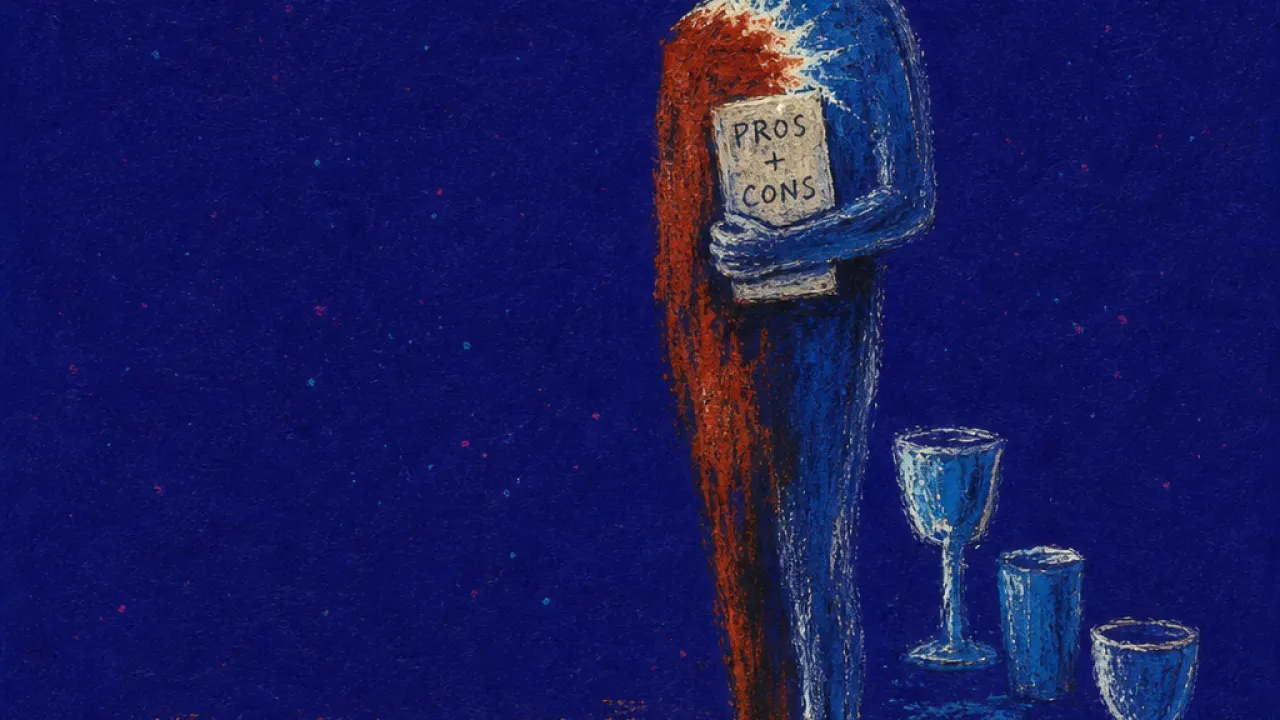
The reflex to protect the option already in hand, even when it keeps your body still, is the pattern Loss Aversion keeps circling. You may recognize it in that shallow breathing over a pros-and-cons list, where the page starts to feel less like a map than a warning sign. Jungian archetypal theory gives this pattern a visual language for the tension between possession, loss, and the unseen path forward. The Tarot Cards below mirror the unconscious dynamics of this bias: what has spilled, what is still standing, and what the body has not yet turned around to see.
Five of Cups UprightThe spilled cups make loss visually concrete: liquid has left the vessels, and the ground now holds proof of what cannot be put back exactly as it was. Behind the figure, two cups still stand, but the body remains organized around the cost that has already been paid. Loss Aversion turns that cost into a defensive rule. The psyche begins to protect itself from another spill more intensely than it pursues the remaining route, which is why the bridge can be present and still feel psychologically unavailable. In personal growth, this pattern can keep you loyal to limitation because change carries the possibility of fresh disappointment. The card shows how the fear of another visible loss can become stronger than the desire to build from what is still intact.
Seven of Cups ReversedThe laurel wreath looks like victory until the small skull underneath changes the emotional temperature of the symbol. The image makes gain and loss occupy the same cup, so success is not shown as pure reward; it is shown as a win with mortality, cost, and closure attached. Loss Aversion takes hold when the mind organizes the decision around what will be forfeited. You may preserve every path in imagination because choosing one makes the others die as possibilities. The card exposes the hidden cost of that preservation: the fear of loss can become more powerful than the actual value of the option being protected.
Eight of Cups ReversedThe stacked cups occupy the foreground while the figure becomes smaller against the dark terrain, so the eye feels the weight of what could be lost before it can fully register what might be found. The missing cup is invisible, but the existing eight are materially present. Loss Aversion grows from that imbalance between visible loss and invisible gain. You may be treating the familiar option as safer because its cost is countable, while the cost of staying remains emotionally submerged; the card makes that bias visible by showing how loudly the known cups speak from the edge of the path.
Nine of Cups ReversedThe cups are close enough to define the man's status, but they sit behind a boundary rather than in active use. His closed body position keeps the existing arrangement intact, as if stepping away from it would mean losing more than simply changing direction. That spatial separation makes potential loss feel larger than potential movement. The current setup becomes psychologically overvalued because it is visible, stable, and already possessed, while the alternative remains untested and less emotionally concrete. In a choice reading, this pattern identifies the fear of losing what is already arranged. You may be measuring the decision through what could disappear, while the card asks whether the protected display is still worth the future it is costing.
Ace of Pentacles ReversedThe coin is large, heavy-looking, and easy to imagine slipping if the hand relaxes even slightly. The low fence and manor below offer a picture of security, so the body learns to protect what is already held before it asks what else could be built. Loss Aversion in career grows from that same preservation reflex. A stalled job can feel safer than an unproven path because the current paycheck, title, or team identity is visible, while the future gain is still beyond the archway. The pattern reveals how protecting the known can quietly become the mechanism that keeps the promotion bottleneck intact.
Two of Pentacles ReversedThe figure cannot fully plant both feet while keeping both pentacles moving, so every adjustment implies a possible drop. The rough water and moving ships make each route feel unstable, as if one wrong shift could remove a future from view. Loss Aversion enters a choice spread when the mind weighs the pain of giving something up more heavily than the value of what it might choose. The decision becomes organized around prevention, not direction. You may notice that every option starts to feel like a loss calculation. The card makes that bias visible: if the body is only trying not to drop anything, it may no longer be asking which path is actually worth carrying.
Four of Pentacles UprightThe figure cannot stand, reach, or turn without disturbing one of the pentacles. The body has organized itself around preventing loss, so movement itself becomes a liability. Loss Aversion shows up here as an inner bias toward keeping what is familiar, even when the familiar has become restrictive. In introspection, this can mean holding onto an old identity, an old defense, an old hurt, or a painful explanation because releasing it feels like losing proof, protection, or control. The card makes the trade-off concrete. Security is achieved, but only by immobilizing the system that security was supposed to protect. You are not failing to move because there is no path; the psyche is overvaluing what might be lost and undervaluing what could return when the grip loosens.
ReversedThe figure grips one pentacle, pins two under his feet, and balances another on his crown, creating a body organized around preventing loss. Every point of contact says the same thing: nothing can be released, shifted, or risked without threatening the whole arrangement. In the reversed psychological texture, that arrangement becomes an inefficient loop. The hands and feet are active, but their activity produces no movement; it only keeps the existing position from changing. In personal growth, this becomes the tendency to overprotect current stability while discounting the invisible cost of staying the same. Loss Aversion makes the familiar self feel more valuable than the possible self. You may know that growth requires risk, but the card exposes why the risk feels so intense: the mind weighs the pain of losing control more heavily than the potential expansion on the other side.
Five of Pentacles UprightThe illuminated window offers a visible contrast to the cold path, yet the figures keep moving through the weather they already know. Their bodies remain committed to the exposed route, while the sheltered space is framed as nearby but not chosen. This is the logic of Loss Aversion inside a hard decision: the known discomfort feels safer than the unknown cost of changing direction. The mind treats the potential loss attached to a new option as more real than the ongoing loss already being paid. In a decision reading, the card makes that accounting distortion visible. You may be asking which option is safer, while the deeper audit is whether familiarity is being mistaken for protection.
Six of Pentacles ReversedThe recipients' hands reach upward from a lower position while the coins descend one by one, making every unit of resource feel countable and fragile. The scale beside the transfer intensifies the sense that any choice will create a measurable deficit somewhere. As Loss Aversion, the card shows how a crossroads can become organized around what might disappear. You may overvalue the coin you could lose and undervalue the space a different choice could open, so the decision feels like damage control rather than agency.
Seven of Pentacles ReversedThe one coin on the ground is small beside the six still attached to the vine, so the eye is pulled toward what could be lost or missed. The worker stands between the harvested result and the unfinished crop, physically held in the tension between keeping and risking. Loss Aversion makes career progress feel fragile, as if changing teams, asking for more, or leaving a role could erase what you have built. The card exposes how protection can become narrowing: the mind defends visible security so intensely that unrealized opportunity starts to feel dangerous.
Eight of Pentacles ReversedThe solid pentacles sit close to the body, while the path and town stay small in the distance. One foot reaches between grounded coins, making the visible, already-held value feel physically nearer than any future possibility. This is the geometry of a decision field organized around potential loss. You may scan the choice for what could disappear first: money, time, stability, status, belonging, or the proof that your previous effort was rational. Loss Aversion fits because the card's tangible objects dominate the visual field. The hidden cost is that what can be counted may feel more important than what can only be discovered after choosing.
Nine of Pentacles ReversedThe garden is abundant but protected, with the woman's body placed inside a field of owned value and controlled life. The glove, the hooded falcon, and the estate all show contact with power through layers of protection. Loss Aversion forms when You let the possible loss of this protected field become louder than the evidence for a better choice. At a crossroads, the mind starts auditing security, comfort, status, and familiarity as if any reduction in them were automatically a bad decision.
Ten of Pentacles ReversedThe house, arch, wall, crest, dogs, and pentacles cluster into an image of a life that is already protected. The scene gives the eye many things that could be lost before it shows any new direction. That is why Loss Aversion fits this card in a decision spread. You may feel the current option as heavier because it has names, proofs, and visible security, while the alternative exists as an undefined risk. The card reveals how fear of losing a known structure can distort the value of an unknown one.
Knight of Pentacles ReversedThe pentacle sits in the knight's hand as the most concrete object in the scene, protected by armor and held between the rider and the open distance. The future is visible, but it is filtered through the fear of what might be dropped, spent, or left behind. That visual frame links to Loss Aversion because the decision field becomes organized around prevention rather than value. You may be comparing options, but the nervous system is really tracking what could be lost, making even a promising choice feel like a threat to what is already secured.
Queen of Pentacles ReversedThe Queen's stone throne, held pentacle, and fertile setting make stability visible as a real asset. In the reversed field, that stability can become overprotected, turning the secure seat into a reason not to test the larger landscape beyond it. Loss Aversion enters career life when the current role, salary, reputation, or familiar team feels more real than the opportunity that has not yet materialized. You may call the hesitation practicality, but the deeper mechanism is the mind overweighting what could be lost and under-reading what continued stagnation is already costing. The card supports this pattern because everything valuable is close to the body and already held. The psychological audit is not about reckless movement; it is about noticing when the need to preserve the pentacle starts blocking the very growth the garden was built to support.
King of Pentacles ReversedThe armored body sits behind marble, walls, and symbols of ownership while one hand secures the pentacle and the other holds authority. The whole image is organized around protecting what has already been gathered. When protection becomes the dominant filter, a choice is no longer evaluated by its full possibility range; it is scanned for what might disappear. You may keep circling the safest option because the nervous system treats potential loss as louder than potential growth, even when the decision needs a wider field of evidence.
Ace of Swords ReversedThe sword is double-edged, and reversed the eye can become caught on the side that cuts. The barren ground below makes cost feel concrete, while the potential gain remains abstract in the sky. Loss Aversion turns decision-making into damage prevention. The psyche overweights what might be lost by acting and underweights what is already being lost by staying suspended, making the current state feel safer simply because it is familiar. In a choice reading, this pattern shows where You may be measuring only the pain of movement. The card's blade reveals both edges of the decision: the risk of choosing and the quieter risk of refusing to choose.
Two of Swords ReversedThe crossed swords sit directly over the woman's chest, as if the body is guarding the vulnerable place where loss would be felt. Behind her, the sea and distant shore remain dim and uncertain, making whatever lies beyond the present position feel emotionally difficult to measure. Loss Aversion appears when the mind gives up more weight to what could disappear than to what could open. The choice becomes organized around protecting the current attachment to both options, because lowering one sword would make a sacrifice visible. In a crossroads moment, this card shows how fear of loss can disguise itself as careful judgment. You may be comparing futures, but the nervous system may actually be defending against the grief of no longer being able to keep every possible life.
Three of Swords UprightThe heart hangs exposed against a grey sky, and the existing wound dominates the whole visual field. With no body, ground, or future scene around it, the pain of what has already happened becomes the central reference point. In timing questions, Loss Aversion makes the next decision orbit a previous miss. You may become more focused on avoiding another painful loss than on reading the current cycle accurately, so the old wound quietly controls what counts as a safe window now.
Five of Swords ReversedThe image keeps the visible loss in the background: two people walking away, two swords abandoned, a shore that offers no warm landing. Even the figure who appears to have won is surrounded by evidence of what has been lost to secure that position. Loss Aversion forms when the mind gives more weight to what might be forfeited than to what might become possible. At a crossroads, You may choose the path that prevents embarrassment, regret, or visible loss, even if that path keeps You holding a hollow advantage. Five of Swords makes the mechanism concrete by showing a win that is organized around avoidance of loss rather than genuine alignment. The reversed pattern traps the decision at the shoreline: moving forward would require admitting what cannot be recovered, so the mind keeps defending the old position a little longer.
Six of Swords ReversedThe boat is leaving the shore, but it does not travel empty. The six swords remain planted inside the vessel, ordered and familiar, carrying the marks of what has already happened. In the reversed texture, the cargo becomes more persuasive than the destination. Loss Aversion emerges when the mind treats the possibility of losing the friendship, the history, or the shared social world as more frightening than the cost of staying overburdened. The old shore may no longer be livable, but the memory of it still organizes the crossing. What has been invested starts to feel like something that must be protected at any price. In friendship, this can look like staying available to someone who rarely reciprocates because the years together feel too valuable to question. The card does not shame that attachment; it shows why release is complicated. You are not only evaluating the present friendship, you are carrying the meaning of every past version of it.
Eight of Swords UprightThe swords stand close enough to signal danger while leaving spaces that could be walked through, and the blindfold prevents the woman from verifying the actual distance. The possible injury becomes more vivid than the possible exit. Loss Aversion makes the pain of what could be lost louder than the value of what could open. You may read every option through the blade it might carry, while the reading's real work is to separate genuine risk from the mind's tendency to overprice loss.
Ten of Swords UprightThe ten swords have already entered the body, so the image does not speculate about pain; it shows loss as a completed visual fact. The calm river and thin horizon light remain present, but the body is held by the overwhelming evidence of what has already been damaged. That visual weighting mirrors Loss Aversion in a choice reading. You may be trying to make a rational decision, but the pattern gives the potential loss a louder signal than the quieter cost of staying undecided. The result is not clarity; it is a risk field where avoiding one visible cost can keep you attached to a larger invisible one.
Queen of Swords ReversedThe sword is not decorative; it is a cutting instrument held close to a guarded throne. The Queen's extended hand makes the approach feel conditional, as if every entry must first account for what might be lost. That visual economy mirrors Loss Aversion in a decision spread. The mind starts measuring the choice by the pain of the cut rather than the truth of the path, so staying with the known can feel wiser than it really is. You are not simply being cautious; the pattern shows where the fear of losing a position is overpowering the possibility of gaining a life.
Three of Wands ReversedThe cliff in the Three of Wands draws a clean line between solid ground and the open sea. In the reversed texture, that boundary becomes psychologically charged: the land feels real because it is underfoot, while the ships and distant shore feel abstract because they require risk before they become experience. Loss Aversion grows from that imbalance in visibility. The possible loss attached to leaving the ground feels immediate and concrete, while the possible gain across the water feels delayed, uncertain, and easier to discount. For a choice-based question, this pattern shows how staying can disguise itself as neutral. The card asks You to audit both sides of the ledger, because not choosing the sea still has a cost, even when that cost is quieter than the fear of losing what is already familiar.
Seven of Wands ReversedThe figure has the high ground, but that advantage also creates a drop. His stance is braced not only against the wands below, but against the possibility of losing the ledge he already occupies. Loss Aversion turns that ledge into the whole decision. You may overvalue the current option because leaving it feels immediately dangerous, while the cost of staying feels delayed, abstract, or easier to rationalize. The card makes the bias visible by showing a body that is defending position before it has fully compared paths.
Eight of Wands ReversedThe stream cuts across the ground as a quiet boundary, separating one bank from another beneath the fast-moving wands. The image carries a threshold: landing somewhere also means not landing elsewhere. Loss Aversion intensifies the negative space around the path not taken. In a choice reading, You may feel the possible loss of one option more vividly than the actual value of the option in front of You, which makes the decision feel like a threat to future possibility rather than an act of agency.
Nine of Wands ReversedThe bandage on the figure's head makes previous impact visually inseparable from present perception. Behind him, the wand fence creates a guarded container that makes the known position feel more secure than the open field ahead. Loss Aversion takes shape when the mind gives more weight to what could be lost than to what could be gained. In the reversed Nine of Wands, the wound does not simply inform caution; it inflates the emotional volume of potential loss until movement feels disproportionately dangerous. In decision tarot, this pattern helps identify when the fear of losing investment, identity, comfort, or a familiar role is quietly running the calculation. The card asks whether the current option is truly valuable, or whether it only feels valuable because leaving it would make the loss visible.
Ten of Wands ReversedThe man's arms are completely occupied by the ten wands, so release is not a small gesture in the image; it would require reorganizing the whole body. The burden has become familiar enough to hold, but too totalizing to adjust. Loss Aversion works through that same embodied logic. The possible loss becomes more vivid than the possible freedom, so the mind clutches the known weight even when carrying it drains the very energy that could be used for a better option. In a choice reading, the card makes the hidden bias concrete. What you fear losing may be taking up so much space that you cannot fully perceive what staying is already costing.
No cards available for this filter.