Still Fluent, Slowly Disappearing?

Explore how systems thin your voice, the tarot cards that mirror it, and reading insights from related sessions.

Institutional Self-erosion

What does this feel like?

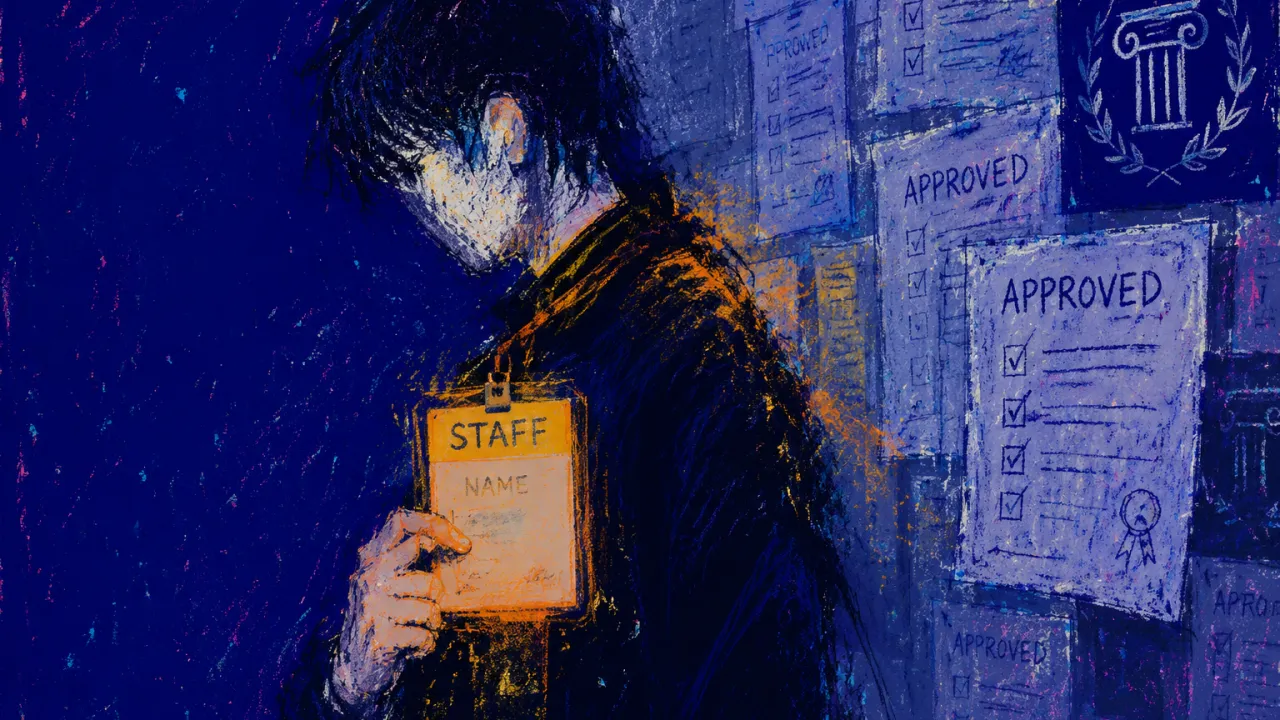
Institutional Self-Erosion is the moment you realize you can sound completely fluent in a room that keeps making you less recognizable to yourself. You notice it when you open a doc at 11:47 p.m. and rewrite one clean sentence until it sounds less like you and more like the room that will judge it. Your shoulders are up near your ears, your tongue presses against the back of your teeth, and your whole body is waiting for the tiny internal warning that says too much, too casual, too direct, too naive. You know how to be employable, admissible, promotable, acceptable; you know which words make people relax, which opinions need padding, which parts of your curiosity should be converted into strategy before anyone sees them. The strange part is that none of it looks dramatic. You are still submitting the paper, taking the meeting, answering the family message, showing up polished, using the correct tone, making choices that can be defended on paper. But each small translation leaves a residue: a half-second pause before you say what you think, a private standard you stop checking, a preference you call impractical before it has a chance to breathe. After a while the institution's language becomes so available that your own feels unprofessional, immature, inconvenient, or hard to justify. You start asking whether you want something, then immediately edit the question into whether it will read well, count, impress, protect access, or keep the peace. The cost is not that you become someone else overnight; it is that the outline of you gets borrowed so slowly you can still function while feeling thinner from the inside, much like the reversed image of The Hierophant, where the robes stay vivid, the temple stays composed, and the figures inside the ceremony have almost no room left to change shape.

What's pulling at you?

You're not losing yourself because you lack conviction; you're caught in a place that rewards being readable while quietly asking your own inner measure to get smaller. Part of you wants the access, credibility, and stability the institution can offer, and another part knows that every approved version of you costs a little more contact with your own voice.

How It Shows Up?

  • You open Slack, Teams, or your uni portal and feel your face shift before you've typed a word. The reply in your head is direct, but the one you send has three cushions, a smiley you don't feel, and a careful phrase like happy to help, because the room has taught you which version of you passes through without friction. Your neck tightens, your breathing gets smaller, and your hand stays on the trackpad after you hit send, as if you're waiting to see whether the system will approve your shape today. The temple is quiet, the robes are tidy, and you can let the tightness count as data before you turn it into another performance.
  • You're in a seminar, stand-up, crit, or review meeting, and someone asks what you really think. You feel the honest answer arrive first, then watch yourself filter it through what sounds fundable, team-friendly, senior-approved, or intellectually safe. Your throat narrows, your fingertips get cold, and you nod while your own thought slips behind the gray pillars of the room. It is okay for the unedited version to exist privately for a minute before you decide what to do with it.
  • At drinks, a birthday dinner, or a networking thing, you hear yourself describing your life in the clean version: busy but good, grateful for the opportunity, learning a lot, no big complaints. Everyone smiles because the sentence is easy to receive, and your mouth smiles too, but your stomach drops in a small, private way. You feel split between the person standing under warm lights with a drink in hand and the part of you sitting somewhere outside the stained-glass window, unnamed and underdressed. You do not have to make the room hold everything; noticing the split is already a clear place to stand.
  • After a call with a parent, partner, supervisor, or old friend, you realize you used the version of your voice that keeps the interaction smooth. You said that makes sense, no worries, whatever works, while your chest stayed heavy and your jaw did the tiny side-to-side movement you only notice when the call ends. The acceptable version of the conversation is over, but the unspoken one keeps walking around your apartment with you, like a figure hidden in the dark recess behind the throne. You can let the after-feeling have space without turning it into a confrontation tonight.
  • On Sunday night, your calendar opens and your body reacts before your mind has a sentence. The week looks ordinary - meetings, deadlines, classes, shifts, errands - but your shoulders brace like the row of wands is only standing because you keep lending it your spine. There is a dull pressure behind your eyes, a shallow inhale you cannot deepen, and a familiar thought: I can do it if I make myself smaller. You can pause at the body signal itself; it does not have to become a full life decision before bedtime.

Institutional Self-erosion in Tarot Cards

Institutional Self-Erosion lives in the gap between sounding fluent in the institution's language and losing contact with the standards that used to make your ambition feel alive. You can feel it in the clenched jaw after a call, the shallow inhale over a calendar, or the way your throat tightens before an honest answer gets edited. From an existential perspective, the structural framework here is the pressure to stay readable to a system while your own outline becomes harder to feel. These Tarot Cards reflect that pressure by making its shape visible.

The Hierophant Reversed
The Hierophant's temple is full of symbols, color, rank, and sanctioned meaning, yet the deepest space sits behind the throne as a dark recess. The visible self is organized by ceremony; the unseen interior remains inaccessible through the very structure that claims to guide access. Reversed, this becomes Institutional Self-Erosion in the family field. You can learn the correct tone, the acceptable version of your story, the role that keeps contact functional, and the language that prevents conflict, while the parts of you that do not fit the family institution lose oxygen. The card identifies a quiet cost rather than a dramatic break. The self is not destroyed all at once; it is worn down by repeatedly translating aliveness into approved symbols until your inner life becomes something you visit in secret instead of something the family structure can recognize.
Justice Reversed
Justice sits in red and green before stone, metal, and a veiled institutional interior. The warm human colors are visible, but the entire body is framed by gray pillars and ceremonial procedure. In study, this structure names the slow pressure to become what the system can measure: polished, compliant, legible, and repeatedly weighed. You may still be producing work, but the voice behind the work can shrink when every choice is filtered through what the hall will approve. The card does not turn that loss into failure. It frames it as a spatial pressure: the self is being narrowed by the architecture it is trying to pass through.
The Hanged Man Reversed
The inverted body can start to look adapted to the frame: the ankle takes the load, the arms stay hidden, and the blank surrounding space offers no reminder of another posture. The living support becomes the whole environment, so restriction stops appearing exceptional and begins to feel like the operating condition. In career terms, the reversed pressure shows how a workplace structure can slowly train you to become smaller than your actual range. You may keep reorganizing your voice, timing, ambition, and standards around what the institution can tolerate, until survival inside the role starts replacing recognition of your own professional shape.
Death Reversed
The card compresses ruler, priest, woman, and child into the same foreground impact zone, while the open route in the distance loses practical force against the horse's immediate passage. Every social position is present, yet none of them creates enough space to remain unchanged. In a workplace, that compression can feel like being asked to keep adapting until adaptation becomes self-erasure. You may call it flexibility, resilience, or being a team player, but the card's structure shows a field where every identity is pulled into the institution's transition and made smaller by the need to survive it. Institutional Self-Erosion is the slow wearing down of inner shape under repeated professional demands. The Death card makes the erosion visible by showing that the system's movement does not only change the landscape; it also presses on the people inside it until their roles, boundaries, and self-recognition begin to lose contour.
The Devil Reversed
The two figures have begun to resemble the world that holds them: horns appear on their heads, tails rise from their bodies, and their posture remains arranged below the Devil's cube. The visual pressure is not only restraint; it is assimilation into the restraint's shape. In a workplace, this describes the slow cost of surviving a hierarchy by copying its rules too deeply. A person may learn the right tone, the acceptable silence, the strategic detachment, and the political performance, yet each adaptation can make the original self harder to locate. Institutional Self-Erosion is the career struggle of becoming fluent in a system that diminishes you. The reversed Devil structure marks the point where the job is no longer just something you endure; it has started editing the body language, values, and self-recognition you bring into every room.
The Tower Reversed
The tower is not only being struck from the outside; it is burning from within. Its own windows have become exhaust points, and the dark air around it turns the whole scene into a pressure chamber rather than an open sky. Institutional Self-Erosion begins when a workplace’s broken physics gets absorbed as a private measure of worth. The unstable manager, the impossible target, the political promotion system, or the constant emergency no longer feels like an external structure; it starts to feel like evidence about your capacity. The reversed Tower texture is not dramatic release but internalized collapse. It shows the moment when surviving the institution becomes confused with being good enough, and your career self gets slowly shaped by a building that is already on fire.
The Moon Reversed
The moonlit field can become so familiar that reflected light starts to feel like normal visibility. The calm face above, the symmetrical towers, and the alarmed ground below create a workplace image where surface order covers a distorted reference system. When a career environment repeatedly makes unclear rules look professional, your inner calibration can begin to shrink around it. You may start measuring your judgment against an institution that never gave you stable coordinates in the first place. Institutional Self-Erosion names the slow internal cost of adapting to that field. The card locates the struggle in the environment's repeated distortion of reference, while preserving the possibility of seeing the distortion as separate from your capacity.
Five of Cups Reversed
The black cloak turns the figure into a dark vertical mass, with the remaining cups hidden behind the body's own blocked field. In the reversed tension of this image, the loss-site becomes so normalized that the body starts using it as the default workplace map. Career systems can do this when repeated devaluation, opaque feedback, or stalled advancement teaches you to read yourself through the institution's narrowest measurement. You may still have skill, contribution, and relational capital, but the internal reference point has been trained around what was dismissed or spilled. Institutional Self-Erosion names the slow transfer of authority from your own evidence to the workplace structure that failed to hold it. The card's remaining cups matter because they mark the part of your value that is still there, even when the visible system has stopped reflecting it.
Five of Pentacles Upright
The card places an elevated, glowing institutional symbol above two bodies bent low against weather, injury, and exposure. The visual hierarchy is stark: the building holds warmth and order, while the people outside absorb the cost of moving without protection. In a career reading, that contrast becomes the experience of working inside or near an institution whose values look coherent from the outside while your daily reality is depletion, under-recognition, or exclusion from stabilizing resources. Over time, the gap can start to distort the way you read your own professional worth. Institutional Self-Erosion is the struggle named by that gap. The card does not reduce the issue to confidence; it shows how repeated exposure to a cold professional structure can wear down the inner sense that your contribution deserves shelter, dignity, and a path forward.
Reversed
The stained-glass pentacles are elevated, symmetrical, and protected inside the architecture, while the human figures remain low, weathered, and unnamed outside it. The institution is clear as an image, but unclear as a shelter. In university life, that contrast can wear down the sense of being a real participant in the academic world. You keep measuring yourself against the polished image of competence, funding, grades, programs, and prestige while your actual learning body is left in the cold. The struggle is the slow erosion that happens when an institution stays visible as an ideal but does not become a place where your limits can be held. The card frames that erosion through distance: the window shines, but the self keeps shrinking on the outside of it.
Ten of Pentacles Reversed
The architecture is louder than the bodies: arch, wall, crest, pentacle lattice, and decorated pillars arrange the scene before any person acts. The people appear inside an established system whose symbols already know what counts as value. In a reversed career reading, that structure turns inward as the institution's language, metrics, and approval systems begin to replace your own reference points. The struggle is not simply working inside a company; it is slowly losing the ability to tell where the institution ends and your own judgment begins.
King of Pentacles Reversed
The king's robe blends with the vines and ground, and the castle behind him extends the body into property, title, and domain. The person is still visible, but the surrounding system keeps borrowing his outline. At work, this structure names the slow disappearance that can happen when a role becomes the main container for identity. You may be recognized through title, seniority, compensation, or access, while the parts of you that are not useful to the institution receive less and less space. The struggle is not ambition itself; it is the erosion that begins when the job's architecture becomes the only place where your value feels real.
Four of Swords Reversed
The figure's color sits close to the tomb and wall, making the knight look almost absorbed by the architecture. The body does not stand apart from the institution-like space; it becomes part of its still, gray arrangement. In career life, Institutional Self-Erosion appears when the workplace's definitions of usefulness, competence, and availability slowly replace your own internal reference points. You may still function, but your sense of value begins to take the shape of the structure that contains you. The reversed Four of Swords makes that erosion visible through the body's blending into its surroundings. The danger is not dramatic collapse; it is the quiet loss of distinction between your professional role and your actual self.
Five of Swords Reversed
The shore is treated like stable ground even though the scene is built from conflict debris, retreating backs, and grey water at the edge. Under the reversed tension, the body adapts to the battlefield as if it were a normal workplace floor. For your career, this is the shape of Institutional Self-Erosion: repeated exposure to zero-sum politics can make sharpness feel like professionalism and guardedness feel like maturity. The card marks the moment when survival in the system starts rewriting your sense of who you are allowed to be at work.
Seven of Swords Reversed
The swords are intact, but their function has been distorted by the way they are carried. Instead of being held by the hilts as clean instruments of action, they press into the figure's hands as awkward cargo while his body keeps the movement quiet. Reversed, this image points to the long-term cost of adapting to institutional rules that cannot be spoken plainly. You may still look capable, strategic, and composed at work, but the method of staying viable begins to wear down the person doing the carrying. The struggle is not just fatigue from a demanding job. It is the erosion that happens when survival inside the workplace requires you to keep translating your values, voice, and judgment into indirect forms the system will tolerate.
Ten of Swords Upright
Ten nearly uniform swords turn the spine into a grid of precise impacts, as if the body's support system has been converted into a place for repeated use and damage. The red cloak holds the force of life in the foreground, but that force no longer circulates into movement. In career terms, the image describes a professional self gradually reduced to what the system can extract, measure, or exhaust. You may still be functioning, producing, and proving yourself, but the card shows the deeper cost: the structure is taking from the same central line that should be supporting your direction.
Seven of Wands Reversed
The figure's green clothing, brown boots, and wooden staff visually merge him with the terrain and the wand he uses. The tool, the stance, and the body begin to read as one continuous defensive apparatus against the six lower rods. In a workplace frame, that fusion points to the slow loss of separation between person, role, and output. You are not only using skill to defend your position; the structure pressures your skill, identity, and availability into the same object, until being useful feels almost indistinguishable from being under attack.
Nine of Wands Reversed
The row of wands looks like a stable structure, but its weakest point is being stabilized by a person with a bandaged head. The scene appears orderly only because the figure has been absorbed into the architecture. In career terms, this is the slow erosion that happens when a workplace depends on your resilience while barely naming it as labor. You remain functional by becoming less visible as a person and more useful as infrastructure. The card's reversed weight is not just exhaustion. It shows the loss of self-boundary that occurs when the institution keeps standing because you keep lending it your body, attention, and recovery time.

Institutional Self-erosion in Tarot Card Reading Insights

When Institutional Self-Erosion makes your own voice harder to locate, other people bring the same pressure into readings: work questions, study choices, family scripts, and the quiet cost of staying acceptable. The focus shifts from the cards themselves to what surfaced when people asked how to stay readable without disappearing. Tarot Reading Insights from related sessions.

Psychological struggles related to Institutional Self-erosion